👉 Register for Free. How to Diagnose Sleep Apnea Faster in Primary Care – FREE Webinar by Dr. Audrey Wells. – Friday, April 24 at 12 PM ET

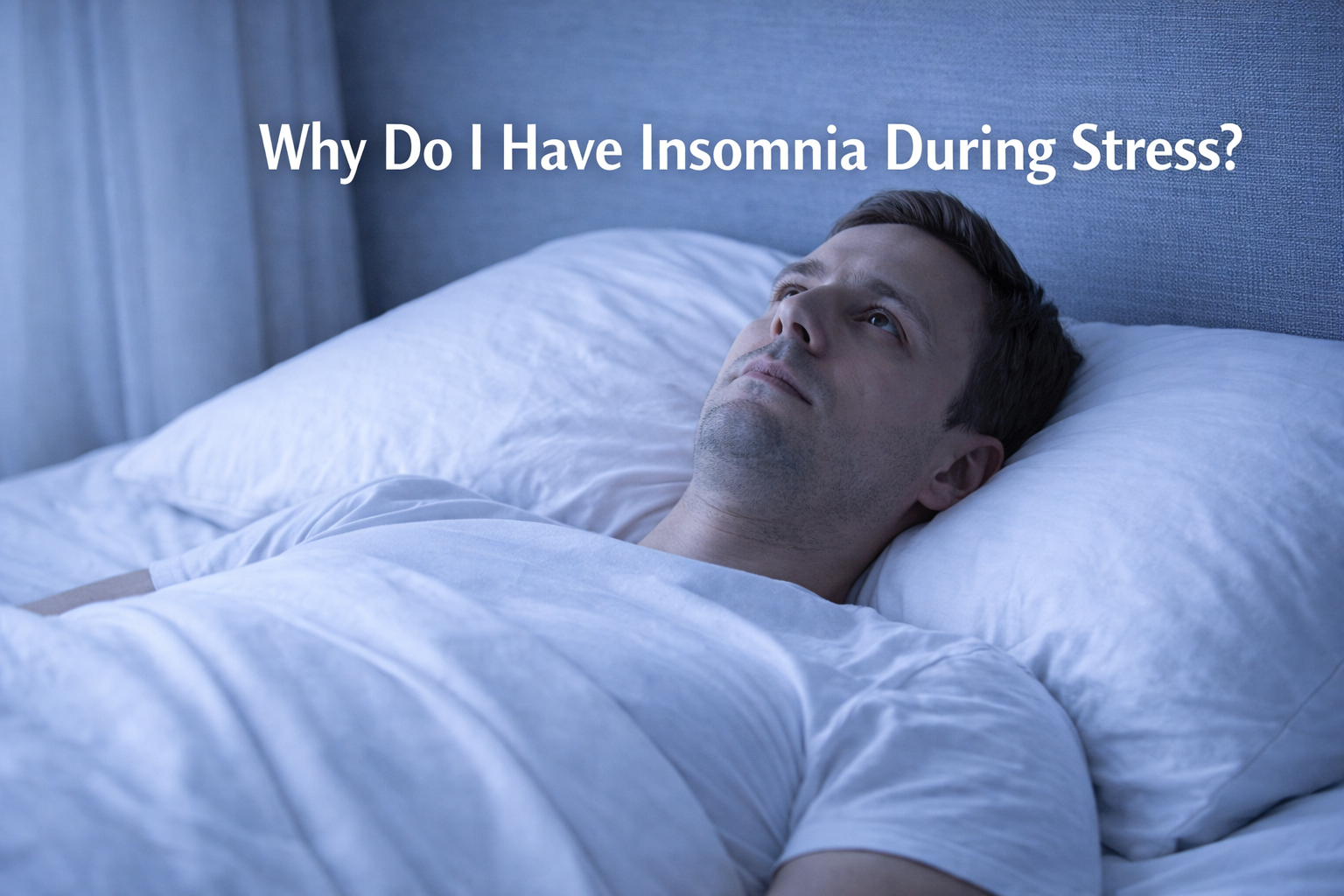
Why Do I Have Insomnia During Stress?
Insomnia during stress is not simply anxiety keeping you awake. It is a cascade of physiological responses that suppress melatonin, raise cortisol, and activate your nervous system at the exact time it needs to be winding down. Understanding the mechanism is the first step toward addressing it correctly.
Reviewed by Dr. Avinesh Bhar, Board Certified Sleep Physician at Sliiip.com
You are exhausted. You need sleep more than ever. But the moment your head hits the pillow, your mind accelerates. You lie awake for hours and then spend the next day in a fog. Insomnia during stress is one of the most common sleep complaints in adults. It is also one of the most misunderstood.
Research shows that approximately 30% of adults experience acute insomnia during periods of elevated stress, and a significant subset develop a chronic pattern that persists long after the stressor resolves.
SLIIIP’s board-certified sleep physicians can do sleep evaluations for sleep apnea. Virtual consultations in all 50 states. Home sleep tests shipped to your door.
Myth vs. Reality
Myth: Insomnia during stress is just worry keeping you awake.
Reality: Stress triggers a measurable hormonal response. Cortisol rises, core body temperature increases, and your sympathetic nervous system remains activated. These are biological changes that directly oppose the conditions your body needs to initiate and maintain sleep. It is not a mental weakness. It is a physiological conflict.
Myth: If you relax more before bed, the insomnia will resolve.
Reality: Relaxation strategies can help reduce the severity of stress-related insomnia. But if the insomnia has persisted for more than a few weeks, the brain often develops conditioned arousal. It begins to associate the bedroom with wakefulness rather than sleep. Breaking that pattern requires a clinical approach, not just better habits.
Ready to address your insomnia during stress?
Sliiip has completed 10,000+ sleep consultations with patients across all 50 states. No referral required. Most major insurance plans accepted, including Medicare and Tricare.
CHECK YOUR SLEEP SYMPTOMS: TAKE THE 2 MINUTE QUIZ
TAKE THE QUIZ
What Stress Does to Your Sleep Biology
When your brain perceives a threat, real or perceived, it activates the hypothalamic-pituitary-adrenal axis. Cortisol is released. Your body prepares to respond to danger. This is the same system that evolved to protect you from physical threats.
At night, that same system works against you. Cortisol suppresses melatonin production. Your core temperature stays elevated. Your heart rate remains higher than it should be. These are the conditions that cause insomnia during stress.
The problem is that your body does not distinguish between a predator and a deadline. The hormonal response is similar. And at 2 a.m., your nervous system does not know the meeting is tomorrow, not tonight.
Why Insomnia During Stress Can Outlast the Stressor
This is the part most people do not expect. The stress event may pass. But insomnia often stays.
When sleep disruption continues for more than a few weeks, the brain forms an association between the sleep environment and wakefulness. You start dreading bed. You begin clock-watching. You catastrophize about not sleeping. This is called conditioned arousal and it is a clinical phenomenon, not a character flaw.
The body also loses confidence in its ability to sleep naturally. This is why people with insomnia during stress often report that their worst nights are when nothing is actually wrong. The pattern has become self-sustaining. See insomnia treatment methods that address the root cause.
The Hidden Factor: Sleep-Disordered Breathing
Stress-related insomnia is often presented as a standalone problem. But for many patients, there is a second layer that goes undetected.
Sleep-disordered breathing, including obstructive sleep apnea, causes nighttime arousals that the person may not consciously register. These arousals make sleep feel light, fragmented, and unrestorative. When stress compounds this pattern, the result is severe and persistent insomnia that does not respond to standard behavioral interventions alone.
If your insomnia during stress has not resolved with relaxation, sleep hygiene improvements, or reduced stressors, a physician evaluation for sleep-disordered breathing is the appropriate next step.
Watch: Sleeping with Sleep Apnea
Expert Q&A
Q: Is insomnia during stress always temporary? Not always. Acute insomnia tied to a single stressor can resolve within days or weeks once the stressor passes. But for many patients, the insomnia develops its own momentum through conditioned arousal and hyperarousal patterns. When stress-triggered insomnia persists beyond four weeks, it warrants a clinical assessment rather than continued self-management. A physician-reviewed sleep evaluation can determine what is sustaining the disruption. Dr. Avinesh Bhar, Board Certified Sleep Physician, Sliiip.comWhat a Sleep Evaluation Reveals
A sleep evaluation does more than confirm insomnia. It identifies what is driving it. In some cases, the evaluation reveals elevated arousal thresholds consistent with stress-related hyperactivation. In others, it reveals underlying sleep-disordered breathing that was masked by the insomnia narrative. In all cases, it gives the physician the information needed to make a specific recommendation rather than a general one. A home sleep test is one component of the evaluation process. It rules in or out breathing-related disruptions that may be compounding the stress response. Results are reviewed by a board-certified physician and discussed via telehealth.
This Is a Clinical Problem, Not a Willpower Problem
Why are you still struggling with insomnia during stress?
Sliiip physicians have completed 10,000+ consultations with patients in all 50 states. No referral required. Major insurance accepted, including Medicare and Tricare.
Get a physician-reviewed sleep evaluation from home. Know what is actually causing your insomnia.
SLIIIP’s board-certified sleep physicians can do sleep evaluations for sleep apnea. Virtual consultations in all 50 states. Home sleep tests shipped to your door.
Behavioral Support for Insomnia During Stress
Certain behavioral strategies reduce the severity of stress-related insomnia. These are not replacements for clinical evaluation. They are supported.
Maintain a consistent wake time.
Even after a poor night of sleep, waking at the same time builds sleep pressure that improves the following night. Sleeping in after insomnia episodes deepens the pattern.
Reduce time in bed.
Counterintuitively, spending less time in bed builds more consolidated sleep. Extended time in bed during insomnia during stress reinforces the association between bed and wakefulness.
Limit evening light exposure.
Blue light from screens suppresses melatonin at the precise time your body needs to begin the sleep transition. Dimming lights and reducing screen use in the hour before bed reduces this interference.
Avoid clock-watching.
Checking the time during wakefulness increases arousal and reinforces anxiety about sleep. Removing clocks from view reduces this feedback loop.
Restrict caffeine after noon.
Caffeine has a half-life of approximately five to six hours. Afternoon caffeine use directly reduces the depth of sleep, making stress-related insomnia significantly worse.
These strategies are components of Cognitive Behavioral Therapy for Insomnia (CBT-I), which is the gold standard non-pharmacological approach. Sliiip physicians can guide this process as part of a comprehensive sleep care plan.
Frequently Asked Questions
Why do I have insomnia during stress even when I am exhausted?
Exhaustion and the ability to sleep are driven by different physiological systems. Cortisol and sympathetic nervous system activation from stress can override your sleep drive even when you are severely sleep-deprived. Your body is caught between two competing signals: the need to sleep and the perceived need to stay alert. A sleep physician can help identify which system is dominating and why.
Is insomnia during stress dangerous?
Chronic sleep disruption from stress-related insomnia has real physiological consequences. Persistent poor sleep is associated with impaired immune function, increased cardiovascular risk, reduced cognitive performance, and worsened mood regulation. It is not simply uncomfortable. It requires clinical attention when it persists beyond a few weeks.
What is the difference between stress insomnia and sleep apnea?
Stress insomnia primarily involves difficulty falling asleep or staying asleep driven by hyperarousal. Sleep apnea involves repeated breathing disruptions that cause nighttime arousals and unrefreshing sleep. The two conditions frequently co-exist. A physician evaluation is the only reliable way to distinguish between them and determine the appropriate care path.
Can insomnia during stress cause sleep apnea to worsen?
Stress-related insomnia can worsen sleep-disordered breathing indirectly. Disrupted sleep architecture reduces the time spent in REM sleep, when airway muscle tone is naturally lowest. This can increase the frequency of obstructive events. Addressing both conditions is more effective than treating either one in isolation.
Will insomnia during stress go away on its own?
In cases tied to a single, finite stressor, insomnia often resolves within a few weeks. But when it persists beyond four weeks or recurs with each new stressor, it has likely developed a self-sustaining pattern. At that point, waiting it out is not the most effective strategy. A clinical evaluation provides a clear explanation and a specific path forward.
What is conditioned arousal?
Conditioned arousal is the phenomenon where the brain begins associating the sleep environment, including the bed, bedroom, and bedtime, with wakefulness rather than sleep. It develops when insomnia during stress persists long enough that the brain forms a learned response. Behavioral sleep medicine approaches, including CBT-I, are designed to break this association systematically.
Does alcohol help with insomnia during stress?
Alcohol is a sedative that can accelerate sleep onset but significantly disrupts sleep architecture in the second half of the night. It suppresses REM sleep and increases sleep fragmentation. Many people report waking between 2 and 4 a.m. after drinking. Using alcohol as a sleep aid during stress typically worsens the insomnia pattern over time.
Can I treat insomnia during stress without medication?
Yes. Cognitive Behavioral Therapy for Insomnia is as effective as sleep medications for most cases of chronic insomnia, with more durable results. It addresses the underlying patterns maintaining the insomnia rather than temporarily suppressing symptoms. Sliiip physicians can guide this approach as part of your care plan.
How quickly can a sleep evaluation provide answers?
A telehealth consultation with a Sliiip physician can be scheduled without a referral. If a home sleep test is appropriate, it ships to your home within days and results are reviewed within a week of return. The entire evaluation process is designed to be efficient and does not require an in-person visit.
Does sleep apnea cause insomnia?
Yes. Sleep-disordered breathing frequently presents as insomnia, particularly in women and in patients who do not snore loudly. The nighttime arousals caused by obstructed breathing produce the same pattern of fragmented, unrefreshing sleep that stress-related insomnia produces. A physician evaluation distinguishes between the two.
Does stress cause sleep apnea?
Stress does not directly cause obstructive sleep apnea. But it can worsen the perception of sleep quality in people who already have sleep-disordered breathing. It can also reduce the effectiveness of behavioral coping strategies, making it harder to manage either condition independently.
Is CBT-I available through Sliiip?
Yes. Sliiip physicians provide Cognitive Behavioral Therapy for Insomnia as part of comprehensive sleep care. This includes sleep restriction guidance, stimulus control techniques, and cognitive restructuring tailored to your specific sleep pattern.
SLIIIP’s board-certified sleep physicians can do sleep evaluations for sleep apnea. Virtual consultations in all 50 states. Home sleep tests shipped to your door.
Latest posts
-
Why Are My Naps Never Refreshing?
Last updated: October 2, 2026. Medically reviewed by Dr. Avinesh Bhar, Board-Certified Sleep Physician, SLIIIP.com. Naps that leave you groggy usually come down to how long you sleep, when you…
-
Is Sleeping Too Much a Sleep Disorder?
Last updated: October 2, 2026. Medically reviewed by Dr. Avinesh Bhar, Board-Certified Sleep Physician, SLIIIP.com. Sleeping too much is not always a sleep disorder, but it can be a sign…
-
Why Does My Insomnia Get Worse After Stopping Sleep Medication?
Last updated: October 2, 2026. Medically reviewed by Dr. Avinesh Bhar, Board-Certified Sleep Physician, SLIIIP.com. Insomnia can get worse after stopping sleep medication for three main reasons. They are rebound…
Get updates
Spam-free subscription, we guarantee. This is just a friendly ping when new content is out.

