👉 Register for Free. How to Diagnose Sleep Apnea Faster in Primary Care – FREE Webinar by Dr. Audrey Wells. – Friday, April 24 at 12 PM ET

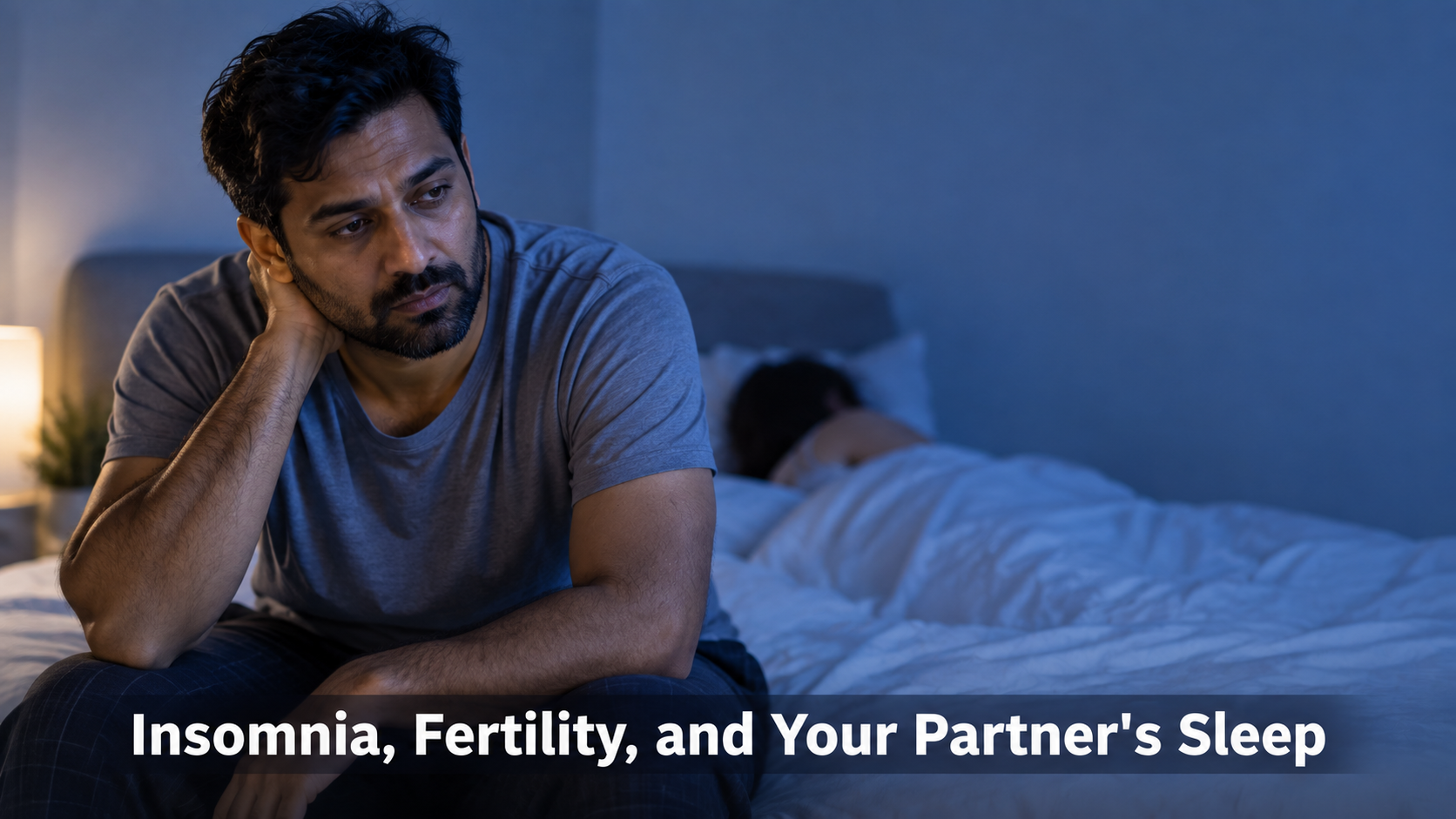
Can Insomnia Make It Harder to Get Pregnant? What About Your Partner’s Sleep?
Last updated: September 21, 2026. Medically reviewed by Dr. Avinesh Bhar, Board-Certified Sleep Physician, SLIIIP.com.
Yes, insomnia can make it harder to get pregnant, and while most conversations about sleep and fertility focus entirely on the woman, a male partner’s sleep quality plays a real and often overlooked role in the same equation. Fertility is treated as a couple’s issue in every other respect except sleep, where the male half of the picture rarely comes up at all. Dr. Avinesh Bhar, Board-Certified Sleep Physician at SLIIIP.com, notes that couples trying to conceive are far more likely to have her sleep discussed at a fertility appointment than his. Bringing both partners’ sleep into the conversation gives a more complete picture of what might be contributing to a longer time to conception.
SLIIIP’s board-certified sleep physicians can do sleep evaluations for sleep apnea. Virtual consultations in all 50 states. Home sleep tests shipped to your door.
How Insomnia Affects Fertility in Women
Chronic poor sleep and insomnia are linked to a longer time to conception in women, largely through disruption of the reproductive hormone axis. The brain region that governs the sleep-wake cycle also regulates the release of hormones involved in ovulation, so disrupted sleep and disrupted reproductive timing are connected at a fairly basic biological level.
This side of the picture is well established and is the focus of most existing guidance on sleep and fertility.
What About the Male Partner’s Sleep?
Male fertility depends heavily on testosterone, and testosterone production follows a sleep-linked daily rhythm, rising through the night and peaking around the first period of REM sleep. Insufficient or fragmented sleep, including sleep disrupted by undiagnosed sleep apnea, is associated with reduced sperm count, lower sperm motility, and increased sperm DNA fragmentation.
A peer-reviewed review of disordered sleep and reproductive health found that men with obstructive sleep apnea and more significant oxygen drops during sleep tend to have lower testosterone levels, and that erectile dysfunction, which is common in men with untreated sleep apnea, improves clinically once the sleep apnea itself is properly treated, according to a review published on PubMed Central.
Why This Side of the Conversation Gets Skipped
Fertility workups are typically structured around the woman’s cycle, hormones, and reproductive anatomy, since she is the one carrying the pregnancy. This structure makes clinical sense for most of the fertility evaluation, but it can leave a male partner’s sleep quality, snoring, or possible sleep apnea entirely unasked about, even when it may be a contributing factor.
A couple where one partner has loud snoring, witnessed breathing pauses, or excessive daytime sleepiness has a reasonable, specific detail worth raising, not just a general lifestyle note to mention in passing.
Could Both Partners’ Sleep Be Contributing at Once?
It is entirely possible for both partners to have sleep issues contributing to a longer time to conception simultaneously, and addressing only one side leaves part of the picture unresolved. Shared sleep environment factors, such as a bed partner’s loud snoring keeping one partner awake, can also compound the problem for whichever partner is trying to sleep through it.
Evaluating sleep for both partners, rather than assuming it is only a factor for whoever is trying to conceive, is a more complete approach when time to conception has become a concern.
What This Looks Like as a Practical Step
Rather than treating fertility and sleep as two separate conversations, couples can bring a simple joint sleep log to their fertility appointment: bedtime, wake time, snoring or witnessed pauses, and how rested each partner feels each morning, for both of them. This turns an easy-to-skip detail into something concrete a specialist can act on.
If either log shows a pattern of loud snoring, long pauses, or persistent unrefreshing sleep, that is specific enough information to justify a sleep evaluation rather than a vague mention of ‘we’re both pretty tired.’
Watch: Is Mild Sleep Apnea Serious?
When to See a Doctor
If either partner snores loudly, has witnessed breathing pauses, or experiences persistent daytime fatigue, a sleep evaluation is a reasonable step to raise alongside a fertility workup rather than something to mention only if asked. Dr. Bhar recommends bringing up both partners’ sleep at the same time fertility is being discussed, since testosterone and sperm quality respond to treatment of an underlying sleep disorder just as reproductive hormones do in women.
A home sleep test for either or both partners can clarify whether sleep apnea is part of the picture, providing information that can be shared directly with a fertility specialist.
Insurance and Cost
SLIIIP works with most major insurance plans, including Medicare and TRICARE, and offers transparent cash pricing for patients without applicable coverage.

SLIIIP’s board-certified sleep physicians can do sleep evaluations for sleep apnea. Virtual consultations in all 50 states. Home sleep tests shipped to your door.
Frequently Asked Questions
Can insomnia make it harder to get pregnant?
Yes, chronic poor sleep and insomnia are linked to a longer time to conception, largely through effects on reproductive hormones.
Does a male partner’s sleep affect fertility too?
Yes, testosterone production and sperm quality are both linked to sleep quality, including undiagnosed sleep apnea.
Can sleep apnea affect sperm count?
Yes, research links obstructive sleep apnea to reduced sperm count, lower motility, and increased DNA fragmentation.
Does snoring affect fertility?
Snoring itself is not the direct cause, but it can be a sign of sleep apnea, which is associated with reduced testosterone and sperm quality.
Can treating sleep apnea improve male fertility?
Treating sleep apnea has been associated with clinical improvement in erectile function and may support healthier testosterone levels.
Why isn’t male sleep usually discussed in fertility appointments?
Fertility workups are typically structured around the woman’s reproductive cycle, which can leave a male partner’s sleep unaddressed.
When is testosterone typically highest during sleep?
Testosterone rises through the night and peaks around the first period of REM sleep.
Can both partners’ sleep problems affect fertility at the same time?
Yes, it is possible for both partners’ sleep to independently contribute to a longer time to conception.
Should couples trying to conceive both get sleep evaluations?
It is a reasonable step, especially if either partner snores, has witnessed breathing pauses, or feels persistently fatigued.
Can a partner’s snoring affect the other partner’s fertility indirectly?
It can, by disrupting the other partner’s sleep quality, which is separately linked to reproductive hormone regulation.
Is erectile dysfunction linked to sleep apnea?
Yes, erectile dysfunction is common in men with untreated sleep apnea and can improve when the sleep apnea is treated.
Does sleep duration alone affect sperm quality?
Yes, studies have found lower sperm counts in men who sleep short durations compared with those who sleep average amounts.
Can stress about fertility itself cause insomnia?
Yes, the stress of trying to conceive can itself disrupt sleep, creating a cycle that is worth addressing directly.
How does insomnia affect ovulation?
Disrupted sleep can affect the brain regions that regulate the hormones controlling ovulation timing.
Can a home sleep test help during fertility evaluation?
Yes, it can determine whether sleep apnea is present in either partner, information relevant to the overall fertility picture.
Is it too late to address sleep once fertility treatment has started?
No, sleep can be evaluated and addressed at any point, including alongside ongoing fertility treatment.
Can weight affect both sleep apnea and fertility together?
Yes, weight gain can increase sleep apnea risk and is independently associated with reduced fertility in both partners.
Does alcohol use affect fertility-related sleep?
Yes, alcohol fragments sleep and can compound existing sleep quality issues relevant to fertility.
Can a fertility specialist and a sleep physician work together?
Yes, a sleep physician can evaluate the sleep side of the picture while continuing to coordinate with a fertility specialist.
What is the first step if we suspect sleep is affecting our fertility as a couple?
Raise sleep symptoms for both partners with your fertility specialist and consider a sleep evaluation for whichever partner has symptoms.
Take the Next Step
SLIIIP’s board-certified sleep physicians can do sleep evaluations for sleep apnea. Virtual consultations in all 50 states. Home sleep tests shipped to your door.
Latest posts
-
Thyroid and Sleep Apnea: The Two-Way Connection Explained
Last updated: September 21, 2026. Medically reviewed by Dr. Avinesh Bhar, Board-Certified Sleep Physician, SLIIIP.com. Thyroid problems and sleep apnea are connected in both directions: an underactive thyroid can raise…
-
Can Insomnia Make It Harder to Get Pregnant? What About Your Partner’s Sleep?
Last updated: September 21, 2026. Medically reviewed by Dr. Avinesh Bhar, Board-Certified Sleep Physician, SLIIIP.com. Yes, insomnia can make it harder to get pregnant, and while most conversations about sleep…
-
How Are My Hot Flashes Related to Menopause? The Mechanism Explained
Last updated: September 21, 2026. Medically reviewed by Dr. Avinesh Bhar, Board-Certified Sleep Physician, SLIIIP.com. Hot flashes are directly related to menopause through declining estrogen’s effect on the hypothalamus, the…
Get updates
Spam-free subscription, we guarantee. This is just a friendly ping when new content is out.

