👉 Register for Free. Peri/Menopause at Midnight: Why You Wake Up Hot, Wired, and Wide Awake at 3AM. – Friday, March 27th, 3:00 AM ET with Dr. Audrey Wells.

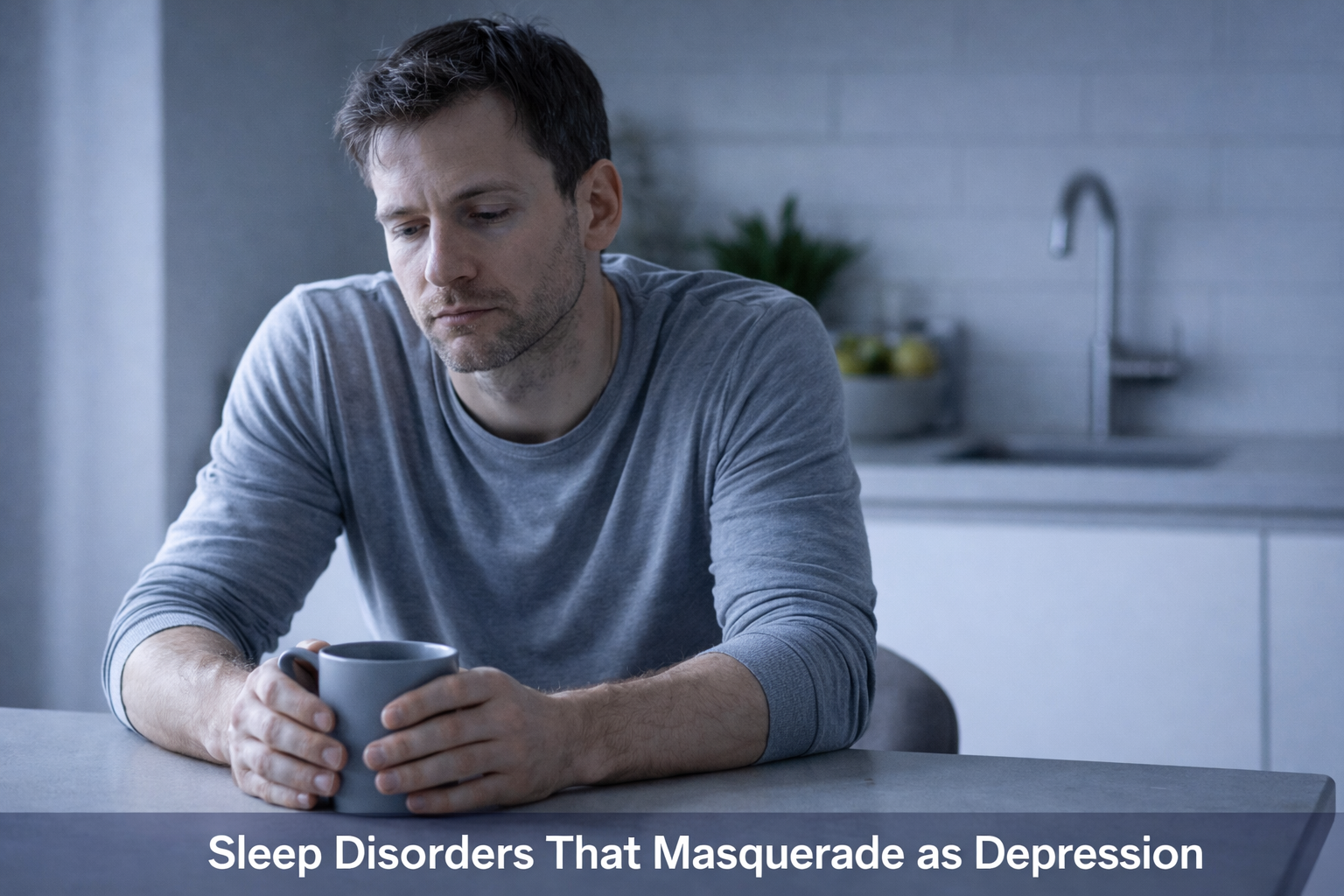
Sleep Disorders That Masquerade as Depression
Several sleep disorders produce symptoms that are clinically indistinguishable from depression, including persistent low mood, fatigue, loss of motivation, and cognitive slowing. These conditions are frequently misidentified as primary depression. When the underlying sleep disorder is identified and addressed, mood symptoms often improve significantly.
Medically reviewed by Dr. Avinesh Bhar, Board Certified Sleep Physician, Sliiip.com
You feel flat. Unmotivated. Unable to concentrate. You sleep but you never feel rested. You have been told it is depression. But what if the real driver is not a mood disorder at all?
Dr. Avinesh Bhar, board-certified sleep physician at Sliiip.com, regularly sees patients managed for depression for months or years whose primary driver is an unidentified sleep disorder. The symptom overlap is not coincidental. Sleep deprivation at the physiological level produces mood, cognitive, and motivational changes that match the clinical presentation of depressive illness.
SLIIIP’s board-certified sleep physicians can do sleep evaluations for sleep apnea. Virtual consultations in all 50 states. Home sleep tests shipped to your door.
Studies indicate that 90 percent of patients with major depressive disorder also report significant sleep disturbance. In many cases, the sleep problem precedes the mood symptoms. (Sleep Medicine Reviews)
Myth vs. Reality
Common Belief | Clinical Reality |
Low mood means depression | Persistent fatigue from untreated sleep disorders produces mood changes that closely mimic clinical depression |
Sleep disorders and depression are unrelated | Obstructive sleep apnea is associated with elevated rates of depression. Treatment of the sleep disorder often reduces depressive symptoms |
Treating depression will fix my sleep | When an underlying sleep disorder is present, treating mood symptoms without addressing it produces incomplete improvement |
My sleep problems are a symptom of depression | Sleep disorders often precede the mood presentation. The sleep disorder may be the driver, not the symptom |
How Sleep Deprivation Mimics Depression
Sleep deprivation produces a reproducible cluster of symptoms: low motivation, persistent fatigue, difficulty concentrating, emotional blunting, reduced interest in activities. These are the direct neurological consequences of insufficient restorative sleep.
Chronic sleep disruption impairs prefrontal cortex function, which governs mood regulation, executive function, and emotional control. It elevates inflammatory markers and disrupts the hormonal systems that regulate energy, motivation, and affect.
The result is a clinical presentation nearly identical to major depressive disorder. Without objective sleep data, differentiation is difficult at the primary care level.

Sleep Disorders Most Likely to Mimic Depression
Obstructive sleep apnea is the most common sleep disorder associated with depressive presentation. Repeated oxygen drops and sleep fragmentation produce chronic fatigue, mood disruption, cognitive slowing, and reduced motivation. Many patients with sleep apnea are actually experiencing a sleep problem, not a primary mood disorder.
Insomnia disorder, particularly chronic insomnia, produces measurable changes in prefrontal function, emotional regulation, and mood stability. The sleep disorder is the driver. The depressive symptoms follow.
Circadian rhythm disorders, including delayed sleep-wake phase disorder, can produce persistent low mood, fatigue, and social withdrawal that resembles depression. The patient’s biological clock is misaligned with the demands of their schedule.
Restless legs syndrome and periodic limb movement disorder disrupt sleep architecture nightly, creating a sustained state of sleep deprivation with significant mood consequences.
Why the Misdiagnosis Happens
Primary care settings are not well equipped to differentiate sleep disorders from mood disorders based on symptom interviews alone. Without objective sleep data, the diagnosis defaults to the more familiar condition.
Women are at particularly high risk of misdiagnosis. Sleep apnea in women presents atypically, often without snoring, and closely resembles depression or anxiety. Women with undiagnosed sleep apnea are significantly more likely to be managed for mood disorders before anyone evaluates their sleep.
The Sleep-Mood Relationship: Bidirectional but Not Equal
Depression and sleep disorders are bidirectionally related. Depression disrupts sleep. Sleep disorders produce depressive symptoms. This creates a reinforcing cycle that is difficult to exit without addressing both directions.
However, sleep disorders frequently precede the mood presentation. Longitudinal studies show that insomnia and sleep-disordered breathing predict the later development of depressive symptoms.
Expert Q&A
Q: How do you determine whether a patient has depression or a sleep disorder when the symptoms look the same?
I start with a thorough sleep history, which is frequently absent from standard depression evaluations. Sleep architecture, sleep timing, breathing symptoms, and the temporal relationship between sleep problems and mood changes all provide diagnostic information. A home sleep test then gives me objective data on what is happening physiologically during sleep. That data often reveals the answer that symptom interviews alone cannot provide.
Dr. Avinesh Bhar, Board Certified Sleep Physician, Sliiip.com
Q: If someone is already being treated for depression, should they still get a sleep evaluation?
If the patient’s mood has not improved adequately, or if significant sleep problems persist, a sleep evaluation is warranted. Co-occurring sleep disorders reduce the effectiveness of mood treatment. Identifying and addressing the sleep component often produces improvement that was not achievable through mood treatment alone.
Dr. Avinesh Bhar, Board Certified Sleep Physician, Sliiip.com
Behavioral Strategies to Support Sleep and Mood
- Maintain a consistent wake time every day, including weekends
- Get natural light exposure within 30 minutes of waking
- Increase physical activity during the day, but avoid intense exercise close to bedtime
- Limit alcohol and caffeine, both of which disrupt sleep architecture and worsen mood stability
- Practice a consistent evening wind-down routine
- If nighttime waking with mood symptoms is frequent, document the timing and discuss it with a sleep physician

SLIIIP’s board-certified sleep physicians can do sleep evaluations for sleep apnea. Virtual consultations in all 50 states. Home sleep tests shipped to your door.
Frequently Asked Questions
Can a sleep disorder cause depression?
Chronic sleep disruption produces mood changes, cognitive slowing, and reduced motivation consistent with depression. Longitudinal research shows that sleep disorders frequently precede the development of depressive symptoms.
What sleep disorders are most commonly mistaken for depression?
Obstructive sleep apnea, chronic insomnia, circadian rhythm disorders, and restless legs syndrome are the conditions most likely to produce depressive presentations. Sleep apnea is particularly strongly associated with mood disruption.
Why does sleep apnea cause mood symptoms?
Sleep apnea causes repeated oxygen drops and sleep fragmentation. This produces chronic fatigue, elevates inflammatory markers, and impairs prefrontal cortex function and hormonal systems governing mood and motivation.
How do I know if my depression is actually a sleep disorder?
Indicators include mood symptoms worse in the morning, unrefreshing sleep despite adequate duration, and depression that has not responded adequately to appropriate treatment. A physician evaluation can determine whether an underlying sleep disorder is present.
Can treating sleep apnea improve depression?
Clinical evidence consistently shows that patients whose depressive symptoms are associated with sleep apnea experience meaningful mood improvement when their sleep disorder is identified and managed.
Is it possible to have both depression and a sleep disorder?
Yes. Depression and sleep disorders are bidirectionally related and frequently co-occur. Addressing only one produces incomplete results. A sleep physician can evaluate the sleep component and coordinate care.
Why are women more often misdiagnosed with depression instead of sleep apnea?
Women with sleep apnea are more likely to present with fatigue, mood changes, and insomnia rather than classic snoring. This atypical presentation makes sleep apnea easy to miss in standard clinical settings.
Can a home sleep test help identify why I have depression-like symptoms?
A home sleep test identifies sleep-disordered breathing and sleep architecture disruption. Sliiip offers FDA-approved testing reviewed by board-certified physicians. No referral required.
How do I get evaluated for a sleep disorder if I am already being treated for depression?
You do not need to stop any current mental health care to seek a sleep evaluation. Sliiip conducts independent telemedicine sleep consultations. No referral is required.
What is the connection between poor sleep and low motivation?
Chronic sleep disruption impairs dopaminergic function and prefrontal cortex activity, both central to motivation and reward processing. Low motivation with poor sleep quality may reflect a physiological response to sleep deprivation.
Latest posts
-
Why Treating Sleep First Improves Your Health Outcomes
Untreated sleep disorders reduce the effectiveness of virtually every health intervention, from cardiovascular management to mental health treatment. When sleep is disrupted at the physiological level, the body cannot regulate…
-
Sleep Disorders That Masquerade as Depression
Several sleep disorders produce symptoms that are clinically indistinguishable from depression, including persistent low mood, fatigue, loss of motivation, and cognitive slowing. These conditions are frequently misidentified as primary depression.…
-
When Anxiety Looks Like Insomnia and When It Is Sleep Apnea
Anxiety, insomnia, and sleep apnea share overlapping symptoms that are frequently misidentified. Racing thoughts, difficulty falling asleep, and unrefreshing sleep can reflect anxiety, primary insomnia, or untreated sleep-disordered breathing. Accurate…
Get updates
Spam-free subscription, we guarantee. This is just a friendly ping when new content is out.

