👉 Register for Free. How to Diagnose Sleep Apnea Faster in Primary Care – FREE Webinar by Dr. Audrey Wells. – Friday, April 24 at 12 PM ET

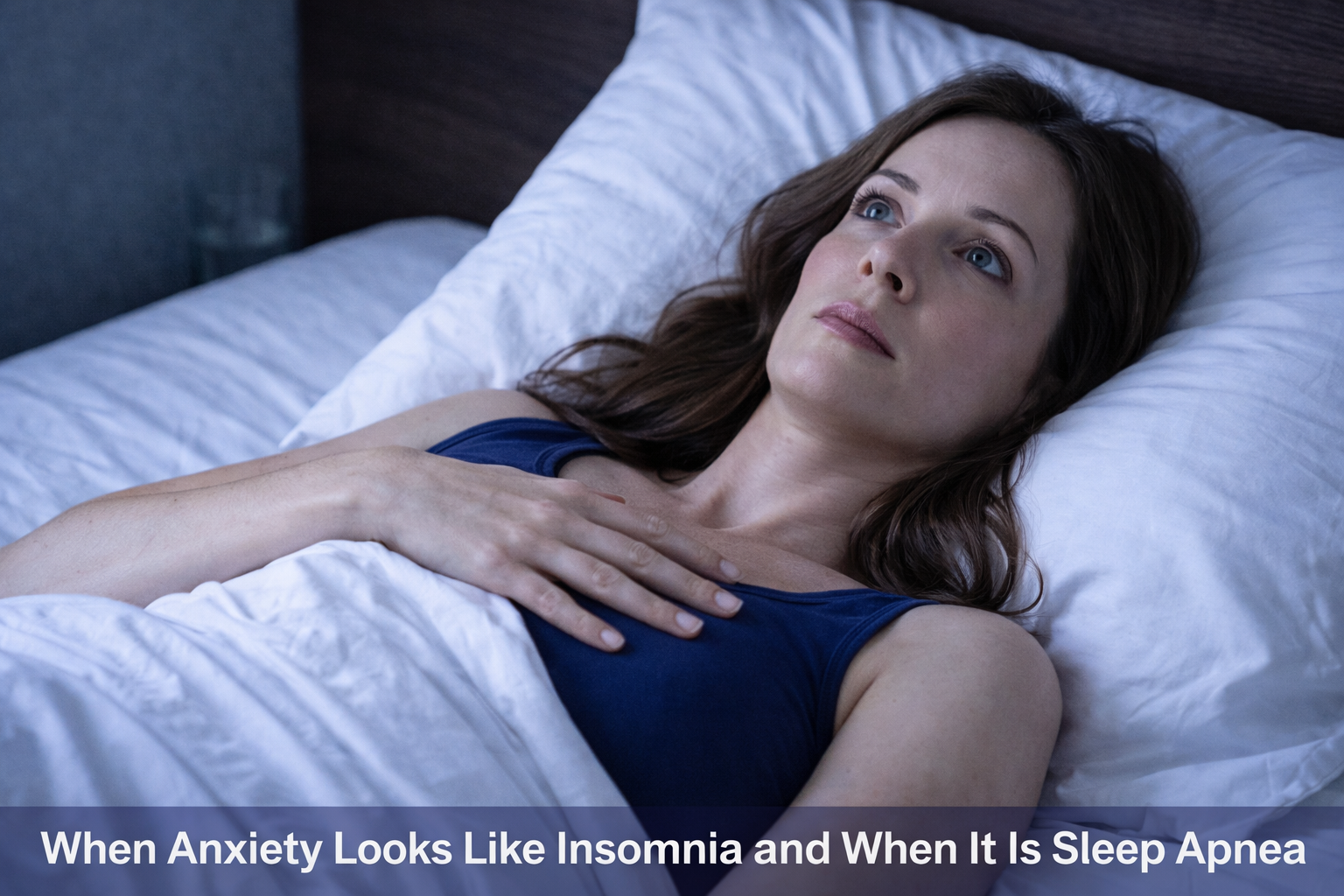
When Anxiety Looks Like Insomnia and When It Is Sleep Apnea
Anxiety, insomnia, and sleep apnea share overlapping symptoms that are frequently misidentified. Racing thoughts, difficulty falling asleep, and unrefreshing sleep can reflect anxiety, primary insomnia, or untreated sleep-disordered breathing. Accurate diagnosis requires a clinical evaluation. Treating the wrong condition delays recovery and leaves the real cause unaddressed.
Medically reviewed by Dr. Avinesh Bhar, Board Certified Sleep Physician, Sliiip.com
You lie awake at night. Your mind will not stop. You feel wired, anxious, and exhausted at the same time. You have been told it is anxiety. You have been told it is insomnia. But months of trying to manage it have not worked.
Dr. Avinesh Bhar, board-certified sleep physician at Sliiip.com, encounters this diagnostic confusion regularly. Anxiety, insomnia, and sleep apnea are three distinct conditions with significant symptom overlap. Treating only one when multiple are present produces incomplete results and ongoing suffering.
SLIIIP’s board-certified sleep physicians can do sleep evaluations for sleep apnea. Virtual consultations in all 50 states. Home sleep tests shipped to your door.
Up to 50 percent of patients with obstructive sleep apnea report insomnia symptoms. Among those diagnosed with primary insomnia, a significant percentage have unidentified sleep-disordered breathing. (Journal of Clinical Sleep Medicine)
Myth vs. Reality
Common Belief | Clinical Reality |
If I am anxious, my sleep problems are psychological | Anxiety and sleep-disordered breathing frequently co-occur. One does not rule out the other |
Sleep apnea only affects people who snore loudly | Many patients with sleep-disordered breathing do not snore noticeably, particularly women |
If I could manage my anxiety better, I would sleep | Sleep-disordered breathing creates physiological arousal that no behavioral intervention can resolve |
Insomnia and sleep apnea are completely different | They share symptoms and often co-occur. Differentiation requires objective testing |
CHECK YOUR SLEEP SYMPTOMS: TAKE THE 2 MINUTE QUIZ
TAKE THE QUIZ
How Anxiety Affects Sleep
Anxiety activates the hypothalamic-pituitary-adrenal axis, increasing cortisol and physiological arousal. This makes it difficult to relax into sleep and creates a state of hypervigilance the brain interprets as threat detection rather than rest.
Anxiety-driven insomnia is real and clinically significant. But anxiety does not cause oxygen desaturation during sleep. It does not cause airway collapse. These are physiological events that require objective measurement.
Many patients treated for anxiety continue to sleep poorly because a concurrent physiological sleep disorder has never been identified.
How Sleep Apnea Mimics Anxiety
Untreated sleep apnea produces a cascade of physiological consequences that closely mimic anxiety. Recurrent oxygen drops trigger cortisol release and sympathetic nervous system activation. Patients wake in a state of physiological stress without understanding why.
The result is chronic hyperarousal. Racing thoughts at night. A feeling of dread or unease. These are physiological consequences of disrupted breathing during sleep, not symptoms of a psychological disorder.
Patients with undiagnosed sleep apnea are frequently prescribed treatments for anxiety. When the underlying sleep disorder remains unaddressed, those treatments produce limited benefit.
The Diagnostic Problem
The overlap between these conditions makes clinical differentiation difficult without objective data. A home sleep test provides objective data on breathing patterns, oxygen levels, and sleep architecture. No symptom checklist or anxiety scale can produce this information.
If you have been told you have anxiety or insomnia and your symptoms have not improved, a sleep evaluation is warranted.
When CBT-I Helps and When It Does Not
CBT-I is the most evidence-based behavioral approach for insomnia. It addresses hyperarousal and cognitive patterns that perpetuate sleeplessness.
In patients whose insomnia is driven by undetected sleep apnea, CBT-I provides partial relief at best. The physiological cause remains active and continues to fragment sleep regardless of behavioral changes.
What Sleep Apnea Can Look Like in Anxious Patients
In patients with anxiety, sleep apnea often presents without the classic signs. Snoring may be absent or mild. The primary complaints are insomnia, difficulty falling asleep, and waking through the night with a sense of unease.
Women with sleep apnea are particularly likely to present this way. If you are a woman with anxiety, insomnia, and unexplained fatigue, a sleep apnea evaluation specific to women is clinically appropriate.
Expert Q&A
Q: How do you tell the difference between anxiety-driven insomnia and insomnia caused by sleep apnea?
Clinically, the distinction is difficult without objective data. A home sleep test measures what anxiety scales cannot: whether breathing is disrupted during sleep, how often oxygen levels drop, and whether sleep architecture is fragmented by physiological events. That data is the foundation of an accurate diagnosis.
Dr. Avinesh Bhar, Board Certified Sleep Physician, Sliiip.com
Q: Can treating sleep apnea improve anxiety symptoms?
In patients whose anxiety is partly driven by disrupted breathing, addressing the sleep disorder can reduce the chronic cortisol elevation and sympathetic activation that fuel anxious arousal at night. I have seen patients whose anxiety symptoms improved meaningfully once their sleep was evaluated and the underlying breathing disorder was identified and managed.
Dr. Avinesh Bhar, Board Certified Sleep Physician, Sliiip.com
Lifestyle and Behavioral Strategies
- Establish a consistent sleep schedule seven days per week
- Use stimulus control techniques: leave the bed if you cannot sleep within 20 minutes
- Practice a consistent wind-down routine 30 to 60 minutes before bed
- Reduce blue light exposure after sunset
- Limit alcohol, which fragments sleep and worsens airway muscle tone
- Address daytime anxiety with appropriate behavioral support, but do not expect it alone to resolve sleep-disordered breathing

SLIIIP’s board-certified sleep physicians can do sleep evaluations for sleep apnea. Virtual consultations in all 50 states. Home sleep tests shipped to your door.
Frequently Asked Questions
Can anxiety cause sleep apnea?
Anxiety does not cause sleep apnea. Obstructive sleep apnea is a physiological condition involving airway collapse during sleep. However, untreated sleep apnea can worsen anxiety by causing chronic physiological stress responses.
What is the connection between anxiety and insomnia?
Anxiety activates the brain’s threat-detection system, which is physiologically incompatible with sleep. This creates hyperarousal and difficulty falling or staying asleep. However, anxiety alone does not explain all insomnia presentations.
How do I know if I have sleep apnea instead of anxiety?
Symptom overlap makes self-assessment unreliable. A home sleep test measures breathing events, oxygen desaturation, and sleep architecture. That objective data is the appropriate diagnostic tool.
Can untreated sleep apnea cause anxiety or panic attacks?
Repeated oxygen drops trigger cortisol release and sympathetic activation. This chronic physiological stress can contribute to anxiety, mood changes, and nocturnal panic-like episodes.
What happens if anxiety and sleep apnea are both present?
Both conditions need to be addressed. Treating anxiety without identifying co-occurring sleep apnea results in incomplete improvement. A sleep physician can coordinate a comprehensive care plan addressing both.
Can a home sleep test detect whether my insomnia is caused by sleep apnea?
Yes. A home sleep test measures breathing events and oxygen desaturation. If sleep-disordered breathing is detected, it provides objective evidence of a physiological cause. Sliiip uses FDA-approved SleepImage and WatchPAT devices.
Why has CBT-I not worked for my insomnia?
If your insomnia has a physiological driver such as sleep-disordered breathing, CBT-I will provide limited improvement because it does not address the underlying cause. An evaluation to rule out sleep apnea is the appropriate next step.
Does sleep apnea present differently in women?
Yes. Women with sleep apnea are more likely to present with insomnia, fatigue, mood changes, and anxiety than with classic snoring and gasping. This leads to frequent misdiagnosis.
Do I need a referral to see a sleep physician at Sliiip?
No referral is required. You can book directly through Sliiip.com. Sliiip offers telemedicine sleep medicine in all 50 states.
What if I have already been treated for anxiety and my sleep is still poor?
Persistent sleep problems despite anxiety treatment are a significant clinical signal. An unidentified physiological sleep disorder may be contributing. A board-certified sleep physician can evaluate whether sleep-disordered breathing is driving your ongoing symptoms.
SLIIIP’s board-certified sleep physicians can do sleep evaluations for sleep apnea. Virtual consultations in all 50 states. Home sleep tests shipped to your door.
Latest posts
-
RingConn vs Oura: Which Smart Ring Tracks Sleep Better?
Last updated: September 10, 2026. Medically reviewed by Dr. Avinesh Bhar, Board-Certified Sleep Physician, SLIIIP.com. RingConn and Oura both track sleep through a finger-worn ring, but they differ most in…
-
Withings ScanWatch Sleep Tracking Accuracy: What It Can and Cannot Tell You
Last updated: September 10, 2026. Medically reviewed by Dr. Avinesh Bhar, Board-Certified Sleep Physician, SLIIIP.com. Withings ScanWatch is a hybrid analog watch that tracks sleep stages and can flag nighttime…
-
Are Cheap Fitness Trackers Accurate for Sleep?
September 10, 2026. Medically reviewed by Dr. Avinesh Bhar, Board-Certified Sleep Physician, SLIIIP.com. Cheap fitness trackers can be reasonably accurate at telling you when you fell asleep and woke up,…
Get updates
Spam-free subscription, we guarantee. This is just a friendly ping when new content is out.

