👉 Register for Free. How to Diagnose Sleep Apnea Faster in Primary Care – FREE Webinar by Dr. Audrey Wells. – Friday, April 24 at 12 PM ET


How to Reset Your Back to School Sleep Schedule as an Adult
Rebuilding a back to school sleep schedule takes planning rather than willpower, explains Dr. Avinesh Bhar, Board-Certified Sleep Physician at SLIIIP.com, because the adult body clock moves in small daily steps instead of one large jump.
Parents, teachers, bus drivers, and graduate students all face the same late August problem. Summer evenings stretch, wake times drift, and the first week of the academic calendar arrives with a 6:00 a.m. alarm that feels impossible. The gap between your summer wake time and your school year wake time is usually between 60 and 120 minutes, and that gap is what makes the first week so rough.
SLIIIP’s board-certified sleep physicians can do sleep evaluations for sleep apnea. Virtual consultations in all 50 states. Home sleep tests shipped to your door.
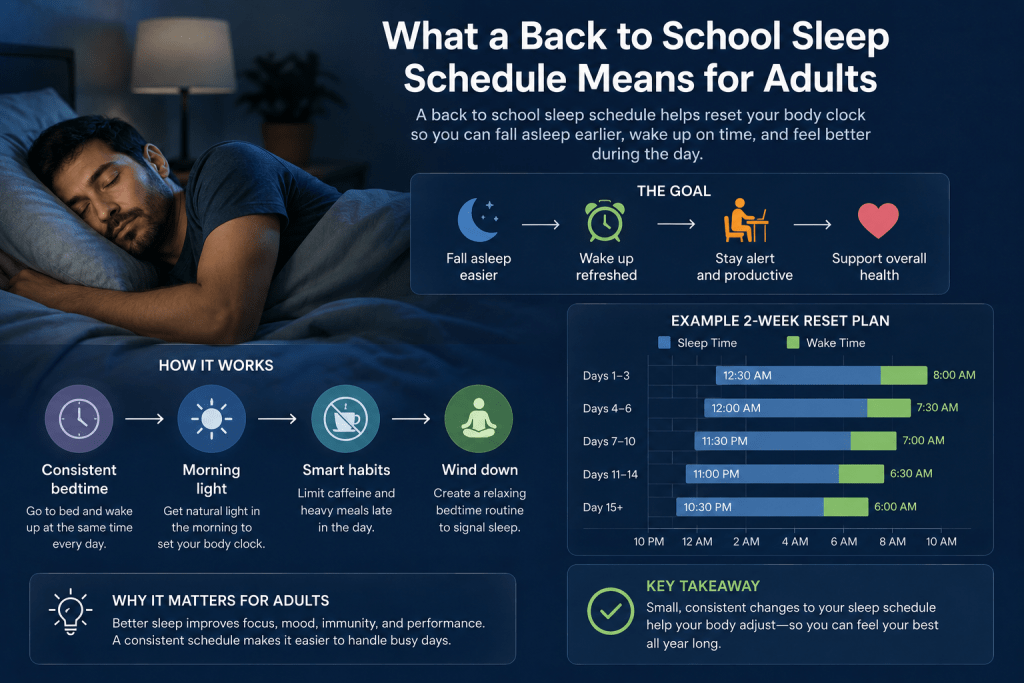
What a Back to School Sleep Schedule Means for Adults
For adults, a back to school sleep schedule is not simply an earlier alarm. It is a coordinated shift of three separate things: the time you fall asleep, the time you wake up, and the timing of the light and food signals that tell your body clock what time it is.
Your internal clock sits in a small region of the brain that responds mostly to light. Over a summer of late sunsets and relaxed mornings, that clock quietly drifts later. Setting an early alarm without moving the rest of the schedule produces short nights, not an earlier clock. Moving your alarm earlier while leaving your light exposure, meals, and bedtime unchanged is the single most common mistake adults make in late August.
The practical goal is simple. You want your body to feel sleepy at the new bedtime on its own, so the alarm is a formality rather than an interruption. If you want the broader mechanics behind this, our guide on how to fix your circadian rhythm covers the underlying system in more detail.
CHECK YOUR SLEEP SYMPTOMS: TAKE THE 2 MINUTE QUIZ
TAKE THE QUIZ
Why Summer Pushes Adult Bedtimes Later
Three summer habits do most of the damage.
Late sunlight is the biggest one. In much of the country, evening light in July lasts well past 8:30 p.m., and bright light in the hours before bed pushes your clock later. Second, social schedules move. Dinners, patios, travel, and later screen time all cluster in the evening. Third, mornings loosen. Without a fixed start time, wake times slide by an hour or more, and the later wake time then supports an even later bedtime the following night.
None of this is a discipline problem. It is a timing problem, and timing problems respond well to planned adjustments.
Start Two to Three Weeks Before the First Day
The most reliable window is 14 to 21 days before your first early morning. That gives you enough runway to move in small increments without creating a stretch of short nights.
If you are already inside that window, you can still shift, but you should expect to accept some tiredness during the first several school days. Adults who try to move 90 minutes over a single weekend usually end up sleep deprived rather than reset.
Map it out first. Write down your current average bedtime and wake time, then the target times. The difference divided by 15 minutes gives you the number of days you need.
The 15 Minute Method for Moving Bedtime Earlier
This is the core of the process.
Move both your bedtime and your wake time earlier by 15 minutes every two days. If you currently sleep from midnight to 8:00 a.m. and need to reach 10:30 p.m. to 6:30 a.m., that is a 90 minute shift, which takes about 12 days at this pace.
Hold each new time for two nights before moving again. The wake time is the anchor, so protect it even on the days when the earlier bedtime does not work. Getting up at the target time on a slightly short night builds sleep pressure that makes the following night easier.
A few practical notes. Do not stay in bed awake for long stretches trying to force an earlier sleep onset. If you are still awake after roughly 20 minutes, get up, keep the lights low, do something quiet, and return when you feel sleepy. Our article on how to fix your sleep schedule walks through this step in more depth.
Morning Light Is the Strongest Signal You Have
Light in the first hour after waking does more to advance your clock than any other habit.
Get outside within 30 to 60 minutes of waking, ideally for 15 to 30 minutes. Cloudy days still work, because outdoor light on an overcast morning is far brighter than typical indoor lighting. Walking the dog or drinking coffee outside both count.
Consistent morning light exposure is what makes an earlier bedtime feel natural rather than forced. Pair it with movement if you can, since morning activity reinforces the same signal. Our best morning routine guide has a simple template you can adapt.
On the other end of the day, reduce bright light in the two hours before your target bedtime. Dim overhead lights, use lamps instead, and lower screen brightness. The goal is contrast between your morning and your evening.
Evening Habits That Hold the New Schedule in Place
Once the timing starts moving, evening routine keeps it there.
Keep the last hour before bed predictable and low stimulation. Reading, stretching, a shower, and preparing for the next day all work. Avoid finishing work email in bed, since that trains your brain to treat the bedroom as an alert environment.
Keep the room cool, dark, and quiet. A warm shower about 90 minutes before bed supports the body temperature drop that helps sleep onset.
Set out clothes, lunches, and bags the night before. During the school year, morning friction is what pushes adults to hit snooze, and snoozing undermines the wake time anchor that the whole shift depends on. The ultimate sleep routine guide covers additional evening structure worth borrowing.
Caffeine, Alcohol, and Late Meals
Caffeine has a long tail. Half of a dose is still in your system roughly five to six hours later, and for some adults considerably longer. If your new bedtime is 10:30 p.m., set a caffeine cutoff around early afternoon and hold it.
Alcohol is the more deceptive one. It can shorten the time it takes to fall asleep while fragmenting the second half of the night, which is exactly the portion you are trying to protect during a schedule shift.
Large late meals also work against you. Aim to finish dinner two to three hours before your target bedtime. A light snack is fine, but a heavy meal close to bedtime often delays sleep onset at the moment you are trying to move it earlier.
Some adults ask about melatonin during this period. Timing matters more than dose, and it is a conversation worth having with a clinician rather than guesswork. Our overview of melatonin and sleep explains what the research supports and what it does not.
Weekends Are Where Most Adults Lose Progress
Sleeping in on Saturday and Sunday recreates the same drift you spent two weeks correcting. Researchers often describe this pattern as social jet lag, and it is why Monday feels harder than Wednesday.
Keep weekend wake times within about 60 minutes of your weekday wake time. If you need recovery, take an early afternoon nap of 20 to 30 minutes rather than extending your morning. Our piece on the benefits of napping explains how to time this without hurting nighttime sleep.
The same logic applies to holiday weekends in September and October. Every long weekend is a chance to drift, and every drift costs a few days of readjustment.
When Trouble Shifting Points to Something Else
Most adults complete a back to school sleep schedule shift in two or three weeks. When it does not work, the timing may not be the real issue.
Dr. Avinesh Bhar notes that adults who follow a consistent earlier schedule for several weeks and still wake up unrefreshed are describing something different from a timing problem. Loud snoring, witnessed pauses in breathing, waking with a dry mouth or headache, and daytime sleepiness that persists despite adequate time in bed are patterns that are commonly associated with sleep disordered breathing in research literature and are worth evaluating.
Persistent morning grogginess after several weeks of consistent sleep timing is a reason to talk to a clinician rather than a reason to try harder. The CDC publishes general guidance on adult sleep duration, and the National Heart, Lung, and Blood Institute maintains plain language material on what insufficient sleep does over time.
A sleep evaluation is one part of a broader clinical picture, not a standalone answer. If mood changes, chronic pain, thyroid concerns, or medication effects are in play, those belong with your primary care clinician or the appropriate specialist. If you are already using CPAP or an oral device, do not adjust prescribed settings on your own while shifting your schedule. Our article on why you wake up tired covers other common contributors.
Watch: Dr. Wells explains what is excessive daytime sleepiness
Building a Schedule That Survives October
The transition is the easy part. Keeping it is the work.
Pick a wake time you can hold on nearly every day of the school year, including most weekends. Anchor it with morning light. Protect a consistent wind down window. Then stop negotiating with it during the first stressful week of the semester, because that is exactly when the schedule earns its value.
A back to school sleep schedule built on those four habits tends to hold through the fall. One built on an early alarm alone rarely lasts past the second week.
At Sliiip, we accept the following insurances:

SLIIIP’s board-certified sleep physicians can do sleep evaluations for sleep apnea. Virtual consultations in all 50 states. Home sleep tests shipped to your door.
Frequently Asked Questions
How early should adults start shifting their sleep schedule before school starts?
Two to three weeks is the reliable window. That allows a 15 minute shift every two days without stacking short nights.
How much can I move my bedtime in one night?
About 15 minutes is realistic for most adults. Larger jumps usually produce a long stretch of lying awake rather than an earlier sleep onset.
Should I move my wake time or my bedtime first?
Move both together, but treat the wake time as the anchor. An earlier wake time builds the sleep pressure that makes the earlier bedtime possible.
Does staying up late on weekends undo the whole shift?
It sets you back. Keeping weekend wake times within roughly an hour of weekday times protects most of your progress.
How much morning light do I actually need?
Fifteen to thirty minutes of outdoor light within an hour of waking is a reasonable target. Overcast mornings still count.
Does light through a window work as well as going outside?
Not usually. Window glass and indoor positioning cut intensity substantially compared with standing outdoors.
When should I stop drinking caffeine on the new schedule?
Early afternoon works for most adults with a 10:30 p.m. bedtime. Sensitive individuals may need an earlier cutoff.
Does alcohol help me fall asleep earlier during a schedule change?
It may shorten sleep onset, but it commonly fragments the later portion of the night, which works against the shift you are making.
Can I use naps while adjusting my schedule?
Short early afternoon naps of 20 to 30 minutes are generally compatible. Long or late naps reduce the sleep pressure you need at night.
What if I cannot fall asleep at the new bedtime?
Get up after about 20 minutes, keep lights low, do something quiet, and return when sleepy. Hold the wake time regardless.
Is it harder for adults than for teenagers to shift earlier?
Both groups find advancing the clock harder than delaying it. Teenagers often have a stronger biological push toward later timing.
Should I stop using screens entirely in the evening?
Not necessarily. Reducing brightness, moving screens farther away, and dimming room lighting in the last two hours is a practical middle ground.
Does exercise timing matter for shifting earlier?
Morning activity reinforces the earlier signal. Intense late evening exercise raises arousal for some adults and may delay sleep onset.
How long until the new schedule feels normal?
Most adults report the new timing feeling natural within two to three weeks of consistent practice.
Does melatonin help with an earlier schedule?
Timing matters more than dose, and it is worth discussing with a clinician rather than guessing. It is not a substitute for consistent light and timing habits.
What if my job or commute makes a consistent wake time impossible?
Anchor what you can and prioritize morning light on the days you control. Rotating or overnight schedules are a different situation worth discussing with a sleep physician.
Is grogginess in the first week normal?
Some adjustment fatigue is common. Grogginess that persists for several weeks despite consistent timing is worth evaluating.
Can hitting snooze ruin the shift?
It fragments your final sleep and blurs the wake time anchor. Setting one alarm and getting up immediately is more effective.
Should my kids follow the same schedule adjustment?
The same gradual approach applies, though children and teenagers have different sleep duration needs. Pediatric questions belong with your pediatrician.
When should I talk to a sleep physician about this?
If you hold a consistent earlier schedule for several weeks and still feel unrefreshed, or if snoring, breathing pauses, or persistent daytime sleepiness are present, an evaluation is reasonable.
SLIIIP’s board-certified sleep physicians can do sleep evaluations for sleep apnea. Virtual consultations in all 50 states. Home sleep tests shipped to your door.
Latest posts
-
Why Are My Naps Never Refreshing?
Last updated: October 2, 2026. Medically reviewed by Dr. Avinesh Bhar, Board-Certified Sleep Physician, SLIIIP.com. Naps that leave you groggy usually come down to how long you sleep, when you…
-
Is Sleeping Too Much a Sleep Disorder?
Last updated: October 2, 2026. Medically reviewed by Dr. Avinesh Bhar, Board-Certified Sleep Physician, SLIIIP.com. Sleeping too much is not always a sleep disorder, but it can be a sign…
-
Why Does My Insomnia Get Worse After Stopping Sleep Medication?
Last updated: October 2, 2026. Medically reviewed by Dr. Avinesh Bhar, Board-Certified Sleep Physician, SLIIIP.com. Insomnia can get worse after stopping sleep medication for three main reasons. They are rebound…
Get updates
Spam-free subscription, we guarantee. This is just a friendly ping when new content is out.

