👉 Register for Free. How to Diagnose Sleep Apnea Faster in Primary Care – FREE Webinar by Dr. Audrey Wells. – Friday, April 24 at 12 PM ET

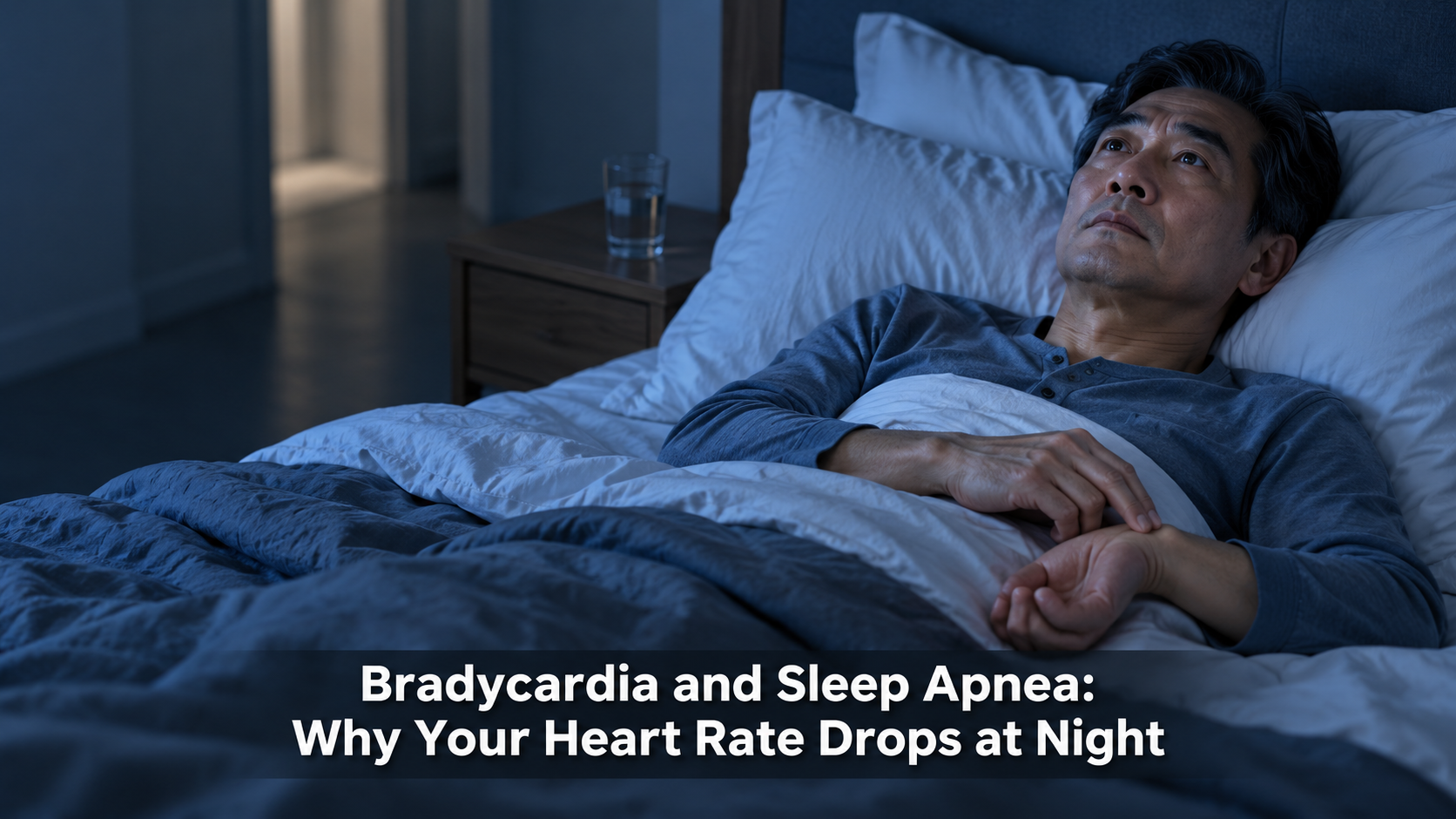
Bradycardia and Sleep Apnea: Why Your Heart Rate Drops at Night
Last updated: September 21, 2026. Medically reviewed by Dr. Avinesh Bhar, Board-Certified Sleep Physician, SLIIIP.com.
Sleep apnea can cause bradycardia, an abnormally slow heart rate, during the breathing pauses themselves, a pattern first documented in sleep medicine research decades ago and still commonly seen in patients with untreated sleep apnea today. This slowing happens in the vast majority of apnea events and is a direct, measurable physiological response, not a separate or unrelated heart problem. Dr. Avinesh Bhar, Board-Certified Sleep Physician at SLIIIP.com, notes that nocturnal bradycardia is sometimes picked up incidentally on a wearable device or cardiac monitor, well before anyone considers that sleep apnea might be the cause. Understanding why the heart rate drops during these events clarifies when it is expected and when it deserves further evaluation.
SLIIIP’s board-certified sleep physicians can do sleep evaluations for sleep apnea. Virtual consultations in all 50 states. Home sleep tests shipped to your door.
What Happens to Heart Rate During an Apnea Event
A landmark 1982 study found that bradycardia occurred during 95 percent of all apnea events studied, whether obstructive, central, or mixed, and that the degree of heart rate slowing increased with both the length of the apnea and the severity of the oxygen desaturation that accompanied it. Heart rate slowed by an average of 9.5 beats per minute during shorter apneas and by 16.6 beats per minute during longer ones, according to research published on PubMed Central.
This pattern is often followed by a rebound tachycardia, a rapid increase in heart rate, once breathing resumes and oxygen levels recover, creating a repeating cycle of slowing and speeding up throughout the night in someone with frequent breathing events.
Why Does Breathing Interruption Slow the Heart?
The mechanism is thought to involve the diving reflex, a protective physiological response also seen in mammals that hold their breath underwater, in which the body redirects blood flow to protect vital organs when oxygen becomes scarce. Sleep apnea triggers a version of this reflex through activation of the vagus nerve, which slows the heart as part of the body’s response to the combination of apnea and low oxygen.
This reflex is thought to increase sympathetic activity to blood vessels while simultaneously slowing the heart itself, a combination that helps explain why sleep apnea affects both heart rate and blood pressure at the same time.
When Does Nocturnal Bradycardia Need Further Evaluation?
Brief, apnea-related slowing that resolves once breathing resumes is a well-documented and expected pattern in sleep apnea, even in people with no underlying heart condition. More concerning patterns include prolonged sinus pauses, conduction blocks where the heart’s electrical signal is delayed or interrupted, or bradycardia and related symptoms occurring during the daytime rather than only tied to nighttime breathing events, which case reports have described as a rarer but real presentation.
According to a case report published on PubMed Central, sleep apnea should be considered a possible underlying cause whenever cardiac bradyarrhythmias appear in someone with risk factors for the condition, such as obesity, habitual snoring, or witnessed breathing pauses, even if the arrhythmia is detected during the day. Cases like these illustrate why a cardiac workup for an unexplained slow heart rate benefits from including sleep history as a standard question, not an afterthought.
When to See a Doctor
If a wearable device, cardiac monitor, or prior test has flagged nocturnal bradycardia, or if you experience lightheadedness, fainting, or chest discomfort that a cardiologist has not fully explained, sleep apnea is worth raising as a possible underlying cause. Dr. Bhar recommends a sleep evaluation for anyone with unexplained nocturnal or daytime bradyarrhythmia, particularly if snoring, witnessed breathing pauses, or excessive daytime sleepiness are also present, since treating the sleep apnea can resolve the associated bradycardia in many patients.
A home sleep test can clarify whether breathing disruptions are occurring and correlate with the heart rate changes a cardiologist may have already identified.
Insurance and Cost
SLIIIP works with most major insurance plans, including Medicare and TRICARE, and offers transparent cash pricing for patients without applicable coverage.

SLIIIP’s board-certified sleep physicians can do sleep evaluations for sleep apnea. Virtual consultations in all 50 states. Home sleep tests shipped to your door.
Frequently Asked Questions
Can sleep apnea cause bradycardia?
Yes, research shows bradycardia occurs during the large majority of apnea events, as a direct physiological response to the breathing pause.
What is considered bradycardia?
Generally a heart rate below 60 beats per minute in adults, though the threshold used in sleep apnea research is sometimes lower.
Why does the heart rate slow during an apnea event?
A reflex similar to the mammalian diving response is triggered by the combination of apnea and low oxygen, causing vagus nerve activation that slows the heart.
Does the heart rate speed up again after the apnea ends?
Yes, a rebound tachycardia often follows once breathing resumes and oxygen levels recover.
Is nocturnal bradycardia from sleep apnea dangerous?
Brief, apnea-related slowing is common and often not dangerous on its own, though prolonged pauses or conduction blocks warrant further evaluation.
Can sleep apnea cause bradycardia during the day, not just at night?
Yes, case reports describe sleep apnea as a cause of daytime bradyarrhythmia, though this is less common than the nighttime pattern.
How much does heart rate typically drop during an apnea event?
Research has found average drops of roughly 9 to 17 beats per minute depending on the length of the apnea and degree of oxygen desaturation.
Can treating sleep apnea resolve bradycardia?
Yes, in many patients, treating the underlying sleep apnea resolves the associated nocturnal bradycardia without needing a pacemaker.
When might a pacemaker be considered for sleep apnea related bradycardia?
This is typically considered when bradyarrhythmias are severe, cause symptoms, or persist despite treating the sleep apnea itself.
Can a smartwatch detect sleep apnea related bradycardia?
Some wearable devices can flag unusually low heart rate patterns, which may prompt further evaluation for an underlying cause like sleep apnea.
Is bradycardia during sleep normal for everyone?
Some heart rate slowing during sleep is normal, but sleep apnea can cause a more pronounced and repetitive pattern tied to breathing events.
Can central sleep apnea cause bradycardia too?
Yes, the original research on this topic found bradycardia occurred during obstructive, central, and mixed apnea events alike.
What is a sinus pause?
It is a temporary halt in the heart’s normal electrical signal, and prolonged pauses associated with sleep apnea can be a reason for further cardiac evaluation.
Can obesity increase the risk of sleep apnea related bradyarrhythmias?
Yes, obesity is a shared risk factor for both sleep apnea and the arrhythmias associated with it.
Should I see a cardiologist or a sleep physician first for bradycardia?
Either can be a reasonable starting point, and the two often coordinate care when sleep apnea is a suspected contributor.
Can REM sleep affect bradycardia patterns?
Yes, some bradyarrhythmias linked to sleep apnea are more pronounced or specifically occur during REM sleep.
Does snoring always accompany sleep apnea related bradycardia?
Not always; some patients with significant breathing-related heart rate changes do not snore loudly.
Can a home sleep test detect the heart rate changes linked to bradycardia?
Yes, home sleep tests typically monitor heart rate alongside breathing and oxygen levels, which can reveal this pattern.
Is nocturnal bradycardia the same as a heart block?
No, heart block refers to a specific type of electrical conduction problem, while bradycardia describes the slow rate itself, which can have several causes.
What is the first step if bradycardia has been found on a test?
Book a sleep evaluation to determine whether sleep apnea may be an underlying, treatable contributor to the pattern.
Take the Next Step
SLIIIP’s board-certified sleep physicians can do sleep evaluations for sleep apnea. Virtual consultations in all 50 states. Home sleep tests shipped to your door.
Latest posts
-
Bradycardia and Sleep Apnea: Why Your Heart Rate Drops at Night
Last updated: September 21, 2026. Medically reviewed by Dr. Avinesh Bhar, Board-Certified Sleep Physician, SLIIIP.com. Sleep apnea can cause bradycardia, an abnormally slow heart rate, during the breathing pauses themselves,…
-
Diabetes and Sleep Apnea: The Two-Way Connection Explained
Last updated: September 21, 2026. Medically reviewed by Dr. Avinesh Bhar, Board-Certified Sleep Physician, SLIIIP.com. Diabetes and sleep apnea are connected in both directions: untreated sleep apnea makes blood sugar…
-
Thyroid and Sleep Apnea: The Two-Way Connection Explained
Last updated: September 21, 2026. Medically reviewed by Dr. Avinesh Bhar, Board-Certified Sleep Physician, SLIIIP.com. Thyroid problems and sleep apnea are connected in both directions: an underactive thyroid can raise…
Get updates
Spam-free subscription, we guarantee. This is just a friendly ping when new content is out.

