👉 Register for Free. How to Diagnose Sleep Apnea Faster in Primary Care – FREE Webinar by Dr. Audrey Wells. – Friday, April 24 at 12 PM ET


Brown Noise for Sleep: Does It Really Help You Rest?
Brown noise for sleep, the deep and steady rumble that many people play at bedtime, has become a popular wind down tool, and Dr. Avinesh Bhar, Board-Certified Sleep Physician at SLIIIP.com, sees more patients asking whether the sound truly helps them drift off. Social media clips and streaming playlists have pushed this low, blanket-like hum into millions of bedrooms. The honest answer is that some people find it soothing, while the science is still young. Sound can shape how easily you settle at night, but it is only one piece of good rest. This article explains what brown noise is, what the evidence does and does not show, how it compares to white and pink noise, and when a quiet room is not the real issue. The goal is a clear, honest look rather than hype.
SLIIIP’s board-certified sleep physicians can do sleep evaluations for sleep apnea. Virtual consultations in all 50 states. Home sleep tests shipped to your door.
What Is Brown Noise?
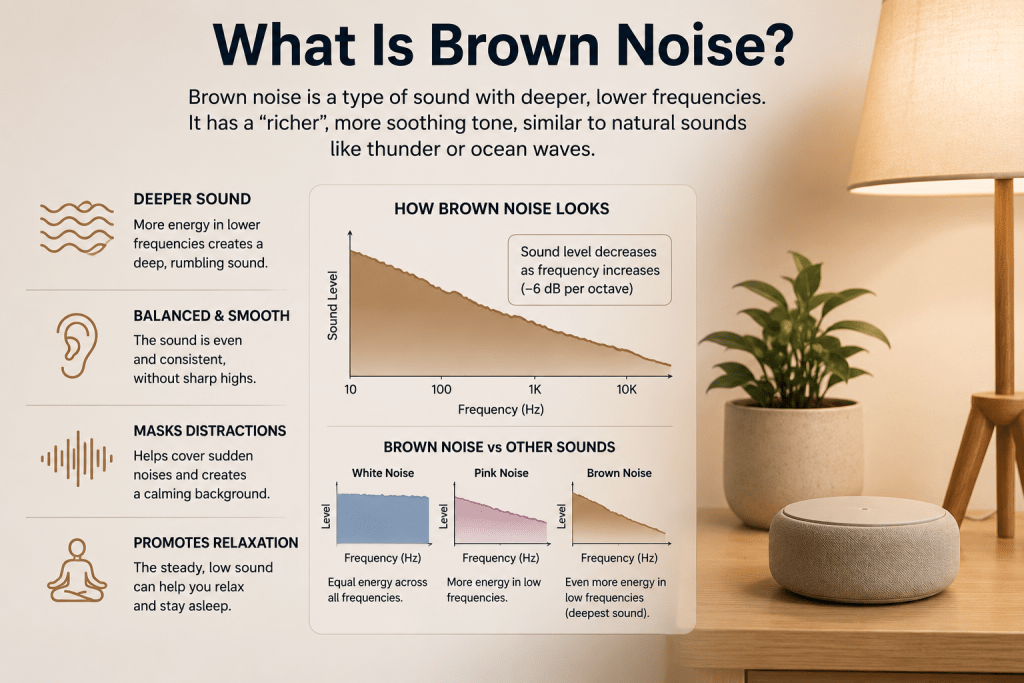
Brown noise is a type of sound that carries more energy in the lower frequencies, which gives it a deep, rolling quality. Think of a steady waterfall, a low jet engine hum, or heavy rain without the sharp high notes. It sounds fuller and softer than the hiss many people picture when they think of static.
The name has nothing to do with the color brown. It comes from a pattern called Brownian motion, the same random movement scientists use to describe drifting particles. The sound follows a similar mathematical curve, which is why it leans so heavily on the low end.
Brown noise sits within a family often called colored noise. Each color, from white to pink to brown, describes how sound energy spreads across frequencies. You can explore related calming audio in our guide on sleep sounds and relaxing music.
CHECK YOUR SLEEP SYMPTOMS: TAKE THE 2 MINUTE QUIZ
TAKE THE QUIZ
Does Brown Noise for Sleep Actually Work?
The research on brown noise for sleep is limited, and most of it is small or early. Some people report falling asleep faster or feeling less disturbed by outside sounds, but strong, large scale proof is not yet here. These reports are associations and personal experiences, not guarantees that the sound will work for everyone.
What the evidence does suggest is that a steady background sound can help mask sudden noises. A car door, a creaking floor, or a partner shifting in bed stands out less against a constant hum. For light sleepers, that masking effect may be the real benefit rather than anything unique to the low frequencies.
It is also worth being honest about the placebo effect. When you expect a tool to help you relax, that expectation alone can ease the mind. That does not make the tool useless, but it does mean results vary a great deal from person to person. If falling asleep is your struggle, our article on how to fall asleep fast offers broader, evidence based ideas.
Why Some People Find Brown Noise Soothing
The appeal often comes down to consistency. A steady, unchanging sound gives the brain something predictable to rest against, which can quiet the urge to track every small noise in the room. For a busy mind, a constant hum can act like a soft wall between you and a noisy world.
The low, rumbly tone of brown noise feels gentler to many ears than the sharper hiss of white noise. That softer quality is a common reason people say they prefer it. Comfort and preference matter here, because the sound you like is the one you are most likely to keep using.
For people who lie awake with racing thoughts, a background sound can offer a simple anchor for attention. Our guide on how to stop overthinking at night pairs well with this idea. Still, sound is a helper, not a cure, and it works best as part of a calming routine.
Brown Noise Versus White and Pink Noise
White noise spreads energy evenly across all frequencies, which gives it a bright, hissy sound like an untuned radio. It is the most familiar of the colored noises and the one many sound machines default to.
Pink noise softens the high frequencies, landing between white and brown. Many describe it as sounding like steady rainfall. Brown noise goes further, dropping even more of the high end, so it feels the deepest and most rounded of the three.
There is no single winner for everyone. The best choice is the one that feels calming to you and helps you relax. Trying each for a few nights is a simple way to learn your own preference without overthinking it.
How to Try Brown Noise for Better Rest
If you want to experiment, keep it simple and low pressure. Play the sound at a low, comfortable volume, loud enough to blend into the room but not so loud that it becomes its own distraction. A volume that covers background noise without demanding attention is usually the sweet spot.
Use a timer or a device you can leave running, and place the speaker a short distance from your bed rather than right by your ear. Pair the sound with the rest of a steady wind down, such as dim lights and a screen break. Our ultimate sleep routine guide shows how these pieces fit together.
Give any new habit a week or two before you judge it. According to the Centers for Disease Control and Prevention, consistent bedtime habits are a foundation of healthy rest, and a background sound is only one small part of that picture. If it helps, keep it. If it does not, there is no harm in setting it aside.
Watch: How much snoring is normal? SLIIIP.com
When Sound Is Not the Real Problem
A soothing hum can smooth the edges of a restless night, but it cannot fix an underlying sleep condition. If you still wake tired, gasp for air, or snore heavily despite a calm, quiet setup, the issue may go deeper than noise. Those signs point to something a sound machine cannot address.
Conditions like obstructive sleep apnea fragment sleep from the inside, no matter how peaceful the room sounds. As Dr. Avinesh Bhar points out, no audio track can open a narrowed airway, so persistent tiredness deserves a real evaluation. If you often wake unrefreshed, our article on why you wake up tired is a useful next read.
The National Heart, Lung, and Blood Institute notes that ongoing sleep trouble is worth a professional look rather than trial and error at home. A sleep evaluation is one part of a broader view of your health, and any concern beyond sleep belongs with your own physician. SLIIIP.com makes that step easy with virtual visits and home sleep tests that fit around your routine.
At Sliiip, we accept the following insurances:

SLIIIP’s board-certified sleep physicians can do sleep evaluations for sleep apnea. Virtual consultations in all 50 states. Home sleep tests shipped to your door.
Frequently Asked Questions
What is brown noise?
Brown noise is a deep, steady sound with more energy in the low frequencies. It resembles a rumbling waterfall or heavy rain without sharp high notes.
Does brown noise for sleep really work?
Some people find it soothing, but the research is still limited and early. Results vary widely from one person to the next.
Why is it called brown noise if it is a sound?
The name comes from Brownian motion, a random pattern of movement in science. It has nothing to do with the color brown.
Is brown noise better than white noise for sleep?
Neither is proven best for everyone, and it comes down to preference. Many find brown noise gentler because it drops the sharper high tones.
How is brown noise different from pink noise?
Pink noise sits between white and brown and sounds like steady rain. Brown noise cuts more of the high end, so it feels deeper.
Can brown noise help me fall asleep faster?
It may help by masking sudden sounds and giving the mind an anchor. Some people notice a difference, though it is not guaranteed.
Is it safe to play brown noise all night?
A low, comfortable volume is generally considered fine for most people. Keeping the sound gentle protects your ears and your rest.
How loud should brown noise be?
Aim for a level that blends into the room without demanding attention. If it becomes its own distraction, turn it down.
Does brown noise help with racing thoughts at night?
A steady sound can give busy attention something simple to settle on. It works best alongside a calming bedtime routine.
Can brown noise help with tinnitus?
Some people use background sound to make ringing less noticeable. Anyone with tinnitus should discuss options with their own doctor.
Is brown noise good for focus during the day?
Some find a steady hum helpful for concentration, though this varies. It is a personal preference rather than a proven rule.
Will brown noise work for my baby?
Any sleep sound for infants should follow your pediatrician’s guidance on volume and safety. This article does not offer medical advice for children.
Do I need a special machine to play brown noise?
No, many free apps and streaming tracks offer it. A simple speaker set at a low volume is enough.
Can brown noise cause any harm?
At a comfortable volume, it is generally low risk for most people. Very loud sound over long periods is best avoided to protect hearing.
How long should I try brown noise before deciding?
Give it a week or two as part of a steady routine. That gives you a fair sense of whether it helps.
Why do I still wake up tired even with brown noise?
Sound cannot fix an underlying sleep condition. Lasting tiredness despite good habits is worth a professional look.
Is brown noise a treatment for insomnia?
No, it is a comfort tool, not a treatment. Persistent insomnia deserves guidance from a qualified clinician.
Can brown noise replace a sleep evaluation?
No, a soothing sound cannot diagnose or address a sleep disorder. An evaluation is the right step for ongoing problems.
Does brown noise affect deep sleep?
Evidence here is limited and mixed, so no firm claim can be made. If deep sleep is a concern, a professional can help you explore it.
When should I see a sleep professional instead of trying sounds?
If you snore heavily, gasp for air, or stay tired despite calm nights, seek an evaluation. A sleep visit can clarify what is really going on.
SLIIIP’s board-certified sleep physicians can do sleep evaluations for sleep apnea. Virtual consultations in all 50 states. Home sleep tests shipped to your door.
Latest posts
-
RingConn vs Oura: Which Smart Ring Tracks Sleep Better?
Last updated: September 10, 2026. Medically reviewed by Dr. Avinesh Bhar, Board-Certified Sleep Physician, SLIIIP.com. RingConn and Oura both track sleep through a finger-worn ring, but they differ most in…
-
Withings ScanWatch Sleep Tracking Accuracy: What It Can and Cannot Tell You
Last updated: September 10, 2026. Medically reviewed by Dr. Avinesh Bhar, Board-Certified Sleep Physician, SLIIIP.com. Withings ScanWatch is a hybrid analog watch that tracks sleep stages and can flag nighttime…
-
Are Cheap Fitness Trackers Accurate for Sleep?
September 10, 2026. Medically reviewed by Dr. Avinesh Bhar, Board-Certified Sleep Physician, SLIIIP.com. Cheap fitness trackers can be reasonably accurate at telling you when you fell asleep and woke up,…
Get updates
Spam-free subscription, we guarantee. This is just a friendly ping when new content is out.

