👉 Register for Free. How to Diagnose Sleep Apnea Faster in Primary Care – FREE Webinar by Dr. Audrey Wells. – Friday, April 24 at 12 PM ET

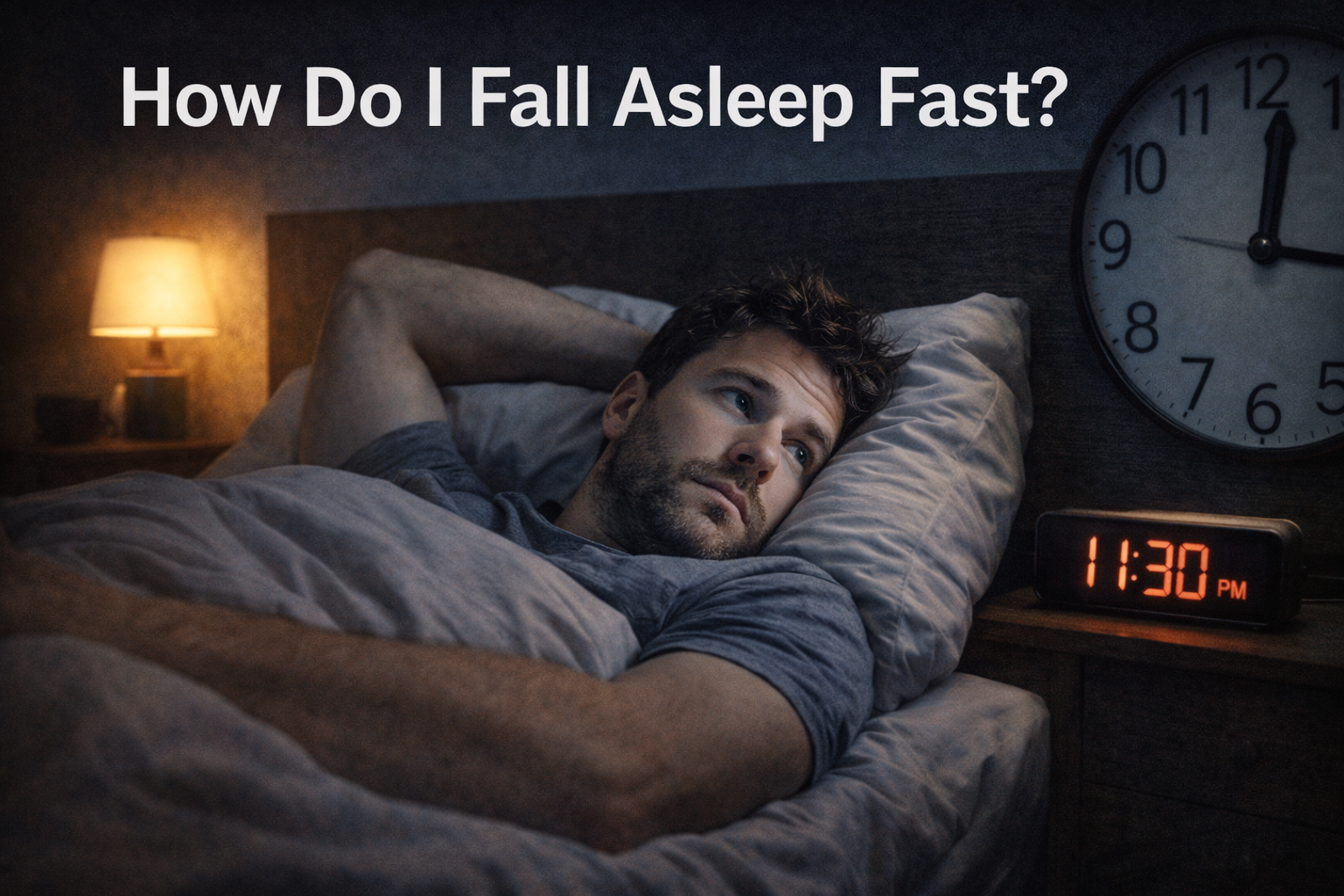
How Do I Fall Asleep Fast?
It is 11:30 PM. You have to be up in seven hours. You close your eyes, take a deep breath, and wait. And wait. Thirty minutes later, you are still staring at the ceiling, checking the time, doing the mental math and wondering “Hhw do I fall asleep fast?”
If this sounds familiar, you are not alone. Dr. Avinesh Bhar, a sleep medicine physician and Founder of SLIIIP has heart this complaint often. Sometimes the problem is situational, caused by stress, caffeine, or an overstimulated mind. But when it happens regularly, there may be more going on than a bad nighttime routine.
This article covers proven techniques that can help you fall asleep faster, explains the science behind why they work, and helps you recognize when difficulty falling asleep may be a sign of something that requires more than a relaxation technique.
Why You Cannot Fall Asleep Quickly
Your ability to fall asleep depends on two systems working together: sleep drive (the buildup of pressure to sleep throughout the day) and arousal level (the degree to which your nervous system is in an alert state). When these are in balance, you feel sleepy at bedtime and transition to sleep within 10 to 20 minutes.
When something disrupts this balance, whether it is a hyperactive stress response, caffeine blocking your sleep drive, blue light suppressing melatonin, or an underlying sleep disorder causing physiological arousal, falling asleep becomes a struggle. The techniques below address the most common barriers to sleep onset.
If you’ve been struggling for some time to have a good night’s sleep, you may have considered undergoing a sleep apnea test at home.
Home sleep apnea tests are covered by most insurances and can be done in 2-3 nights. They are evaluated by a sleep specialist on the online call, highlighting the importance of accurate testing methods in clinical sleep medicine.

Proven Techniques to Fall Asleep Faster
1. The Military Sleep Method
Developed for soldiers who needed to fall asleep in uncomfortable conditions, this technique is designed to produce sleep within two minutes with practice. The steps are: relax your entire face including jaw, tongue, and the muscles around your eyes; drop your shoulders as low as they go, then relax your upper and lower arms one at a time; exhale slowly and relax your chest; relax your legs from thighs to calves to feet; clear your mind by imagining a calming scene (lying in a canoe on a calm lake, lying in a velvet hammock in a dark room) or repeating the phrase “don’t think” for 10 seconds.
This method requires practice. Most people see results after two to three weeks of consistent use. It works by systematically reducing physical tension and mental chatter, the two primary barriers to sleep onset.
2. The 4-7-8 Breathing Technique
Developed by Dr. Andrew Weil, this breathing pattern activates the parasympathetic nervous system: inhale through your nose for 4 counts, hold your breath for 7 counts, and exhale slowly through your mouth for 8 counts. Repeat this cycle three to four times. The extended exhale is the key element, as it stimulates the vagus nerve and triggers a relaxation response. Many people find this technique effective within the first few sessions.
3. Progressive Muscle Relaxation (PMR)
Starting from your toes and working up to your forehead, tense each muscle group for 5 seconds, then release for 30 seconds. Move through feet, calves, thighs, abdomen, chest, hands, arms, shoulders, neck, and face. The contrast between tension and release teaches your body the physical sensation of relaxation and helps identify areas where you are holding stress. Clinical studies show PMR reduces the time it takes to fall asleep and improves overall sleep quality in people with insomnia.
4. Paradoxical Intention
This cognitive technique involves lying in bed with your eyes open and telling yourself to stay awake. By removing the pressure to fall asleep, you reduce the performance anxiety that often keeps people awake. Research has shown that paradoxical intention can be surprisingly effective for people who experience frustration and anxiety about their inability to sleep.
5. Imagery Distraction
Instead of trying to empty your mind, give it something peaceful to focus on. Visualize a calming, detailed scene: walking through a quiet forest, sitting by a stream, exploring a favorite place. The key is to engage all your senses in the visualization, imagining what you see, hear, feel, and smell. This redirects mental activity away from stressful thoughts and toward relaxation. For more structured approaches, explore guided meditation for sleep disorders.
6. The Stimulus Control Method
This technique retrains your brain to associate the bed with sleep. The rules are straightforward: only go to bed when you feel sleepy, use the bed only for sleep (not reading, scrolling, or watching TV), and if you cannot fall asleep within 15 to 20 minutes, get up and do something quiet in dim light until you feel sleepy again. It may feel counterintuitive at first, but it is one of the most effective behavioral strategies for chronic sleep-onset difficulty.

Optimize Your Sleep Environment
Temperature
Your core body temperature needs to drop slightly to initiate sleep. Keep your bedroom between 60 and 67 degrees Fahrenheit (15.5 to 19.4 degrees Celsius). If you tend to sleep hot, consider breathable bedding materials and moisture-wicking sleepwear. Sleep experts recommend thinking of your bedroom as a cool, dark, quiet cave for the best results.
Darkness
Even small amounts of light can suppress melatonin production and interfere with sleep onset. Use blackout curtains or a sleep mask to ensure your room is as dark as possible. Cover or remove any light-emitting electronics, including alarm clocks and charging indicators.
Noise
If you cannot control environmental noise, a white noise machine or fan can mask disruptive sounds. Some people find pink noise (a softer, lower-frequency variant) even more effective. Earplugs are another simple option for noise-sensitive sleepers. You can also explore relaxing sleep sounds and music as part of your bedtime wind-down.
Screen Curfew
Set a firm boundary of 30 to 60 minutes of screen-free time before bed. Replace scrolling with a low-stimulation activity such as reading a physical book, listening to a podcast, gentle stretching, or journaling.
When Techniques Are Not Enough: Recognizing a Deeper Problem
Relaxation techniques and sleep hygiene adjustments work well for occasional difficulty falling asleep. But if you consistently cannot fall asleep despite following best practices, or if you fall asleep but wake up feeling unrefreshed, something more significant may be at play.
Important: Chronic difficulty falling asleep can be a symptom of an underlying sleep disorder such as obstructive sleep apnea, restless legs syndrome, or a circadian rhythm disorder. If relaxation techniques are not producing results after two to three weeks of consistent practice, a professional sleep evaluation should be considered.

Self-Assessment: Should You See a Sleep Specialist?
Consider professional evaluation if:
- You consistently take more than 30 minutes to fall asleep despite using relaxation techniques
- You wake frequently during the night or too early in the morning
- You snore loudly, gasp, or have been told you stop breathing during sleep
- You feel excessively tired during the day even when you get adequate hours of sleep
- Your difficulty falling asleep has lasted more than one month and is affecting your daily life
- You experience restless or uncomfortable sensations in your legs at night
Oral Appliance Therapy: What Patients Want to Know
If your difficulty falling asleep is connected to an underlying condition like obstructive sleep apnea, treating the root cause can transform your sleep quality. Oral appliance therapy provides a quiet, comfortable alternative to CPAP that many patients prefer.

Below an expert sleep dentist answers common questions patients have about oral appliances for sleep apnea.
Dr. Bana Hosseinian DDS,MDS
Diplomate, American Board of Orthodontics
Craniofacial Orthodontist
Question 1: They don’t think they have sleep apnea.
I would consider looking at the symptoms like fatigue , dark circles around the eyes and snoring and possibly doing a take home sleep test to double check if sleep apnea is diagnosed.
Question 2: They think the oral appliance will be uncomfortable
We can show them the appliance and tell them its like. night guard or an orthodontic retainer. also compare the sleep appliance to C-PAP and how low profile it is .
Question 3: They wonder if they have to wear the oral appliance all their life?
Yes. They need to wear the device as a modality to help them with sleep apnea as an alternative to C-PAP therapy.
Question 4: How many years can an oral appliance last?
It depends on how well the patient takes good care of the appliance. they will last on average 4-5 years.
Question 5: Is it more comfortable than CPAP?
The oral appliance is much more comfortable than C-Pap as patients don’t need to deal with wearing masks, cleaning the tubes and carrying a heavy machine especially when they are traveling.
Frequently Asked Questions
How long should it take to fall asleep?
Healthy adults typically fall asleep within 10 to 20 minutes of getting into bed. Falling asleep in less than 5 minutes may indicate sleep deprivation, while consistently taking longer than 30 minutes suggests a sleep-onset problem that may benefit from evaluation.
Does the military method really work?
Many people report success with the military sleep method, though it requires consistent practice over two to three weeks before it becomes reliable. It works by systematically reducing physical tension and quieting mental activity. However, like all relaxation techniques, it addresses the symptoms rather than the cause. If an underlying sleep disorder is present, the technique may provide only limited benefit.
Can sleep apnea make it hard to fall asleep?
Yes. While sleep apnea is best known for disrupting sleep during the night, the chronic poor sleep quality and stress hormone elevation it causes can create a state of nervous system hyperarousal that makes falling asleep progressively harder over time. Treating the sleep apnea often resolves this difficulty. If you suspect sleep apnea may be affecting your ability to fall asleep, a home sleep test is a convenient first step toward diagnosis.
Latest posts
-
Why Can’t I Wake Up Even After Getting Enough Sleep?
Last updated: October 2, 2026. Medically reviewed by Dr. Avinesh Bhar, Board-Certified Sleep Physician, SLIIIP.com. If you can’t wake up after enough sleep, the cause is usually not the number…
-
Why Does My Heart Rate Drop So Low While I Sleep?
Last updated: October 2, 2026. Medically reviewed by Dr. Avinesh Bhar, Board-Certified Sleep Physician, SLIIIP.com. Your heart rate drops low while sleeping mainly because your body needs less work from…
-
Why Are My Naps Never Refreshing?
Last updated: October 2, 2026. Medically reviewed by Dr. Avinesh Bhar, Board-Certified Sleep Physician, SLIIIP.com. Naps that leave you groggy usually come down to how long you sleep, when you…
Get updates
Spam-free subscription, we guarantee. This is just a friendly ping when new content is out.

