👉 Register for Free. How to Diagnose Sleep Apnea Faster in Primary Care – FREE Webinar by Dr. Audrey Wells. – Friday, April 24 at 12 PM ET

Glymphatic System and Sleep: Your Brain’s Night Wash
The glymphatic system and sleep came into focus about a decade ago when researchers described a fluid pathway that appears to flush waste products through brain tissue, and Dr. Avinesh Bhar, Board-Certified Sleep Physician at SLIIIP.com, gets asked about it by patients who have seen the phrase called a nightly brain wash.
The short version: the idea is real science, the picture is still being filled in, and most of the strongest evidence so far comes from animal studies. That is worth knowing before anyone reorganizes their whole night around it.
SLIIIP’s board-certified sleep physicians can do sleep evaluations for sleep apnea. Virtual consultations in all 50 states. Home sleep tests shipped to your door.
What the Glymphatic System Is
Most of the body has a lymphatic network that carries away waste and extra fluid. The brain does not have that same network in the usual form, which left an open question for a long time: how does brain tissue clear the byproducts that build up during a day of activity?
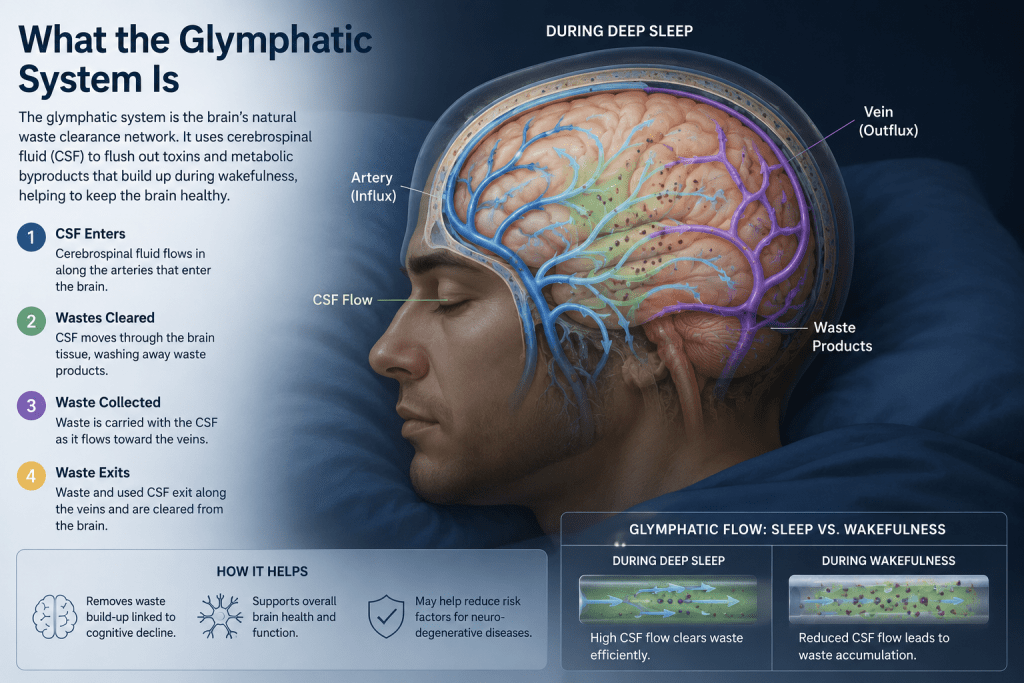
The proposed answer is a pathway that uses cerebrospinal fluid, the clear fluid that surrounds the brain and spinal cord. In this model, fluid moves along the outside of blood vessels, passes through brain tissue, picks up waste products, and drains away. Support cells called astrocytes appear to help direct that flow, which is where the name comes from. It blends glial cells with the lymphatic idea.
This is a description of normal housekeeping, not a treatment and not something you can feel happening. Nobody senses their brain rinsing itself. The interest comes from what researchers observed about when the process seems most active.
CHECK YOUR SLEEP SYMPTOMS: TAKE THE 2 MINUTE QUIZ
TAKE THE QUIZ
What Research on the Glymphatic System and Sleep Shows
The finding that drew attention was timing. In rodent studies, this fluid movement appeared to increase substantially during sleep compared with wakefulness, and the space between brain cells appeared to expand during sleep, which would allow fluid to move more freely.
Researchers also tracked amyloid beta, a protein that clumps together in Alzheimer disease, and reported faster clearance during sleep in those animal models. That is the source of most headlines you have seen.
A few points keep this in perspective.
Much of the direct evidence is from mice. Human brains are harder to study this way, since the methods used in animals cannot simply be repeated in people.
Human research is developing but limited. Imaging studies in people suggest fluid dynamics do change with sleep and wake states, though measuring clearance directly in a living human brain remains difficult.
The details are debated. Some research groups have questioned how much fluid actually moves and by what mechanism. That kind of disagreement is normal in a young field.
Association is not the same as cause. Poor sleep and dementia risk are linked in population research, but a link does not prove that one causes the other, and it does not prove the mechanism is this pathway.
What is not in dispute is simpler and older: sleep supports brain function, memory consolidation, and recovery. The glymphatic system and sleep research adds a possible explanation for part of that, and it is a reasonable extra reason to protect your nights.
Where Sleep Position Fits In
You have probably seen claims that side sleeping cleans the brain better. That claim traces back to a rodent study that compared body positions and reported more efficient clearance in the lateral position than on the back or stomach.
It is an interesting finding. It is also one animal study, and it has not been established as a rule for humans. There is no strong evidence that changing your sleep position will change waste clearance in your brain.
Side sleeping does have better established reasons behind it. It tends to reduce snoring for many people, and back sleeping can make breathing disruptions worse for some. Comfort, joint pain, and reflux also factor in. Our guide to the best sleeping position covers what the evidence supports.
If you sleep on your side and feel good, there is no reason to change. If you sleep on your back and sleep well, there is no urgent reason to switch either.
Why Sleep Quality Matters, Not Just Hours
If this pathway is more active during sleep, then broken sleep is the part worth paying attention to, not just short sleep.
Deep sleep, sometimes called slow wave sleep, is the stage most often connected to this research. Deep sleep tends to cluster in the first part of the night, and it gets reduced by frequent awakenings, alcohol close to bedtime, and an irregular schedule. Our article on getting more deep sleep walks through what actually shifts it.
Breathing disruptions during sleep matter here too. Dr. Avinesh Bhar notes that untreated sleep apnea fragments sleep repeatedly through the night, often without the person remembering any of it, and that fragmentation reduces time spent in deeper stages. Someone can spend eight hours in bed and still get very little consolidated sleep.
Signs worth raising with a clinician include loud snoring, gasping or choking at night, a partner noticing pauses in breathing, morning headaches, and waking up unrefreshed. Mental fog during the day is a common complaint, which we cover in our article on sleep apnea and brain fog. If you regularly wake up tired, that is worth a conversation rather than another supplement.
A sleep evaluation is one piece of a broader workup. It reviews your history, symptoms, and schedule, and considers whether testing would add useful information.
Watch: Your Brain with Sleep Apnea
Daily Habits That Support Healthy Sleep
There is no habit that has been shown to boost this pathway directly. What research on the glymphatic system and sleep does support is protecting sleep itself, which comes down to familiar basics.
Keep a steady schedule. A consistent wake time, including weekends, anchors the body clock better than a strict bedtime does.
Get morning daylight. Fifteen minutes outside early helps set the timing for the following night.
Limit alcohol before bed. It may bring on drowsiness, but it reduces deep sleep and increases awakenings later in the night.
Keep caffeine in the first half of the day. It stays in the system far longer than most people expect.
Move regularly. Daytime activity supports deeper sleep. Intense exercise very close to bedtime leaves some people alert.
Make the room cool, dark, and quiet. Fewer disturbances means fewer partial awakenings you never remember.
Protect the first half of the night. That is when deep sleep is most concentrated, so a late bedtime often costs more than an early alarm does.
Take snoring seriously. Loud, regular snoring is worth evaluating rather than accepting as normal.
For general sleep guidance, the Centers for Disease Control and Prevention publishes plain language recommendations. The National Heart, Lung, and Blood Institute explains how ongoing short sleep affects health over time.
At Sliiip, we accept the following insurances:

SLIIIP’s board-certified sleep physicians can do sleep evaluations for sleep apnea. Virtual consultations in all 50 states. Home sleep tests shipped to your door.
Frequently Asked Questions
What is the glymphatic system?
It is a proposed pathway in which cerebrospinal fluid moves through brain tissue and helps carry away waste products, with support cells guiding the flow.
How are the glymphatic system and sleep connected?
Research, largely in animals, suggests this fluid movement increases during sleep compared with wakefulness, which is why the two are discussed together.
Does my brain really clean itself at night?
Waste clearance in the brain is a real biological process. The specific model and how much of it depends on sleep are still being studied.
Is this proven in humans?
Human research is ongoing and suggestive, but the strongest direct evidence still comes from animal studies. Measuring this in living people is technically difficult.
Does poor sleep cause Alzheimer disease?
Population studies show a link between poor sleep and dementia risk, but a link does not prove cause. Researchers are still working out the direction of that relationship.
Which sleep stage matters most here?
Deep slow wave sleep is the stage most often discussed in this research. It is concentrated in the earlier part of the night.
Does sleeping on my side clear waste better?
That idea comes from a rodent study. It has not been established in humans, so it is not a reason on its own to change position.
Is back sleeping harmful?
Not for everyone. For some people it worsens snoring and breathing disruptions, which is a more practical reason to consider a change.
Can naps help this process?
Naps have benefits for alertness, but they contain far less deep sleep than a full night, so they are not a replacement.
Does drinking more water help?
Normal hydration supports general health. There is no evidence that extra water increases brain waste clearance.
Do supplements support the glymphatic system?
No supplement has been shown to do this in people. Any supplement is worth discussing with a clinician before starting.
Does exercise affect it?
Regular physical activity supports better sleep overall, and some early research has looked at exercise and fluid dynamics. The human evidence is preliminary.
How does alcohol fit in?
Alcohol reduces deep sleep and increases awakenings in the second half of the night, which works against sleep quality regardless of mechanism.
Can sleep apnea affect brain waste clearance?
Sleep apnea fragments sleep and reduces deeper stages. Researchers are studying the downstream effects, and the fragmentation itself is reason enough to get it evaluated.
How many hours do adults need?
Most adults do well with seven or more hours a night, though quality and consistency matter alongside the total.
Is one bad night a problem?
A single short night is not a lasting concern for most people. Ongoing patterns matter more than any one night.
Can a wearable measure this?
No consumer device measures brain waste clearance. Trackers estimate sleep stages, and those estimates are approximate.
What if I sleep enough and still feel foggy?
Persistent mental fog despite adequate time in bed is worth a medical review, since sleep quality or another health factor may be involved.
Do I need a lab test to check for sleep apnea?
Not always. A home sleep test can often be done in your own bed when a physician determines it fits your situation. Our page on the home sleep apnea test explains the process.
When should I see a sleep physician?
If you snore loudly, wake unrefreshed, feel excessively sleepy during the day, or have been told you stop breathing at night, an evaluation is a reasonable next step.
Ready to Look Closer
Protecting deep, uninterrupted sleep is the practical takeaway from this research. If something is breaking up your nights, that is worth identifying.
SLIIIP’s board-certified sleep physicians can do sleep evaluations for sleep apnea. Virtual consultations in all 50 states. Home sleep tests shipped to your door.
Latest posts
-
RingConn vs Oura: Which Smart Ring Tracks Sleep Better?
Last updated: September 10, 2026. Medically reviewed by Dr. Avinesh Bhar, Board-Certified Sleep Physician, SLIIIP.com. RingConn and Oura both track sleep through a finger-worn ring, but they differ most in…
-
Withings ScanWatch Sleep Tracking Accuracy: What It Can and Cannot Tell You
Last updated: September 10, 2026. Medically reviewed by Dr. Avinesh Bhar, Board-Certified Sleep Physician, SLIIIP.com. Withings ScanWatch is a hybrid analog watch that tracks sleep stages and can flag nighttime…
-
Are Cheap Fitness Trackers Accurate for Sleep?
September 10, 2026. Medically reviewed by Dr. Avinesh Bhar, Board-Certified Sleep Physician, SLIIIP.com. Cheap fitness trackers can be reasonably accurate at telling you when you fell asleep and woke up,…
Get updates
Spam-free subscription, we guarantee. This is just a friendly ping when new content is out.

