👉 Register for Free. How to Diagnose Sleep Apnea Faster in Primary Care – FREE Webinar by Dr. Audrey Wells. – Friday, April 24 at 12 PM ET


Is My Sleep Normal? How to Tell When Your Nights Need a Closer Look
Almost everyone has stared at the ceiling in the middle of the night and wondered if my sleep was normal, and according to Dr. Avinesh Bhar, Board-Certified Sleep Physician at SLIIIP.com, that question deserves a real answer instead of a shrug. Sleep is one of the few health habits people do every single night without ever comparing notes. You cannot see your own sleep. You only feel the results the next morning. That gap between what happens at night and what you notice during the day is the reason so many sleep problems go unrecognized for years.
This guide walks through what healthy sleep actually looks like, which nightly quirks are completely ordinary, and which patterns are worth bringing to a clinician.
SLIIIP’s board-certified sleep physicians can do sleep evaluations for sleep apnea. Virtual consultations in all 50 states. Home sleep tests shipped to your door.
When People Ask Is My Sleep Normal, What Are They Really Asking?
The question almost never comes out of nowhere. Something prompted it. Maybe a partner mentioned loud snoring. Maybe a watch flagged a low score. Maybe the morning fog just never lifted.
Underneath the words is my sleep normal, most people are asking one of three different things:
Am I getting enough hours? This is the most common worry and the easiest to check.
Is the quality of my sleep good, even if the hours look fine? This is where things get harder, because quality is not something you can count on a clock.
Is something happening while I am asleep that I cannot see? Breathing pauses, leg movements, and long stretches of light sleep all fall into this group.
Those are three separate questions with three separate answers. Sorting out which one applies to you is the first useful step.
CHECK YOUR SLEEP SYMPTOMS: TAKE THE 2 MINUTE QUIZ
TAKE THE QUIZ
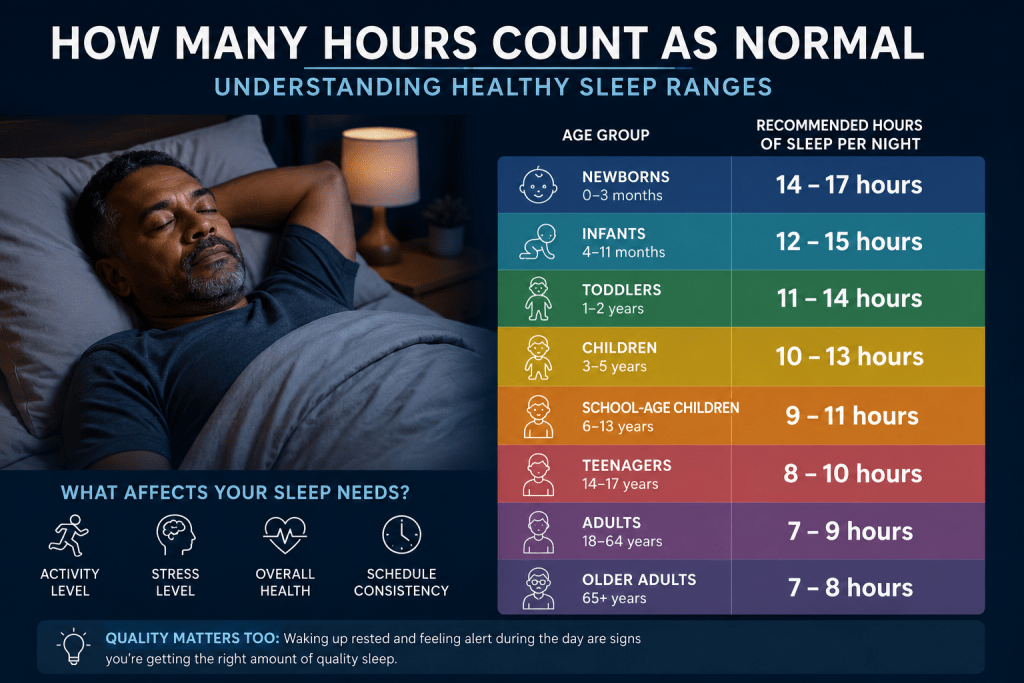
How Many Hours Count as Normal
Most healthy adults need seven to nine hours a night. That range comes from decades of population research and it holds up well across most age groups.
A few points matter more than the number itself:
Older adults still need roughly the same amount. Sleep tends to become lighter and more broken with age, but the requirement does not drop much.
Teenagers and young adults need more, usually eight to ten hours, and their internal clock naturally pushes them later.
Consistently sleeping less than six hours is associated in research with a higher risk of several health conditions, which is why short sleep is worth mentioning to a clinician rather than accepting as a personality trait. The Centers for Disease Control and Prevention treats short sleep as a public health concern for exactly this reason.
There is also a smaller group on the other end. Regularly needing ten or more hours and still waking up tired can point to a sleep disorder rather than a large sleep need.
If you want a deeper look at the minimum your body protects most fiercely, our guide on how much core sleep you need breaks that down.
Normal Sleep Is Not Perfect Sleep
This is where most people get tripped up. Healthy sleep is messier than the internet suggests.
The following are all completely ordinary:
Taking ten to twenty minutes to fall asleep. Falling asleep in under five minutes every night actually suggests you are sleep deprived.
Waking up briefly once or twice a night. Most people surface between sleep cycles and never remember it. Remembering it is not a problem as long as you drift back within a few minutes.
Having one bad night after stress, travel, alcohol, or a late meal.
Sleeping worse the first night in a hotel. Half your brain stays slightly more alert in a new place.
Dreaming vividly some nights and remembering nothing on others.
A single rough night is not a sleep disorder. A pattern that repeats several nights a week for a month or more is what clinicians pay attention to.
Signs Your Sleep May Deserve a Closer Look
This is where the answer to “Is my sleep normal?” starts to become “probably not.”. Any of these patterns, repeated over weeks, is worth raising with a clinician:
Loud snoring, gasping, or choking sounds. Often reported by a partner rather than noticed by the sleeper. These are among the most recognized signs of sleep apnea.
Waking up tired no matter how long you slept. Eight hours in bed should not feel like four. If it does, something is interrupting the depth of your sleep.
Falling asleep unintentionally during the day. Nodding off in meetings, while reading, or at a red light is not normal tiredness.
Taking more than thirty minutes to fall asleep, most nights. Especially when your mind will not settle.
Waking at the same time every night and staying awake. The classic pattern many people describe as waking up at 2 a.m. and being unable to return to sleep.
Morning headaches, dry mouth, or a sore throat. These often trace back to how you are breathing at night.
Restless legs or an urge to move that eases only when you get up.
Mood changes, irritability, or difficulty concentrating that track with poor nights.
None of these confirms a diagnosis on its own. Each is a reason to ask more questions rather than to worry.
Why Sleep Trackers Confuse the Question
Wearables have made more people curious about their sleep, which is a genuine benefit. They have also created a lot of unnecessary anxiety.
Consumer devices estimate sleep stages using movement and heart rate. They are reasonably good at telling you when you were asleep overall. They are much less reliable at telling you how much deep sleep or REM sleep you got.
A low score from a wearable is a reason to pay attention to how you feel, not a diagnosis. Some people start sleeping worse simply because they are anxious about their nightly numbers.
The more useful signal is daytime function. Do you wake up rested? Can you get through the afternoon without fighting your eyelids? Those questions tell you more than a percentage on a screen.
What a Sleep Physician Actually Looks At
When you bring the question to a clinician, the conversation goes wider than hours slept. Dr. Avinesh Bhar and the SLIIIP team typically review several areas together.
Your schedule and consistency, including weekends. Large weekend shifts can create symptoms that look like insomnia.
Your breathing at night, including snoring, witnessed pauses, and morning symptoms.
Your daytime sleepiness, usually measured with a short standardized questionnaire.
Your medical history, since thyroid conditions, reflux, chronic pain, and several medications all affect sleep.
Your mood, because sleep and mental health influence each other in both directions. Some people who feel low are actually dealing with a sleep problem, which our article on sleep disorders that masquerade as depression explores in more detail.
From there, the next step is often a home sleep test or a discussion about behavioral approaches. It is one part of a broader workup, not a verdict on its own.
When a Home Sleep Test Makes Sense
A home sleep test measures breathing, oxygen levels, and heart rate while you sleep in your own bed. It is the standard first step when obstructive sleep apnea is suspected.
It tends to be appropriate when snoring, witnessed breathing pauses, or unexplained daytime sleepiness are part of the picture. It is less useful for insomnia, where the issue is falling or staying asleep rather than breathing.
If you are unsure which category you fall into, our guide on whether you need a sleep study walks through the decision. You can also read about what to expect from a home sleep apnea test before booking.
The National Heart, Lung, and Blood Institute offers additional background on how ongoing sleep loss affects the body over time.
Watch: How much snoring is normal? SLIIIP.com
Simple Habits That Make the Question Easier to Answer
Before assuming something is wrong, it helps to give your sleep a fair trial for two to three weeks.
Keep your wake time steady, including weekends. Wake time anchors your body clock more strongly than bedtime does.
Get bright light within an hour of waking. Outdoor light works best.
Move your last coffee earlier. Caffeine has a long tail and afternoon cups reach further into the night than most people expect.
Reserve the bed for sleep. Working and scrolling in bed weakens the association your brain needs.
Keep the room cool, dark, and quiet.
Give alcohol a wide berth close to bedtime. It helps people fall asleep and then fragments the second half of the night.
If your sleep improves noticeably with these adjustments, habits were likely the issue. If nothing changes after a few consistent weeks, that is useful information worth sharing with a clinician.
For a fuller routine, see our ultimate sleep routine guide.
At Sliiip, we accept the following insurances:

SLIIIP’s board-certified sleep physicians can do sleep evaluations for sleep apnea. Virtual consultations in all 50 states. Home sleep tests shipped to your door.
Frequently Asked Questions
Is my sleep normal if I wake up once every night?
Yes. Brief awakenings between sleep cycles are ordinary as long as you fall back asleep within a few minutes.
How long should it take to fall asleep?
Roughly ten to twenty minutes. Much faster can signal sleep deprivation, and much slower on most nights is worth discussing.
Is seven hours enough sleep?
For most adults, yes. Seven to nine hours is the usual healthy range, and where you land in it varies by person.
Why do I wake up tired after eight hours?
Time in bed and sleep quality are different things. Fragmented or shallow sleep can leave you unrested despite adequate hours.
Is snoring normal?
Light, occasional snoring is common. Loud nightly snoring, especially with pauses or gasping, is worth evaluating.
Can I catch up on sleep during the weekend?
Partly. Some recovery happens, but large weekend shifts can push your body clock later and make Monday harder.
Is it normal to dream every night?
Yes. Everyone dreams nightly. Whether you remember dreams depends largely on when you wake up.
Does napping mean my sleep is poor?
Not necessarily. A short early afternoon nap is fine for many people. Needing long daily naps to function is worth reviewing.
Is waking up at the same time each night a problem?
It can be. Consistent awakenings at a fixed hour, especially with trouble returning to sleep, deserve a closer look.
How accurate are sleep trackers?
They estimate total sleep reasonably well and sleep stages less reliably. Treat them as trends rather than measurements.
Is my sleep normal if I need an alarm every morning?
Needing an alarm is common. Feeling unable to function without hitting snooze repeatedly may point to insufficient or disrupted sleep.
Can stress alone cause bad sleep?
Yes. Stress is one of the most frequent triggers for short term sleep difficulty, and it usually settles as the stressor eases.
How many nights of poor sleep are concerning?
Clinicians generally look for a pattern occurring three or more nights a week for at least a month.
Does sleeping position matter?
It can. Back sleeping tends to worsen snoring and breathing pauses for some people.
Is it normal to sleep more as I get older?
Sleep needs to stay fairly stable with age. Sleep often becomes lighter and more broken, which is different from needing more.
Can medications affect my sleep?
Yes. Several common medications influence sleep architecture. Review your list with a clinician rather than stopping anything on your own.
Is a home sleep test uncomfortable?
Most people find it straightforward. You sleep in your own bed wearing a small sensor setup.
Does insurance cover a sleep evaluation?
Many plans do. You can check your specific coverage through the benefits verification link on this page.
Should I see a doctor or just fix my habits first?
Trying consistent habits for a few weeks is reasonable. If breathing symptoms or daytime sleepiness are present, do not wait.
What happens during a virtual sleep consultation?
A physician reviews your history, symptoms, and schedule, then recommends next steps, which may include a home sleep test.
Ready to Get a Real Answer?
You should not have to guess about a third of your life. If the question keeps coming back, a short conversation with a sleep physician can settle it.
SLIIIP’s board-certified sleep physicians can do sleep evaluations for sleep apnea. Virtual consultations in all 50 states. Home sleep tests shipped to your door.
Latest posts
-
Why Can’t I Wake Up Even After Getting Enough Sleep?
Last updated: October 2, 2026. Medically reviewed by Dr. Avinesh Bhar, Board-Certified Sleep Physician, SLIIIP.com. If you can’t wake up after enough sleep, the cause is usually not the number…
-
Why Does My Heart Rate Drop So Low While I Sleep?
Last updated: October 2, 2026. Medically reviewed by Dr. Avinesh Bhar, Board-Certified Sleep Physician, SLIIIP.com. Your heart rate drops low while sleeping mainly because your body needs less work from…
-
Why Are My Naps Never Refreshing?
Last updated: October 2, 2026. Medically reviewed by Dr. Avinesh Bhar, Board-Certified Sleep Physician, SLIIIP.com. Naps that leave you groggy usually come down to how long you sleep, when you…
Get updates
Spam-free subscription, we guarantee. This is just a friendly ping when new content is out.

