👉 Register for Free. How to Diagnose Sleep Apnea Faster in Primary Care – FREE Webinar by Dr. Audrey Wells. – Friday, April 24 at 12 PM ET

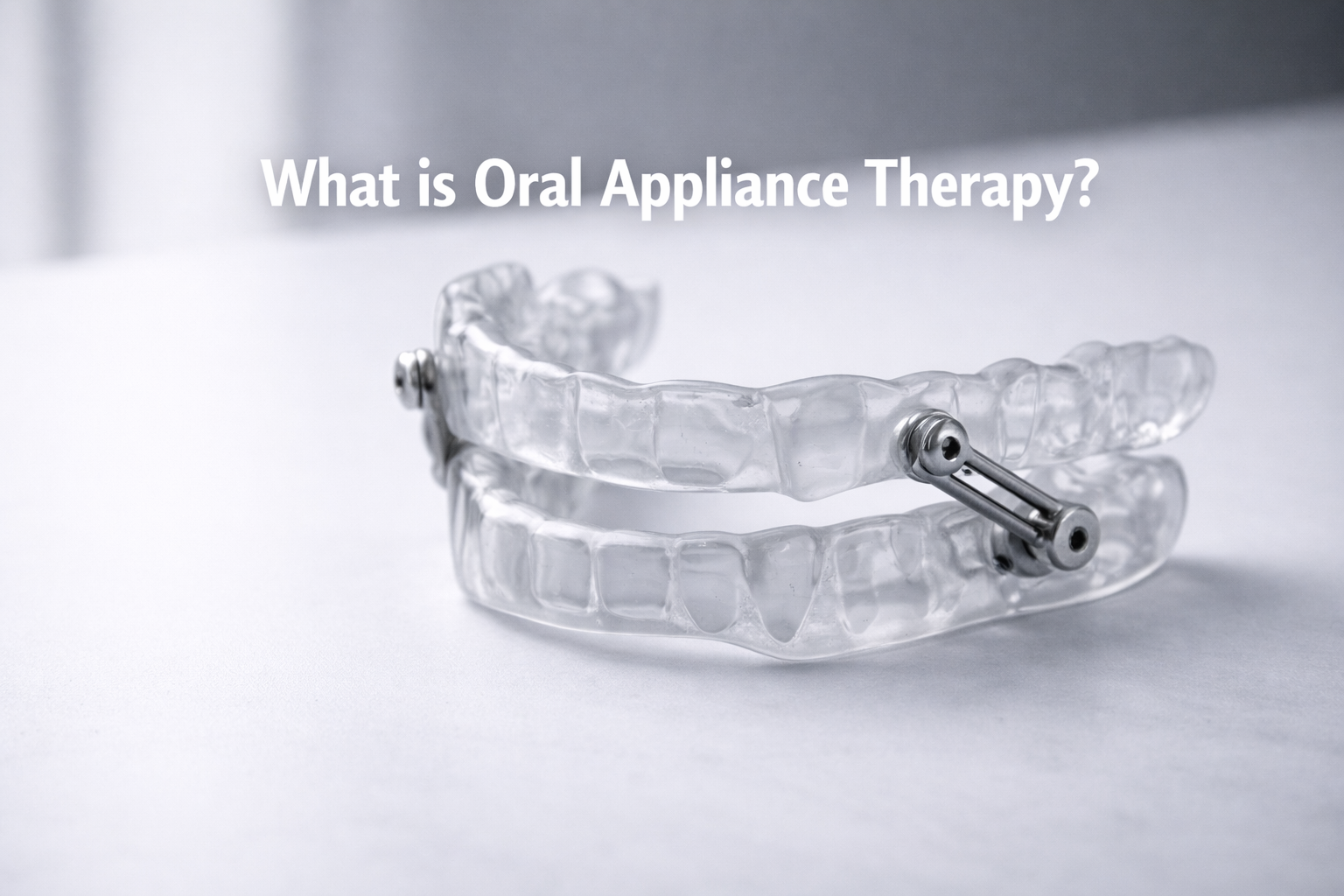
What is Oral Appliance Therapy?
Oral Appliance Therapy uses custom-fabricated, titratable mandibular advancement devices (MADs) worn only during sleep. These precision appliances gently reposition the lower jaw (and tongue) forward to prevent the soft palate, tongue, and pharyngeal tissues from collapsing into the airway.
This article has been written by Keith Thornton, DDS
Unlike fixed or boil-and-bite devices, true medical-grade OAT appliances are:
- Fully custom-made from digital scans or impressions
- Adjustable in millimeter increments for optimal titration
- Medicare-approved (when they meet strict criteria)
The result? Maintained airway patency, reduced apneas/hypopneas, stabilized oxygen levels, and dramatically quieter sleep — all without masks, hoses, or electricity.
History of TAP® — Born from Clinical Need and Validated by the U.S. Army
I invented the Thornton Adjustable Positioner (TAP) in the early 1990s when sleep apnea treatment was still in its infancy. This breakthrough was a simple, patient-adjustable hook mechanism that connects upper and lower trays, giving dentists and patients precise control over mandibular advancement.

SLIIIP’s board-certified sleep physicians can do sleep evaluations for sleep apnea. Virtual consultations in all 50 states. Home sleep tests shipped to your door.
I was introduced to Sleep Related Breathing Disorders (SRBD) in 1992 by an ENT surgeon who was a primary referral source for TMD. He had determined that surgery was not a good option for treatment of CPAP failures and had heard about a tongue retaining device. Without warning he referred to what was to be my first SRDB patient.
She had a BMI of 51, AHI of 85, mean O2 saturation of 87%, and a low nadir of 48%.
Comorbidities included congestive heart failure, uncontrolled hypertension, gerd, diabetes, atrial fibrillation among others. She was non adherent with CPAP at a pressure of 18. Her sleep physician told her that since she had “failed CPAP” and was not a surgical candidate, her option was to go to “this dentist who might have a solution”. She received the only device available, a TRD, within a week. She died two weeks later in her sleep of cardiac arrest. I learned several lessons from this:
- CPAP failures are common, even among the most severe patients treated by expert specialists.
- Dentists have the education and skills to treat this problem but need better tools.
- The problem is a mechanical collapse of the pharynx which can be treated by the same principals used in CPR and anesthesia by “airway management”.
This led me on my quest to develop devices that would manage all levels of SRBD from mild snoring to severe obstructive sleep apnea syndrome and to have credible evidence published in the medical literature.
The TAP’s credibility skyrocketed with the largest oral appliance study ever conducted at the time: the U.S. Army / Walter Reed Army Medical Center study (Holley et al., 2011) involving 497 OSA patients across all severity levels. Results were striking:
- Mean AHI dropped from 30 to 8.4
- 70.3% of mild, 47.6% of moderate, and 41.4% of severe patients achieved AHI <5
- In mild-to-moderate cases, TAP outcomes were statistically equivalent to CPAP
This military-grade validation helped establish TAP as the most trusted oral appliance therapy in dental sleep medicine.
CHECK YOUR SLEEP SYMPTOMS: TAKE THE 2 MINUTE QUIZ
TAKE THE QUIZ
Clinically Proven – 50+ Peer-Reviewed Studies
TAP appliances are the most independently researched MADs in existence — over 50 peer-reviewed studies conducted by investigators with no financial ties to the device.
Some recent data comes from Dr. David C. Upton’s 2025 retrospective study (published with co-authors Nanda & Robertson):
- 86 CPAP-intolerant adults with moderate-to-severe OSA
- 72% achieved major clinical improvement (≥50% AHI reduction OR reduction to mild levels <15 events/hour)
- Excellent long-term tolerability and high patient satisfaction
Combined with the Army study and dozens of others, the evidence is unequivocal: when properly titrated by a qualified sleep dentist, TAP delivers success rates of 60–84% in mild-to-moderate OSA and meaningful improvement even in severe cases — with real-world adherence often exceeding 80–90%.
HCPCS E0486 — Medicare Credibility and Long-Term Durability
TAP custom appliances qualify for HCPCS code E0486 — the only code Medicare recognizes for custom-fabricated, adjustable mandibular advancement devices used to treat OSA.

To earn E0486 status, the device must:
- Be truly custom-made for the individual patient
- Be adjustable by the patient or dentist in small increments
- Include fitting and adjustment as part of the benefit
This Medicare designation gives you and your patients confidence that TAP is not “just a dental splint” — it is recognized durable medical equipment with proven medical necessity. Most commercial payers follow suit.
Real-world durability: Properly maintained custom TAP appliances routinely last 3–5 years or longer
Watch: Sleep Apnea – What is Oral Appliance Therapy?
The TAP Mouth Shield — To Promote Nasal Breathing
One feature that sets every TAP appliance apart is the patented Mouth Shield (standard on myTAP, nylon flexTAP and flexTAP models)
This soft silicone shield attaches to the advancement hardware and sits comfortably inside the lips. It:
- Gently discourages mouth breathing
- Promotes exclusive nasal breathing
- Dramatically reduces dry mouth and excess saliva
- Improves overall treatment outcomes and comfort
Several studies have validated the use of TAP + Mouth Shield and proven the following:
- Significant reduction in mouth-breathing percentage and snoring, and improved periodontal parameters with no negative impact on gum health in periodontitis patients who snore
- Outperformed APAP in slashing premature atrial contractions by 62%, boosting cardiac conduction, and enhancing vascular function in patients with AFib.2
Led to cognitive improvements (MoCA scores) in 71% of MCI participants and 50% of those with AD, plus snoring reduction in older adults with snoring—including those with mild cognitive impairment (MCI) and Alzheimer’s disease (AD).3

SLIIIP’s board-certified sleep physicians can do sleep evaluations for sleep apnea. Virtual consultations in all 50 states. Home sleep tests shipped to your door.
No other major oral appliance family includes nasal-breathing support as a standard, built-in component.
Bottom line: TAP oral appliance therapy is a clinically proven and effective treatment for obstructive sleep apnea (OSA).
Visit www.tapintosleep.com to learn more.
Citations:
1 Lin, J.-Y.; Schneiderman, E.; Hui, J.; Parra Carrasquer, C.; Stenberg, W.; German, Z.; Harvey, J.A.; Schramm, P. Effects of Oral Appliance Therapy with a Mouth Shield in Periodontitis Patients Who Snore: A Split-Mouth Randomized Controlled Trial. Dent. J. 2025, 13, 292. https://doi.org/10.3390/dj13070292
2 Schramm P, Schneiderman E, Hui J, German Z and Lin JY (2025) Case Report: Combination oral appliance therapy acute influence on cardiac electrophysiology and hemodynamics in OSA patient with paroxysmal atrial fibrillation. Front. Sleep 4:1580381. doi: 10.3389/frsle.2025.1580381
3 Schramm, P.; Das, N.; Schneiderman, E.; German, Z.; Hui, J.; Wilson, D.; Spence, J.S.; Moura, P.; Chapman, S.B. Snoring Remediation with Oral Appliance Therapy Potentially Reverses Cognitive Impairment: An Intervention Controlled Pilot Study. Geriatrics 2021, 6, 107. https://doi.org/10.3390/geriatrics6040107
About the Author: Keith Thornton, DDS
Keith Thornton, DDS is a third-generation dentist who practiced restorative dentistry for 40 years in Dallas. His practice is limited to the treatment of airway and breathing disorders. He is a member of nine different dental and medical organizations and has had numerous leadership positions. He has been a member of the American Academy of Dental Sleep Medicine since 1993 and was an original Diplomate of the American Board of Dental Sleep Medicine. He has been a visiting faculty member at A&M College of Dentistry, and a consultant to the Army, Air Force and the VA. He has developed several medical devices that treat snoring and obstructive sleep apnea and has over 70 issued patents. He is the founder, co-owner, and chief technology officer for Airway Management, Inc.
SLIIIP’s board-certified sleep physicians can do sleep evaluations for sleep apnea. Virtual consultations in all 50 states. Home sleep tests shipped to your door.
Latest posts
-
Why Are My Naps Never Refreshing?
Last updated: October 2, 2026. Medically reviewed by Dr. Avinesh Bhar, Board-Certified Sleep Physician, SLIIIP.com. Naps that leave you groggy usually come down to how long you sleep, when you…
-
Is Sleeping Too Much a Sleep Disorder?
Last updated: October 2, 2026. Medically reviewed by Dr. Avinesh Bhar, Board-Certified Sleep Physician, SLIIIP.com. Sleeping too much is not always a sleep disorder, but it can be a sign…
-
Why Does My Insomnia Get Worse After Stopping Sleep Medication?
Last updated: October 2, 2026. Medically reviewed by Dr. Avinesh Bhar, Board-Certified Sleep Physician, SLIIIP.com. Insomnia can get worse after stopping sleep medication for three main reasons. They are rebound…
Get updates
Spam-free subscription, we guarantee. This is just a friendly ping when new content is out.

