👉 Register for Free. How to Diagnose Sleep Apnea Faster in Primary Care – FREE Webinar by Dr. Audrey Wells. – Friday, April 24 at 12 PM ET

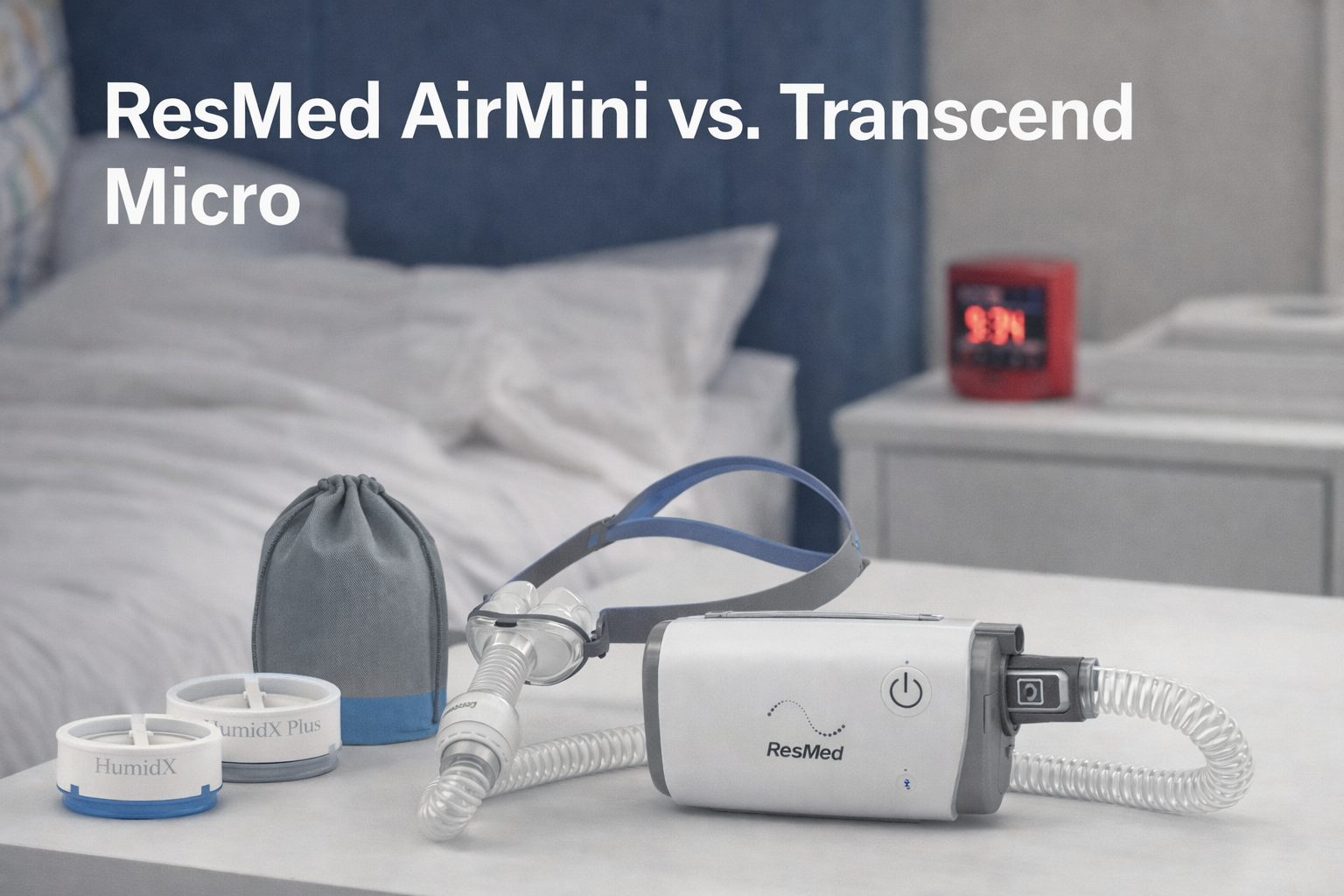
ResMed AirMini vs. Transcend Micro: Which Travel CPAP Wins?
Choosing between the ResMed AirMini and the Transcend Micro comes down to three things: the mask you already own, how aggressively you travel, and whether app-based sleep tracking matters to you. Both deliver medical-grade APAP therapy in a pocket-sized device. The right one depends on your specific setup.
Medically reviewed by Dr. Avinesh Bhar, Board Certified Sleep Physician at Sliiip.com
Traveling with sleep apnea used to mean hauling a full-size machine, a humidifier, distilled water, and a power adapter. That era is over.
Travel CPAPs have closed the gap on home-unit performance. The ResMed AirMini and Transcend Micro are the two most capable options on the market. But they are built around different priorities, and picking the wrong one will frustrate you within the first trip.
SLIIIP’s board-certified sleep physicians can do sleep evaluations for sleep apnea. Virtual consultations in all 50 states. Home sleep tests shipped to your door.
This guide breaks down every meaningful difference between them.
Sleep apnea affects an estimated 936 million adults worldwide, yet adherence to CPAP therapy drops significantly during travel. The right travel CPAP eliminates the barriers that cause patients to skip therapy away from home.
Myth vs. Reality: Travel CPAPs
Myth: Travel CPAPs are just scaled-down versions of home machines that sacrifice performance.
Reality: Both the AirMini and Transcend Micro deliver full APAP therapy with auto-adjusting pressure, integrated humidification, and real-time data logging. For the majority of patients, clinical outcomes during travel are indistinguishable from those using full-size home devices.
Quick Comparison: AirMini vs. Transcend Micro
Feature | ResMed AirMini | Transcend Micro |
Weight | 10.6 oz (0.66 lbs) | 7.7 oz (0.48 lbs) |
Noise Level | ~30 dBA | 27 dBA (with muffler) |
Mask Compatibility | Select ResMed masks only | Any standard CPAP mask |
Humidification | HumidX (waterless) | AirMist HME (universal) |
Drying Mode | None | 30-minute auto-dry cycle |
App | ResMed AirMini App | Transcend/myAir |
FAA Approved | Yes | Yes |
Already on CPAP? Get Your Prescription Through Sliiip First
A travel CPAP requires a valid CPAP prescription. If you are not yet evaluated or need a prescription update, Sliiip board-certified physicians can complete this via telemedicine in one appointment.
No referral required. Available in 43 states. Major insurance, Medicare, and Tricare accepted.

SLIIIP’s board-certified sleep physicians can do sleep evaluations for sleep apnea. Virtual consultations in all 50 states. Home sleep tests shipped to your door.
Portability: How Small Is Small Enough?
The Transcend Micro is currently the world’s smallest and lightest travel CPAP. At 7.7 ounces, it fits in the palm of your hand. For backpackers, frequent flyers with strict carry-on limits, or anyone who counts every ounce, the Transcend Micro has a clear physical advantage.
The ResMed AirMini is slightly larger, roughly the size of a smartphone with a case. It still fits in a jacket pocket. The weight difference between the two is less than three ounces. For most travelers, that distinction is irrelevant. For ultralight packers, it matters.
Both are FAA-approved for in-flight use.
Mask Compatibility: The Decision That May Already Be Made For You
This is the most consequential difference between these two machines.
The ResMed AirMini is designed to work within the ResMed ecosystem. It natively supports a short list of ResMed masks, primarily the AirFit P10, AirFit N20, and AirTouch N20. If you use any other mask, you need a third-party adapter. That adapter typically disables the waterless HumidX humidification feature.
The Transcend Micro accepts any standard CPAP mask with no adapter required. If you have a mask you have dialed in over months of use, the Transcend Micro lets you keep it.
The practical rule: if you are a committed ResMed mask user, the AirMini is the cleaner option. If you use any other brand, the Transcend Micro is the more rational choice.
Learn more: Best CPAP Mask Guide
Noise: Real-World Difference or Marketing?
Both devices are louder than home CPAPs because they sacrifice sound-dampening space for compactness. The measured gap between them is real but modest.
The Transcend Micro ships with a WhisperSoft Muffler that brings measured noise down to 27 dBA. That is genuinely quiet. The ResMed AirMini runs at approximately 30 dBA without a muffler. Three decibels of difference is audible but unlikely to be disruptive in a hotel room.
Both machines produce consistent, steady white noise rather than irregular or variable sound. Most patients adapt within one or two nights. If you sleep in shared lodging or with a light-sleeping partner, the Transcend Micro with its muffler attached is the quieter option by a measurable margin.
Humidification: Waterless Solutions, Different Constraints
Distilled water is not available everywhere. Both machines solve this with a Heat Moisture Exchanger system that recycles the moisture from your own exhaled breath.
The ResMed AirMini uses the HumidX, a small filter-like component that sits inside the mask connection. It is effective and well-integrated. The constraint is that it only functions with compatible ResMed masks. If you use an adapter to attach a non-compatible mask, the HumidX stops working.
The Transcend Micro uses the AirMist HME, which is universally compatible and attaches at the standard mask connection point. No mask restrictions.
Both systems are a reasonable trade-off compared to carrying water. Patients in very dry climates occasionally report that HME humidification feels less effective than a heated humidifier. This is a known limitation of both systems.
Learn more: Cotton Mouth on CPAP
The Transcend Micro’s 30-Minute Drying Mode
This feature has no equivalent on the AirMini. At the press of a button, the Transcend Micro circulates filtered air through the tube and mask for 30 minutes after a session. The result is a drier internal circuit with reduced opportunity for bacteria and mold growth.
For patients who travel frequently, camp, or use their machine in humid environments, this is a clinically relevant hygiene benefit. It reduces the reliance on CPAP cleaning equipment.
Learn more: CPAP Cleaning Machine Guide
App and Data Tracking
The ResMed AirMini app is widely recognized as one of the cleaner sleep data interfaces available for a travel CPAP. It displays AHI scores, leak rates, and pressure data in an accessible format. If sleep data monitoring is part of your regular routine, the AirMini has a slight edge here.
The Transcend Micro records data on-device and syncs via its companion app. The interface is functional, though generally considered less polished than ResMed’s offering.
Learn more: What Is a Good AHI Score on CPAP
Expert Perspective
Q: How do I know which travel CPAP is right for my therapy needs?
Dr. Avinesh Bhar, Board Certified Sleep Physician at Sliiip.com, responds:
The first question I ask patients is: what mask are you using now and how well are you tolerating it? If someone has spent months dialing in comfort with a non-ResMed mask, switching to a ResMed mask just to use the AirMini is usually not worth it. Conversely, if a patient is already in the ResMed ecosystem, the AirMini is the smoother experience. Travel CPAP adherence depends on removing friction, not adding it.
Watch: Sleep Apnea, Explained
Who Should Choose the ResMed AirMini?
The AirMini is the right choice if you already own and prefer a compatible ResMed mask, want the most recognized brand name in sleep therapy, or prioritize the cleaner app experience for data tracking.
The transition from a home ResMed device to the AirMini is nearly seamless. The therapy algorithm is familiar, the data syncs to the same ecosystem, and setup takes minutes.
Learn more: ResMed AirMini Travel CPAP Review
Who Should Choose the Transcend Micro?
The Transcend Micro is the right choice if you use a non-ResMed mask and do not want to change it, travel with minimal luggage and every ounce matters, want the quieter machine with the muffler included, or need the built-in drying cycle for hygiene in challenging conditions.
It is also the more straightforward choice for patients who travel internationally and want universal accessory compatibility.
Learn more: Transcend Micro CPAP Review
A Word on Insurance and Travel CPAPs
Most insurance plans classify travel CPAPs as convenience items and do not cover them. This is a separate category from your primary CPAP prescription. However, your primary CPAP, supplied and managed through a telemedicine platform like Sliiip, typically is covered under major insurance including Medicare and Tricare.
If you are not yet on CPAP therapy, or if your current prescription is outdated, a Sliiip physician consultation is the starting point.
Learn more: Does Insurance Cover CPAP Machines | How Much Are CPAP Machines
Lifestyle Tips for Traveling With CPAP
Establish a travel routine before your first trip. Pack your machine, mask, tubing, and power adapter in a dedicated pouch so nothing is left behind.
Use a power voltage adapter when traveling internationally. Both devices accept a range of voltages, but confirm compatibility for your specific destination before departure.
Carry your CPAP machine as a carry-on bag item, not checked luggage. TSA recognizes CPAP devices as medical equipment. You will be asked to remove it from the bag at security.
Do not use tap water with an HME humidifier system. Both the HumidX and AirMist systems work without any water. The HME system is the reason you do not need to source distilled water in unfamiliar places.
Schedule a follow-up with your sleep physician after extended travel periods if your symptoms return. Adherence issues during travel sometimes reveal a need for pressure adjustment.
Learn more: Travel CPAP Guide | Best Portable CPAP Machines
Start Your CPAP Journey With a Board-Certified Sleep Physician
Whether you are newly diagnosed or looking to optimize existing therapy, Sliiip physicians manage CPAP care entirely through telemedicine. More than 10,000 consultations completed. No referral required.

Your travel CPAP performs only as well as your prescription is optimized. Talk to a specialist first.
SLIIIP’s board-certified sleep physicians can do sleep evaluations for sleep apnea. Virtual consultations in all 50 states. Home sleep tests shipped to your door.
Frequently Asked Questions
What is the main difference between the ResMed AirMini and the Transcend Micro?
The primary difference is mask compatibility. The ResMed AirMini works natively only with select ResMed masks and its integrated HumidX humidification is tied to that compatibility. The Transcend Micro accepts any standard CPAP mask with no adapter required and uses a universal HME humidification system. Both deliver equivalent APAP therapy performance during travel.
Is the ResMed AirMini or Transcend Micro quieter?
The Transcend Micro, when used with its included WhisperSoft Muffler, measures approximately 27 dBA. The ResMed AirMini measures approximately 30 dBA without a muffler. The three-decibel difference is audible but unlikely to be disruptive for most users. Both machines produce a consistent, steady sound rather than variable noise.
Do travel CPAPs require a prescription?
Yes. Both the ResMed AirMini and the Transcend Micro are Class II medical devices that require a valid CPAP prescription for purchase. If you do not have a current prescription, a telemedicine consultation with a board-certified sleep physician is the first step.
Can I use my existing CPAP mask with the ResMed AirMini?
Only if your mask is on the AirMini compatibility list, which includes select ResMed models such as the AirFit P10, N20, and AirTouch N20. If you use a different mask, a third-party adapter is required, and this typically disables the integrated HumidX humidification feature.
Which travel CPAP is better for international travel?
Both accept a wide input voltage range that covers most international destinations. The Transcend Micro has a slight edge for international travel because its universal mask compatibility and AirMist HME system work with accessories sourced anywhere in the world. Neither requires distilled water, which is the primary practical challenge for international CPAP users.
What is the HumidX system on the ResMed AirMini?
The HumidX is a waterless humidification component that sits inside the mask connection and recaptures moisture from exhaled breath. It eliminates the need to source distilled water while traveling. It only functions with compatible ResMed masks. If a third-party adapter is used, the HumidX is bypassed and humidification is not available.
Does the Transcend Micro really have a drying mode?
Yes. The Transcend Micro includes a 30-minute drying cycle that circulates filtered air through the tubing and mask after a therapy session. This reduces internal moisture, which inhibits bacterial and mold growth. This feature has no equivalent on the ResMed AirMini and is particularly useful for patients who travel to humid climates or use their machine while camping.
How do travel CPAPs compare to full-size home machines?
For the majority of patients, travel CPAPs deliver equivalent therapeutic outcomes. Both the AirMini and Transcend Micro auto-adjust pressure in real time, record therapy data, and provide humidification. The trade-offs are slightly higher noise levels and less robust humidification compared to heated water-based home units. Neither trade-off significantly affects clinical outcomes for most patients.
Will insurance cover a travel CPAP?
In most cases, no. Travel CPAPs are classified as convenience items by the majority of insurance plans and are not covered. Your primary home CPAP, however, is typically covered under major insurance, Medicare, and Tricare when prescribed through a licensed physician. A telemedicine consultation with Sliiip can confirm your coverage and provide a valid prescription.
How do I know if my CPAP pressure settings are optimized for travel?
If you notice increased fatigue, more frequent awakenings, or a return of symptoms during travel, your pressure settings may need adjustment. Both machines support APAP mode, which auto-adjusts within a prescribed range. A Sliiip telemedicine appointment can review your data and recalibrate your pressure range based on recent therapy performance.
Can I use either travel CPAP on an airplane?
Yes. Both the ResMed AirMini and the Transcend Micro are FAA-approved for in-flight use. They should be carried on rather than checked. TSA treats CPAP machines as medical devices and will ask you to remove the machine from your bag for separate screening.
Which travel CPAP has the better app?
The ResMed AirMini app is generally considered more polished and user-friendly for reviewing therapy data including AHI, leak rate, and pressure curves. The Transcend Micro companion app is functional but typically rated lower for interface quality. If regular sleep data review is important to your therapy management, the AirMini has a marginal advantage.
SLIIIP’s board-certified sleep physicians can do sleep evaluations for sleep apnea. Virtual consultations in all 50 states. Home sleep tests shipped to your door.
Latest posts
-
Why Are My Naps Never Refreshing?
Last updated: October 2, 2026. Medically reviewed by Dr. Avinesh Bhar, Board-Certified Sleep Physician, SLIIIP.com. Naps that leave you groggy usually come down to how long you sleep, when you…
-
Is Sleeping Too Much a Sleep Disorder?
Last updated: October 2, 2026. Medically reviewed by Dr. Avinesh Bhar, Board-Certified Sleep Physician, SLIIIP.com. Sleeping too much is not always a sleep disorder, but it can be a sign…
-
Why Does My Insomnia Get Worse After Stopping Sleep Medication?
Last updated: October 2, 2026. Medically reviewed by Dr. Avinesh Bhar, Board-Certified Sleep Physician, SLIIIP.com. Insomnia can get worse after stopping sleep medication for three main reasons. They are rebound…
Get updates
Spam-free subscription, we guarantee. This is just a friendly ping when new content is out.

