👉 Register for Free. How to Diagnose Sleep Apnea Faster in Primary Care – FREE Webinar by Dr. Audrey Wells. – Friday, April 24 at 12 PM ET


Sleep Restriction Therapy
Sleep restriction therapy sounds counterintuitive at first, since the plan involves spending less time in bed to fix poor sleep, and Dr. Avinesh Bhar, Board-Certified Sleep Physician at SLIIIP.com, often spends the first visit explaining why this method works when nothing else has.
Sleep restriction therapy is one of the most powerful tools inside Cognitive Behavioral Therapy for Insomnia, also known as CBT-I.
SLIIIP’s board-certified sleep physicians can do sleep evaluations for sleep apnea. Virtual consultations in all 50 states. Home sleep tests shipped to your door.
What Sleep Restriction Therapy Is
Sleep restriction therapy is a structured plan that limits the time you spend in bed to match the time you actually sleep. The goal is to rebuild your natural sleep drive and tighten the bond between bed and sleep. It is not about cutting your total sleep need. It is about cutting wasted time lying awake.
Sleep restriction therapy was developed in the 1980s and is now a core piece of CBT-I. Sleep medicine groups around the world list CBT-I as the first line option for chronic insomnia, ahead of sleeping pills. You can read more about how the full method works in our guide on cognitive behavior therapy CBT-I for sleep disorders.
CHECK YOUR SLEEP SYMPTOMS: TAKE THE 2 MINUTE QUIZ
TAKE THE QUIZ
Why Sleep Restriction Therapy Works
To understand why this method works, you need to know two things about sleep. Your body has a sleep drive that builds the longer you stay awake. Your brain also builds an association between your bed and what you do there.
When you have insomnia, two problems show up. Your sleep drive gets weak because you spend too much time in bed. And your brain links the bed with worry, frustration, and being awake. Sleep restriction therapy fixes both.
- It builds up sleep pressure by cutting time in bed.
- It restores the bed and sleep connection because you only get into bed when you are truly sleepy.
- It teaches your body a consistent rhythm.
According to the Centers for Disease Control and Prevention, about one in three adults in the U.S. does not get enough sleep on a regular basis. For many of these people, the issue is not the bed or the bedroom. The issue is timing and behavior.
If you want to read about how CBT-I compares to medication, see is CBT-I better than sleep meds and CBT-I vs sleep medications.
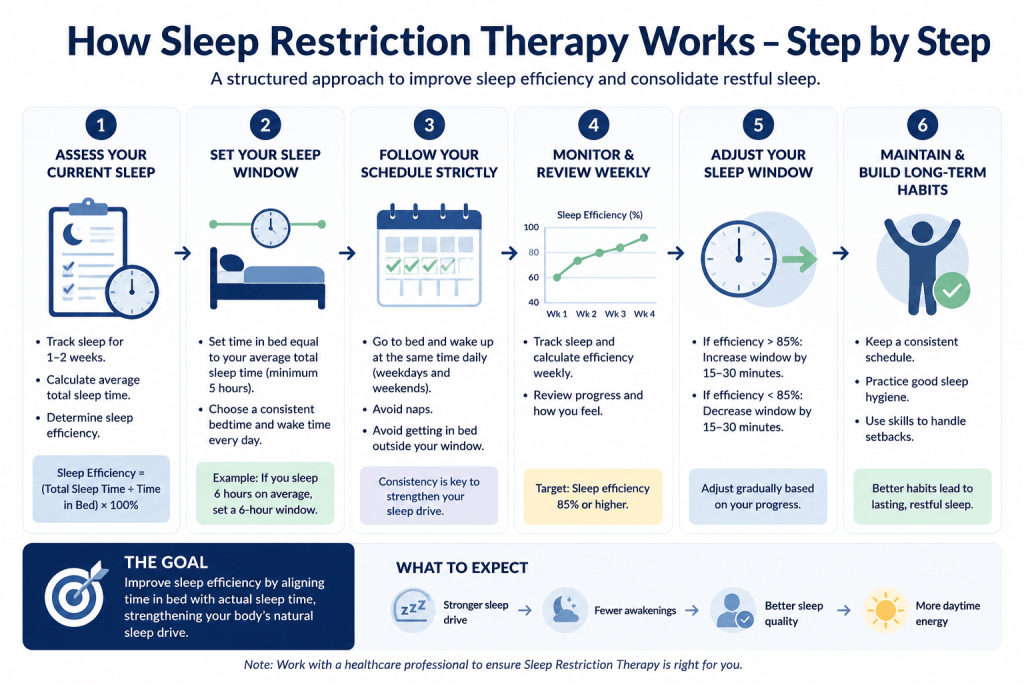
How Sleep Restriction Therapy Works Step by Step
Here is the basic process most clinicians use. Always do this under guidance from a sleep professional, especially if you drive, work with heavy machines, or have other health issues.
Step 1. Track Your Sleep for One Week
Keep a simple sleep diary. Write down:
- The time you got into bed
- The time you fell asleep
- Any wake ups during the night
- The time you woke up for good
- The time you got out of bed
This gives you your average total sleep time and your sleep efficiency.
Step 2. Calculate Your Sleep Window
Your new time in bed is set to match your average actual sleep time, with a minimum of around five and a half hours. If you sleep five hours on average, your sleep window starts at five and a half hours.
Step 3. Set a Fixed Wake Time
Pick a wake time you can hold seven days a week. Count backward to set your bedtime. If your wake time is 6 a.m. and your window is six hours, your bedtime is midnight.
Step 4. Hold the Window for One Week
Get into bed only at your set bedtime. Get out at your set wake time. No naps. No going to bed early because you feel tired.
Step 5. Adjust Weekly
If your sleep efficiency, the time asleep divided by time in bed, is 85 percent or higher, add 15 to 30 minutes to your window. If it is below 80 percent, cut your window further or hold it steady.
Step 6. Continue Until You Reach Your Target Sleep
Most people land between seven and eight hours of solid sleep within four to eight weeks.
What Sleep Restriction Therapy Feels Like Week by Week
This is the part most patients want to know about. Honesty matters here. Sleep restriction therapy will likely make you more tired in the first two weeks. That is the cost of building sleep pressure. It is short and it has a clear payoff.
- Week 1. You feel tired during the day. Falling asleep at night gets faster.
- Week 2. Sleep starts to feel deeper. Night wake ups may still happen.
- Week 3. Your sleep drive is strong. Most people sleep through the night more often.
- Week 4 to 6. You start adding time back to your window. Sleep stays solid.
- Week 7 to 8. Many people reach their target sleep with little time awake in bed.
For a closer look at the journey, read what CBT-I feels like week by week.
Who Should Try Sleep Restriction Therapy
Sleep restriction therapy works best for people with chronic insomnia. That means three or more nights of poor sleep each week for three or more months. It also works for people who:
- Lie awake for 30 minutes or more before falling asleep
- Wake up several times at night
- Wake up early and cannot fall back asleep
- Spend extra time in bed hoping to catch up
- Have tried sleep hygiene tips with no real change
See do I have insomnia or something else if you are not sure where you fit.
Who Should Not Start Sleep Restriction Therapy Alone
This is not a method for everyone, and not a method to start without medical guidance. Talk to a clinician first if you have:
- Bipolar disorder, since sleep loss can trigger episodes
- A history of seizures
- Untreated sleep apnea
- Severe depression with safety concerns
- A job that requires driving or operating machines
- Pregnancy or early postpartum
- A history of parasomnias like sleepwalking
If snoring, gasping, or choking is part of your nights, rule out sleep apnea first. A home sleep apnea test can give you a real answer from your own bed.
Common Mistakes That Slow Progress
Even strong plans can stall when small habits get in the way. Watch for these.
- Sneaking in naps. Even short naps drain the sleep pressure your plan is trying to build.
- Going to bed early on a tired day. This is the most common slip. Hold the window.
- Quitting in week two. This is when fatigue peaks. The payoff is just past this point.
- Skipping the sleep diary. Without daily logs, your plan cannot be adjusted well.
- Mixing in sleeping pills without telling your clinician. This hides your real progress.
- Using your phone in bed when awake. This rebuilds the wrong link with the bed.
If your mind races at night, pair this method with our guides on how do I stop overthinking at night and can’t shut brain off at night.
Sleep Restriction Therapy vs Other Approaches
People often ask how this method stacks up against other sleep tools.
- Sleep hygiene tips. Helpful for mild cases. Not strong enough for chronic insomnia.
- Sleeping pills. Fast but short term. Often lose power and may cause rebound insomnia. See why CBT-I works when medications don’t.
- Melatonin. Useful for some circadian issues. Not a fix for chronic insomnia.
- Meditation and breathing. Strong support tools, especially with sleep restriction.
- Full CBT-I program. The gold standard. Sleep restriction therapy is one of its core pieces.
For a wider view of options, see insomnia treatment methods and how to fix insomnia naturally.
Tips to Get Through the Hard Weeks
The middle of the plan is the hardest part. These habits help most people push through.
- Plan light, calm days. Save big decisions and heavy tasks for later weeks.
- Get morning light. Step outside in the first hour after waking.
- Move your body. Light exercise during the day boosts sleep pressure.
- Eat dinner early. Late meals make sleep restriction harder.
- Avoid alcohol. Even one drink can wreck the data of the week.
- Have a wind down routine. A short, simple, screen free routine helps.
- Be honest with your clinician. Small slips matter and need to be tracked.
Watch: SLIIIP – Specialist Sleep Care from the Comfort of Anywhere
How SLIIIP.com Supports Sleep Restriction Therapy
SLIIIP.com is a sleep telehealth platform built for people who cannot or do not want to visit an in person clinic. Our team offers:
- Virtual consultations in all 50 states
- Home sleep tests shipped to your door
- Nationwide coverage with board certified sleep physicians
- Insurance verification for many major plans
- Digital therapeutics for chronic insomnia
This setup lets you start a sleep restriction therapy plan from home. You meet your doctor by video. If a sleep test is needed to rule out apnea first, the device ships to you. Learn more in how it works, our insomnia treatment page, and our digital therapeutics program.
According to the National Heart, Lung, and Blood Institute, chronic insomnia is best supported with behavior based care first, with medication used only when needed. Sleep restriction therapy fits squarely inside that guidance.
At Sliiip, we accept the following insurances:

SLIIIP’s board-certified sleep physicians can do sleep evaluations for sleep apnea. Virtual consultations in all 50 states. Home sleep tests shipped to your door.
Frequently Asked Questions
What is sleep restriction therapy?
It is a CBT-I technique that limits time in bed to match real sleep, then expands the window as sleep improves.
Is sleep restriction therapy safe?
For most healthy adults, yes, when done with a clinician. Some groups need extra care first.
How long does sleep restriction therapy take to work?
Most people see real change in three to five weeks. Full results often land by week six to eight.
Will I be tired during sleep restriction therapy?
Yes, especially in the first two weeks. This is part of how the method works.
Can I drive while doing sleep restriction therapy?
Use caution. Talk to your clinician about how to manage daytime tiredness.
What is sleep efficiency?
Time asleep divided by time in bed. The goal is 85 percent or higher.
How short can my sleep window be?
Most plans set a floor of about five and a half hours to protect safety.
Can I nap during sleep restriction therapy?
No. Naps drain the sleep pressure the plan is trying to build.
Do I keep the same wake time on weekends?
Yes. A fixed wake time, seven days a week, is key to the method.
What if I wake up in the middle of the night?
Stay calm. If you are awake more than 20 minutes, get out of bed. See how to stop waking up multiple times at night.
Does sleep restriction therapy help with menopause sleep issues?
Yes, often. See menopause sleep problems natural remedies and hormonal insomnia.
Can I keep my sleep meds while doing this?
This depends on your doctor. Most plans aim to taper slowly.
Will sleep restriction therapy work for shift workers?
A clinician can adjust the plan to your shift pattern.
Can teens or older adults try this?
Yes, with clinical guidance. Older adults often start with a wider window.
What if I have sleep apnea too?
Apnea should be treated first or in tandem. See signs of sleep apnea.
Is this the same as just going to bed later?
No. Sleep restriction therapy uses data, a fixed wake time, and weekly changes.
Will I ever sleep eight hours again?
Many people do. The window grows back as sleep improves.
Can racing thoughts stop this from working?
The cognitive part of CBT-I helps with this. See why do I overthink before bed.
Does insurance cover sleep restriction therapy?
Many plans cover CBT-I when ordered by a sleep doctor. You can verify your benefits today.
How do I start a plan today?
You can book a virtual visit with SLIIIP.com from any state in the U.S.
Start Sleep Restriction Therapy the Right Way
A short, structured plan can shift your nights in just a few weeks. Dr. Avinesh Bhar and the SLIIIP.com team can guide you through sleep restriction therapy, rule out other sleep issues first, and build a plan that fits your life.
SLIIIP’s board-certified sleep physicians can do sleep evaluations for sleep apnea. Virtual consultations in all 50 states. Home sleep tests shipped to your door.
Latest posts
-
Why Do I Feel Drunk or Confused When I Wake Up?
Last updated: October 2, 2026. Medically reviewed by Dr. Avinesh Bhar, Board-Certified Sleep Physician, SLIIIP.com. If you often feel drunk when you wake up, you may have sleep drunkenness. It…
-
Why Do I Sleep Through Multiple Alarms?
Last updated: October 2, 2026. Medically reviewed by Dr. Avinesh Bhar, Board-Certified Sleep Physician, SLIIIP.com. Most people who sleep through alarms are either deep in slow-wave sleep, short on sleep,…
-
Why Can’t I Wake Up Even After Getting Enough Sleep?
Last updated: October 2, 2026. Medically reviewed by Dr. Avinesh Bhar, Board-Certified Sleep Physician, SLIIIP.com. If you can’t wake up after enough sleep, the cause is usually not the number…
Get updates
Spam-free subscription, we guarantee. This is just a friendly ping when new content is out.

