👉 Register for Free. How to Diagnose Sleep Apnea Faster in Primary Care – FREE Webinar by Dr. Audrey Wells. – Friday, April 24 at 12 PM ET


Sleep Apnea Weight Loss Plateau: When the Scale Stops Moving
A sleep apnea weight loss plateau is a pattern worth investigating rather than pushing through, says Dr. Avinesh Bhar, Board-Certified Sleep Physician at SLIIIP.com, particularly when the effort has stayed consistent and the results have not.
The frustration is specific. You are doing the things that worked before, tracking honestly, keeping up with activity, and the number has not moved in weeks. Untreated sleep disordered breathing is associated in research with changes to appetite signaling, glucose handling, and daytime energy, all of which sit upstream of the scale.
SLIIIP’s board-certified sleep physicians can do sleep evaluations for sleep apnea. Virtual consultations in all 50 states. Home sleep tests shipped to your door.
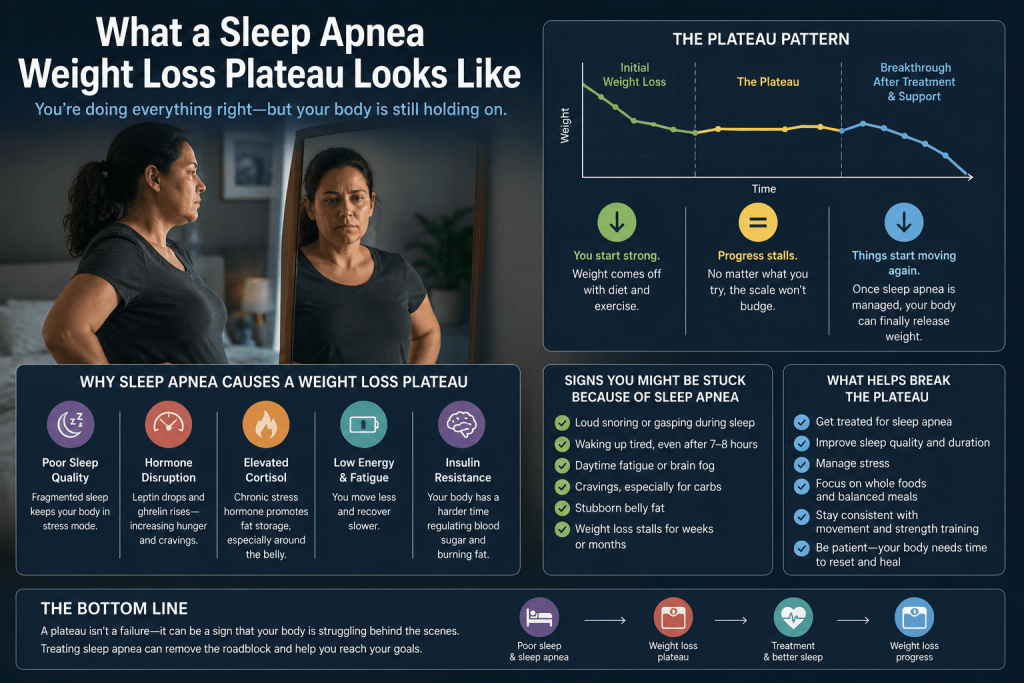
What a Sleep Apnea Weight Loss Plateau Looks Like
Plateaus are normal. Most people hit one, and the usual explanations apply first: a lower body weight requires fewer calories, tracking drifts over time, activity quietly decreases, water retention masks progress, and muscle gain offsets fat loss on the scale.
Rule those out before looking further. The pattern that raises a different question is a plateau paired with unrefreshing sleep, not a plateau on its own.
A sleep apnea weight loss plateau tends to come bundled with other signals. Loud snoring. Waking up tired after seven or eight hours in bed. Afternoon sleepiness that no amount of coffee fixes. Waking with a dry mouth, a headache, or a racing heart. Nighttime trips to the bathroom. A partner who has mentioned pauses in your breathing.
If none of those are present, sleep is probably not the missing variable. If several are, it is worth checking.
CHECK YOUR SLEEP SYMPTOMS: TAKE THE 2 MINUTE QUIZ
TAKE THE QUIZ
How Disrupted Sleep Is Associated With Appetite
Research consistently links short and fragmented sleep with changes in the hormones that regulate hunger and fullness.
Studies have observed higher levels of ghrelin, which signals hunger, and lower levels of leptin, which signals satiety, after periods of restricted sleep. The practical effect people describe is straightforward: hungrier during the day, less satisfied after meals, and a stronger pull toward calorie dense food in the evening.
Sleep fragmentation matters here, not just total hours. Someone with untreated sleep apnea can spend eight hours in bed while the sleep itself is repeatedly interrupted by breathing events, many of which never reach conscious awareness.
Research has also associated poor sleep with reduced insulin sensitivity, meaning the body handles glucose less efficiently. Our overview of sleep and obesity covers this relationship in more detail.
These are associations documented across multiple studies, not a claim that sleep alone determines body weight.
The Energy Side of the Equation
The other half is what happens to movement.
Fatigue reduces non exercise activity, the incidental movement that makes up a meaningful share of daily energy expenditure. People who are exhausted take fewer steps, stand less, fidget less, and drive instead of walking. None of it feels like a decision.
Structured exercise suffers too. Sessions get skipped, intensity drops, and recovery takes longer. The workout that felt manageable in January feels punishing when sleep quality has degraded.
If persistent tiredness is part of your picture, our article on why you wake up tired covers the range of contributors worth considering.
Why This Becomes a Loop
The relationship runs in both directions, which is what makes it hard to break from one side alone.
Excess weight, particularly around the neck and upper airway, is a recognized risk factor for obstructive sleep apnea. At the same time, untreated sleep apnea is associated with the metabolic and behavioral changes described above. Each side reinforces the other.
We cover both directions separately. Our article on whether being overweight causes sleep apnea looks at the risk factor side, and whether losing weight reduces sleep apnea looks at what happens when weight changes. The piece on whether sleep apnea causes weight gain addresses the opposite direction.
The reason this matters for a sleep apnea weight loss plateau is simple. If one side of the loop is untreated, effort applied only to the other side may produce less than it should.
What Treatment Does and Does Not Do
This deserves a careful answer, because the internet oversells it.
Treating sleep apnea is not a weight loss intervention. Research on positive airway pressure therapy and body weight has produced mixed results, and some analyses have found modest weight gain rather than loss after starting treatment. Nobody should begin sleep apnea treatment expecting the scale to drop as a result.
What treatment is associated with is improved sleep quality, reduced daytime sleepiness, and better daytime functioning. For some people, those changes make consistent activity and eating patterns easier to sustain. That is an indirect and individual effect, not a guaranteed one.
The honest framing is this: addressing untreated sleep apnea removes a potential obstacle. It does not do the work.
GLP-1 Medications and Sleep
Many people asking about a plateau are now doing so while taking a GLP-1 medication.
Weight changes on these medications can alter airway anatomy over time, and some people find their sleep changes as a result. This is a conversation to have with the clinician who prescribed the medication and, if you have a diagnosis, with your sleep physician. Do not adjust prescribed medication or prescribed device settings on your own. Our article on GLP-1s and sleep covers what is currently understood.
If you already use CPAP or an oral appliance and your weight has changed substantially in either direction, your prescribed settings may need review by your clinician. That is a reason to schedule an appointment, not a reason to change anything yourself.
Other Explanations That Belong With Your Primary Care Clinician
Sleep is one candidate among several, and it is not the most common one.
Thyroid function, polycystic ovary syndrome, insulin resistance, perimenopause, certain antidepressants and antipsychotics, corticosteroids, and some blood pressure medications can all affect weight regulation. Chronic stress and depression are relevant too.
These belong with your primary care clinician or the appropriate specialist, and a sleep evaluation does not replace that conversation. The CDC publishes general guidance on adult sleep, and the National Heart, Lung, and Blood Institute maintains plain language material on what raises risk for sleep apnea.
If you are working with a registered dietitian or a weight management clinician, tell them what your sleep looks like. It is a variable they can factor in.
What an Evaluation Involves
The process is less involved than most people expect.
A sleep physician reviews your history, symptoms, and risk factors during a consultation. If testing is indicated, a home sleep test is often the appropriate first step. The equipment ships to your address, you wear it for a night or two in your own bed, and you return it. A physician interprets the results.
When Dr. Bhar Recommends Getting Checked
Dr. Avinesh Bhar notes that a plateau alone is rarely a reason to test for sleep apnea. The combination is what matters.
Testing is reasonable when a stalled result sits alongside loud snoring, witnessed breathing pauses, waking unrefreshed after adequate time in bed, persistent daytime sleepiness, morning headaches, or waking with a dry mouth. Risk factors add weight to that picture, including a larger neck circumference, high blood pressure that is difficult to control, type 2 diabetes, and a family history of sleep apnea.
A sleep evaluation is one part of a broader clinical workup rather than a standalone explanation for a plateau. If mood, disordered eating patterns, or a history of restrictive dieting are part of your situation, those belong with the appropriate clinician first, and a sleep evaluation should not delay that care.
Our article on struggling with weight loss and sleep issues covers the practical side of this relationship.
Watch: Will losing weight cure my sleep apnea?
Practical Next Steps
Start by writing down what your sleep actually looks like for two weeks. Bedtime, wake time, how many times you remember waking, how you feel in the first hour, and whether anyone has commented on your snoring.
Bring that record to a clinician rather than a search engine. It turns a suspected sleep apnea weight loss plateau into something a physician can work with, and it often clarifies the picture before any testing happens.
Then keep the two questions separate. Whether you have sleep apnea and whether your plateau will resolve are different questions, and answering the first honestly is worth doing regardless of what happens to the second.
At Sliiip, we accept the following insurances:

SLIIIP’s board-certified sleep physicians can do sleep evaluations for sleep apnea. Virtual consultations in all 50 states. Home sleep tests shipped to your door.
Frequently Asked Questions
Can sleep apnea stop me from losing weight?
Untreated sleep disordered breathing is associated in research with appetite and metabolic changes and with reduced daytime energy. It is one possible contributing factor rather than a confirmed cause of any individual plateau.
How would I know if sleep is the issue?
Look for a plateau alongside snoring, unrefreshing sleep, morning headaches, dry mouth, or persistent daytime sleepiness. A plateau by itself points elsewhere first.
Does treating sleep apnea cause weight loss?
No. Research on this has been mixed, and some analyses found modest weight gain after starting therapy. Treatment addresses sleep, not body weight.
Why am I hungrier when I sleep badly?
Studies have observed higher hunger signaling and lower fullness signaling after restricted sleep, which many people experience as increased appetite and reduced satisfaction after meals.
Can I have sleep apnea at a normal weight?
Yes. Weight is one risk factor among several. Airway anatomy, jaw structure, nasal obstruction, age, and family history all contribute.
Does snoring alone mean I have sleep apnea?
No. Many people snore without it. Snoring combined with witnessed breathing pauses or daytime sleepiness is a stronger signal.
Could my plateau just be normal?
Very likely. Plateaus are common and usually explained by reduced energy needs at a lower weight, tracking drift, water retention, or muscle gain.
Should I get tested before changing my diet?
Those are separate decisions. Testing answers a health question. Nutrition changes belong with your primary care clinician or a registered dietitian.
Does sleep apnea affect blood sugar?
Research has associated it with reduced insulin sensitivity. Discuss glucose concerns with your primary care clinician.
What does a home sleep test measure?
It typically records breathing, oxygen levels, heart rate, and effort during sleep. A physician interprets the results.
Do I need an overnight lab study?
Not always. Home testing is often appropriate for suspected obstructive sleep apnea. Your physician determines which is suitable.
Will insurance cover an evaluation?
Many plans do. Benefits can be verified before scheduling so you know your coverage in advance.
I use CPAP and I still cannot lose weight. Why?
Therapy addresses breathing during sleep, not weight regulation. Other factors may be involved, and your primary care clinician can help investigate them.
Should I adjust my CPAP settings if my weight changed?
No. Prescribed settings should only be changed by your clinician. Significant weight change in either direction is a reason to schedule a review.
Does sleep apnea affect exercise performance?
Fatigue and reduced recovery are commonly reported. Some people notice workouts feel harder than their fitness level would suggest.
Can a GLP-1 medication change my sleep?
Weight changes can alter airway anatomy over time. Discuss this with the prescribing clinician and your sleep physician if you have a diagnosis.
What else could be causing my plateau?
Thyroid conditions, PCOS, insulin resistance, perimenopause, and several common medications can all play a role. These belong with your primary care clinician.
How long should a plateau last before I look into it?
Several weeks of no change despite consistent effort is a reasonable point to raise it with a clinician, particularly if sleep symptoms are present.
Does napping help?
A short early afternoon nap can offset some sleep debt. It does not address untreated breathing problems during sleep.
When should I see a sleep physician?
When unrefreshing sleep, snoring, witnessed breathing pauses, or persistent daytime sleepiness are present alongside your other concerns.
SLIIIP’s board-certified sleep physicians can do sleep evaluations for sleep apnea. Virtual consultations in all 50 states. Home sleep tests shipped to your door.
Latest posts
-
Why Can’t I Wake Up Even After Getting Enough Sleep?
Last updated: October 2, 2026. Medically reviewed by Dr. Avinesh Bhar, Board-Certified Sleep Physician, SLIIIP.com. If you can’t wake up after enough sleep, the cause is usually not the number…
-
Why Does My Heart Rate Drop So Low While I Sleep?
Last updated: October 2, 2026. Medically reviewed by Dr. Avinesh Bhar, Board-Certified Sleep Physician, SLIIIP.com. Your heart rate drops low while sleeping mainly because your body needs less work from…
-
Why Are My Naps Never Refreshing?
Last updated: October 2, 2026. Medically reviewed by Dr. Avinesh Bhar, Board-Certified Sleep Physician, SLIIIP.com. Naps that leave you groggy usually come down to how long you sleep, when you…
Get updates
Spam-free subscription, we guarantee. This is just a friendly ping when new content is out.

