👉 Register for Free. How to Diagnose Sleep Apnea Faster in Primary Care – FREE Webinar by Dr. Audrey Wells. – Friday, April 24 at 12 PM ET

The 6 Hour Rule: What the Research Actually Says About Caffeine Cutoff Times
The 6 hour rule is frequently questioned. According to Dr. Avinesh Bhar, Board-Certified Sleep Physician at SLIIIP.com, many individuals experience symptoms without clear awareness. You may have heard that you should stop drinking coffee 6 hours before bed, but most people have no idea where that number comes from or whether it actually fits their body. SLIIIP.com offers virtual consultations in all 50 states with nationwide coverage, plus home sleep tests shipped to your door, so you can connect the dots between caffeine timing, sleep quality, and everyday fatigue without ever leaving home.
SLIIIP.com was built to make that answer easy to find, with virtual consultations in all 50 states, home sleep tests shipped to your door, and nationwide coverage.
SLIIIP’s board-certified sleep physicians can do sleep evaluations for sleep apnea. Virtual consultations in all 50 states. Home sleep tests shipped to your door.
Where the 6 Hour Rule Comes From
The 6 hour rule did not appear out of thin air. It comes from a 2013 sleep study published in the Journal of Clinical Sleep Medicine. Researchers gave healthy adults 400 mg of caffeine, roughly the amount in two strong cups of coffee, at three different times: right at bedtime, 3 hours before bedtime, and 6 hours before bedtime. Even the dose taken a full 6 hours before bed cut total sleep by more than 1 hour.
That single result reshaped a lot of sleep advice. For years the working idea was that caffeine left your system within a few hours, so an early dinner cup was harmless. The 2013 study showed the opposite. Six hours was not a safety zone. It was still enough to steal sleep from people who felt completely unaffected.
For more on this kind of sneaky sleep loss, see why am I waking up tired even after 8 hours.
CHECK YOUR SLEEP SYMPTOMS: TAKE THE 2 MINUTE QUIZ
TAKE THE QUIZ
What the Rule Says Today
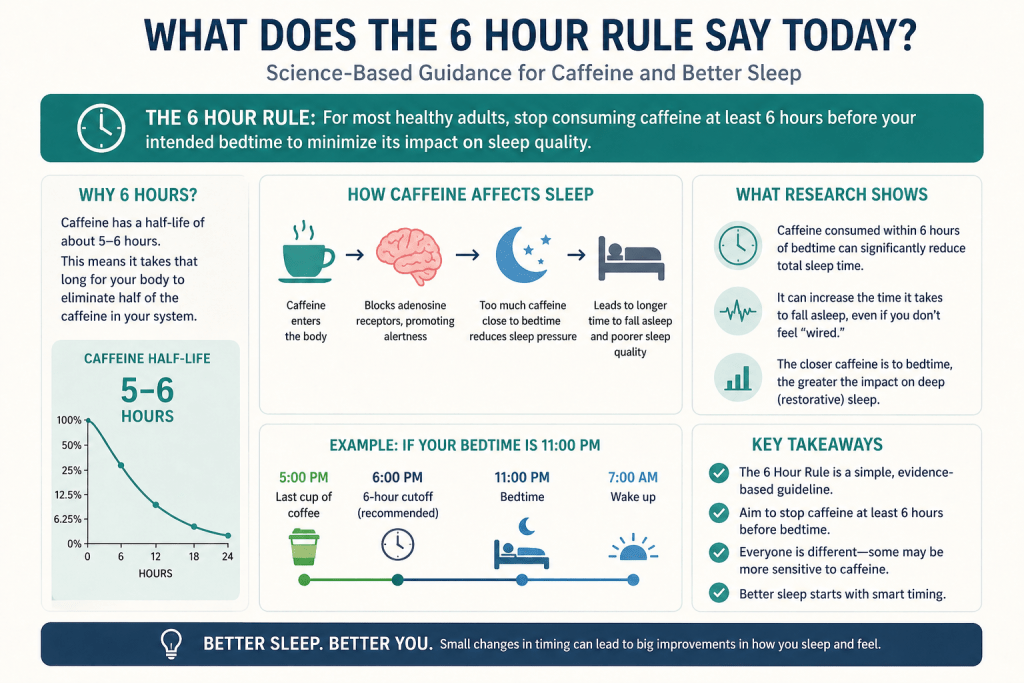
In simple terms, the rule states that you should stop all caffeine at least 6 hours before bedtime to protect sleep quality. For an 11 p.m. bedtime, that puts your last cup at 5 p.m. or earlier.
The cutoff is built around the fact that caffeine has a half life of about 5 hours in healthy adults. Six hours after a 200 mg cup, you still have around 90 to 100 mg active in your bloodstream. The 6 hour mark is the rough crossover where, on average, the dose has dropped low enough that most healthy sleepers can still get through a normal night.
It is a guideline, not a guarantee. The research suggests it works for many people, but biology, age, and habits change everything.
Why 6 Hours Is Not Enough for Everyone
The cutoff is an average. For roughly half of adults, 6 hours is not enough of a buffer. Slow metabolizers, older adults, pregnant individuals, people on certain medications, and anyone with a fragile sleep pattern often need 8 to 10 hours of clearance.
Common reasons 6 hours falls short:
- Slow CYP1A2 enzyme activity. A genetic variant that breaks caffeine down at half speed.
- Age over 50. Liver enzymes and sleep itself become more sensitive.
- Pregnancy. Half life can stretch to 10 hours or more.
- Birth control pills. Often double the time caffeine stays active.
- Anxiety or hormonal shifts. Lower the threshold for noticing stimulants.
- Existing insomnia. Even small doses can keep the brain in a wired state.
If you tried the 6 hour cutoff and still toss and turn, your body may simply need a longer runway. For more on hard to crack sleep issues, see our insomnia treatment methods guide.
What 6 Hours Looks Like in Real Life
Putting the cutoff into practice is easier when you map it to your real schedule. Use the chart below as a starting point and adjust based on how you sleep:
- Bedtime 9 p.m. Caffeine cutoff at 3 p.m.
- Bedtime 10 p.m. Caffeine cutoff at 4 p.m.
- Bedtime 11 p.m. Caffeine cutoff at 5 p.m.
- Bedtime at midnight. Caffeine cutoff at 6 p.m.
- Bedtime 1 a.m. Caffeine cutoff at 7 p.m.
Be honest about when you actually fall asleep, not when you climb into bed. If you regularly take 30 minutes to fall asleep, plan your cutoff against your true sleep onset time, not lights out.
For tips on settling down faster at night, see our piece on how I fall asleep fast.
What the Research Actually Says About Sleep Quality
This is where many people get tripped up. The 2013 study did not just measure how long people slept. It measured the structure and feel of that sleep. The 6 hour caffeine group:
- Took longer to fall asleep
- Spent more time awake during the night
- Had less deep, restorative sleep
- Reported normal sleep when asked, despite the data
That last point is the most important. People felt fine, but their brains had not gotten a full night. Sleep is one of the few areas where you cannot trust the way you feel as a sole sign of quality. This is why subjective comfort with late caffeine is not proof that it is safe for your rest.
To learn more about this stage of sleep, read how do I get more deep sleep?
How This Cutoff Compares to Other Advice
You may have seen different cutoff numbers. Here is how the most common ones stack up:
- The 12 hour rule. A strict version that puts the last cup near noon. Best for very sensitive sleepers, slow metabolizers, and people with active insomnia.
- The 10 hour rule. A safer middle ground for older adults, pregnant individuals, and anyone on medications that slow caffeine breakdown.
- The 8 hour rule. A practical compromise that protects deep sleep for most adults.
- The 6 hour cutoff. The research backed minimum. Works for many healthy adults with strong sleep but leaves a thin margin.
- The “as long as I feel fine” approach. Often the cause of hidden sleep loss, since people underestimate caffeine effects.
If you sleep well on the 6 hour cutoff, you have likely won the genetic lottery on caffeine clearance. If you do not, it is not a willpower issue. It is a biology issue.
Why the 6 Hour Rule Still Matters Even on Good Days
Some people argue the rule is overkill. They sleep through the night with an evening espresso and feel fine the next morning. The catch is that “fine” is not the same as fully rested. Late caffeine quietly trims deep sleep over weeks and months. The effects show up as:
- Slower thinking by mid afternoon
- Lower mood, especially in the evening
- More irritability with no clear cause
- A growing reliance on coffee just to feel normal
- Poor recovery from workouts or stress
Dr. Avinesh Bhar often points out that people only realize how much late caffeine was costing them after they switch to a stricter cutoff. The 6 hour rule is the floor, not the ceiling, for healthy sleep.
When Strict Cutoffs Are Not Enough
For some people, even a 12 hour cutoff does not solve the sleep problem. That is a sign that something other than caffeine is at play. Sleep apnea, chronic insomnia, restless legs, hormonal shifts, and anxiety can all create persistent fatigue that no timing rule can fix. Caffeine cutoffs help, but they cannot replace a real evaluation when sleep keeps breaking down.
Warning signs that point to a deeper issue include:
- Loud snoring or gasping at night
- Waking up with headaches, dry mouth, or a racing heart
- Feeling exhausted no matter how long you sleep
- Falling asleep during meetings, while reading, or in traffic
- Anxiety or racing thoughts every night
If any of these sound familiar, our guide on is it worth getting tested for sleep apnea is a good next step.
How to Find Your Personal Caffeine Cutoff
This guideline is a starting point, not a personal answer. To dial in your real cutoff, try this simple two week test:
- Set a fixed bedtime. Pick a target you can stick with for 14 nights.
- Start at 6 hours. No caffeine within 6 hours of bedtime for 4 to 5 nights.
- Track sleep quality. Note how long it takes to fall asleep, how often you wake, and how you feel in the morning.
- Move the cutoff. If sleep is still poor, push to 8 hours, then 10, then 12 if needed.
- Find the line. Settle on the earliest cutoff where your sleep feels solid for several nights in a row.
This kind of self check turns a vague rule into a habit that fits your body. For more on building steady routines, see our ultimate sleep routine guide for 2025.
Watch: Sliiip – How We Work for You
When to Talk to a Sleep Specialist
If your sleep stays shaky even with strict caffeine timing, it is worth getting professional input. Persistent fatigue, snoring, night waking, and morning headaches are not normal parts of life. A board-certified sleep physician can help you find the real cause and a real fix.
SLIIIP.com makes this easier through virtual consultations in all 50 states, board-certified sleep physicians, and home sleep tests shipped to your door. There are no waiting rooms and no long drives.
According to the National Heart, Lung, and Blood Institute, poor sleep affects nearly every system in the body, from heart health to memory and mood. Protecting your nights is one of the simplest ways to support overall wellness.
At Sliiip, we accept the following insurances:

SLIIIP’s board-certified sleep physicians can do sleep evaluations for sleep apnea. Virtual consultations in all 50 states. Home sleep tests shipped to your door.
Frequently Asked Questions
- What is the 6 hour rule for caffeine?
It is the guideline that says you should stop all caffeine at least 6 hours before bedtime to protect sleep quality.
- Where did the rule come from?
It comes from a 2013 sleep study where caffeine taken 6 hours before bed still cut sleep by more than 1 hour in healthy adults.
3. Is 6 hours enough for everyone?
No. Many people, including older adults, pregnant individuals, and slow metabolizers, need 8 to 12 hours of clearance for solid sleep.
- What time should I stop coffee with an 11 p.m. bedtime?
Under this guideline, your last caffeine should be at 5 p.m. or earlier. Many people sleep better with a 1 to 3 p.m. cutoff.
- Does the rule apply to tea and soda?
Yes. The cutoff covers all caffeine sources, including coffee, tea, soda, energy drinks, pre workout, and chocolate.
- Does decaf coffee count?
Decaf has small amounts of caffeine, usually 2 to 15 mg per cup. For most people the effect is minor, but very sensitive sleepers may notice it.
- Why do I sleep “fine” with late coffee but still feel tired?
Late caffeine often shrinks deep sleep without waking you up. You stay asleep, but the rest is shallow. For more, see Why do I wake up tired?
- What if I work late shifts?
Apply the cutoff to your real bedtime, not the calendar. If you sleep at 8 a.m., your cutoff would be 2 a.m.
- Will quitting late caffeine help my insomnia?
It often helps, especially when paired with a steady sleep schedule. Our insomnia treatment methods guide goes deeper.
- Is one cup of coffee at noon really safe?
For many adults, yes. For slow metabolizers or older adults, even noon coffee can shorten deep sleep. The 14 day self test in this article can tell you which group you are in.
- Does the cutoff apply to children and teens?
Children and teens are more sensitive and have less margin. Most pediatric experts suggest stricter limits and very early cutoffs.
- Do I need to count chocolate?
Yes, especially dark chocolate. A late dessert can add 25 to 70 mg of caffeine, which on top of other sources is enough to matter.
- What if I drink coffee for migraines?
Some migraine medications use caffeine on purpose. If you need a late dose, ask your doctor about timing and try to stick to mornings on non flare days.
- Does drinking water help clear caffeine faster?
Not really. Water supports overall hydration but does not change how fast your liver breaks caffeine down.
- Can a hot shower or exercise speed clearance?
No. Caffeine clearance depends mostly on liver enzymes and your personal genetics, not on activity or showers.
- Is this guideline the same as the half life of caffeine?
They are related but not the same. Half life is biology. The cutoff is a practical guideline based on that biology.
- Will I lose energy if I stop caffeine late?
You may feel tired for a few days, then most people gain steady energy from deeper sleep.
- Can naps replace late afternoon coffee?
A short, early nap can boost alertness without the same sleep cost. See our benefits of napping guide.
- Does the rule apply on weekends?
Yes. Late weekend coffee can shift your sleep schedule and make Monday harder. Our piece on how do I fix my sleep schedule covers this.
- When should I see a sleep doctor?
If sleep stays poor even with strict caffeine timing, or you notice signs of a sleep disorder, a board-certified sleep physician can help you find the cause.
Better Sleep Starts With Smarter Timing
The 6 hour rule is one of the simplest sleep upgrades you can make. It costs nothing, takes no extra time, and uses solid research as its backbone. When you respect the cutoff and adjust it to your own biology, you give your brain a real chance to rest, repair, and recharge.
If poor sleep keeps showing up no matter what you do, do not assume it is just a habit problem.
SLIIIP’s board-certified sleep physicians can do sleep evaluations for sleep apnea. Virtual consultations in all 50 states. Home sleep tests shipped to your door.
Thank you for reading this article.
Latest posts
-
Why Are My Naps Never Refreshing?
Last updated: October 2, 2026. Medically reviewed by Dr. Avinesh Bhar, Board-Certified Sleep Physician, SLIIIP.com. Naps that leave you groggy usually come down to how long you sleep, when you…
-
Is Sleeping Too Much a Sleep Disorder?
Last updated: October 2, 2026. Medically reviewed by Dr. Avinesh Bhar, Board-Certified Sleep Physician, SLIIIP.com. Sleeping too much is not always a sleep disorder, but it can be a sign…
-
Why Does My Insomnia Get Worse After Stopping Sleep Medication?
Last updated: October 2, 2026. Medically reviewed by Dr. Avinesh Bhar, Board-Certified Sleep Physician, SLIIIP.com. Insomnia can get worse after stopping sleep medication for three main reasons. They are rebound…
Get updates
Spam-free subscription, we guarantee. This is just a friendly ping when new content is out.

