👉 Register for Free. How to Diagnose Sleep Apnea Faster in Primary Care – FREE Webinar by Dr. Audrey Wells. – Friday, April 24 at 12 PM ET


How Do I Fix My Sleep Schedule?
Your alarm goes off and you feel like you just fell asleep 20 minutes ago. Your sleep schedule is broken, and you have no idea how to fix it. This is the scenario that Dr. Avinesh Bhar sees every day in his practice and often his patients ask, “How do I fix my sleep schedule?”
This article explains how your body clock works, what causes it to get off track, and evidence-based strategies to get it back on schedule. It also covers a commonly missed connection: when a broken sleep schedule is actually a symptom of an undiagnosed sleep disorder.
How Your Body Clock Controls Sleep
Your circadian rhythm is a roughly 24-hour internal clock managed by the suprachiasmatic nucleus (SCN) in the hypothalamus. This master clock takes cues primarily from light exposure to regulate when you feel alert and when you feel sleepy. It controls the release of melatonin (the hormone that signals sleepiness), cortisol (the hormone that promotes wakefulness), and dozens of other processes throughout your body.
When this clock is properly aligned with your schedule, you feel naturally sleepy in the evening and alert in the morning. When it shifts out of alignment, whether from irregular habits, travel, shift work, or other factors, you end up fighting your own biology every time you try to sleep or wake up.

Common Causes of a Disrupted Sleep Schedule
1. Inconsistent Sleep and Wake Times
The most common cause of a broken sleep schedule is simple inconsistency. Staying up late on weekends and then trying to wake up early on Monday creates a condition researchers call social jet lag. Your body clock cannot adjust fast enough to handle large swings in sleep timing, and the result is the same foggy, miserable feeling you get from actual jet lag.
2. Screen Time and Late-Night Light Exposure
Blue light from phones, tablets, computers, and televisions suppresses melatonin production and signals your brain to stay alert. Using screens within one to two hours of bedtime is one of the most common reasons people cannot fall asleep at their intended bedtime, gradually pushing their sleep schedule later and later.
3. Shift Work
Rotating or night shift schedules force your body to be awake when your circadian rhythm expects sleep, and to sleep when your body expects wakefulness. Shift workers have significantly higher rates of insomnia, fatigue, gastrointestinal problems, cardiovascular disease, and mood disorders. The circadian disruption is the primary driver.
4. Jet Lag
Crossing time zones displaces your body clock from the local day-night cycle. The general rule is that it takes approximately one day per time zone crossed for your circadian rhythm to fully adjust. Eastward travel is typically harder to adjust to because it requires advancing your clock (going to sleep earlier), which the body resists more than delaying it.
5. Delayed Sleep-Wake Phase Disorder
This is a clinical circadian rhythm disorder in which your natural sleep window is significantly later than conventional times, often 2 AM or later. People with this condition sleep normally once they fall asleep, but they cannot fall asleep at a socially acceptable hour. It is most common in adolescents and young adults, and it is frequently misdiagnosed as insomnia.
6. Undiagnosed Sleep Disorders
Sleep apnea, restless legs syndrome, and other sleep disorders can make your sleep so fragmented and non-restorative that your entire sleep-wake cycle becomes dysregulated. If your body is not getting quality sleep regardless of how many hours you spend in bed, your circadian signals can weaken and your schedule drifts. Many people who believe they simply have a broken schedule actually have an undiagnosed condition that is preventing restorative sleep.
https://youtube.com/shorts/SWepqwQ0VzM (EMBED VIDEO IMAGE)
Often Overlooked: If you have tried standard advice for fixing your sleep schedule (consistent times, less caffeine, no screens) without improvement, an underlying sleep disorder may be the reason. Sleep apnea in particular can silently undermine every effort to maintain a stable sleep schedule by fragmenting sleep throughout the night.
“Sleep and mental health are tightly linked. When your schedule is off, mood and anxiety often worsen, and when those improve, sleep tends to follow. Addressing both together is key, and a consistent sleep routine is foundational for mental well-being.”
Stephen Morris, DO
Sports and Performance Psychiatrist
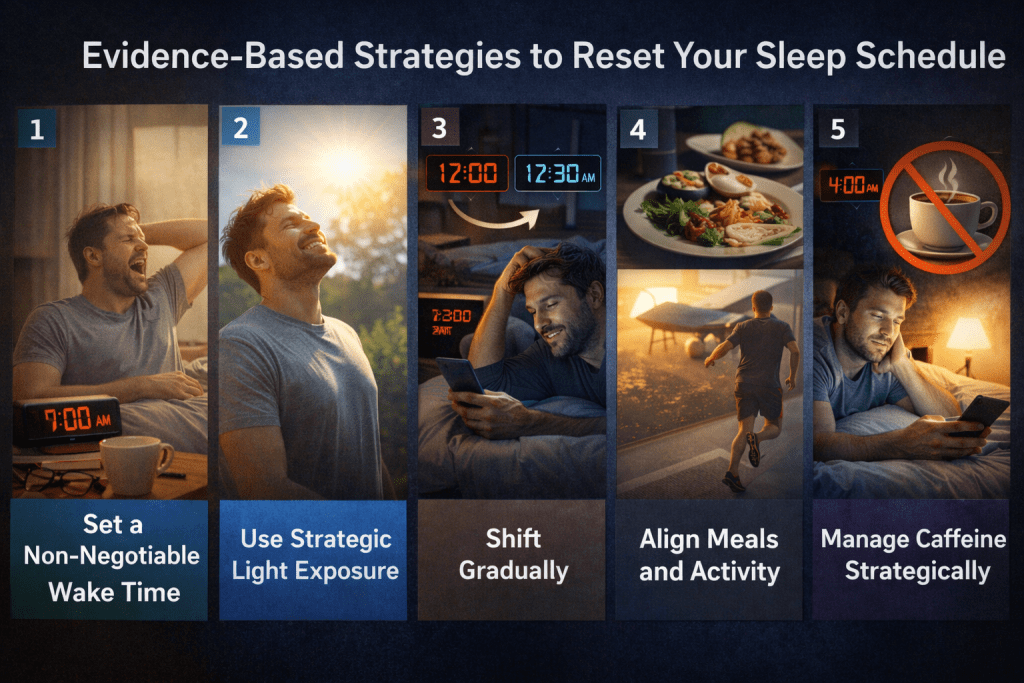
Evidence-Based Strategies to Reset Your Sleep Schedule
1. Set a Non-Negotiable Wake Time
Your wake time is the single most powerful tool for resetting your circadian rhythm. Choose a wake time that works for your schedule and stick with it every single day, including weekends. Your body will gradually adjust your sleep onset to align with this consistent wake signal. This is more important than setting a bedtime, because your wake time anchors the entire circadian cycle.
2. Use Strategic Light Exposure
Light is the most powerful cue for your circadian clock. Get bright light exposure within 30 minutes of waking, ideally 10 to 15 minutes of natural sunlight. This suppresses melatonin and signals your brain that the day has begun. In the evening, dim lights at least one to two hours before your target bedtime and avoid screens or use blue-light-filtering settings. If natural morning light is not available, a 10,000-lux light therapy box can serve as an effective substitute.
3. Shift Gradually
If your schedule is significantly off, do not try to fix it all at once. Adjust your sleep and wake times by 15 to 30 minutes every two to three days. This gives your circadian clock time to adjust without the misery of forcing a dramatic change overnight.
4. Align Meals and Activity With Your Target Schedule
Your circadian rhythm does not just respond to light. Meal timing and physical activity are secondary cues that help reinforce your body clock. Eat meals at consistent times aligned with your target schedule, exercise during the day (preferably in the morning or early afternoon), and avoid heavy meals within two to three hours of bedtime. For more tips on structuring your evenings, see our ultimate sleep routine guide.
5. Manage Caffeine Strategically
Caffeine has a half-life of 5 to 7 hours and blocks the adenosine receptors that promote sleepiness. Set a hard cutoff for caffeine consumption at least 8 hours before your target bedtime. For most people, this means no caffeine after noon or early afternoon.
6. Consider Short-Term Melatonin Use
A low dose of melatonin (0.5 to 3 mg) taken 1 to 2 hours before your target bedtime can help advance your circadian rhythm. Melatonin is most effective for jet lag and delayed sleep phase issues. It is not a long-term sleep aid and works best as part of a comprehensive schedule reset strategy. Consult your healthcare provider before use.
7. Rule Out Underlying Sleep Disorders
If your schedule refuses to stabilize despite consistent effort, a sleep evaluation is warranted. A board-certified sleep specialist can assess whether a condition like sleep apnea, restless legs syndrome, or a clinical circadian rhythm disorder is undermining your efforts. Telemedicine services like SLIIIP make it easy to consult a specialist and arrange a home sleep study without delays.
Self-Assessment: Is Your Schedule Problem More Than a Habit?
Consider a professional sleep evaluation if:
- You have tried consistent sleep-wake times for at least two weeks without improvement
- You snore, gasp, or have been told you stop breathing during sleep
- You feel unrefreshed in the morning regardless of how long you sleep
- You experience excessive daytime sleepiness that interferes with daily activities
- You have uncomfortable leg sensations at night that make it hard to stay still
- Your schedule was once normal but gradually shifted without a clear lifestyle explanation
“I think one of the most effective ways to reset your sleep schedule is to focus on consistency rather than perfection. This means trying your best to go to bed and wake up at the same time each day. This helps regulate your body’s internal clock. Limit daytime naps, get early morning light exposure, and reduce screen time before bed as these can all significantly improve sleep quality. It’s also important to be patient, as meaningful changes in sleep patterns often take several days to stabilize.”
Holly Schiff
Frequently Asked Questions
How long does it take to fix a broken sleep schedule?
Most people can reset their circadian rhythm within one to three weeks of consistent effort. The key is maintaining a fixed wake time every day, using strategic light exposure, and shifting gradually. If an underlying sleep disorder is present, fixing the schedule may require treating the disorder first.
Is it bad to sleep at different times every day?
Yes. Irregular sleep timing weakens your circadian signals, making it harder to fall asleep and wake up. Studies have linked irregular sleep schedules to increased risks of obesity, cardiovascular disease, depression, and impaired cognitive performance. Consistency is one of the most important factors in healthy sleep.
Can sleep apnea cause a messed up sleep schedule?
Absolutely. Sleep apnea fragments your sleep throughout the night, preventing deep restorative stages and causing your body to compensate with irregular sleep patterns. Many people with untreated sleep apnea find that their schedule stabilizes once treatment begins, whether with CPAP or oral appliance therapy.
Latest posts
-
What to Do If Your Home Sleep Test Fails or Comes Back Inconclusive
Last updated: September 2, 2026. Medically reviewed by Dr. Avinesh Bhar, Board-Certified Sleep Physician, SLIIIP.com. If your home sleep apnea test failed or came back inconclusive, the standard next step…
-
Home Sleep Apnea Test vs. Over-the-Counter Test Kits: What Is the Difference?
Last updated: September 2, 2026. Medically reviewed by Dr. Avinesh Bhar, Board-Certified Sleep Physician, SLIIIP.com. A home sleep apnea test and an over-the-counter test kit are not the same thing,…
-
How to Stop Checking Your Sleep Score Without Giving Up on Better Sleep
Last updated: September 2, 2026. Medically reviewed by Dr. Avinesh Bhar, Board-Certified Sleep Physician, SLIIIP.com. The way to stop obsessively checking your sleep score is to change when and how…
Get updates
Spam-free subscription, we guarantee. This is just a friendly ping when new content is out.

