👉 Register for Free. How to Diagnose Sleep Apnea Faster in Primary Care – FREE Webinar by Dr. Audrey Wells. – Friday, April 24 at 12 PM ET

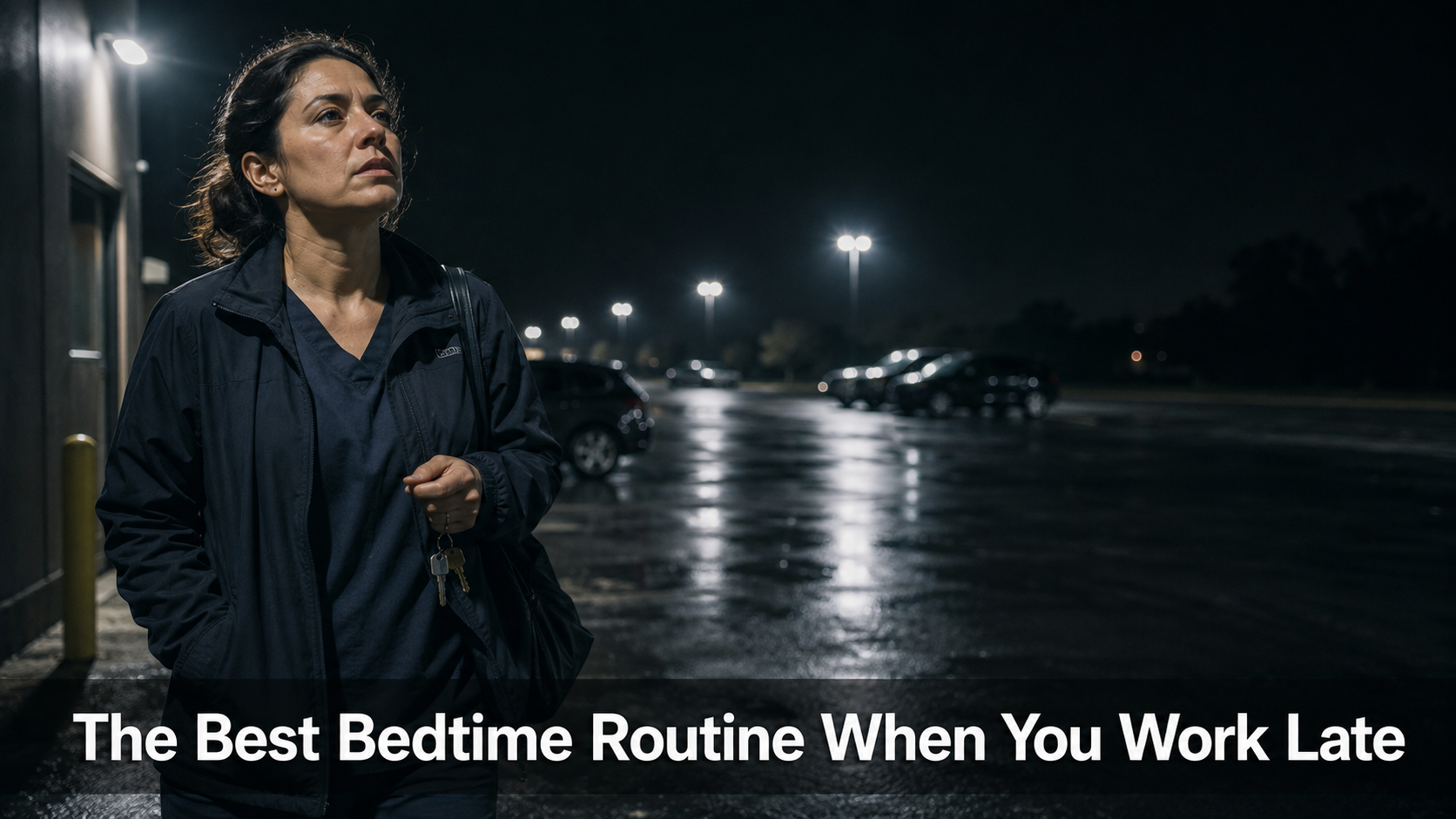
The Best Bedtime Routine When You Work Late Until 11 PM
Building a bedtime routine when you work late takes a different structure than the standard advice assumes, says Dr. Avinesh Bhar, Board-Certified Sleep Physician at SLIIIP.com, because most sleep guidance is written for people who stop working at five. If your shift ends at 11 PM, you have no buffer between the demands of the job and the moment you need to be asleep. That single gap explains most of the trouble late finishers have. This guide lays out a workable plan, working backward from your wake time.
SLIIIP’s board-certified sleep physicians can do sleep evaluations for sleep apnea. Virtual consultations in all 50 states. Home sleep tests shipped to your door.
Why Finishing at 11 PM Is Its Own Problem
Occupational health researchers treat the evening shift as a distinct challenge, separate from overnight work. The difficulty is not that the hours are strange. It is that there is no wind down period built into the day.
A day worker leaves at five and gets six hours of ordinary life before bed. Dinner, a walk, a show, a slow drift toward tired. You get none of that. You go from a state of alertness that the job requires straight to a dark bedroom, and your body has no reason to cooperate.
Alertness does not switch off. It decays, and decay takes time. Your heart rate stays elevated. Stress hormones stay circulating. If you go straight from the workplace to the pillow, you will typically lie there for an hour, which then makes the bed itself feel like a frustrating place.
The fix is not more willpower. It is building the buffer that your schedule failed to provide.
CHECK YOUR SLEEP SYMPTOMS: TAKE THE 2 MINUTE QUIZ
TAKE THE QUIZ
Start With Your Wake Time, Not Your Bedtime
Most people plan this backward. They pick a bedtime and hope the mornings sort themselves out. A bedtime routine when you work late has to be built from the alarm outward, not from the end of the shift forward.
Do the reverse. Decide what time you must be up, then count back seven to nine hours, then add roughly an hour of wind down on top. If you need to be awake at 8 AM, you are aiming to be asleep by midnight or 1 AM, which means your routine starts the moment your shift ends.
If that math does not work, something in the schedule has to give. Either the wake time moves later or the morning obligations get restructured. A routine cannot manufacture hours that are not in the day.
Consistency matters more than the exact numbers. Our guide on how to fix your sleep schedule covers the correction process if yours has drifted badly.

A Bedtime Routine When You Work Late: The 90 Minute Blueprint
Here is a workable shape. Adjust the clock times to your own shift.
11:00 PM, still at work. Start dimming your exposure. Turn down screen brightness. If your workplace is brightly lit, this is the moment to stop adding light to your day.
11:15 PM, the commute. Treat this as the first stage of the routine, not dead time. Keep the car interior dim. Music or a familiar podcast rather than news or anything that will spin you up. If you walk or take transit, sunglasses at night sound odd but genuinely help in a brightly lit city.
11:30 PM, arrival. Do not turn on the overhead lights. Use lamps. Change out of work clothes immediately, which is a small ritual that does more psychological work than people expect.
11:40 PM, decompress. Twenty minutes of something that is not productive. A warm shower is the most reliable option, because the drop in body temperature afterward supports sleep onset. Light stretching, a few pages of a book, or a quiet conversation all work.
12:00 AM, the offload. Write down anything unfinished from the shift. Tomorrow’s tasks, the thing you forgot to tell someone, the problem you are still chewing on. This is the step most people skip and the one that most reliably stops the 2 AM mental replay.
12:15 AM, bed. The bedroom is cool, dark, and quiet. Phone charging in another room.
The Centers for Disease Control and Prevention makes a similar point in its shift work training, recommending a relaxing routine before bedtime with light levels kept low for one to two hours beforehand.
Light Is the Lever That Actually Moves Things
Your internal clock is set mainly by light exposure. The National Heart, Lung, and Blood Institute describes how circadian clocks stay in sync with cues in the environment, and light is the loudest cue there is.
For a late finisher, this cuts both ways. Bright light after your shift tells your body that the day is continuing, which pushes your sleep even later. Dim light after 10 PM does the opposite.
The practical version is short, and it is the single highest yield part of any bedtime routine when you work late. Reduce light from the end of your shift onward. Then get real daylight within an hour of waking, even briefly, to hold your wake time steady. That morning light is what stops the whole schedule from sliding later week by week.
If your rhythm has already shifted well past where you want it, how to fix your circadian rhythm goes into the process in more depth.
Food, Caffeine, and the Drink After Work
Three specifics matter here.
Caffeine. It has a longer tail than most people assume, and the CDC training materials note that clearance is much slower in some individuals. If your shift ends at 11 PM, your last coffee should be early in the shift, not at the end of it.
Food. Arriving home starving and eating a full meal at midnight raises your heart rate and body temperature at exactly the wrong moment. Eat properly during your shift. A light snack at home is fine and better than lying in bed hungry.
Alcohol. This one deserves directness. The drink after work is a common habit among evening shift workers, and it is genuinely effective at getting you to sleep faster. The problem is the second half of the night, where alcohol fragments sleep and often wakes you at 3 or 4 AM. Occupational health guidance also flags the added risk of driving after drinking during the small hours, when alertness is naturally at its lowest.
Handling the Second Wind
Many late finishers report a strange burst of energy around midnight, well after they should be tired. This is usually a mix of leftover work adrenaline and the fact that your body has learned to expect activity at that hour.
Do not fight it in bed. That is the fastest way to build an association between your mattress and frustration. If you are lying awake and getting tense, get up, keep the lights low, do something dull, and return when you feel drowsy.
If your particular version of this is a mind that will not stop reviewing the shift, our articles on why you overthink before bed and not being able to shut your brain off at night go deeper. And if you feel exhausted but wired, why you cannot fall asleep even when tired covers that specific mismatch.
Naps and Days Off
A short nap in the early afternoon before a late shift is a reasonable tool, and it is standard advice in shift work training. Keep it brief and early enough that it does not eat into your night. Our piece on the benefits of napping covers timing.
Days off are the bigger trap. Reverting to a normal schedule on your two days off and then swinging back creates a repeating jet lag effect. A partial compromise beats a full swing. Shift your sleep an hour or two toward the conventional pattern rather than four or five, and keep some block of hours that is always sleep time regardless of the day.
Full time evening shift work is not the same as overnight work, but the underlying principles overlap. Our article on the night shift and sleep covers the overnight version, and your sleep routine guide covers the standard schedule version.
Watch: 8 Tricks to Core Sleep – Sliiip.com
When the Schedule Is Not the Real Problem
Dr. Avinesh Bhar notes that late shift workers often assume every sleep problem traces back to their hours, which can delay finding a treatable cause for years. A well built bedtime routine when you work late will improve most schedule driven sleep trouble. It will not resolve a medical one.
Some signs point elsewhere. Loud snoring, witnessed pauses in breathing, waking with a dry mouth or morning headaches, or gasping awake suggest a breathing problem during sleep rather than a scheduling one. Heavy daytime sleepiness despite getting adequate sleep is another flag, as covered in why you wake up tired.
If your sleep trouble has persisted beyond three months even on a stable schedule, that crosses into territory worth evaluating. Chronic insomnia and when to get a sleep test explains the threshold, and do I have insomnia or something else helps sort the options.
A home sleep test can settle the breathing question without a lab visit. Nothing here replaces personal medical advice, and no one should adjust a prescribed medication or device setting on their own.
At Sliiip, we accept the following insurances:

SLIIIP’s board-certified sleep physicians can do sleep evaluations for sleep apnea. Virtual consultations in all 50 states. Home sleep tests shipped to your door.
Frequently Asked Questions
How long should my wind down be if I finish at 11 PM?
Aim for sixty to ninety minutes between leaving work and lights out. Shorter than forty five minutes rarely gives your body enough time to shift out of work mode.
Is it bad to go straight to bed after a late shift?
Not dangerous, just usually ineffective. Most people lie awake, which over time teaches the brain to associate bed with frustration rather than sleep.
What time should I stop drinking caffeine?
Early in your shift rather than at the end. Caffeine clears slowly, and some people take far longer than average to eliminate it.
Does the drink after work actually help?
It shortens the time to fall asleep and then disrupts the later half of the night. Most people trade an easier start for a broken finish.
Should I eat when I get home at 11:30 PM?
A light snack is fine and better than lying in bed hungry. A full heavy meal that late tends to work against sleep onset.
Why do I get a second wind around midnight?
Leftover alertness from the job combined with a body clock that has learned to expect activity at that hour. It usually fades once the routine becomes consistent.
Should I use blackout curtains?
Yes, particularly if you sleep past sunrise. Morning light entering the bedroom is a common reason late workers wake early and cannot get back to sleep.
Can I keep my phone in the bedroom?
Better not to. Both the light and the content work against you, and it removes the temptation to check the time when you wake.
What about days off?
Shift partway toward a conventional schedule rather than fully. Keeping some hours that are always sleep time reduces the jet lag effect.
Is a nap before my shift a good idea?
A short early afternoon nap is a standard shift work strategy. Keep it brief so it does not reduce the sleep pressure you need later.
Why do I wake up at 3 AM after a late shift?
Alcohol is the most common cause. Environmental noise, a warm room, and unfinished mental processing from the shift also contribute.
Should I exercise after work at midnight?
Vigorous exercise that late raises body temperature and alertness. Light stretching is a better fit for the wind down window.
Does a hot shower before bed really help?
The warmth itself is not the mechanism. The drop in body temperature afterward supports falling asleep, and the ritual signals the end of the day.
How long until a new routine starts working?
Give it two to three weeks of consistency. The first few nights often feel worse before the pattern settles.
What if my commute is in bright city light?
Reduce what you can. Sunglasses on the walk home look unusual but limit the light signal that tells your body the day is continuing.
Do I still need morning daylight if I work evenings?
Yes. Light shortly after waking anchors your wake time and stops the whole schedule from drifting steadily later.
Is melatonin useful for this schedule?
It acts as a timing signal rather than a sedative, so it may help with shifting a clock. Discuss timing and dose with a clinician first.
What if I share a home with people on normal hours?
Tell them your sleep hours explicitly and treat them as protected. Occupational health guidance treats this as a core part of shift work coping.
Can working late cause a sleep disorder?
Irregular and non standard hours are associated with a higher rate of sleep problems. Persistent symptoms deserve evaluation rather than assumption.
When should I see a sleep doctor?
If you snore loudly, gasp awake, feel very sleepy by day despite adequate sleep, or have struggled beyond three months on a steady schedule.
SLIIIP’s board-certified sleep physicians can do sleep evaluations for sleep apnea. Virtual consultations in all 50 states. Home sleep tests shipped to your door.
Latest posts
-
Why Are My Naps Never Refreshing?
Last updated: October 2, 2026. Medically reviewed by Dr. Avinesh Bhar, Board-Certified Sleep Physician, SLIIIP.com. Naps that leave you groggy usually come down to how long you sleep, when you…
-
Is Sleeping Too Much a Sleep Disorder?
Last updated: October 2, 2026. Medically reviewed by Dr. Avinesh Bhar, Board-Certified Sleep Physician, SLIIIP.com. Sleeping too much is not always a sleep disorder, but it can be a sign…
-
Why Does My Insomnia Get Worse After Stopping Sleep Medication?
Last updated: October 2, 2026. Medically reviewed by Dr. Avinesh Bhar, Board-Certified Sleep Physician, SLIIIP.com. Insomnia can get worse after stopping sleep medication for three main reasons. They are rebound…
Get updates
Spam-free subscription, we guarantee. This is just a friendly ping when new content is out.

