👉 Register for Free. How to Diagnose Sleep Apnea Faster in Primary Care – FREE Webinar by Dr. Audrey Wells. – Friday, April 24 at 12 PM ET


Caffeine and Sleep: How Late Is Too Late for Coffee?
Caffeine and sleep pull against each other for far longer than most coffee drinkers assume, and Dr. Avinesh Bhar, Board-Certified Sleep Physician at SLIIIP.com, regularly meets patients who blame stress for restless nights when a 3 pm cup is still working.
The last cup of the day is rarely the one people think about. It is often the one doing the most damage to the night ahead.
SLIIIP’s board-certified sleep physicians can do sleep evaluations for sleep apnea. Virtual consultations in all 50 states. Home sleep tests shipped to your door.
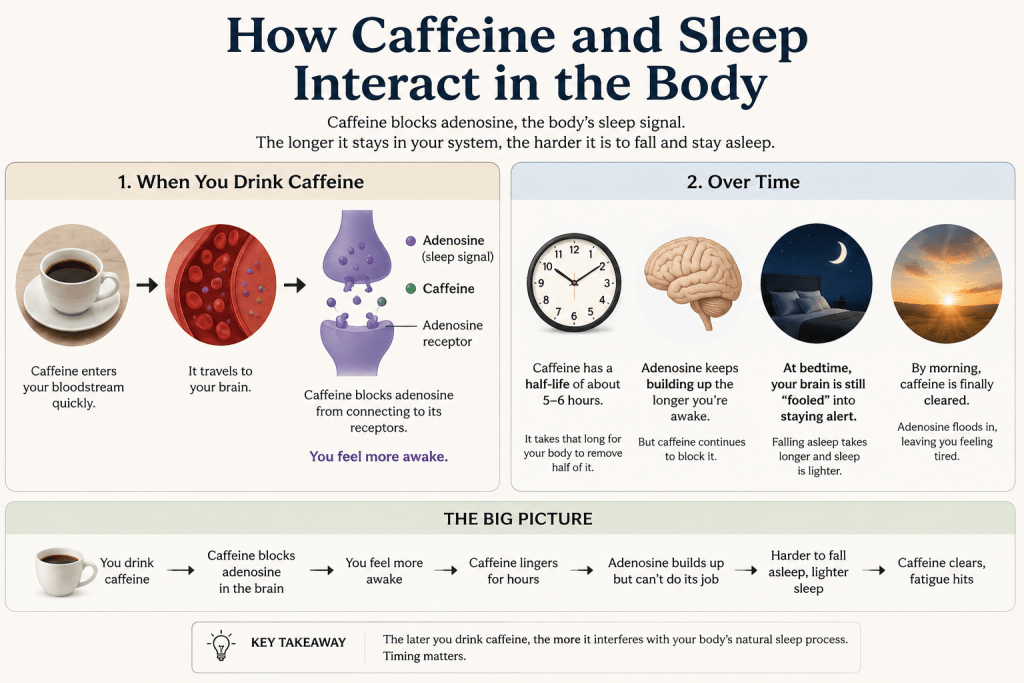
How Caffeine and Sleep Interact in the Body
Your brain builds up a chemical called adenosine across the whole day. The longer you stay awake, the more of it accumulates, and the heavier your eyelids get by evening. Sleep researchers call this sleep pressure.
Caffeine works by sitting in the spots where adenosine would normally attach. The adenosine is still there. Your brain simply stops receiving the message.
Caffeine does not give you energy. It hides the tiredness you already have.
That distinction explains the crash. Once caffeine clears, all the adenosine that piled up while you were not listening delivers its message at once.
CHECK YOUR SLEEP SYMPTOMS: TAKE THE 2 MINUTE QUIZ
TAKE THE QUIZ
The Half Life Problem Nobody Accounts For
Half life is the time your body needs to clear half of a substance. For caffeine, research generally puts that window somewhere around five to six hours in a typical adult.
Run the math on a 200 milligram afternoon coffee at 3 pm. Around 100 milligrams remain at roughly 9 pm. Around 50 milligrams are still circulating near 2 am or 3 am, which is close to the amount in a small cup of tea.
That leftover load is small enough to ignore and large enough to matter. It rarely stops you from falling asleep. It changes what happens after.
Studies on caffeine and sleep quality show reductions in deep sleep even when total time in bed stays the same. People report sleeping through the night while waking up unrefreshed. If that pattern sounds familiar, our article on why you wake up tired covers the other common explanations.
So How Late Is Too Late?
A common recommendation is to stop caffeine roughly eight hours before bed. For a 10 pm bedtime, that puts the cutoff around 2 pm.
Some clinicians suggest a wider margin of ten to twelve hours for sensitive sleepers. Neither number is a rule handed down from a lab. They are starting points.
Your personal cutoff depends on how quickly your body clears caffeine, and that varies enormously between individuals.
Genetics account for much of the difference. Liver enzyme activity varies from person to person, which is why one friend drinks espresso after dinner and sleeps fine while another lies awake after a single morning latte.
Other factors shift the timeline. Pregnancy slows clearance considerably. Certain medications and oral contraceptives extend it. Smoking speeds it up. Age tends to slow it gradually.
The practical approach is to test rather than guess. Move your cutoff two hours earlier for two weeks and pay attention to how mornings feel. If nothing changes, move it earlier again.
Where Caffeine Hides
People underestimate their intake because they only count coffee. Any honest look at caffeine and sleep has to start with an accurate daily total.
A standard brewed coffee runs roughly 95 milligrams per cup, though the range is wide. Espresso holds around 65 milligrams per shot, and most drinks contain two. Black tea lands near 45 milligrams, green tea closer to 30.
Energy drinks vary from about 80 to well over 300 milligrams per can. Some pre workout powders exceed 300 milligrams in a single scoop.
Dark chocolate carries a modest amount. Certain pain relievers include caffeine on purpose, often without the buyer noticing. Decaf is not caffeine free either, typically holding a small residual dose.
Add a morning cup, an afternoon cup, a diet soda with lunch, and dark chocolate after dinner, and the daily total climbs quietly past what most people would estimate.
What Caffeine Cannot Explain
Cutting caffeine is worth doing. It is also not a universal answer, and this is where people go wrong.
If you moved your cutoff to noon, held it for a month, and still woke up exhausted, the caffeine was not the main problem. Something else is fragmenting your nights.
Loud snoring, gasping, witnessed pauses in breathing, morning headaches, and dry mouth all point toward how you breathe during sleep. Our overview of signs of sleep apnea lists the patterns clinicians look for.
Heavy caffeine use is sometimes a symptom rather than a cause. People who need four cups to function are often compensating for sleep that is not doing its job, which builds a loop: poor sleep drives more caffeine, and more caffeine degrades sleep further.
Repeated night waking has its own set of explanations. Our guides on waking up at 2 am and how to stop waking up multiple times at night go through them.
Lifestyle Habits That Make the Cutoff Easier
These are comfort and routine measures. They do not diagnose anything and they do not replace an evaluation.
Set a fixed cutoff time and treat it like a fixed appointment. A moving target never holds.
Taper rather than quitting abruptly. Withdrawal headaches and irritability push people straight back to old habits within days.
Front load your intake. Most of your caffeine comes in the first half of the morning.
Delay the first cup by about an hour after waking. Many people find the afternoon slump softens when the morning dose comes slightly later.
Swap the afternoon cup for something warm without caffeine. The ritual matters as much as the drink for a lot of people.
Watch decaf timing if you are highly sensitive. Small residual amounts still register for some.
Get outdoor light in the morning. Light exposure supports the internal clock that caffeine has been masking. Our morning routine guide covers practical ways to build it in.
Keep a steady sleep schedule. Consistency does more for daytime energy than any adjustment to your coffee order.
Watch alcohol in the evening, which fragments sleep in its own way and often gets paired with heavy daytime caffeine.
For broader guidance, the Centers for Disease Control and Prevention publishes practical sleep recommendations, and the National Heart, Lung, and Blood Institute maintains a plain language overview of sleep apnea.
If falling asleep is the harder part of your night, our guide on how to fall asleep fast offers additional approaches, and our natural approaches to insomnia piece goes deeper.
Watch: Dr. Bhar answers why am I still tired after 8 hours of sleep?
When to Involve a Sleep Physician
Dr. Avinesh Bhar and the SLIIIP clinical team start with your history. What you drink, when you drink it, how your nights run, and what your mornings feel like all shape the next step.
Bring specifics. Two weeks of notes covering your cutoff time, your bedtime, night wakings, and daytime energy gives a clinician far more to work with than a general sense of being tired.
A home sleep test records airflow, breathing effort, oxygen levels, and heart rate while you sleep in your own bed. The device ships to your door with instructions. You wear it, mail it back, and a physician reviews the results. Our page on the home sleep apnea test explains each stage.
Measurement is what separates a caffeine habit from a breathing problem. Both produce fatigue, and fatigue alone cannot tell you which one you are dealing with.
At Sliiip, we accept the following insurances:

SLIIIP’s board-certified sleep physicians can do sleep evaluations for sleep apnea. Virtual consultations in all 50 states. Home sleep tests shipped to your door.
Frequently Asked Questions
How late is too late for coffee?
A common starting point is eight hours before bed, so roughly 2 pm for a 10 pm bedtime. Sensitive sleepers often need a wider margin.
How long does caffeine stay in your system?
Half of a dose typically clears in about five to six hours, but meaningful amounts can linger well past midnight after an afternoon cup.
Can I fall asleep fine and still be affected?
Yes. Research on caffeine and sleep shows reduced deep sleep even when people fall asleep normally and stay in bed the same number of hours.
Does everyone process caffeine at the same speed?
No. Genetics, medications, pregnancy, smoking, and age all shift how quickly your body clears it.
Is decaf actually caffeine free?
Not entirely. It contains a small residual amount that some highly sensitive people still notice in the evening.
How much caffeine is in a cup of coffee?
Roughly 95 milligrams for standard brewed coffee, though brewing method and serving size change that considerably.
Do energy drinks affect sleep more than coffee?
The caffeine acts the same way. Serving sizes are often larger, and added sugar can compound the effect on your evening.
Why do I crash in the afternoon?
The adenosine that built up while caffeine was blocking the signal arrives all at once as the caffeine clears.
Should I quit caffeine entirely?
Not necessarily. Timing changes solve the problem for most people without eliminating anything.
Why do I get headaches when I cut back?
Withdrawal is common and usually short lived. Tapering gradually tends to be easier than stopping all at once.
Does caffeine cause insomnia?
It can contribute significantly, though insomnia has multiple causes. A clinician can help identify which apply to you.
Can tea replace coffee in the afternoon?
Tea holds less caffeine but is not free of it. Herbal options without caffeine are a closer match for late day.
Does caffeine affect sleep apnea?
It does not cause it. Heavy use often masks the daytime fatigue that would otherwise prompt someone to get evaluated.
Is morning coffee before breakfast a problem?
For most people it is a matter of preference and stomach comfort rather than sleep quality.
Why do I need coffee just to function?
High dependence sometimes reflects sleep that is not restorative. That is worth investigating rather than medicating with more caffeine.
Does caffeine tolerance build over time?
Some tolerance develops to the alertness effect. The disruption to sleep architecture does not fade the same way.
How long does it take to feel better after moving my cutoff?
Many people notice a difference within one to two weeks. Give any change a fair trial before judging it.
Can caffeine make anxiety at night worse?
It can amplify a racing mind for some people. Track your own pattern and discuss it with a clinician.
What if cutting caffeine changes nothing?
That is useful information. Persistent fatigue despite good habits deserves a proper sleep evaluation.
When should I stop troubleshooting on my own?
When snoring is loud, a partner reports pauses in breathing, or exhaustion follows you daily despite adequate hours in bed.
SLIIIP’s board-certified sleep physicians can do sleep evaluations for sleep apnea. Virtual consultations in all 50 states. Home sleep tests shipped to your door.
Latest posts
-
Why Can’t I Wake Up Even After Getting Enough Sleep?
Last updated: October 2, 2026. Medically reviewed by Dr. Avinesh Bhar, Board-Certified Sleep Physician, SLIIIP.com. If you can’t wake up after enough sleep, the cause is usually not the number…
-
Why Does My Heart Rate Drop So Low While I Sleep?
Last updated: October 2, 2026. Medically reviewed by Dr. Avinesh Bhar, Board-Certified Sleep Physician, SLIIIP.com. Your heart rate drops low while sleeping mainly because your body needs less work from…
-
Why Are My Naps Never Refreshing?
Last updated: October 2, 2026. Medically reviewed by Dr. Avinesh Bhar, Board-Certified Sleep Physician, SLIIIP.com. Naps that leave you groggy usually come down to how long you sleep, when you…
Get updates
Spam-free subscription, we guarantee. This is just a friendly ping when new content is out.

