👉 Register for Free. How to Diagnose Sleep Apnea Faster in Primary Care – FREE Webinar by Dr. Audrey Wells. – Friday, April 24 at 12 PM ET

Cramming for Exams vs Sleeping: What the Research Actually Shows
Cramming for exams is the default study method for most students, and according to Dr. Avinesh Bhar, Board-Certified Sleep Physician at SLIIIP.com, the reason it survives is not that it works well but that it produces a convincing feeling of progress while you are doing it.
The pattern is familiar. The exam is Thursday. Serious reading starts Tuesday night. By Wednesday you have covered a semester of material in two sessions, and it feels like the information is there. Then the paper lands in front of you and the recall is thinner than expected.
This article looks at what cramming actually is as a learning method, why it feels effective while you are inside it, how it collides with sleep, and what to do when the deadline is close and there is no time left to do it properly.
SLIIIP’s board-certified sleep physicians can do sleep evaluations for sleep apnea. Virtual consultations in all 50 states. Home sleep tests shipped to your door.
What Cramming for Exams Really Is
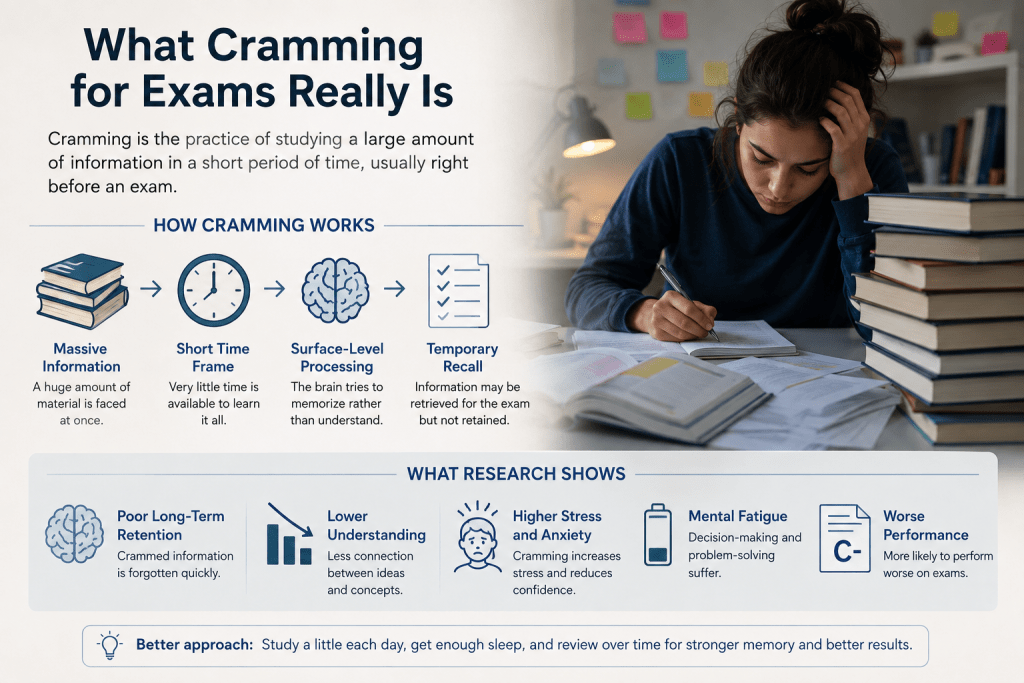
In learning research, cramming has a plainer name: massed practice. It means packing all your exposure to a subject into one long block instead of spreading it across several shorter sessions.
The alternative is called spaced practice. Same total hours, different distribution. Four sessions of one hour across four days rather than one session of four hours the night before.
The distinction is not about effort. It is about arrangement. Two students can spend exactly the same amount of time on the same material and end up with different amounts of it available on exam day, purely because of how the hours were arranged.
There is a second difference that matters just as much. Spaced practice puts nights in between the sessions. Massed practice usually removes one.
CHECK YOUR SLEEP SYMPTOMS: TAKE THE 2 MINUTE QUIZ
TAKE THE QUIZ
Why Cramming for Exams Feels Like It Works
If the method were obviously bad, students would abandon it. It survives because it produces a genuine sensation of mastery in the moment.
When you have read the same chapter three times in two hours, the material becomes fluent. It reads easily. Nothing surprises you. Your brain interprets that ease as knowledge.
Ease of reading and ability to retrieve are not the same thing. Recognizing information on a page is a much lower bar than producing it from memory in a silent room with a clock running. Cramming is very good at creating the first and much weaker at building the second.
There is also a timing illusion. Material reviewed a few hours ago is still fresh and readily accessible. That freshness fades quickly, which is why students often describe the strange experience of knowing something perfectly at midnight and losing it by ten the next morning.
And there is survivorship. Everyone remembers the exam they crammed for and passed. Nobody attributes a mediocre grade to the fact that the material never moved into durable storage.
Where Sleep Enters the Picture
This is the part most study guides leave out, and it is the reason cramming and sleep cannot be discussed separately.
Learning is not finished when you close the book. The stabilizing of newly learned material is thought to continue overnight, which means every night between studying and testing is part of the process rather than a pause in it.
Spaced practice gives that process several opportunities. Cramming gives it one, and often a shortened one, because the session runs late.
The National Heart, Lung, and Blood Institute describes how insufficient sleep is associated with trouble learning, focusing, and remembering, along with slower task completion and more errors. The Centers for Disease Control and Prevention similarly lists better attention and memory among the benefits of adequate sleep.
So the cost lands twice. You take in less during a long tired session, and then you shorten the night that would have stabilized what you did take in. The lost hour of sleep is not a neutral trade for an extra hour of reading.
For more on what a protected night contributes, see our guides on how to get more deep sleep and on core sleep versus deep sleep.
What Crammed Material Does After the Exam
There is a longer term issue that matters more than students expect.
Material learned in a single block tends to fade quickly. That is tolerable if the exam is the end of the story. It is a real problem in any subject that builds, which describes most of them. Anatomy feeds into physiology. Calculus feeds into everything. First year statistics reappears in a final year project.
Cramming can pass a paper while leaving nothing behind for the next course to build on. Students who cram consistently often find each semester harder than the last, not because the material got harder but because the foundation was never actually laid.
How to Cram Better When You Have No Choice
Sometimes the calendar simply beats you. Three deadlines collided, someone got sick, work picked up. The realistic question is how to lose the least.
Test yourself instead of rereading. Rereading builds fluency, which fools you. Closing the book and trying to produce the answer builds retrieval, which is what the exam asks for. Practice questions, blank paper recall, and explaining a concept out loud all beat a fourth pass through the highlighter.
Triage ruthlessly. Identify what is most likely to carry marks and accept that you will not cover everything. Trying to cover all of it thinly usually produces worse results than covering the core properly.
Do the hard thinking first. Work through the difficult concepts while you still have capacity. Leave the mechanical tasks, the formatting, and the light review for the tired hours.
Set a hard stop and keep it. Decide before you start when the session ends, and end it even if a chapter remains. Open ended sessions expand until the night is gone and the next day is compromised too.
Protect a real block of sleep. Three or four continuous hours is meaningfully better than none. Sleeping in a block also beats collapsing at the desk in scattered fragments.
Use a short nap rather than another coffee. A brief nap in the afternoon can restore alertness without the evening cost. Our overview of the benefits of napping covers the timing.
Do a calm review, not a frantic one, before bed. A short pass over the hardest section, finished well before lights out, gives it a night of processing. A stressful session right up to bedtime tends to make sleep harder without adding much.
If the racing mind keeps you at the desk long after the work stops being productive, our guide on how to stop overthinking at night has practical techniques, and how to fall asleep fast covers the wind down.
Building a Semester Where Cramming Is Not Necessary
The permanent fix is structural rather than heroic.
Mark the major deadlines in week one, before anything is urgent. Decide then which weeks will be heavy, because deciding under pressure almost always favors the late night.
Do short reviews of each subject on a rolling basis rather than a full pass at the end. Twenty minutes on Tuesday plus twenty on Friday will outperform two hours the night before, and it costs less total time.
Keep a wake time you can hold most days and let the bedtime follow from it. A stable schedule makes every study hour more productive, which is the cheapest performance gain available. Our walkthrough on how to fix your sleep schedule covers the reset if yours has drifted.
The point is not discipline for its own sake. It is that the same total work produces a better result when it is arranged with nights in the middle of it.
When Exhaustion Is Not About the Study Schedule
There is a group of students for whom none of this applies. They are not staying up late. They are in bed for eight hours, they wake at a reasonable time, and they still cannot concentrate through an afternoon of reading.
That pattern is worth separating from study habits entirely. Sleep can be long in duration and still be poor in quality, and repeated brief interruptions can fragment a night without the person remembering waking at all.
Signs worth attention include loud or frequent snoring, waking with a dry mouth or a morning headache, gasping or choking awake, and falling asleep during lectures. Persistent daytime sleepiness that does not improve with adequate time in bed is one of the more common signs of an underlying sleep disorder, and obstructive sleep apnea is not limited to older adults.
Dr. Avinesh Bhar and the SLIIIP team evaluate these patterns through virtual consultations, and testing can often be arranged at home rather than in a lab. See our guides on sleep apnea symptoms and why you may feel exhausted no matter how much you sleep, or read about how to get a home sleep test.
This article is general education and is not a diagnosis. If you already use a prescribed therapy such as CPAP or an oral appliance, do not stop using it or change its settings on your own during an exam period. Speak with your treating physician first.
Watch: Signs of a Sleep Disorder – SLIIIP.COM
The Takeaway
Cramming for exams is not the opposite of sleeping. It is a study method that happens to consume the nights that would have made the studying stick. Spread the same hours across more days, test yourself instead of rereading, and treat the night before as part of the preparation rather than spare capacity.
For the wider case on why rest belongs in the schedule, see our guide on the importance of sleep.
At Sliiip, we accept the following insurances:

SLIIIP’s board-certified sleep physicians can do sleep evaluations for sleep apnea. Virtual consultations in all 50 states. Home sleep tests shipped to your door.
Frequently Asked Questions
Does cramming actually work?
It can produce short term recall for an exam, but material learned in one block tends to fade quickly and is generally retained less well.
Why does crammed material feel so solid at the time?
Repeated reading creates fluency. Ease of reading feels like knowledge but is a weaker signal than being able to retrieve the answer.
Is spaced study really better than one long session?
The same total hours spread across more days is generally associated with better retention, partly because more nights sit between the sessions.
How many days ahead should I start studying?
There is no universal number, but several shorter sessions across a week usually outperform one long session the night before.
Is it better to cram or to sleep?
Where you have a choice, protecting the night usually serves you better, since short sleep affects taking in, storing, and retrieving material.
Can I cram and still sleep?
Yes. Set a hard stop, protect a continuous block of sleep, and do a short calm review before bed rather than a frantic one.
What is the best cramming technique?
Testing yourself rather than rereading. Practice questions and blank paper recall build the skill the exam actually measures.
Should I reread my notes over and over?
Rereading builds familiarity but is generally a weaker method than active retrieval.
How long can a useful study session last?
Most people lose focus well before the two hour mark. Shorter blocks with breaks tend to be more productive.
Does highlighting help?
Highlighting alone is a passive method. It helps most when combined with recall practice afterward.
Is three hours of sleep better than none before an exam?
A short continuous block of sleep is generally better than staying awake through the night.
Should I nap during a cram session?
A short nap of about twenty minutes can restore alertness for a few hours without the evening cost of more caffeine.
Why do I forget crammed material so quickly?
Massed practice tends to produce memory that fades fast, which becomes a problem in subjects that build on earlier material.
Does caffeine improve cramming?
It can mask sleepiness for a while but does not restore accuracy or recall, and it lingers long enough to affect that night.
How do I stop procrastinating until the last minute?
Scheduling short fixed sessions early in the term is usually more effective than relying on motivation later.
Does stress during exams affect memory?
Stress can make retrieval harder, which is one reason material that felt solid the night before can feel out of reach in the room.
Is group study useful for last minute revision?
It can help if it involves explaining and questioning each other, which is a form of retrieval practice.
What should I do the night before an exam?
Finish reviewing at least an hour before bed, keep the wind down calm, and protect the night rather than extending the session.
Why am I exhausted even when I do not cram?
Persistent tiredness despite adequate time in bed can point to a sleep quality issue rather than a study habit.
When should a student see a sleep physician?
When sleepiness persists for weeks despite enough time in bed, or when snoring, gasping, or morning headaches are present.
SLIIIP’s board-certified sleep physicians can do sleep evaluations for sleep apnea. Virtual consultations in all 50 states. Home sleep tests shipped to your door.
Latest posts
-
Evie Ring Sleep Tracking Review: Does It Work?
Last updated: September 14, 2026. Medically reviewed by Dr. Avinesh Bhar, Board-Certified Sleep Physician, SLIIIP.com. The Evie Ring tracks sleep using a finger-based light sensor that estimates heart rate, movement,…
-
Do EEG Sleep Headbands Actually Track Sleep Accurately?
Last updated: September 14, 2026. Medically reviewed by Dr. Avinesh Bhar, Board-Certified Sleep Physician, SLIIIP.com. EEG sleep headbands, like the Dreem headband, use dry electrodes to record brain wave activity,…
-
Circular Ring Sleep Accuracy: What It Gets Right and Wrong
Last updated: September 14, 2026. Medically reviewed by Dr. Avinesh Bhar, Board-Certified Sleep Physician, SLIIIP.com. The Circular Ring estimates sleep stages, heart rate, and recovery using a finger-worn light sensor,…
Get updates
Spam-free subscription, we guarantee. This is just a friendly ping when new content is out.

