👉 Register for Free. How to Diagnose Sleep Apnea Faster in Primary Care – FREE Webinar by Dr. Audrey Wells. – Friday, April 24 at 12 PM ET


Exploding Head Syndrome: The Strange Sleep Condition
The name sounds alarming, which is exactly why Dr. Avinesh Bhar, Board-Certified Sleep Physician at SLIIIP.com, spends the first minute of these visits explaining that exploding head syndrome does not involve any actual damage to the head.
Nothing explodes. Nothing is injured. The event is a sound your brain produces at the doorway between waking and sleep, and nobody else in the room hears it. People describe a slammed door, a gunshot, a cymbal crash, a thunderclap, or a burst of static. Some see a flash of light with it. Then it is over, usually in under a second.
What lasts is the fear. Many people go years without telling anyone, convinced they had a stroke or that something is seriously wrong with their brain.
SLIIIP’s board-certified sleep physicians can do sleep evaluations for sleep apnea. Virtual consultations in all 50 states. Home sleep tests shipped to your door.
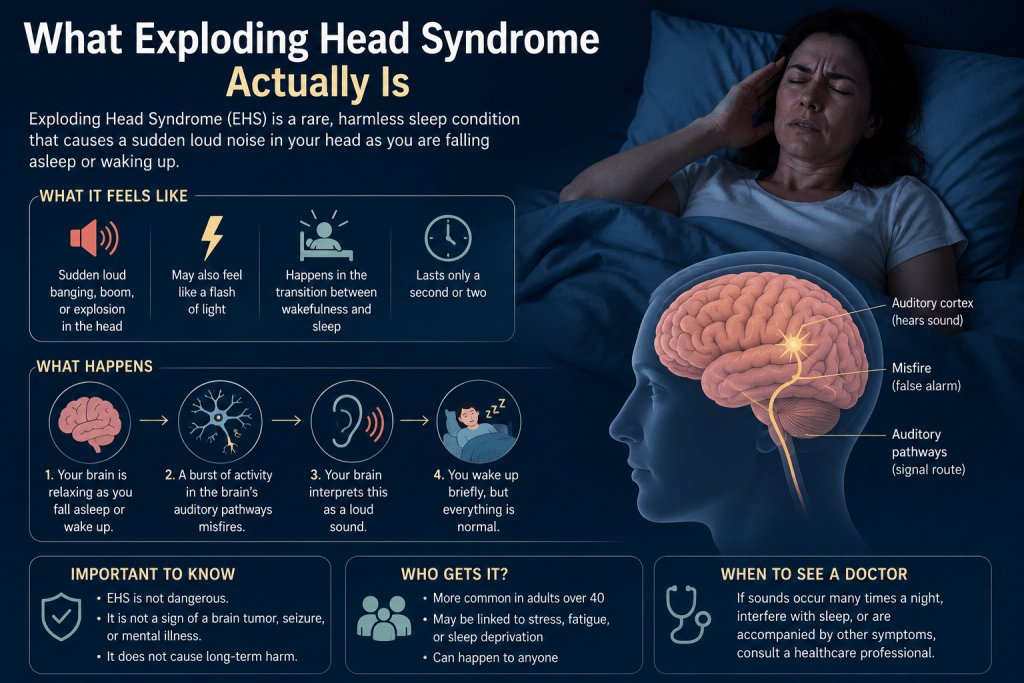
What Exploding Head Syndrome Actually Is
Sleep medicine files this under parasomnias, the group of unusual events that happen around sleep. More specifically it is a sensory parasomnia, meaning the brain generates a perception rather than a movement.
The defining feature is the one most people miss: it does not hurt. A loud noise, yes. A jolt of adrenaline, absolutely. Pain, no. That single detail separates this from several conditions that do need urgent attention, and we will come back to it.
Timing is the second clue. The event fires as you fall asleep or as you surface from sleep. It does not happen in the middle of a deep stretch of the night, and it does not happen while you are fully awake going about your day.
The name comes from a nineteenth century case description and has stuck ever since, which is unfortunate. A more accurate label would be something like a sudden sensory burst at the sleep transition. That does not make for a memorable name, but it is closer to the truth.
CHECK YOUR SLEEP SYMPTOMS: TAKE THE 2 MINUTE QUIZ
TAKE THE QUIZ
How Common It Is
More common than the silence around it suggests. Studies in student populations have reported that a meaningful share of participants had experienced at least one episode, and researchers generally agree the condition is underreported because people are embarrassed to describe it.
It was once thought to affect mostly older adults. Newer work has found episodes across age groups, including young adults and teenagers. Being young does not rule it out, and being older does not mean it is something worse.
Frequency varies enormously. Some people get one episode in a lifetime and forget it. Others go through clusters of several nights in a row, then nothing for months.
What Seems to Trigger It
There is no confirmed mechanism, and reputable sources say so plainly. The leading idea involves the brainstem systems that shut down alerting activity as you fall asleep. If the auditory part of that shutdown misfires, the theory goes, the brain may register a burst of noise that never existed. That remains a hypothesis.
The triggers, on the other hand, are fairly consistent across reports.
Sleep deprivation sits at the top of the list. An overtired brain hits the transition harder.
Stress and anxiety come next. High pressure periods and episode clusters tend to line up, and our guide on nighttime anxiety covers that overlap.
Irregular schedules matter. Shift work, jet lag, and a bedtime that moves two hours on weekends all disrupt the transition. Our piece on night shift work and sleep goes deeper for anyone on rotating hours.
Stimulants and abrupt medication changes have both been reported as associated factors. Bring your list to your clinician rather than adjusting anything yourself.
Fragmented sleep from any cause increases the number of transitions you pass through in a night, and more transitions means more chances for one to misfire. Our article on waking up repeatedly at night is relevant if that is your pattern.
What This Is Not
This section matters more than any other, because the wrong assumption sends people either to the emergency room unnecessarily or, far worse, keeps them home when they should go.
Pain changes everything. A sudden severe headache that peaks within a minute is called a thunderclap headache, and it is a medical emergency. If you experience sudden intense head pain, whether or not it wakes you, seek emergency care immediately. Do not read the rest of this page first.
Hypnic headache is a separate condition that wakes people with pain at a consistent time of night. It is managed by neurology, not by sleep hygiene alone.
Nocturnal seizures can involve sensory symptoms, but usually come with other features such as confusion afterward, tongue biting, loss of bladder control, or stereotyped movements. Those belong in a neurologist’s hands.
Tinnitus is a continuous or recurring ringing that persists while you are awake. The sensory burst discussed here is momentary and tied to the sleep transition.
Nightmares happen inside a dream during sleep. This event happens at the border of sleep, and people are immediately and fully awake afterward.
Sleep related breathing problems are a different matter again. A person who wakes gasping or choking is describing something else, and our article on waking up gasping for air explains why that deserves testing. If your nights also involve morning head pain, our guide on waking up with headaches sorts through the common causes.
Acting out dreams later in the night is its own condition, covered in our overview of REM sleep behavior disorder.
Habits That Reduce Episodes
There is no standard drug treatment, and that is not a gap in care so much as a reflection of how the condition behaves. For most people, episodes fade when the underlying sleep pressure and stress come down.
Protect your total sleep time first. Chronic short sleep is the single most reported trigger.
Keep one wake time, weekends included. Your body clock anchors to when you get up.
Getting outside light within an hour of waking, ten to fifteen minutes is enough for most people.
Set a caffeine cutoff in the early afternoon and hold to it.
Move workouts earlier if you train close to bedtime.
Build a wind down hour with dim light, no work email, and no scrolling.
Keep the bedroom cool, dark, and quiet.
If you have been lying awake and frustrated for roughly twenty minutes, get up, read something dull in low light, and return when you feel heavy.
Reassurance itself is part of the management. Studies and clinical reports both note that once people learn the event is recognized, named, and generally considered harmless, the dread around bedtime drops and episodes often become less frequent. If worry loops are keeping you up, our guide on why the brain will not shut off at night and our routine for fixing insomnia naturally are practical next reads.
For general public health guidance on sleep duration and habits, the CDC sleep resources are a solid starting point. The National Heart, Lung, and Blood Institute publishes plain language material on what short sleep does to the body.
Watch: Dr. Wells explains why sleep trackers don’t work
When to Get Evaluated
Book a visit if episodes happen often enough to make you dread going to bed, if they are breaking your sleep, or if you have been carrying a private fear about what they mean. That last one is reason enough on its own.
Get medical attention promptly if there is pain, if you wake confused, if there is any weakness, numbness, vision change, or trouble speaking, or if the events involve repetitive movements. Those features point away from a benign parasomnia and toward an assessment your primary clinician or a neurologist should lead.
Also get checked if you are exhausted during the day. Snoring, witnessed pauses in breathing, or fatigue that survives a full night in bed are worth objective testing, and a home sleep test gives you data instead of theories. Treating fragmented sleep often reduces the number of rough transitions in the first place.
When patients raise this in a visit, Dr. Avinesh Bhar works through a short set of questions before ordering anything. Was there pain? What time of night does it happen? How many hours are you actually sleeping? What changed in the weeks before it started. Those answers settle most cases without any testing at all.
A sleep evaluation is one piece of a broader picture. Mood, medications, hearing, and neurologic history all interact with what happens at the sleep transition, so your physician may look wider than sleep alone.
At Sliiip, we accept the following insurances:

SLIIIP’s board-certified sleep physicians can do sleep evaluations for sleep apnea. Virtual consultations in all 50 states. Home sleep tests shipped to your door.
Frequently Asked Questions
What is exploding head syndrome?
It is a sensory parasomnia in which a person perceives a sudden loud noise, sometimes with a flash of light, at the transition into or out of sleep.
Is it dangerous?
It is generally regarded as benign. It does not cause brain injury and is not associated with damage to the head.
Does it hurt?
No. The absence of pain is a defining feature. Sudden severe head pain is a different situation and needs urgent medical attention.
How long does an episode last?
Usually under a second, though the startled feeling afterward can last several minutes.
How common is it?
More common than most people assume. Research suggests it is widely underreported because people hesitate to describe it.
Can young people get it?
Yes. It was once thought to affect mainly older adults, but episodes have been documented across age groups.
What causes it?
The mechanism is not confirmed. A leading theory involves a misfire in the brainstem systems that quiet alerting activity during the transition to sleep.
Is it a seizure?
No. Seizures typically involve other features such as confusion afterward, tongue biting, or repetitive movements.
Is it tinnitus?
No. Tinnitus is ongoing ringing that persists while awake. This is momentary and tied to sleep onset or waking.
Is it a nightmare?
No. Nightmares occur within a dream during sleep, while this happens at the border between sleep and wakefulness.
Can stress trigger it?
Stress and anxiety are among the most commonly reported associated factors.
Does poor sleep make it worse?
Sleep deprivation and fragmented sleep are frequently reported triggers.
Can medications play a role?
Some stimulants and abrupt medication changes have been reported in association with episodes. Review your list with your clinician.
Is there a cure?
There is no standard drug treatment. Management focuses on sleep timing, stress, trigger reduction, and reassurance.
Will it damage my hearing?
There is no evidence that it harms hearing, since the sound is generated internally rather than in the ear.
Does it mean I am having a stroke?
It is not a stroke. That said, sudden weakness, numbness, vision change, or trouble speaking always warrants emergency care.
Can it happen during a nap?
Yes, because naps involve the same sleep transition.
Should I get a sleep study?
Not always. A study becomes useful when there are other symptoms such as snoring, breathing pauses, or daytime sleepiness.
Who should I see about this?
Start with a sleep physician. If there is pain, confusion, or neurologic symptoms, your clinician may involve neurology.
Can I be evaluated without visiting a sleep lab?
Yes. SLIIIP offers virtual consultations and ships home sleep tests to your door.
Your Next Step
The strangest part of exploding head syndrome is not the sound. It is how many people carry it silently for years, assuming the worst, when the condition has a name, a literature, and a generally reassuring outlook.
Getting it named is often most of the relief. If your episodes are frequent, if bedtime has started to feel like something to survive, or if daytime exhaustion is tagging along, a conversation with a sleep physician is a short path to clarity.
SLIIIP’s board-certified sleep physicians can do sleep evaluations for sleep apnea. Virtual consultations in all 50 states. Home sleep tests shipped to your door.
Latest posts
-
Why Are My Naps Never Refreshing?
Last updated: October 2, 2026. Medically reviewed by Dr. Avinesh Bhar, Board-Certified Sleep Physician, SLIIIP.com. Naps that leave you groggy usually come down to how long you sleep, when you…
-
Is Sleeping Too Much a Sleep Disorder?
Last updated: October 2, 2026. Medically reviewed by Dr. Avinesh Bhar, Board-Certified Sleep Physician, SLIIIP.com. Sleeping too much is not always a sleep disorder, but it can be a sign…
-
Why Does My Insomnia Get Worse After Stopping Sleep Medication?
Last updated: October 2, 2026. Medically reviewed by Dr. Avinesh Bhar, Board-Certified Sleep Physician, SLIIIP.com. Insomnia can get worse after stopping sleep medication for three main reasons. They are rebound…
Get updates
Spam-free subscription, we guarantee. This is just a friendly ping when new content is out.

