👉 Register for Free. How to Diagnose Sleep Apnea Faster in Primary Care – FREE Webinar by Dr. Audrey Wells. – Friday, April 24 at 12 PM ET

How Do I Fix My Night Shift Sleep?
Anyone coming off a run of overnights has asked how to fix their night shift sleep, and according to Dr. Avinesh Bhar, Board-Certified Sleep Physician at SLIIIP.com, the honest starting point is that you are not doing it wrong. You are working against a biological clock that was never built for this. The goal is not to become a person who sleeps beautifully during the day. The goal is to lose as little sleep as possible while protecting your safety and your health.
This guide covers what actually moves the needle for shift workers, in the order that matters most.
SLIIIP’s board-certified sleep physicians can do sleep evaluations for sleep apnea. Virtual consultations in all 50 states. Home sleep tests shipped to your door.
Why Night Shift Sleep Is So Hard to Fix
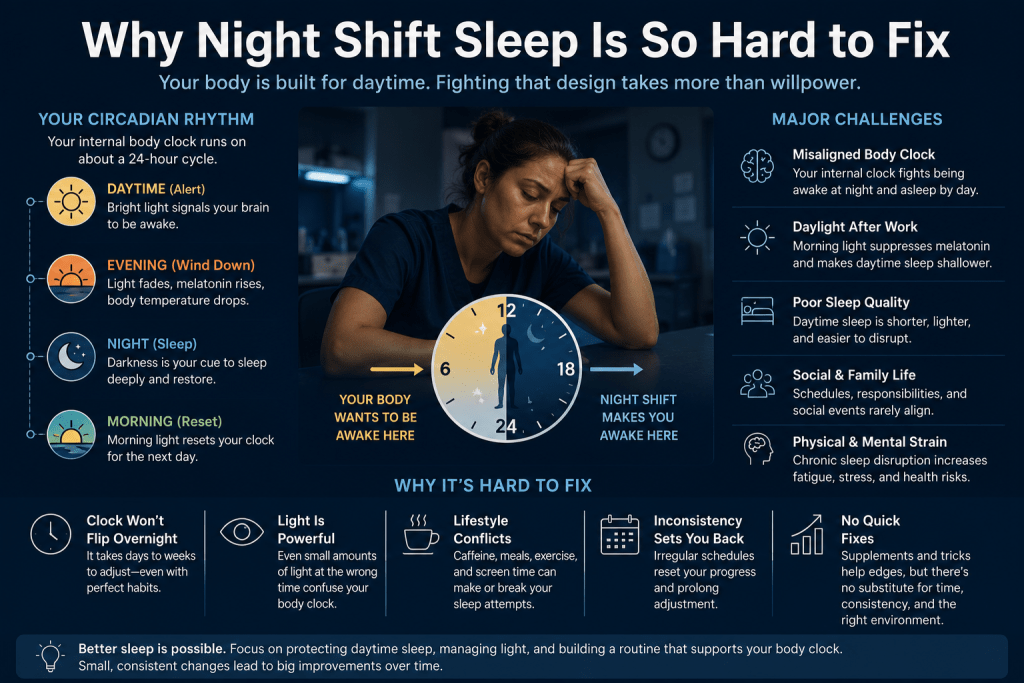
Your body runs on an internal clock set mainly by light. That clock controls when you feel alert, when your body temperature drops, and when it releases the hormones that make sleep possible.
Daylight tells that clock to be awake. So when you get home at 7 in the morning, every signal your body receives says the day is starting. You are asking it to shut down at the exact moment it is designed to switch on.
This is why willpower and good intentions fail here. It is not a discipline problem. It is a signaling problem. Our overview of how the circadian rhythm works explains the underlying mechanism in more detail.
The good news is that signals can be managed. Light, timing, and consistency are levers you control.
CHECK YOUR SLEEP SYMPTOMS: TAKE THE 2 MINUTE QUIZ
TAKE THE QUIZ
Start With a Consistent Anchor
The single biggest mistake shift workers make is sleeping at a different time every day.
Pick a core block of four to five hours that stays the same on every workday, and build the rest of your sleep around it. If you get home at 7, that anchor might run from 8 in the morning until around 1 in the afternoon. Add a second shorter block before your shift if you need more.
Splitting sleep into two blocks is completely legitimate. It is not a failure. For many shift workers it works better than fighting for one long stretch.
Consistency matters more than total hours in the beginning. A stable pattern gives your clock something to lock onto. A pattern that moves every day gives it nothing.
Light Is Your Strongest Lever
Nothing else you do will matter as much as controlling light.
During your shift, get bright light early. Bright light in the first half of your shift helps push your clock later and keeps alertness up when you need it most. If your workplace allows it, sit near the brightest area available during the early hours.
Dim the light in the last hours of your shift. This begins the wind down before you leave the building.
Wear dark sunglasses for the drive home. This is the step most people skip and the one that pays off fastest. Morning sunlight on the commute is the strongest possible signal telling your brain to wake up, delivered at the exact moment you need the opposite. Wraparound styles work better than standard frames.
Keep the house dim once you are home. Resist turning on every light and opening the blinds.
The Drive Home Deserves Real Attention
This section is about safety rather than sleep quality.
Drowsy driving after a night shift is a genuine hazard, and the risk is highest on the commute home when your body is at its lowest point of alertness. Falling asleep at the wheel rarely feels like a decision. People describe it as suddenly arriving somewhere with no memory of the previous few minutes.
If you notice drifting, repeated yawning, or trouble holding your lane, pull over. A short nap in a safe parking area before finishing the drive is a reasonable choice. Where possible, carpool, use public transport, or arrange a ride after particularly rough shifts.
Build a Bedroom That Beats Daylight
Your sleep environment has to do more work than a day sleeper does.
Blackout curtains are worth the money. Aim for a room dark enough that you cannot see your hand clearly.
Manage sound rather than eliminating it. A fan or white noise machine masks daytime noise better than silence, because silence makes every passing car stand out.
Keep the room cool. Daytime rooms run warmer, and a cooler room supports the temperature drop that sleep depends on.
Silence your phone properly. Put deliveries on hold and put a note on the door if household traffic is an issue.
Tell people your sleep hours the way you would tell them your work hours. Most interruptions come from family and friends who simply forget.
Caffeine, Food, and Alcohol
Caffeine helps and it is fine to use it strategically. Use it in the first half of your shift and stop well before the end. Caffeine has a long tail, and a cup at 4 in the morning is still working when you are trying to sleep at 8.
Eat your largest meal before or early in your shift rather than at 3 in the morning. Digestion runs slower overnight, and heavy late meals contribute to reflux and restless sleep.
Alcohol is the most common shortcut and the most counterproductive one. It shortens the time it takes to fall asleep and then fragments the second half, which is exactly the portion you are already fighting for.
If you are considering melatonin, the timing question is more important than the product, and dosing should be discussed with a clinician or pharmacist. Our article on melatonin and sleep covers the common mistakes.
Use Naps Deliberately
Naps are a tool for shift workers rather than an admission of defeat.
A short nap before your shift, roughly twenty to thirty minutes, takes the edge off without leaving you groggy.
A nap during a break can be genuinely restorative if your workplace permits it. Keep it short unless you have time for a full cycle, since waking from deep sleep produces heavy grogginess.
Avoid long naps in the evening on days off, as they will pull your sleep apart. Our guide on the benefits of napping explains the timing in more detail.
Days Off Are the Hardest Part
Most shift workers lose their progress on their days off, when they flip back to a daytime schedule for family and social life.
There is no perfect solution. There is a reasonable compromise.
If you have one or two days off, try to stay closer to your work pattern. Go to bed late and wake late rather than reversing completely.
If you have three or more days off, a gradual shift back is easier on your body than an abrupt flip. Move your sleep by a couple of hours per day rather than all at once.
Protect the sleep before your first night back above everything else. A long nap that afternoon is often the difference between a manageable first shift and a dangerous one. Related guidance appears in our article on fixing your sleep schedule.
Watch: Dr. Wells explains what to do when you wake up in the middle of the night
When Night Shift Sleep Becomes a Medical Problem
Some difficulty is expected. Some are not, and this is where an evaluation matters.
Dr. Avinesh Bhar and the SLIIIP team see this pattern often, and the review usually covers your rotation, your breathing at night, your medication list, and your daytime sleepiness together rather than one at a time.
Shift work sleep disorder is a recognized condition in which the mismatch between your schedule and your internal clock causes ongoing insomnia or excessive sleepiness. It sits within the broader family described in our article on circadian rhythm sleep disorders.
Raise it with a clinician if any of these apply:
You cannot sleep even when you have the opportunity and the room is dark and quiet.
You are severely sleepy during shifts despite adequate sleep beforehand.
You snore loudly, gasp, or wake with headaches or a dry mouth. These point toward the airway rather than the schedule, and the signs of sleep apnea are worth reviewing. Sleep apnea is common among shift workers and often gets blamed on the schedule for years.
You have had near misses driving or operating equipment.
Your mood has changed noticeably alongside the sleep problems.
Research links long term shift work with cardiovascular and metabolic conditions, and the National Heart, Lung, and Blood Institute outlines how ongoing sleep loss affects the body. The Centers for Disease Control and Prevention also publishes general guidance on healthy sleep. A sleep evaluation is one part of a broader workup, not a verdict on its own, and it is the fastest way to separate a schedule problem from a breathing problem.
At Sliiip, we accept the following insurances:

SLIIIP’s board-certified sleep physicians can do sleep evaluations for sleep apnea. Virtual consultations in all 50 states. Home sleep tests shipped to your door.
Frequently Asked Questions
How do I fix my night shift sleep quickly?
Start with two changes: a consistent sleep block on workdays and dark sunglasses for the drive home. Those two produce the fastest improvement.
How many hours should a night shift worker sleep?
The same seven to nine hours as anyone else. Splitting it into two blocks is a normal and effective approach.
Is it bad to split sleep into two blocks?
No. Split sleep is a legitimate strategy for shift workers and often works better than trying to sleep straight through.
Should I wear sunglasses driving home from a night shift?
Yes. Morning light is the strongest signal telling your brain to wake up, and blocking it makes falling asleep at home considerably easier.
When should I stop drinking coffee on a night shift?
Well before the end of your shift. Caffeine lasts longer than most people expect and can still be active hours later.
Can I ever fully adjust to night shift?
Complete adjustment is uncommon, especially with rotating schedules or daytime commitments on days off. Most people manage rather than fully adapt.
Why can I not sleep after a night shift even though I am exhausted?
Being tired and being biologically ready for sleep are different. Daylight and an alert internal clock can override exhaustion.
Does melatonin help shift workers?
It may help with timing for some people, but the hour you take it matters more than the product. Discuss it with a clinician before starting.
Should I switch back to a day schedule on my days off?
A partial shift is usually better than a full flip. Staying closer to your work pattern protects your first shift back.
What is shift work sleep disorder?
A recognized condition where the conflict between your schedule and your body clock causes ongoing insomnia or excessive sleepiness.
Is drowsy driving after a night shift really that dangerous?
Yes. Alertness is at its lowest on the commute home. If you notice drifting or repeated yawning, pull over.
How dark does my bedroom need to be?
Dark enough that you cannot clearly see your hand in front of you. Blackout curtains are usually necessary.
Is white noise better than silence for daytime sleep?
Usually yes. Masking daytime sound works better than silence, which makes individual noises more noticeable.
Can night shift work cause sleep apnea?
It does not cause it, but shift workers often attribute apnea symptoms to their schedule, which delays evaluation for years.
How long before my shift should I nap?
A nap ending an hour or two before your shift works well. Twenty to thirty minutes avoids waking up groggy.
Does night shift work affect long term health?
Research associates long term shift work with cardiovascular and metabolic conditions, which is why managing sleep is worth the effort.
Should I eat during my night shift?
Eat your main meal before or early in the shift. Heavy meals in the middle of the night tend to worsen reflux and sleep quality.
Will alcohol help me sleep during the day?
No. It shortens the time to fall asleep and then fragments the rest, which worsens the problem you are trying to solve.
When should I see a sleep physician?
If you cannot sleep despite good conditions, if you are severely sleepy on shift, or if snoring and breathing symptoms are present.
Does insurance cover a sleep evaluation?
Many plans do. You can check your specific coverage using the benefits verification link on this page.
Stop Guessing About Your Nights
If you have tried the light, the curtains, and the schedule and still feel wrecked, the problem may not be the shift. A short conversation with a sleep physician can tell you which one you are dealing with.
SLIIIP’s board-certified sleep physicians can do sleep evaluations for sleep apnea. Virtual consultations in all 50 states. Home sleep tests shipped to your door.
Latest posts
-
Why Can’t I Wake Up Even After Getting Enough Sleep?
Last updated: October 2, 2026. Medically reviewed by Dr. Avinesh Bhar, Board-Certified Sleep Physician, SLIIIP.com. If you can’t wake up after enough sleep, the cause is usually not the number…
-
Why Does My Heart Rate Drop So Low While I Sleep?
Last updated: October 2, 2026. Medically reviewed by Dr. Avinesh Bhar, Board-Certified Sleep Physician, SLIIIP.com. Your heart rate drops low while sleeping mainly because your body needs less work from…
-
Why Are My Naps Never Refreshing?
Last updated: October 2, 2026. Medically reviewed by Dr. Avinesh Bhar, Board-Certified Sleep Physician, SLIIIP.com. Naps that leave you groggy usually come down to how long you sleep, when you…
Get updates
Spam-free subscription, we guarantee. This is just a friendly ping when new content is out.

