👉 Register for Free. How to Diagnose Sleep Apnea Faster in Primary Care – FREE Webinar by Dr. Audrey Wells. – Friday, April 24 at 12 PM ET


Night Shift Survival Strategies That Actually Hold Up Over Time
The night shift survival strategies that work are the ones you can repeat on your worst week, not the ones that look good on a chart, says Dr. Avinesh Bhar, Board-Certified Sleep Physician at SLIIIP.com. Your body clock is driven by light and timing, and no amount of discipline overrides it completely. The goal is not to beat your circadian rhythm. It is to lose less to it. Nurses, drivers, plant operators, first responders, and warehouse crews all face the same core problem: sleeping when the world is loud and bright, then staying alert when your body expects rest. Shift work makes sleep harder for everyone, but it does not explain every symptom. Persistent exhaustion despite good daytime sleep is a separate question, and one worth asking a physician.
SLIIIP’s board-certified sleep physicians can do sleep evaluations for sleep apnea. Virtual consultations in all 50 states. Home sleep tests shipped to your door.
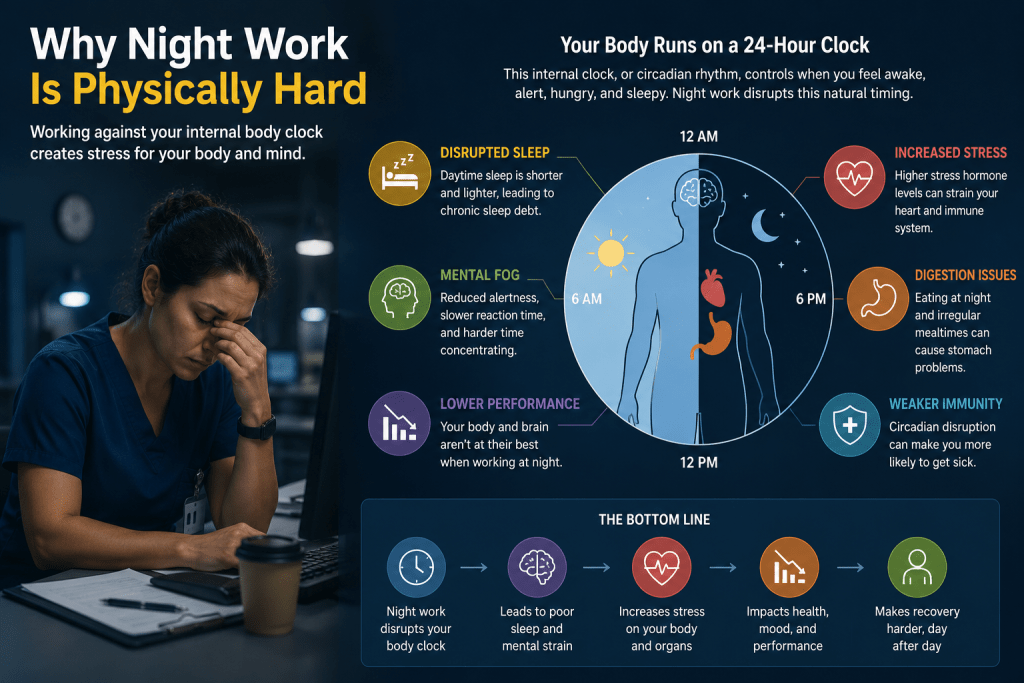
Why Night Work Is Physically Hard
Your internal clock uses light to decide when to promote alertness and when to promote sleep. Working nights asks you to do both in reverse.
Core body temperature falls in the early morning hours, alertness bottoms out somewhere between three and five in the morning, and melatonin production peaks in darkness. Daytime sleep after a night shift is typically shorter and lighter than nighttime sleep, which is why many shift workers lose one to two hours of sleep per day compared with day workers. That deficit accumulates across a roster.
For a fuller look at the physiology and at how shift work disorder is defined, our physician’s written piece on the night shift and sleep covers the clinical background in depth.
The Centers for Disease Control and Prevention notes that adults need seven or more hours of sleep on a regular basis, and that guidance does not change because your hours do.
CHECK YOUR SLEEP SYMPTOMS: TAKE THE 2 MINUTE QUIZ
TAKE THE QUIZ
Night Shift Survival Strategies for Protecting Daytime Sleep
Sleep is the foundation. Everything else is secondary.
Make the bedroom genuinely dark. Blackout curtains plus a sleep mask. Light leaking around a blind is enough to shorten daytime sleep. This single change helps more than any supplement.
Control sound rather than fighting it. A fan, white noise machine, or earplugs cover doorbells, lawn equipment, and traffic. Tell household members and neighbors your sleep hours in plain terms.
Keep the room cool. Daytime bedrooms run warmer than night bedrooms, and body temperature needs to fall for sleep to consolidate.
Wear sunglasses on the drive home. Morning light after a shift tells your clock to wake up. Blocking it makes falling asleep easier.
Pick one sleep pattern and repeat it. Two options work. Sleep in one block soon after your shift, or split it into a shorter morning sleep and a nap before work. Neither is better in general. Consistency is what matters.
Guard the phone. Scrolling in a dark room delays sleep just as effectively at eight in the morning as at midnight.
Staying Alert Through the Shift
The night shift survival strategies that keep you sharp come down to three levers: caffeine timing, light, and movement.
Front load your caffeine. Caffeine has a half life of roughly five to six hours. A cup early in the shift supports alertness. A cup at five in the morning is still in your system when you try to sleep at eight.
Use short naps deliberately. A twenty to thirty minute nap before or during a shift improves alertness without much grogginess. Longer naps risk deep sleep and a heavy wake up. Our guide to the benefits of napping covers timing and length.
Get bright light during the shift. Well lit workspaces support alertness through the night. Dim environments make the low point worse.
Move during the low point. Walking, stretching, or any physical task helps more than another coffee at four in the morning.
Eat lighter at night. Heavy meals during overnight hours sit poorly and increase sleepiness. Smaller meals with protein work better than one large meal.
Getting the Roster on Your Side
Some of the most useful night shift survival strategies happen before your first shift starts.
Ask for forward rotating schedules. Moving from day to evening to night is easier to adapt to than the reverse, because staying up later is easier than forcing sleep earlier.
Ask for longer runs rather than scattered nights. A block of consecutive nights lets partial adaptation happen. Single nights scattered through a week never allow it.
Build in recovery after a block. One full night of sleep before returning to a day schedule reduces the crash.
If your schedule has scrambled your body clock entirely, our guide to fixing your circadian rhythm walks through the reset process, and fixing your sleep schedule covers the day to day mechanics.
Days Off Without Wrecking the Week
This is where most plans fall apart. Fully flipping to a day schedule on your days off means adapting twice each week.
A partial compromise works better than a full swing. Many people do best going to bed a few hours earlier than their shift bedtime on days off rather than reverting completely.
Protect one anchor sleep period. Even a shifted routine benefits from a predictable block you defend every day.
Plan family time around the anchor, not instead of it. Social isolation is a genuine cost of night work, and the answer is scheduling, not skipping sleep.
The Safety Piece Nobody Wants to Discuss
Drowsy driving after a night shift is one of the most serious risks shift workers face, and the drive home after your last shift of a block is the highest risk trip of the week.
If you feel yourself fading, pull over and nap before continuing. Consider carpooling, public transport, or a short nap before leaving the building. Reduced alertness also matters for anyone operating equipment or making clinical decisions near the end of a long shift.
When It Is More Than the Schedule
According to Dr. Avinesh Bhar, many shift workers assume every symptom comes from the roster, which delays the diagnosis of conditions that are common in the general population too.
Raise these with a physician:
- Loud snoring, gasping, or breathing pauses observed by someone else
- Waking with a dry mouth, sore throat, or morning headache
- Sleepiness that persists even after a full uninterrupted daytime sleep
- Falling asleep unintentionally while driving or during quiet tasks
- Uncomfortable leg sensations at night that improve with movement
- Insomnia that continues on days off and during vacations
Sleep apnea, restless legs syndrome, and insomnia occur in shift workers at least as often as in day workers, and they need a different approach than schedule adjustments. The National Heart, Lung, and Blood Institute publishes a plain language overview of sleep deprivation and deficiency worth reading if symptoms have persisted. Our page on circadian rhythm sleep disorders explains when misalignment becomes a clinical diagnosis.
Shift work has been associated in research with a range of longer term health concerns including cardiovascular and metabolic conditions. Those are associations rather than certainties for any individual, and they are a reason to keep regular medical follow up rather than a reason to panic. Cardiac, metabolic, or mood concerns belong with the physician managing that care.
Regarding medication and supplements, this is a conversation for your own physician or pharmacist. Melatonin timing in shift work is specific and easy to get wrong, and our page on melatonin and sleep explains the basics. Never start, stop, or adjust a prescription, including CPAP settings, without speaking to your physician first.
Watch: Dr. Wells explains what to do when you wake up in the middle of the night
When to Talk to a Sleep Physician
Consider an evaluation if exhaustion persists despite protected daytime sleep, if someone has observed breathing pauses, if you have nodded off while driving, or if insomnia continues on days off.
At Sliiip, we accept the following insurances:

SLIIIP’s board-certified sleep physicians can do sleep evaluations for sleep apnea. Virtual consultations in all 50 states. Home sleep tests shipped to your door.
Frequently Asked Questions
What are the best night shift survival strategies for new workers?
Start with darkness, sound control, and a consistent sleep block. Those three deliver more benefits than anything else in the first month.
How many hours should I sleep after a night shift?
Aim for the same seven or more hours you would need otherwise, whether in one block or split across two periods.
Is split sleep bad for you?
No. Splitting sleep into a post shift block and a pre shift nap works well for many people and can total the same hours.
When should I stop drinking caffeine on a night shift?
Roughly six hours before your planned sleep. For a shift ending at seven in the morning, that means nothing after about one or two.
Do sunglasses on the drive home really help?
Yes. Blocking morning light reduces the wake signal your body clock receives and makes falling asleep easier.
How long should a shift nap be?
Twenty to thirty minutes is the usual recommendation, which improves alertness without much grogginess on waking.
Should I flip back to days on my days off?
A partial shift usually beats a full flip. Adapting twice a week is harder than staying partly aligned with your work pattern.
Can I ever fully adapt to night shifts?
Complete adaptation is uncommon, especially with any daytime light exposure. Partial adaptation during a block of consecutive nights is realistic.
Is shift work disorder a real diagnosis?
Yes. It involves insomnia or excessive sleepiness related to a work schedule, and it is worth discussing with a physician.
Does melatonin help shift workers?
Timing is critical and differs from ordinary use. Discuss it with your physician or pharmacist rather than experimenting.
Are night shifts bad for my heart?
Research has linked shift work with higher cardiovascular and metabolic risk at a population level. Regular medical follow up is the sensible response.
Why am I still tired after eight hours of daytime sleep?
Daytime sleep is often lighter and more fragmented. Persistent tiredness despite adequate hours also warrants an evaluation.
How do I stop my family from waking me?
Post your sleep hours, silence the doorbell, use white noise, and treat the block as non negotiable rather than flexible.
Should I exercise before or after a night shift?
Either can work. Avoid intense exercise in the two to three hours before your planned sleep.
What should I eat during an overnight shift?
Smaller meals with protein, spaced through the shift, rather than one heavy meal in the middle of the night.
Is it safe to drive home after a night shift?
Only if you are genuinely alert. If you feel yourself fading, nap first. Drowsy driving is a serious and underrated risk.
Do blackout curtains make a real difference?
Yes. Light leaking into a daytime bedroom is one of the most common and most fixable causes of short sleep.
Can I take a sleep aid to sleep during the day?
That decision belongs with your physician. Hangover effects can carry into a shift and create a safety problem.
Does shift work cause sleep apnea?
No. Apnea occurs independently, but shift work can mask it because tiredness gets attributed to the schedule instead.
When should I see a doctor about shift work sleep problems?
If exhaustion persists despite protected sleep, if insomnia continues on days off, or if anyone has noticed breathing pauses.
Ready to Find Out What Is Behind the Exhaustion
If the schedule alone does not explain how tired you are, testing can tell you what else is going on overnight.
SLIIIP’s board-certified sleep physicians can do sleep evaluations for sleep apnea. Virtual consultations in all 50 states. Home sleep tests shipped to your door.
Latest posts
-
Why Are My Naps Never Refreshing?
Last updated: October 2, 2026. Medically reviewed by Dr. Avinesh Bhar, Board-Certified Sleep Physician, SLIIIP.com. Naps that leave you groggy usually come down to how long you sleep, when you…
-
Is Sleeping Too Much a Sleep Disorder?
Last updated: October 2, 2026. Medically reviewed by Dr. Avinesh Bhar, Board-Certified Sleep Physician, SLIIIP.com. Sleeping too much is not always a sleep disorder, but it can be a sign…
-
Why Does My Insomnia Get Worse After Stopping Sleep Medication?
Last updated: October 2, 2026. Medically reviewed by Dr. Avinesh Bhar, Board-Certified Sleep Physician, SLIIIP.com. Insomnia can get worse after stopping sleep medication for three main reasons. They are rebound…
Get updates
Spam-free subscription, we guarantee. This is just a friendly ping when new content is out.

