

Revenge Bedtime Procrastination: Why You Scroll When You Are Tired
Revenge bedtime procrastination describes a specific pattern rather than a character flaw, says Dr. Avinesh Bhar, Board-Certified Sleep Physician at SLIIIP.com, and it shows up in people who are genuinely exhausted yet keep reaching for the phone.
You know the sequence. You are yawning by 10:00 p.m. You get into bed. You pick up your phone for two minutes and it is suddenly 12:40 a.m. The confusing part is that you were tired the entire time, which is exactly what separates this pattern from ordinary insomnia.
SLIIIP’s board-certified sleep physicians can do sleep evaluations for sleep apnea. Virtual consultations in all 50 states. Home sleep tests shipped to your door.
What Revenge Bedtime Procrastination Actually Is
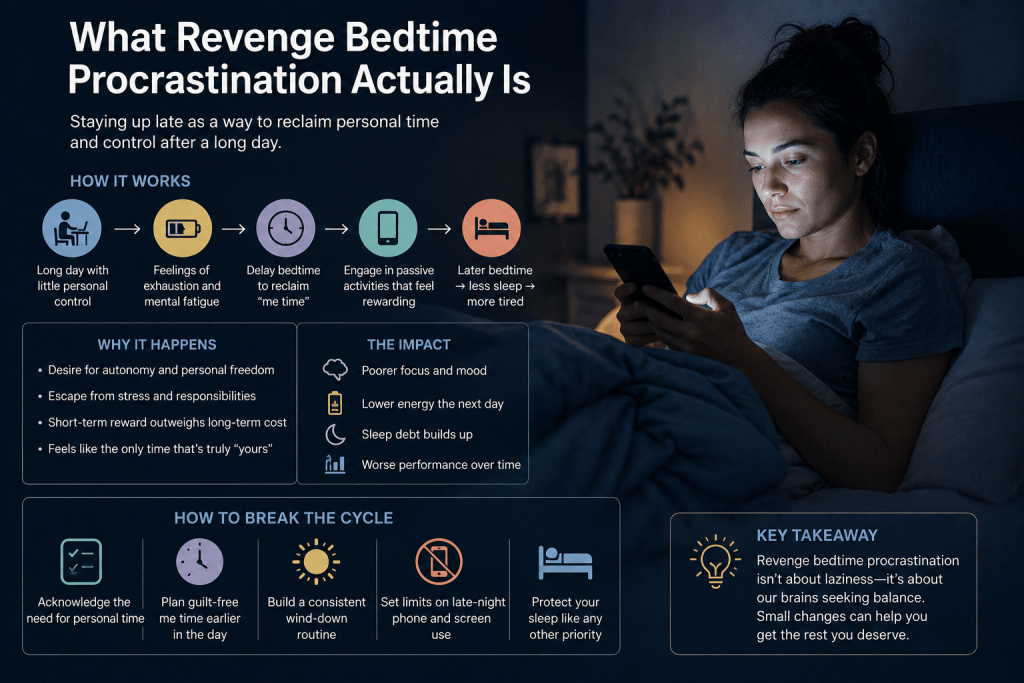
The behavior has three defining features. You delay going to sleep without any outside reason forcing you to stay up. You know the delay will leave you worse off tomorrow. And you do it anyway.
That last part is what makes it feel irrational from the inside. It is not.
The word revenge points at the motive. People who spend the entire day meeting other people’s demands often reach the end of that day with no time that belongs to them. Late night becomes the only unclaimed hour available. Scrolling at midnight is frequently a bid for personal time rather than a failure of discipline, which is why willpower strategies aimed at the phone alone tend to collapse within a week.
This is different from lying awake unable to sleep. If you get into bed, put everything down, and still cannot drift off, the mechanism is a different one, and our article on why you cannot fall asleep even when you are tired is the better fit.
CHECK YOUR SLEEP SYMPTOMS: TAKE THE 2 MINUTE QUIZ
TAKE THE QUIZ
Why the Tiredness Does Not Stop You
Sleepiness arrives in waves rather than a straight line. Your body clock produces a window in the evening where sleep comes easily, and if you push past it, alertness can rise again for a stretch. That second wind is not a sign you were not tired. It is a normal feature of the system.
Two other things work against you at that hour.
Self control runs lower at the end of the day. Whatever capacity you used to get through work, commuting, dinner, and bedtime routines is largely spent by 10:00 p.m. The decision to stop scrolling is being made with your weakest resources of the day.
And the content is engineered to remove stopping points. Infinite feeds, autoplay, and short clips are all designed so that no natural moment to quit ever arrives. You are not deciding to keep scrolling every few minutes. You are simply never being handed a moment where stopping is the obvious next step.
The Real Cost Shows Up Tomorrow
Losing 90 minutes a night is not a small thing repeated. It compounds.
Short sleep affects attention, reaction time, mood regulation, and appetite signals. It also makes the following evening harder, because a day spent depleted increases the pull toward reclaiming time at night. The CDC publishes general guidance on adult sleep duration, and the National Heart, Lung, and Blood Institute maintains plain language material on what insufficient sleep does over time.
There is also a specific trap. Many people conclude that they need less sleep because they function for six hours. Research on this consistently finds that people underestimate their own impairment when chronically short on sleep. If you regularly wake up unrefreshed, our piece on why you wake up tired covers other contributors worth ruling out.
Stop Treating It as a Willpower Problem
The strategies that work address the reason for the delay, not just the delay.
Start by naming what you are actually getting from the late hour. For most people the honest answer is one of three things: unstructured time, quiet, or a break from being needed. Once you can name it, you can ask whether any of it can be moved earlier in the day.
Almost nobody stops revenge bedtime procrastination by simply deciding to stop. People stop when the need behind it gets met somewhere else.
That might be 30 minutes after lunch that belongs entirely to you. It might be a decision that the dishes wait until morning. It might be a conversation with a partner about splitting the evening so each person gets an hour off duty. These sound like scheduling changes rather than sleep interventions, and that is the point.
Build a Transition, Not a Cutoff
A hard rule like no phones after 9:00 p.m. fails because it removes something without replacing it.
Design a wind down block of 30 to 45 minutes instead. Give it a clear start signal, something you notice without checking the time. Dimming the lights, putting on a specific playlist, or making tea all work. Then fill the block with something you actually want to do. Reading, stretching, a shower, a low stakes hobby, or a real conversation all qualify.
The key is that the block should feel like the reward, not the punishment. If your wind down routine is boring, your brain will keep choosing the feed. Our ultimate sleep routine guide has a workable template you can adapt.
Keep the sequence identical every night. Repetition is what turns a routine into a cue.
Make the Phone Harder to Reach
Friction beats intention. A few changes that consistently help:
Charge the phone outside the bedroom and buy a separate alarm clock. This single change does more than any app.
If it must stay in the room, put it across the room and face down. Standing up is a decision point, and decision points are exactly what the feed removes.
Turn the screen to grayscale after a set hour. Color is a large part of what makes feeds compelling, and grayscale reduces the pull noticeably for many people.
Move the most addictive apps off the home screen, or delete them from the phone and keep them on a laptop. Adding 20 seconds of effort is often enough.
Set a timer before you open anything. The problem is rarely the first five minutes of scrolling. It is that no clear ending exists, so any external ending you create is doing real work.
Protect the Morning Anchor
Whatever happened the night before, get up at the same time. A consistent wake time is what preserves the evening sleepiness window that makes an earlier bedtime possible. Sleeping in to compensate pushes the whole system later and makes the next night worse.
Get outside light within an hour of waking. It reinforces the same timing and reduces the second wind that keeps you scrolling. Our guide on how to fix your sleep schedule explains the mechanics if your timing has drifted significantly.
If you are short on sleep, a 20 minute early afternoon nap is a better repair than a late morning. The benefits of napping article covers how to time one without hurting the following night.
When Racing Thoughts Are the Real Driver
Some people are not scrolling for entertainment. They are scrolling to keep their own thoughts quiet.
If putting the phone down leads immediately to replaying conversations, planning tomorrow, or worrying, then the phone is a coping tool rather than the cause. That pattern responds to different techniques, including scheduled worry time earlier in the evening and writing tomorrow’s list before the wind down block begins. Our articles on why you overthink before bed and how to stop overthinking at night go through practical approaches.
If anxiety or low mood is driving the late hours, that belongs with a mental health clinician or your primary care provider rather than a sleep habit checklist.
When It Is Not Just a Habit
Dr. Avinesh Bhar notes that some people who describe revenge bedtime procrastination are describing a slightly different problem underneath.
A few signs suggest that. If you give yourself a full eight hours in bed and still wake up unrefreshed, timing is not the whole story. If a partner reports loud snoring or pauses in your breathing, or if you wake with a dry mouth, morning headaches, or a racing heart, those patterns are commonly associated with sleep disordered breathing in research literature and are worth an evaluation. If you feel genuinely alert at midnight and not at all sleepy until 2:00 a.m. regardless of what you do, that points toward a circadian timing issue rather than a behavior one.
A sleep evaluation is one part of a broader clinical workup, not a standalone answer. Thyroid function, medications, chronic pain, and mood conditions all belong with the appropriate clinician. If you already use CPAP or an oral device, do not change prescribed settings on your own. For persistent difficulty falling or staying asleep, our overview of how to fix insomnia naturally covers evidence based first steps.
Watch: Trouble Going to Sleep
A Realistic Two Week Plan
Week one changes the environment. Move the charger out of the bedroom, buy an alarm clock, and set a fixed wake time you hold every day including weekends. Change nothing else.
Week two adds the replacement. Build the 30 minute wind down block, give it a start signal, and identify one pocket of personal time you can claim during daylight hours. Then hold both for the rest of the month.
Progress is measured in minutes, not perfection. Getting to bed 40 minutes earlier on most nights is a real result. Revenge bedtime procrastination usually loosens when the day stops feeling like it belongs entirely to other people, and that shift takes a few weeks rather than a single decision.
At Sliiip, we accept the following insurances:

SLIIIP’s board-certified sleep physicians can do sleep evaluations for sleep apnea. Virtual consultations in all 50 states. Home sleep tests shipped to your door.
Frequently Asked Questions
What is revenge bedtime procrastination?
It is delaying sleep without any external reason to stay up, while knowing the delay will cost you the next day. The motive is usually reclaiming personal time.
Is it a medical diagnosis?
No. It is a described behavior pattern, not a clinical diagnosis. Persistent sleep difficulty is worth evaluating separately.
Why am I tired but still not going to sleep?
Sleepiness comes in waves, self control is lowest at the end of the day, and feeds are designed without natural stopping points. All three work together.
Is this the same as insomnia?
No. Insomnia involves difficulty falling or staying asleep once you try. This pattern involves choosing not to try yet.
Who does it affect most?
It is reported most often by people with long work hours, caregivers, parents of young children, shift workers, and students. The common thread is low daytime autonomy.
Does blue light cause this?
Light plays a role, but the content and the lack of a stopping point matter more. Grayscale mode and night filters help partly for that reason.
Will a screen time app fix it?
Sometimes, but apps that are easy to dismiss usually stop working within days. Physical friction like charging the phone elsewhere is more durable.
Should I ban my phone from the bedroom completely?
It is the single most effective change for most people. A separate alarm clock removes the main objection.
What if I use my phone as my alarm?
Buy a basic alarm clock. It costs very little and removes the most common reason the phone stays within reach.
How long does it take to break the pattern?
Most people notice a shift within two to three weeks of consistent changes. Progress is usually partial before it is complete.
Can I still scroll at night if I set a timer?
A timer helps because it supplies the ending that the app does not. It works better when the phone is not in bed with you.
Does sleeping in on weekends help me catch up?
It provides some recovery but pushes your timing later, which makes the following week harder. Keep weekend wake times within about an hour of weekday times.
What should I do instead of scrolling?
Choose something you actually enjoy that does not involve a feed. Reading, stretching, music, a shower, or a hobby with a natural stopping point all work.
Is reading on a tablet the same problem?
Reading a single book on a device is much closer to reading print than to scrolling. The infinite feed is the harder part to stop.
Why do I get a second wind at 11:00 p.m.?
Alertness can rise again after you push past your natural sleep window. It is a normal feature of body clock timing rather than proof you were not tired.
Does caffeine make this worse?
Yes. Caffeine has a long half life and afternoon doses can still be active at bedtime, which extends the window where scrolling feels easy.
What if I only have free time at night?
That is the core issue for many people. Finding even 20 or 30 minutes of protected time during the day is usually more effective than fighting the phone.
Does this cause long term health problems?
The behavior itself is not a condition, but chronic short sleep is associated with a range of health outcomes in research. Consistency matters more than any single night.
Could something medical be behind my late nights?
Possibly. Circadian timing disorders, sleep disordered breathing, anxiety, and certain medications can all contribute and are worth discussing with a clinician.
When should I see a sleep physician about this?
If you give yourself adequate time in bed and still wake unrefreshed, or if snoring, breathing pauses, or persistent daytime sleepiness are present, an evaluation is reasonable.
SLIIIP’s board-certified sleep physicians can do sleep evaluations for sleep apnea. Virtual consultations in all 50 states. Home sleep tests shipped to your door.
Latest posts
-
Can Sleep Apnea Cause Chest Pain at Night?
Last updated: November 17, 2026. Medically reviewed by Dr. Avinesh Bhar, Board-Certified Sleep Physician, SLIIIP.com. Sleep apnea is linked to nighttime chest discomfort, but it is rarely the only explanation.…
-
Which Sleep Aids Are Safe With Heart Disease?
Last updated: November 17, 2026. Medically reviewed by Dr. Avinesh Bhar, Board-Certified Sleep Physician, SLIIIP.com. No sleep aid is automatically safe with heart disease, so the right choice depends on…
-
Can Statins Cause Insomnia? What the Research Shows
Last updated: November 17, 2026. Medically reviewed by Dr. Avinesh Bhar, Board-Certified Sleep Physician, SLIIIP.com. For most people, probably not. A meta-analysis of placebo-controlled sleep lab studies found that statins…
Get updates
Spam-free subscription, we guarantee. This is just a friendly ping when new content is out.

