👉 Register for Free. How to Diagnose Sleep Apnea Faster in Primary Care – FREE Webinar by Dr. Audrey Wells. – Friday, April 24 at 12 PM ET

How to Sleep Better Without Medication: What Actually Works
People who want to sleep better without medication usually get further than they expect, says Dr. Avinesh Bhar, Board-Certified Sleep Physician at SLIIIP.com, because the approaches with the strongest research support are behavioral rather than pharmaceutical. The methods that hold up best in clinical studies are things you do, not things you swallow. They ask more of you in the first two weeks and give more back over the following months. This guide covers what those methods are, how they work, and how to tell when a sleep problem needs a medical look instead of a habit change.
SLIIIP’s board-certified sleep physicians can do sleep evaluations for sleep apnea. Virtual consultations in all 50 states. Home sleep tests shipped to your door.
Why So Many People Want to Sleep Better Without Medication
The reasons vary, and all of them are reasonable. Some people dislike feeling foggy the next morning. Some worry about needing a pill every night. Others have already tried melatonin, herbal teas, and over the counter aids, and found the results underwhelming.
Here is the encouraging part. Sleep medicine already agrees with you. For long term insomnia, national guidelines point to a structured behavioral program first, ahead of medication. The National Heart, Lung, and Blood Institute describes cognitive behavioral therapy for insomnia as the usual first treatment option for long term insomnia, delivered over roughly six to eight weeks. That is not a fringe position. It is the mainstream one.
CHECK YOUR SLEEP SYMPTOMS: TAKE THE 2 MINUTE QUIZ
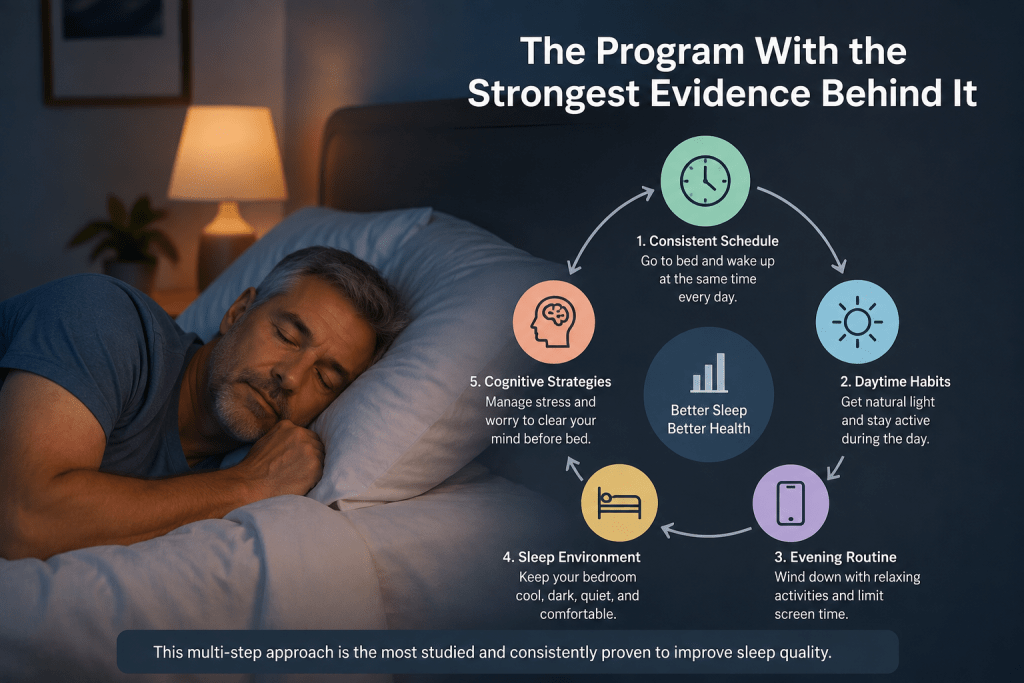
The Program With the Strongest Evidence Behind It
Cognitive behavioral therapy for insomnia, usually shortened to CBT-I, is the closest thing sleep medicine has to a gold standard for chronic sleep trouble. It is not talk therapy about your childhood. It is a short, practical program built from a few specific techniques.
CBT-I works on the parts of insomnia that keep it going long after the original cause has passed. You may have started sleeping badly because of a stressful job or an illness. Months later the stressor is gone but the sleep problem stays, because a second layer has formed on top: worry about sleep, extra time in bed, and a bedroom your brain now links with frustration.
For a fuller picture, our guide to cognitive behavior therapy for sleep disorders covers the structure, and what CBT-I feels like week by week sets expectations for the experience itself.
Stimulus Control: Teaching Your Brain That Bed Means Sleep
This is the technique most people underuse. Your bed should be linked in your mind with sleeping, and with almost nothing else.
The rules are short:
Use the bed for sleep and sex only. No laptops, no scrolling, no television, no paying bills.
If you are lying awake and starting to feel frustrated, get up. Leave the bedroom. Do something calm and dim in another room. Return when you feel sleepy again.
Repeat as often as needed, even if that means several trips out of bed on a rough night.
The point is not to force sleep. The point is to stop practicing wakefulness in your bed. Every hour spent lying awake and annoyed teaches your brain that bed is a place for being annoyed. Getting up interrupts that lesson. Most people find the first few nights unpleasant and the second week noticeably easier.
If your struggle is a mind that will not slow down once the lights go off, our article on what to do when you cannot shut your brain off at night pairs well with this technique.
Sleep Restriction: Less Time in Bed, More Actual Sleep
The name sounds harsh and the logic is counterintuitive, but this is often the fastest working piece of the program.
People with insomnia tend to spend more time in bed, not less. If you are getting five hours of sleep, staying in bed for nine feels like giving yourself the best chance. In practice it spreads five hours thinly across nine, which makes sleep lighter and more broken.
Sleep restriction narrows the window. You pick a fixed wake time and set a bedtime that matches the sleep you are currently getting, with a floor of about five and a half hours. Sleep pressure builds and sleep becomes deeper. As efficiency improves, you widen the window in small steps.
This technique should be done with guidance, not guessed at alone. It temporarily increases daytime sleepiness, which matters if you drive, operate equipment, or have a condition like epilepsy or bipolar disorder. A clinician sets the window and adjusts it with you.
Light and Timing: The Levers Most People Ignore
Your body runs on an internal clock, and light is the main thing that sets it. Two adjustments do most of the work here.
Get outside light early. Fifteen to thirty minutes of morning daylight, ideally within an hour of waking, anchors your clock. Cloudy days still count. Indoor lighting is dimmer than it feels and does not substitute well.
Dim things down in the evening. Warm lamps instead of overhead lights. Screens at low brightness, or put away entirely.
Keep your wake time steady, including weekends. A consistent wake time is the anchor that holds the whole schedule together. If your schedule has drifted badly, our guide on how to fix your sleep schedule walks through the correction process.
Handling a Racing Mind at Two in the Morning
Waking in the middle of the night is normal. Everyone does it. The difference is what happens next. Good sleepers roll over and drift off. Poor sleepers check the clock, calculate how much sleep is left, and start problem solving.
A few things help. Turn the clock away. Try slow breathing with a longer exhale than inhale. Keep a notepad by the bed and write down whatever your mind keeps circling, which gives your brain permission to stop rehearsing it. And apply the stimulus control rule: if you are getting tense, get up.
Our articles on how to stop overthinking at night and waking up in the middle of the night go deeper on both patterns.
Daytime Habits That Support or Undermine Sleep
The basics are boring and they still matter. The Centers for Disease Control and Prevention lists consistent timing, a cool dark quiet bedroom, and avoiding large meals, caffeine, and alcohol before bed among the habits that support good sleep.
A few specifics worth knowing:
Caffeine has a long tail. Half of it is still in your system five to six hours later, and some people clear it far more slowly. An afternoon coffee can affect deep sleep even if you fall asleep fine.
Alcohol is the great impostor. It shortens the time it takes to fall asleep and then fragments the second half of the night. Most people who use a nightcap to sleep are trading the first half of the night for the second half.
Exercise helps. Regular daytime activity improves sleep quality, and vigorous exercise close to bedtime bothers some people and not others.
Naps are not banned, but they cost you. Long or late naps drain the sleep pressure you need at night. Our piece on the benefits of napping covers how to nap without wrecking your night.
Where Supplements and Teas Actually Fit
Since the goal is to sleep better without medication, it is worth being clear about what the over the counter options do and do not do.
Melatonin is a timing signal, not a sedative. It is most useful for shifting a body clock, as with jet lag or a delayed schedule, and weaker for classic insomnia where the clock is fine but the mind will not settle. Our article on melatonin and sleep explains the distinction.
Herbal teas mostly work as rituals. A warm caffeine free drink has real value, largely because the routine itself signals that the day is ending.
Relaxation practice is different, and it is a genuine part of CBT-I. Progressive muscle relaxation, body scans, and guided audio are trained skills that improve with repetition. Guided meditation for sleep is a reasonable place to start.
If you are drawn to the non pharmaceutical route more broadly, our guide on how to fix insomnia naturally covers the wider set of lifestyle levers.
When Habits Are Not the Whole Story
Here is the part that gets skipped. Behavioral techniques work well for insomnia. They do not fix a breathing problem during sleep.
If you are doing everything right and still waking up unrefreshed, something else may be going on. Warning signs include loud snoring, witnessed pauses in breathing, waking with a dry mouth or headache, gasping awake, and heavy daytime sleepiness despite adequate time in bed.
Dr. Avinesh Bhar notes that people often spend months polishing sleep habits when the underlying issue was never behavioral. A home sleep test settles the question quickly. If you are unsure which category you fall into, do I have insomnia or something else is a useful sorting guide, and chronic insomnia and when to get a sleep test covers the threshold for evaluation.
Nothing here replaces personal medical advice, and no one should stop or change a prescribed medication or therapy setting on their own. That conversation belongs with your clinician.
Watch: How to Get Off Sleep Meds Safely – SLIIIP.COM
A Realistic Four Week Plan
If you plan to sleep better without medication, sequence matters more than intensity. Week one: pick a fixed wake time and hold it every day. Get morning light. Start a written sleep log.
Week two: add stimulus control. Bed for sleep only. Out of bed when frustration builds.
Week three: adjust your time in bed based on your log, ideally with clinical guidance. Add a wind down routine.
Week four: review. Sleeping more solidly means widening the window gradually. No movement at all means it is time for an evaluation rather than another month of effort.
Most people notice something by week two. Full benefit usually takes six to eight weeks, and the gains tend to hold, which is why clinicians reach for this approach first.
At Sliiip, we accept the following insurances:

SLIIIP’s board-certified sleep physicians can do sleep evaluations for sleep apnea. Virtual consultations in all 50 states. Home sleep tests shipped to your door.
Frequently Asked Questions
What actually works to sleep better without medication?
Cognitive behavioral therapy for insomnia has the strongest research support. Its core parts are stimulus control, sleep restriction, relaxation training, and correcting unhelpful beliefs.
Is CBT-I really better than sleeping pills?
Guidelines position it as the first option for long term insomnia. Medication can work faster short term, but behavioral gains tend to last after the program ends.
How long before I notice a difference?
Many people see change within two weeks. A full course runs six to eight weeks, and improvements often keep building afterward.
Does melatonin count as taking something?
It is a supplement, not a prescription drug, but you are still ingesting a hormone. If your goal is nothing at all, the behavioral route stands alone.
What is stimulus control?
A rule set that rebuilds the link between bed and sleep. The bed is used only for sleep and sex, and you leave the bedroom when you are lying awake and frustrated.
What is sleep restriction therapy?
Temporarily narrowing time in bed to match your actual sleep, which deepens and consolidates it. The window widens again as efficiency improves.
Should I really get out of bed if I cannot sleep?
Yes, once you feel tense rather than drowsy. Twenty minutes is a common guide, judged by feel rather than by watching a clock.
How long should falling asleep take?
Fifteen to twenty minutes is typical. Falling asleep the instant your head lands can be a sign of significant sleep debt.
Do relaxation techniques like counting actually help?
Structured practice helps more than counting. Progressive muscle relaxation and slow breathing with a long exhale are trained skills that improve with repetition.
Can I nap if I have insomnia?
A short early afternoon nap is usually fine. Long or late naps reduce the sleep pressure you need at night and can worsen the problem.
When should I stop drinking caffeine?
Many clinicians suggest nothing after early afternoon. Caffeine has a long half life and sensitivity varies widely.
Does alcohol help you fall asleep?
It shortens the time to fall asleep, then disrupts the later part of the night. Quality suffers even when total time does not change much.
Do I have to give up my phone in bed?
Both the light and the content work against you. Keeping it out of the bedroom is also the simplest way to stop clock watching.
What temperature should my bedroom be?
Cooler than most people set it. A drop in core body temperature is part of falling asleep, and a warm room works against it.
Does exercise help with sleep?
Regular daytime activity is linked with better sleep quality. Vigorous exercise close to bedtime affects some people and not others, so test it yourself.
Why do I wake at the same time every night?
Brief awakenings between sleep cycles are normal. The problem is what happens next, when clock checking and mental problem solving take over.
Can breathing exercises help me fall asleep?
Slow breathing with a longer exhale supports the calming side of the nervous system. It works best as a practiced habit, not an emergency tool.
Is white noise worth using?
It helps mainly by masking sudden sounds that would otherwise wake you. Steady, low volume, and consistent night to night works best.
Do weighted blankets do anything?
Some people find the pressure calming and it is low risk to try. Evidence is thinner than for the core behavioral techniques.
When should I see a sleep doctor instead of trying more habits?
If trouble persists beyond three months despite consistent effort, or if you snore loudly, gasp awake, or feel very sleepy by day, get evaluated.
SLIIIP’s board-certified sleep physicians can do sleep evaluations for sleep apnea. Virtual consultations in all 50 states. Home sleep tests shipped to your door.
Latest posts
-
Why Are My Naps Never Refreshing?
Last updated: October 2, 2026. Medically reviewed by Dr. Avinesh Bhar, Board-Certified Sleep Physician, SLIIIP.com. Naps that leave you groggy usually come down to how long you sleep, when you…
-
Is Sleeping Too Much a Sleep Disorder?
Last updated: October 2, 2026. Medically reviewed by Dr. Avinesh Bhar, Board-Certified Sleep Physician, SLIIIP.com. Sleeping too much is not always a sleep disorder, but it can be a sign…
-
Why Does My Insomnia Get Worse After Stopping Sleep Medication?
Last updated: October 2, 2026. Medically reviewed by Dr. Avinesh Bhar, Board-Certified Sleep Physician, SLIIIP.com. Insomnia can get worse after stopping sleep medication for three main reasons. They are rebound…
Get updates
Spam-free subscription, we guarantee. This is just a friendly ping when new content is out.

