👉 Register for Free. How to Diagnose Sleep Apnea Faster in Primary Care – FREE Webinar by Dr. Audrey Wells. – Friday, April 24 at 12 PM ET


Sleep Deprivation in College Students: Signs and Effects
Sleep deprivation in college students rarely announces itself as a sleep problem, and Dr. Avinesh Bhar, Board-Certified Sleep Physician at SLIIIP.com, says most students describe it instead as stress, burnout, or simply a hard semester. The tiredness gets blamed on the workload rather than on the missing hours that made the workload feel heavier.
That confusion matters, because the effects of running short on sleep look almost identical to the effects of being overwhelmed. Trouble concentrating, a shorter temper, getting sick more often, and a general sense of moving through fog all show up in both. This article focuses on recognizing the pattern and understanding what it costs, rather than on how many hours you should be logging. If you cannot tell whether what you are feeling is normal student life or something worth acting on, this is the place to start.
SLIIIP’s board-certified sleep physicians can do sleep evaluations for sleep apnea. Virtual consultations in all 50 states. Home sleep tests shipped to your door.
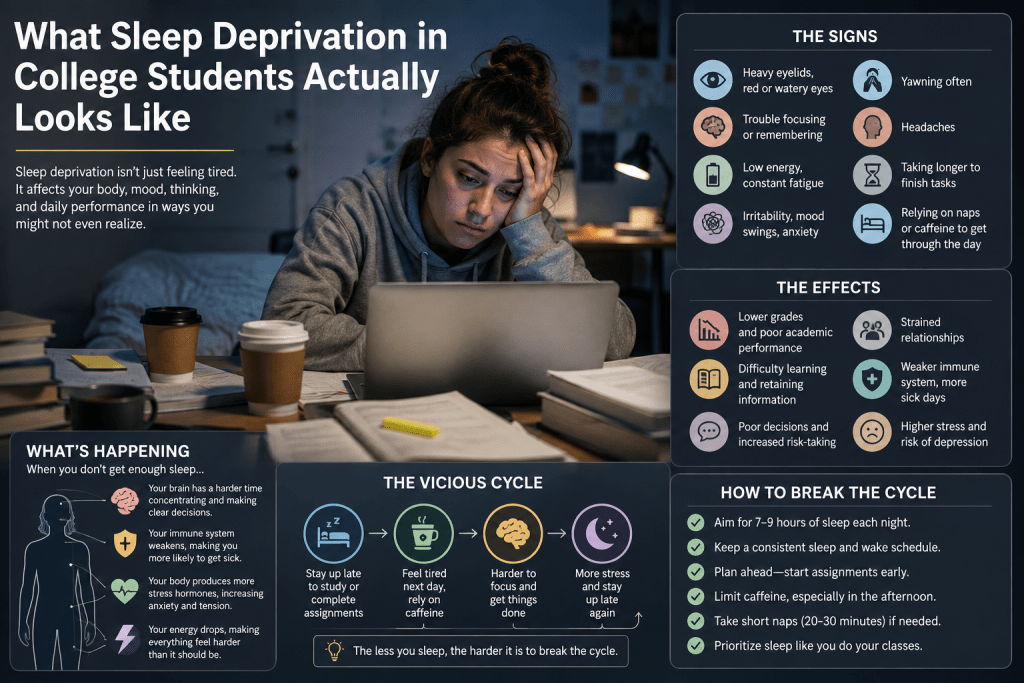
What Sleep Deprivation in College Students Actually Looks Like
The word deprivation suggests something dramatic, like a night with no sleep at all. In practice the far more common version is quiet and gradual. A student loses an hour or two most weeknights, feels roughly normal, and slowly drifts to a baseline well below where they started.
Signs that the pattern has taken hold include:
- Needing an alarm plus two snooze cycles to get up every single morning
- Sleeping ten or eleven hours whenever there is no reason to wake up
- Falling asleep within a minute or two of lying down, which sounds like a good sign but often points to a deficit
- Nodding off in lectures, on the bus, or during any passive activity
- Reading the same paragraph three times without absorbing it
- Feeling flat or irritable without an obvious reason
The National Heart, Lung, and Blood Institute describes sleep deficiency as covering both insufficient sleep and sleep that is poor in quality or badly timed. That definition is worth holding onto, because plenty of students in this situation are technically in bed long enough.
The most misleading part is that self-assessment becomes unreliable as the deficit grows. Studies on sustained short sleep tend to find that performance keeps declining while people’s rating of their own alertness levels off. Students often report feeling adjusted to six hours when their measured performance says otherwise.
CHECK YOUR SLEEP SYMPTOMS: TAKE THE 2 MINUTE QUIZ
TAKE THE QUIZ
The Cognitive Cost
This is the part that touches academic work directly, and it operates on several fronts at once.
Attention goes first. Short sleep is associated with brief lapses where the brain effectively goes offline for a fraction of a second. During a lecture this shows up as missing chunks of an explanation. During an exam it shows up as misreading a question.
Working memory shrinks. Holding several pieces of information at the same time gets harder, which affects anything multi-step: proofs, coding, lab calculations, or building an argument in an essay.
Retention weakens. Sleep is associated with consolidating what was learned during the day. Studying hard and then sleeping five hours means the material is being stored under worse conditions than it could be.
Judgment shifts. Tired brains tend toward the easier option. That looks like choosing to reread notes rather than doing practice problems, or deciding a draft is finished when it is not.
The mental cloudiness that comes with all this is common enough to have its own name among students. Our article on brain fog and sleep quality explains why clarity tracks so closely with how well you sleep rather than only how long.
Mood, Stress, and Mental Health
The relationship here runs in both directions, which is what makes it hard to break.
Short sleep is associated with stronger emotional reactions to ordinary problems. A grade that would normally be mildly annoying lands much harder. Conflicts with roommates escalate faster. Tolerance for frustration drops.
At the same time, stress and anxiety make sleep harder to come by. A student worried about an assignment lies awake, sleeps poorly, wakes less able to handle stress, and finds the next night worse. The loop tends to tighten rather than resolve on its own.
Sleep problems and mental health conditions are associated with one another frequently enough that clinicians often address both together. If anxiety is a significant part of your picture, our piece on anxiety, insomnia, and sleep apnea covers the overlap.
If you are dealing with persistent low mood, hopelessness, or thoughts of harming yourself, please reach out to your campus counseling center or another mental health professional. Sleep is one piece of that picture, not the whole of it.
The Physical Toll
The effects reach past the classroom.
Immune function. Insufficient sleep is associated with a weaker immune response, which is part of why illness moves through residence halls so quickly during high stress weeks.
Appetite and weight. Short sleep is associated with changes in the hormones that regulate hunger and fullness, and with stronger cravings for quick energy foods. The connection between stress, short sleep, and weight is covered in more detail in our article on stress, lack of sleep, and weight management.
Skin and hair. Students sometimes notice changes here before anything else. Our piece on whether sleep deprivation can contribute to hair loss looks at what the evidence does and does not support.
Cardiovascular health. Chronic insufficient sleep is associated over the long term with higher risk for several cardiovascular conditions, according to the Centers for Disease Control and Prevention. This is a decades-long concern rather than a semester-long one, but the habits formed now tend to persist.
Safety. Drowsy driving deserves its own mention. Reaction time and attention lapses make late night drives home from the library, a shift, or a friend’s place genuinely risky. If you feel yourself drifting, pulling over is the right call.
How Recovery Actually Works
Recovery is real, but slower and less complete than most students assume.
One long night helps and does not finish the job. After a stretch of short nights, alertness usually improves substantially after a single full night, while some measures of performance take several nights of adequate sleep to return to baseline.
Consistency does more than volume. Several nights in a row at a normal length tend to work better than one enormous weekend sleep followed by a return to the old pattern.
Naps are a supplement. A short nap of around twenty minutes can restore some alertness during the day without leaving you groggy. Our overview of the benefits of napping covers the timing. A nap does not replace the nighttime sleep it is standing in for.
Caffeine masks rather than repairs. It postpones the feeling of sleepiness without addressing the underlying deficit, and late use pushes the next night later.
If you take a prescribed sleep aid or stimulant medication, do not change the dose or timing on your own to manage a rough stretch. Talk with the prescribing clinician first.
Watch: Sleep Doctors via Telemedicine – SLIIIP.COM
When It Is Not Just a Busy Schedule
Some students protect eight hours, hold a steady routine, and still wake up unrefreshed. That combination points somewhere other than the calendar.
Dr. Avinesh Bhar notes that young adults commonly attribute years of unrefreshing sleep to their workload, which can delay recognition of a treatable sleep condition well past graduation. Obstructive sleep apnea is associated with daytime sleepiness, morning headaches, difficulty concentrating, and sleep that does not feel restorative. It is less common at this age than in middle age, but loud snoring, witnessed pauses in breathing, or persistent nasal obstruction all raise the question.
Signs worth bringing to a physician:
- A roommate reporting loud snoring, gasping, or pauses in breathing
- Waking most mornings with a dry mouth or headache
- Falling asleep in class despite genuinely adequate time in bed
- Exhaustion that does not lift after a full week of normal sleep
Persistent trouble falling or staying asleep runs on a separate track. If that has continued for months, our guide on chronic insomnia and when to get a sleep test explains the usual thresholds.
Nothing here is a diagnosis and none of it replaces an evaluation by a clinician who knows your history. Virtual consultations make it easier to keep the same physician across semesters, breaks, and moves between campus and home.
At Sliiip, we accept the following insurances:

SLIIIP’s board-certified sleep physicians can do sleep evaluations for sleep apnea. Virtual consultations in all 50 states. Home sleep tests shipped to your door.
Frequently Asked Questions
What is sleep deprivation in college students?
It describes a pattern of getting less sleep than the body needs, often gradually rather than through one dramatic night.
How common is sleep deprivation in college students?
Surveys consistently find that a large share of undergraduates sleep less than the recommended adult amount on weeknights.
What are the first signs of being sleep deprived?
Trouble concentrating, needing multiple alarms, and falling asleep almost instantly at night are common early signals.
Can I tell on my own if I am sleep deprived?
Self-assessment becomes less reliable as a deficit builds, which is why sleeping very long on free days is a useful clue.
Does sleep deprivation affect grades?
Sleep is associated with attention and memory retention, so a sustained deficit tends to work against academic performance.
How does sleep deprivation in college students affect mental health?
Short sleep is associated with stronger emotional reactivity and lower stress tolerance, and stress in turn makes sleeping harder.
Can lack of sleep make me sick more often?
Insufficient sleep is associated with a weaker immune response.
Does sleep deprivation cause weight gain?
It is associated with changes in appetite regulation and stronger cravings, though weight involves many factors.
How long does it take to recover from sleep deprivation?
Alertness often improves after one full night, while some performance measures take several consistent nights.
Can I fully catch up on lost sleep?
Recovery is partial rather than complete, and consistency over several nights works better than one long weekend.
Do naps fix sleep deprivation?
Naps can restore some alertness during the day but do not replace the nighttime sleep that was missed.
Does caffeine help with sleep deprivation?
Caffeine postpones the feeling of sleepiness without resolving the underlying deficit.
Is falling asleep instantly a good sign?
Falling asleep within a minute or two often indicates a significant sleep deficit rather than good sleep habits.
Why do I feel worse after sleeping in on weekends?
Large shifts in wake time move your body clock later, which can make the following morning harder.
Can sleep deprivation cause hair loss?
It is one of several factors sometimes discussed in connection with hair changes, though the evidence is limited.
Is drowsy driving a real risk for students?
Yes, since attention lapses and slowed reaction time affect driving directly.
Does sleep deprivation in college students improve after graduation?
Schedules often stabilize, though habits formed during school frequently persist without deliberate change.
Can anxiety cause what looks like sleep deprivation?
Anxiety and short sleep produce overlapping symptoms and often occur together.
What if I sleep eight hours and still feel exhausted?
Unrefreshing sleep despite adequate time in bed is worth discussing with a clinician.
When should a student see a sleep physician?
If exhaustion, snoring, or trouble sleeping persists for months despite a steady routine, an evaluation is reasonable.
SLIIIP’s board-certified sleep physicians can do sleep evaluations for sleep apnea. Virtual consultations in all 50 states. Home sleep tests shipped to your door.
Latest posts
-
Why Are My Naps Never Refreshing?
Last updated: October 2, 2026. Medically reviewed by Dr. Avinesh Bhar, Board-Certified Sleep Physician, SLIIIP.com. Naps that leave you groggy usually come down to how long you sleep, when you…
-
Is Sleeping Too Much a Sleep Disorder?
Last updated: October 2, 2026. Medically reviewed by Dr. Avinesh Bhar, Board-Certified Sleep Physician, SLIIIP.com. Sleeping too much is not always a sleep disorder, but it can be a sign…
-
Why Does My Insomnia Get Worse After Stopping Sleep Medication?
Last updated: October 2, 2026. Medically reviewed by Dr. Avinesh Bhar, Board-Certified Sleep Physician, SLIIIP.com. Insomnia can get worse after stopping sleep medication for three main reasons. They are rebound…
Get updates
Spam-free subscription, we guarantee. This is just a friendly ping when new content is out.

