👉 Register for Free. How to Diagnose Sleep Apnea Faster in Primary Care – FREE Webinar by Dr. Audrey Wells. – Friday, April 24 at 12 PM ET

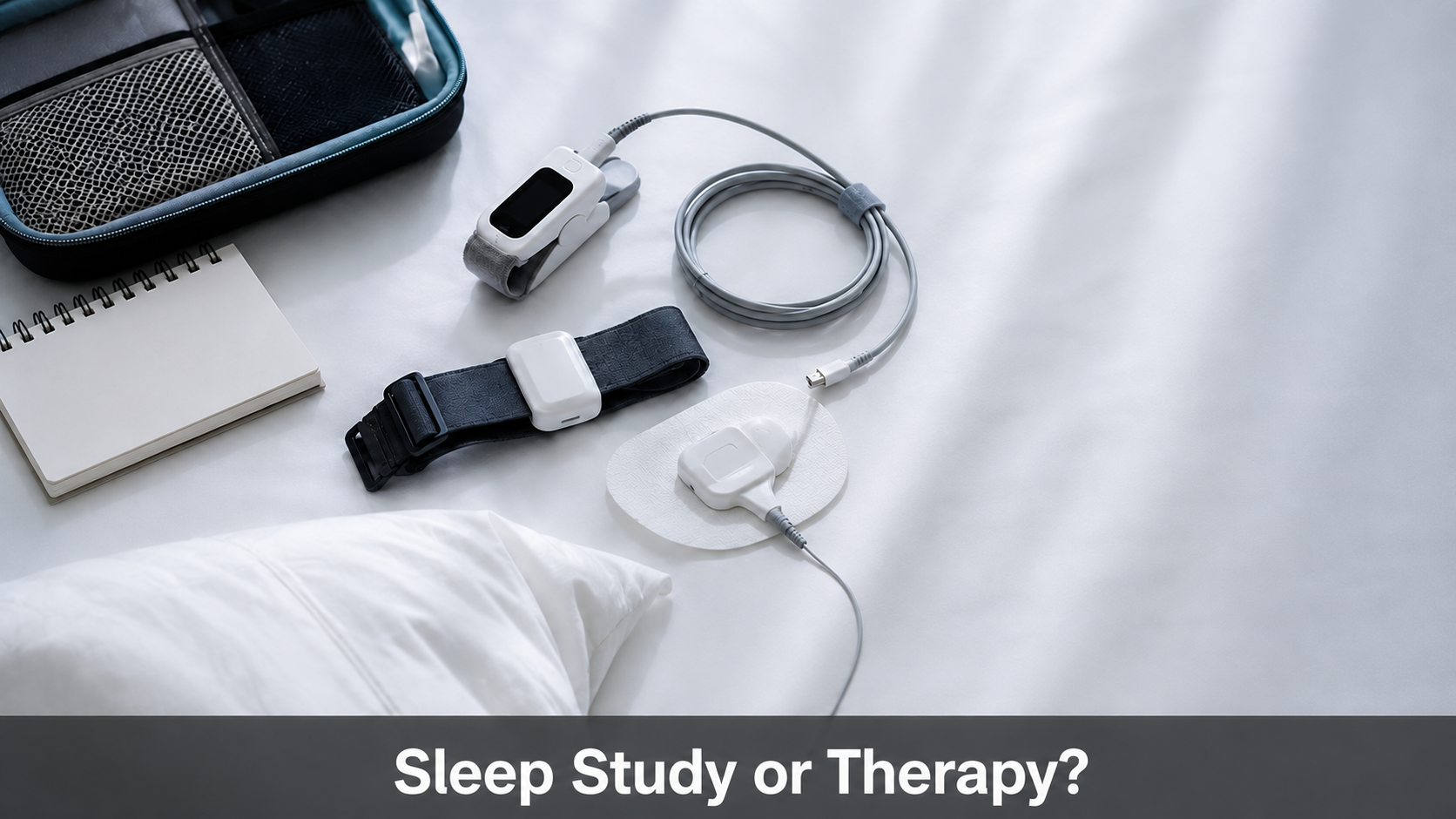
Do I Need a Sleep Study or Therapy? How to Tell Which One Is Right for You
Choosing between a sleep study or therapy is one of the most common crossroads in modern sleep medicine, and Dr. Avinesh Bhar, Board-Certified Sleep Physician at SLIIIP.com, sees patients land on the wrong path more often than people realize. A sleep study and sleep therapy solve very different problems, and picking the wrong one can cost you months of frustration.
SLIIIP’s board-certified sleep physicians can do sleep evaluations for sleep apnea. Virtual consultations in all 50 states. Home sleep tests shipped to your door.
Sleep Study or Therapy: The Core Difference
The simplest way to think about it is this. A sleep study looks for a physical problem with your sleep. Sleep therapy fixes the thoughts and habits that keep you awake. One measures what your body is doing at night. The other reshapes how your brain handles bedtime.
Both are powerful when matched to the right person. Both are wasted when used for the wrong problem.
CHECK YOUR SLEEP SYMPTOMS: TAKE THE 2 MINUTE QUIZ
TAKE THE QUIZ
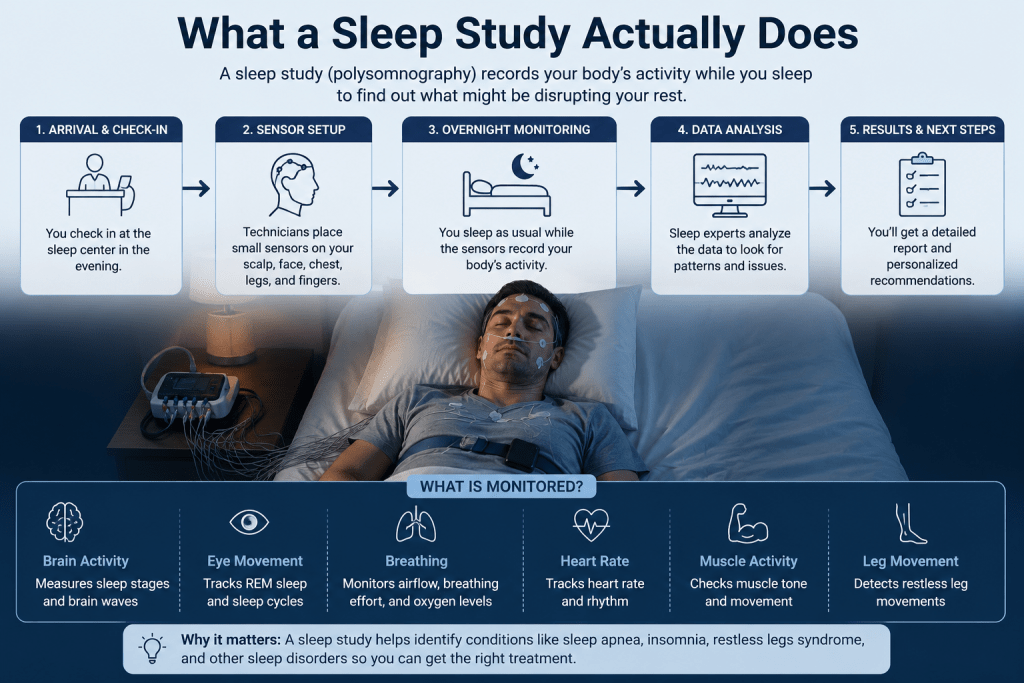
What a Sleep Study Actually Does
A sleep study records what is happening in your body while you sleep. It tracks your breathing, oxygen levels, heart rate, body position, and sleep stages.
The goal is to spot physical conditions like obstructive sleep apnea, central sleep apnea, periodic limb movement disorder, and other measurable issues.
There are two main types:
- Home sleep apnea test: A small device you wear at home for one or two nights. Easy, accurate for most adults, and shipped to your door by SLIIIP. Learn more in home sleep apnea testing and how to get a home sleep test.
- In-lab sleep study: Done overnight in a sleep center with full monitoring. Used for complex cases. See the comparison in home vs lab sleep tests.
According to the National Heart, Lung, and Blood Institute, sleep apnea is common, often missed, and linked to serious long-term health issues like high blood pressure, heart disease, and stroke. If a real medical issue is stealing your breath at night, no amount of therapy will fix it.
What Sleep Therapy Actually Does
Sleep therapy, most often Cognitive Behavior Therapy for Insomnia (CBT-I), retrains the brain to fall asleep, stay asleep, and stop fearing the bed. It is not talk therapy in the traditional sense. It is structured, time-limited, and focused on real behavior change.
CBT-I typically includes:
- Sleep restriction to rebuild sleep pressure
- Stimulus control to break the bed-and-anxiety link
- Cognitive work to challenge unhelpful sleep thoughts
- Relaxation training and wind-down routines
- Sleep hygiene basics
Most people see real change in 4 to 8 weeks. Results tend to last for years. Explore CBT-I for sleep disorders, see what CBT-I feels like week by week, and read the head-to-head in CBT-I vs sleep medications.
Signs You Need a Sleep Study First
If your body is the problem, you need data, not journaling. Book a sleep study first if you notice:
- Loud, chronic snoring that bothers a partner
- Waking up gasping, choking, or short of breath
- Witnessed pauses in breathing at night
- Morning headaches
- Severe daytime sleepiness, even after a full night in bed
- Falling asleep in meetings, while driving, or watching TV
- High blood pressure that is hard to control
- Heart rhythm issues like atrial fibrillation
- Restless legs at night
If any of these sound familiar, take our sleep apnea quiz and review the full list of signs of sleep apnea. Treating insomnia with CBT-I will never solve untreated apnea, and pushing harder on sleep habits can actually feel worse if breathing is the real issue.
Signs You Need Sleep Therapy First
If your sleep mechanics look fine but your brain refuses to settle, therapy is the stronger first step. Consider CBT-I if you mostly deal with:
- Trouble falling asleep for more than 30 minutes
- Waking up at 2 or 3 a.m. and lying awake for an hour or more
- Racing thoughts the moment your head hits the pillow
- Worry about not sleeping, which then keeps you up
- Sleep that has been disrupted for 3 or more weeks
- A reliance on sleeping pills you want to step away from
- Sleep that is worse on Sunday nights or before big days
You can dig deeper into whether I have insomnia or something else, how to fix insomnia naturally, and the sleeping pill scam. For users who want a no-pill route, see why CBT-I works when medications do not.
When You Might Need Both a Sleep Study and Therapy
Plenty of people need both. Roughly 30 to 50 percent of adults with chronic insomnia also have an underlying sleep disorder driving the symptoms, which is why so many CBT-I attempts fail without a sleep study first. Common combinations include:
- Sleep apnea paired with anxiety-driven insomnia
- Restless legs disorder paired with overthinking at night
- Shift work paired with conditioned arousal at bedtime
- Perimenopause paired with breathing changes during sleep
In those cases, the sleep study finds the medical piece. Therapy handles the behavior piece. Together they break the cycle that neither could break alone.
Sleep Study or Therapy: A Quick Decision Guide
Use this fast filter to decide your starting point.
Start with a sleep study if: you snore, gasp at night, wake unrefreshed, or have morning headaches.
Start with therapy if: you fall asleep fine on vacation but not at home, your mind races at bedtime, or you have been using sleeping pills you want to stop.
Start with both if: you tick boxes from both lists, or you have tried one path already without lasting results.
Still unsure? See is it worth getting tested for sleep apnea and do I need a sleep study.
What Happens at SLIIIP When You Are Not Sure
Most patients show up unsure whether they need a sleep study or therapy. That is normal, and it is exactly what SLIIIP is built for. Dr. Avinesh Bhar and the SLIIIP care team walk through your symptoms, history, and goals before pointing you toward the right path, not just the path that pays the most.
SLIIIP services include:
- Virtual sleep consultations with board-certified physicians in all 50 states
- Home sleep tests shipped to your door for at-home testing
- CBT-I support for chronic insomnia and anxious sleep
- Personalized treatment plans for snoring, apnea, and insomnia
- Insurance verification with most major carriers accepted
- Follow-up care and ongoing support
You leave the first visit with a clear answer, not another to-do list.


SLIIIP’s board-certified sleep physicians can do sleep evaluations for sleep apnea. Virtual consultations in all 50 states. Home sleep tests shipped to your door.
Frequently Asked Questions About Sleep Study or Therapy
- How do I know if I need sleep study or therapy?
Start with how you wake up. If you snore and feel exhausted, you likely need a sleep study. If you cannot fall or stay asleep but feel rested when you do, therapy is the stronger first step. - Can I just skip both and try over-the-counter sleep aids?
You can, but unresolved sleep apnea or chronic insomnia tends to come back stronger. Sleep aids treat symptoms, not the cause. - Is a home sleep study as accurate as a lab study?
For most adults with classic apnea symptoms, yes. Complex cases may still need a lab study, but home tests are widely accepted and far more comfortable. - How long does a sleep study take?
A home sleep test runs for one to two nights of normal sleep at home. A lab study is one overnight stay at a sleep center. - What does CBT-I cost compared to a sleep study?
Both are often covered by insurance. SLIIIP can verify benefits for both before you commit to a path. - Can therapy alone fix sleep apnea?
No. Sleep apnea is a breathing problem and needs medical treatment. Therapy can support better habits around treatment, but it cannot replace it. - Can a sleep study fix insomnia?
A sleep study can rule out medical causes, but it will not cure insomnia. Therapy or behavioral change handles that piece. - What if my sleep study is normal but I still cannot sleep?
That is actually a clear signal therapy is your next step. See normal sleep study for more. - Is CBT-I really better than sleeping pills?
For long-term insomnia, yes. Most major medical groups now recommend CBT-I as the first-line option over medication. - How fast does CBT-I work?
Most people see real change within 4 to 8 weeks. Some feel improvement in the first two weeks. - Can I do CBT-I online or virtually?
Yes. Virtual CBT-I is widely available and just as effective as in-person therapy for most people. - Do I need a referral for a sleep study?
With SLIIIP, no. You can book a virtual evaluation directly and a physician will order testing if it makes sense. - Can anxiety mimic sleep apnea symptoms?
Yes. Waking up with a racing heart can come from either anxiety or apnea, which is why a real evaluation matters. - Will my insurance cover a sleep study or therapy?
Most major carriers cover both. SLIIIP can verify your benefits in advance. - Can I take CBT-I and still use my CPAP machine?
Absolutely. Many patients combine apnea treatment with CBT-I for full sleep recovery. - What if I have already done a sleep study years ago?
Sleep can change a lot with weight, age, hormones, and stress. A repeat may be useful. See do I need another sleep study. - Are wearables a substitute for a sleep study?
No. Watches and rings can flag patterns, but they do not measure breathing the way a sleep study does. - Can hormones affect which path I need?
Yes. Perimenopause, thyroid issues, and pregnancy can all change sleep, and sometimes a study and therapy are both needed. - What if I have both apnea and insomnia?
That is more common than people think. SLIIIP can build a plan that treats both at the same time. - How do I get started?
Book a virtual sleep evaluation. From there, the physician will recommend a sleep study, therapy, or both based on your symptoms.
Ready to Stop Guessing?
You should not have to figure out sleep study or therapy on your own. One short virtual visit can replace months of trial and error and point you straight to the option that actually fixes your sleep.
SLIIIP’s board-certified sleep physicians can do sleep evaluations for sleep apnea. Virtual consultations in all 50 states. Home sleep tests shipped to your door.
Latest posts
-
Why Can’t I Wake Up Even After Getting Enough Sleep?
Last updated: October 2, 2026. Medically reviewed by Dr. Avinesh Bhar, Board-Certified Sleep Physician, SLIIIP.com. If you can’t wake up after enough sleep, the cause is usually not the number…
-
Why Does My Heart Rate Drop So Low While I Sleep?
Last updated: October 2, 2026. Medically reviewed by Dr. Avinesh Bhar, Board-Certified Sleep Physician, SLIIIP.com. Your heart rate drops low while sleeping mainly because your body needs less work from…
-
Why Are My Naps Never Refreshing?
Last updated: October 2, 2026. Medically reviewed by Dr. Avinesh Bhar, Board-Certified Sleep Physician, SLIIIP.com. Naps that leave you groggy usually come down to how long you sleep, when you…
Get updates
Spam-free subscription, we guarantee. This is just a friendly ping when new content is out.

