👉 Register for Free. How to Diagnose Sleep Apnea Faster in Primary Care – FREE Webinar by Dr. Audrey Wells. – Friday, April 24 at 12 PM ET


What Does My Oura Sleep Score Mean? A Sleep Physician Explains
Your Oura sleep score is a summary, not a verdict, and reading it that way changes how useful it becomes, says Dr. Avinesh Bhar, Board-Certified Sleep Physician at SLIIIP.com, who reviews wearable data with patients every week. One number is standing in for a whole night of physiology, which means it can be genuinely helpful and genuinely misleading at the same time. This guide breaks down what the ring measures, what each contributor is telling you, where the estimate gets shaky, and when a pattern in your data is worth a real medical evaluation.
SLIIIP’s board-certified sleep physicians can do sleep evaluations for sleep apnea. Virtual consultations in all 50 states. Home sleep tests shipped to your door.
What the Oura Sleep Score Actually Measures
The ring does not read your brain. It reads your body from a finger.
Sensors track your heart rate, heart rate variability, body movement, skin temperature, and blood oxygen levels through the night. An algorithm takes those signals and estimates how long you slept, how broken that sleep was, and roughly how the night divided into light, deep, and REM sleep. Those estimates get combined and weighted into a single number from 0 to 100.
The weighting is proprietary, which means no one outside the company can tell you exactly how much each piece counts. That is worth knowing before you treat a five point drop as meaningful. Our overview of wearable sleep trackers covers how this compares with other devices on the market.
CHECK YOUR SLEEP SYMPTOMS: TAKE THE 2 MINUTE QUIZ
TAKE THE QUIZ
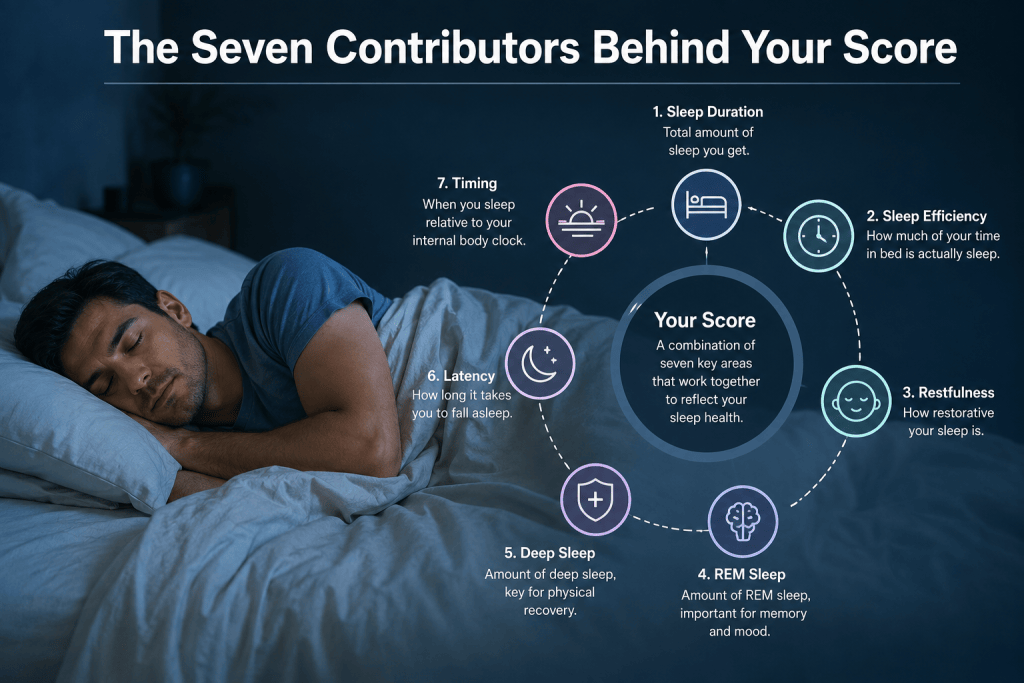
The Seven Contributors Behind Your Score
Tapping into the score reveals seven contributors. These are where the useful information lives.
Total Sleep. How much sleep you got, compared with what the app estimates you need. This is usually the heaviest hitter, and a short night drags the whole score down regardless of how good the rest looks. The Centers for Disease Control and Prevention publishes recommended sleep amounts by age group, which is a useful reality check against whatever target your Oura sleep score is measuring you against.
Efficiency. The share of your time in bed that you actually spent asleep. Lying awake for an hour before sleeping pulls this down even if total sleep is fine.
Restfulness. How still you were. Frequent movement, brief wakings, and tossing all register here.
REM Sleep. The estimated share of the night spent in REM. REM clusters in the second half of the night, so cutting your night short trims REM first.
Deep Sleep. The estimated share of slow wave sleep. This concentrates early in the night and declines naturally with age.
Latency. How long it took you to fall asleep. Both very long and very short latency can register as suboptimal, since falling asleep in under five minutes often signals real sleep debt.
Timing. Whether you slept at hours that line up with your circadian rhythm. Going to bed at 3 a.m. lowers this even if you slept eight solid hours.
If a contributor is in the red, that is your actual signal. The headline number just tells you to go look.
What the Number Ranges Mean
The bands are simple. A score of 85 or above is treated as optimal. Between 70 and 84 is good. Below 70 is a prompt to pay attention.
Two caveats matter more than the bands themselves.
First, your personal baseline beats the universal scale. Someone who consistently lands at 72 and feels fine is not in trouble. Someone who normally sits at 88 and drops to 74 for a week has a real change worth investigating, even though 74 is inside the good range.
Second, scores in the high nineties are designed to be rare. Chasing them is not a health goal.
Why a Ring Estimates Stages Rather Than Confirming Them
This is the part most people miss, and it explains a lot of confusing nights.
Sleep stages are formally defined by brain activity. The National Heart, Lung, and Blood Institute notes that sleep studies use sensors to record eye movements and brain activity in order to classify sleep phases and stages. A ring has none of that. It infers stages from heart rate patterns, movement, and temperature, which correlate with brain states without directly measuring them.
The practical result is that consumer wearables are reasonably good at telling asleep from awake and much less reliable at splitting sleep into specific stages. Treat your deep and REM percentages as rough trends over weeks, not as facts about last night.
This matters when people panic about low deep sleep numbers. If you want the physiology behind that stage, our guide on how to get more deep sleep is a better starting point than the app, and core sleep versus deep sleep untangles the naming conventions different devices use.
Common Reasons Your Score Drops
Most low scores have ordinary explanations.
Alcohol is the most reliable one. A couple of drinks in the evening typically shows up as elevated resting heart rate, suppressed REM, and lower restfulness. People often see this pattern before they consciously connect it.
A late or heavy meal raises heart rate overnight. So does a hard workout close to bedtime, an illness coming on, a warm room, and a stressful day that has not finished unwinding.
Travel and schedule shifts hit the timing contributor directly. So does a weekend of late nights, which is why Sunday scores often look worse than Wednesday scores. If your schedule has drifted, how to fix your sleep schedule covers the correction.
A poorly fitted ring also produces junk data. If it is loose, it may miss part of the night or misread movement as wakefulness.
When a Good Score Comes With a Bad Morning
This happens often, and it is worth taking seriously rather than dismissing.
The score reflects what the sensors detected. It cannot detect everything. If you wake up unrefreshed after a night, the app called an 87, the mismatch is information, not an error to argue with. Your own experience of your sleep is a legitimate data point.
Persistent daytime tiredness despite adequate measured sleep is one of the more common reasons people end up in a sleep clinic. Our articles on why you wake up tired and sleeping eight hours and still feeling tired walk through the usual causes.
There is also a documented flip side. Some people become anxious about their sleep data, which then worsens their sleep. If checking the app in the morning reliably sets your mood for the day, hiding the score for a few weeks is a reasonable experiment.
What Your Oura Sleep Score Cannot Tell You
Here is the boundary that matters most. A consumer wellness ring is not a diagnostic device, and no sleep score can rule a sleep disorder in or out.
It cannot count breathing events. Sleep apnea is measured by how many times per hour your breathing stops or becomes shallow, and that number comes from a validated sleep test, not from an algorithm on your finger. Someone with significant untreated apnea can still post decent scores.
It cannot distinguish insomnia from other causes of broken sleep. It cannot identify restless legs, periodic limb movements, or REM sleep behavior disorder. And its blood oxygen readings are wellness features, not clinical oximetry.
Wearable data can be a useful prompt. It is not a substitute for evaluation. The same limits apply to other devices, as covered in does the Apple Watch detect sleep apnea.
How to Use the Data Well
A few habits make tracking genuinely useful.
Look at weekly averages, not single nights. Night to night variation is normal and mostly noise.
Run experiments with one variable. Cut alcohol for two weeks. Move your last coffee earlier. Hold a fixed wake time. Then compare the averages.
Pay attention to resting heart rate and heart rate variability trends, which often shift before you notice feeling run down.
Give it time. Two weeks or more is needed before your baseline means anything.
And check the score against how you feel. When the two disagree consistently, trust your body and get a professional opinion.
Watch: Dr. Wells explains why sleep trackers don’t work
When to Stop Tracking and Get Tested
Dr. Avinesh Bhar points out that people frequently spend months optimizing habits around their tracker data when the underlying problem was never something a ring could see.
Get evaluated if you snore loudly, if someone has seen you stop breathing, if you wake gasping or with a dry mouth and morning headaches, if you are very sleepy during the day despite adequate time in bed, or if your sleep trouble has run past three months. Restless or crawling sensations in your legs at night point in a different direction and are also worth raising.
A home sleep test can settle the apnea question quickly, and it happens in your own bed. Chronic insomnia and when to get a sleep test covers the threshold, while do I have insomnia or something else helps sort which path applies to you.
Nothing here replaces personal medical advice, and no one should change a prescribed therapy or device setting based on a wearable reading. That conversation belongs with your clinician.
At Sliiip, we accept the following insurances:

SLIIIP’s board-certified sleep physicians can do sleep evaluations for sleep apnea. Virtual consultations in all 50 states. Home sleep tests shipped to your door.
Frequently Asked Questions
What is a good Oura sleep score?
Above 85 is treated as optimal, 70 to 84 as good, and below 70 as a prompt to pay attention. Your own baseline matters more than the universal bands.
Why is my score low when I feel fine?
Usually one contributor is dragging it down, often timing or efficiency. If you feel well and function well, a moderate score is not a problem to solve.
Why is my score high when I feel terrible?
The sensors detected an adequate night by their measures. Persistent tiredness despite good measured sleep is a reason to get evaluated rather than to argue with the app.
How accurate is the sleep staging?
Consumer wearables are decent at separating asleep from awake and less reliable at classifying specific stages. Read stage percentages as long term trends.
Can the ring detect sleep apnea?
No. It is a wellness device, not a diagnostic tool, and it cannot count breathing events. Diagnosis requires a validated sleep test.
Why does alcohol wreck my score?
It typically raises resting heart rate, lowers heart rate variability, suppresses REM, and increases restlessness. The effect often shows up even after one or two drinks.
Should I aim for a score of 100?
No. Very high scores are designed to be rare, and chasing them tends to create anxiety about sleep rather than better sleep.
How long before my data means anything?
Plan on at least two weeks of consistent wear to establish a personal baseline before drawing conclusions.
Does the ring count naps?
Naps are factored into your daily sleep totals. Long or late naps can affect both the score and your night, as covered in our guide to the benefits of napping.
What is the efficiency contributor?
The percentage of your time in bed spent actually asleep. Long stretches of lying awake lower it even when total sleep looks adequate.
Why is my deep sleep percentage so low?
Deep sleep declines naturally with age and concentrates early in the night. Alcohol, late meals, and a warm room all reduce it, and the estimate itself is imprecise.
Why is my REM sleep low?
REM clusters in the later cycles, so a short night trims it first. Alcohol and some medications also suppress it.
Does wearing the ring loosely affect readings?
Yes. A loose fit can cause missed data or misread movement. It should sit snugly without leaving a mark.
Is a single bad night worth worrying about?
No. Night to night variation is normal. Patterns across a week or more are what carry information.
Why do my weekend scores drop?
Later bedtimes shift the timing contributor and often come with alcohol and irregular wake times, which compounds the effect.
Can illness show up before I feel sick?
Elevated skin temperature, higher resting heart rate, and lower heart rate variability often appear a night or two before symptoms. It is a signal to rest, not a diagnosis.
Should I stop tracking if it makes me anxious?
If checking your score consistently affects your mood or your sleep, taking a break is reasonable. Anxiety about sleep data can itself worsen sleep.
What is latency and why does a short one count against me?
Latency is how long it takes to fall asleep. Falling asleep in under five minutes often signals significant sleep debt rather than excellent sleep.
How much sleep should I actually be getting?
Most adults need seven to nine hours, with individual variation. Age changes the recommended range.
When should I see a sleep doctor instead of adjusting habits?
If you snore loudly, gasp awake, feel very sleepy by day despite enough time in bed, or have struggled for more than three months, get evaluated.
SLIIIP’s board-certified sleep physicians can do sleep evaluations for sleep apnea. Virtual consultations in all 50 states. Home sleep tests shipped to your door.
Latest posts
-
Evie Ring Sleep Tracking Review: Does It Work?
Last updated: September 14, 2026. Medically reviewed by Dr. Avinesh Bhar, Board-Certified Sleep Physician, SLIIIP.com. The Evie Ring tracks sleep using a finger-based light sensor that estimates heart rate, movement,…
-
Do EEG Sleep Headbands Actually Track Sleep Accurately?
Last updated: September 14, 2026. Medically reviewed by Dr. Avinesh Bhar, Board-Certified Sleep Physician, SLIIIP.com. EEG sleep headbands, like the Dreem headband, use dry electrodes to record brain wave activity,…
-
Circular Ring Sleep Accuracy: What It Gets Right and Wrong
Last updated: September 14, 2026. Medically reviewed by Dr. Avinesh Bhar, Board-Certified Sleep Physician, SLIIIP.com. The Circular Ring estimates sleep stages, heart rate, and recovery using a finger-worn light sensor,…
Get updates
Spam-free subscription, we guarantee. This is just a friendly ping when new content is out.

