👉 Register for Free. How to Diagnose Sleep Apnea Faster in Primary Care – FREE Webinar by Dr. Audrey Wells. – Friday, April 24 at 12 PM ET

Can’t Sleep the Night Before an Exam? Here Is What to Do
If you can’t sleep the night before an exam, you are dealing with a normal stress response rather than a broken sleep system, according to Dr. Avinesh Bhar, Board-Certified Sleep Physician at SLIIIP.com. Your body is doing exactly what it evolved to do before something that matters, which is stay alert. Understanding that is not just reassurance. It changes what you should actually do about it.
Most advice for this situation fails because it treats the problem as a sleep problem. It is closer to an arousal problem. You are not struggling to sleep because you forgot how, you are struggling because your nervous system has decided tonight is not a good time to shut down. The rest of this guide covers why that happens, what to do in the moment, what makes it worse, and how to tell the difference between ordinary pre-exam nerves and something that has become a pattern.
SLIIIP’s board-certified sleep physicians can do sleep evaluations for sleep apnea. Virtual consultations in all 50 states. Home sleep tests shipped to your door.
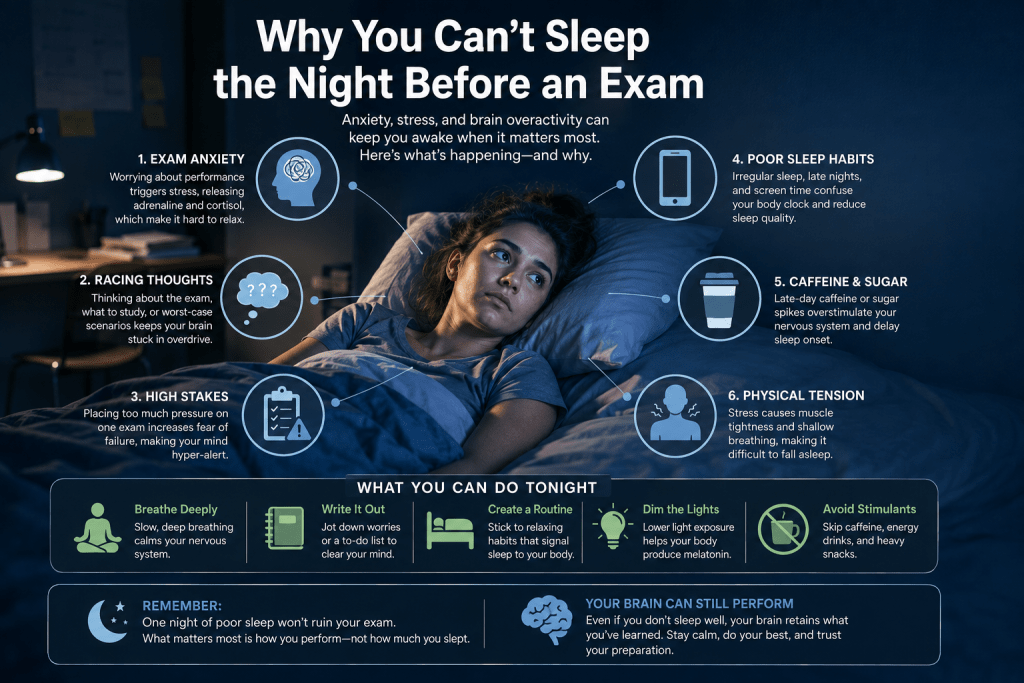
Why You Can’t Sleep the Night Before an Exam
Three things usually stack on top of each other.
Anticipatory arousal. Your body prepares for a demanding event by raising alertness. Heart rate stays a little higher, body temperature drops less than usual, and the mind keeps scanning. This is useful during the exam. It is unhelpful at 11:30 p.m.
Rumination. The mind runs loops: what will be on it, what you did not review, what happens if it goes badly. Each loop keeps arousal elevated, which keeps sleep away, which produces a new loop about not sleeping.
Pressure to sleep. This is the one most students create themselves. Deciding that you must fall asleep by a certain time turns sleep into a task with a deadline. Sleep is the one thing that gets further away the harder you chase it.
There is often a fourth factor. Many students studied right up until the moment they got into bed, sometimes with caffeine still active. The brain does not switch from high focus to sleep on command. It needs a transition, and cramming removes it.
The good news is that this kind of sleeplessness is usually self-limiting. It shows up before the exam and disappears after. If it does not, that is a different situation, covered further down.
CHECK YOUR SLEEP SYMPTOMS: TAKE THE 2 MINUTE QUIZ
TAKE THE QUIZ
What to Do While You Are Lying There Awake
These are ordered by how quickly they tend to help.
Stop tracking the time. Turn the clock away and put the phone face down across the room. Every time you calculate how many hours are left, you add pressure and restart the cycle.
Give up on sleeping, on purpose. Tell yourself that resting quietly with your eyes closed is the goal tonight, and sleep is optional. Lying still in the dark is genuinely restorative, and removing the demand often lets sleep arrive on its own.
If you are still awake after a long stretch, get up. Twenty to thirty minutes is the usual guidance. Go to another room, keep the lights low, and do something dull. Return when you feel drowsy. This keeps your bed associated with sleeping rather than with lying awake frustrated.
Slow your breathing. Longer exhales than inhales, for a few minutes. This is not magic, but it lowers physical arousal, which is the actual obstacle.
Unload the loop onto paper. Write down what you are worried about and anything you want to remember to do in the morning. Rumination often persists because the mind is trying to keep track of things.
Skip a full review session. Reopening your notes at 2:00 a.m. raises alertness and usually raises anxiety.
What Makes It Worse
A few common responses backfire.
Alcohol. It can shorten the time it takes to fall asleep while making the rest of the night more fragmented, which is the opposite of what you want.
Extra caffeine in the evening. Its effects last far longer than most people expect, and a late coffee during a final review session can be the reason you are awake now.
Scrolling. The phone is engaging by design, and engagement is arousal. It also reintroduces the clock.
Doing the math. Calculating that you will get four hours and eleven minutes has never helped anyone sleep.
Trying a new sleep aid the night before a test. Any substance you have not used before can produce grogginess or unexpected effects at exactly the wrong moment. If you take a prescribed sleep medication, do not change the dose or timing on your own before an exam. Talk with the prescribing clinician first.
For a broader look at what does and does not help with sleeplessness, our guide on fixing insomnia naturally covers the approaches with the most support behind them.
Setting Up the Evening So This Happens Less
Some of this is decided hours before you get into bed.
Stop studying earlier than feels comfortable. Give yourself thirty to forty-five minutes between closing the notes and lying down. This transition matters more than the extra review.
Prepare everything physically. Lay out clothes, ID, calculator, and anything else the exam requires. A surprising amount of nighttime rumination is logistical rather than academic.
Write tomorrow’s plan. What time you leave, what you will eat, what you will glance at in the morning. Once it is written, the mind can stop rehearsing it.
Keep the room cool and dark. Body temperature needs to fall for sleep to begin, and a warm room works against that.
Accept the number. Deciding in advance that you will be fine in six hours takes most of the pressure out of the night. Stress about sleeping is often more disruptive than the lost sleep itself.
If You Barely Slept, Here Is How to Handle Test Day
First, the reassurance is real. A single poor night before an exam has a much smaller effect on performance than most students fear, especially on material you already know well. Recall of well-learned information holds up reasonably well. What suffers is sustained attention and careful reading.
Practical adjustments for the day:
- Use caffeine, but moderately and early. A normal dose helps alertness. A triple dose adds jitteriness on top of tiredness.
- Eat something. Skipping breakfast after a bad night compounds the fog.
- Get outside light on the way in, which helps alertness more than most people realize.
- Read questions twice. Attention lapses cause misread questions more than forgotten content.
- Take a short nap if there is time before the exam. Around twenty minutes works best. Our overview of the benefits of napping covers the timing.
Do not spend the morning telling yourself you are going to do badly because you did not sleep. That expectation affects performance more reliably than tiredness does.
Watch: What is Sleep Apnea and How it Affects Me?
When It Is More Than Pre-Exam Nerves
Occasional sleeplessness before something important is ordinary. A pattern is not.
Dr. Avinesh Bhar notes that students often normalize months of difficulty falling asleep because it began during a stressful term, and the stress passed while the sleep problem stayed. Insomnia can begin with an identifiable trigger and then persist on its own, maintained by the habits that formed around it.
Worth raising with a clinician:
- Trouble falling or staying asleep at least three nights a week for three months or longer
- Sleeplessness that continues well after exams end
- Daytime exhaustion despite adequate time in bed
- Loud snoring, gasping at night, or waking with morning headaches
- Anxiety that has expanded well beyond exams
Stress-related sleeplessness that has become chronic is a recognized pattern, discussed further in our article on insomnia during periods of stress. If you are not sure which category you fall into, our guide on telling insomnia from something else is a practical starting point.
The National Heart, Lung, and Blood Institute describes sleep deficiency as covering both too little sleep and sleep of poor quality, and the Centers for Disease Control and Prevention publishes general guidance on adult sleep. Neither replaces an evaluation by a clinician who knows your history. Nothing in this article is a diagnosis.
At Sliiip, we accept the following insurances:

SLIIIP’s board-certified sleep physicians can do sleep evaluations for sleep apnea. Virtual consultations in all 50 states. Home sleep tests shipped to your door.
Frequently Asked Questions
Why can’t I sleep the night before an exam?
Anticipatory arousal, rumination, and pressure to fall asleep tend to stack on top of one another.
Is it normal to not sleep before a test?
Occasional sleeplessness before an important event is a common stress response.
What should I do if I can’t sleep the night before an exam?
Stop tracking the time, let go of the goal of sleeping, and get up briefly if you are still awake after a long stretch.
Should I get out of bed if I cannot fall asleep?
Getting up after about twenty to thirty minutes helps keep the bed associated with sleep rather than frustration.
Will one bad night ruin my exam?
A single poor night usually has a smaller effect than students fear, particularly on well-learned material.
Should I study more if I can’t sleep the night before an exam?
Reopening notes late at night tends to raise alertness and anxiety rather than help.
Does counting how many hours I have left help?
Calculating remaining hours generally increases pressure and makes falling asleep harder.
Can I use alcohol to fall asleep before a test?
Alcohol may shorten sleep onset while making the rest of the night more fragmented.
Should I take a sleep aid the night before an exam?
Trying an unfamiliar substance before a test risks grogginess at the wrong moment.
How much caffeine should I have after a sleepless night?
A normal morning dose supports alertness, while very large amounts often add jitteriness.
Is lying awake with my eyes closed useless?
Quiet rest has real value, and removing the pressure to sleep often allows sleep to arrive.
Why does my mind race at night before exams?
Rumination keeps arousal elevated, and elevated arousal keeps the mind running.
Does writing my worries down actually help?
Putting concerns and tasks on paper can reduce the mental effort of holding onto them.
How long before bed should I stop studying?
Thirty to forty-five minutes gives the mind time to shift out of high focus.
Can breathing exercises help me fall asleep?
Slow breathing with longer exhales lowers physical arousal, which is often the obstacle.
Should I nap before my exam if I did not sleep?
A nap of about twenty minutes can restore alertness without leaving you groggy.
Why do I sleep fine except before tests?
Sleeplessness tied to a specific upcoming event usually reflects situational arousal rather than an ongoing sleep disorder.
When does pre-exam sleeplessness become insomnia?
Difficulty sleeping at least three nights a week for three months or more is the usual threshold for evaluation.
Can anxiety and sleep problems feed each other?
Anxiety and poor sleep commonly reinforce one another in both directions.
When should I talk to a sleep physician?
If sleeplessness or daytime exhaustion continues after exam season ends, an evaluation is reasonable.
SLIIIP’s board-certified sleep physicians can do sleep evaluations for sleep apnea. Virtual consultations in all 50 states. Home sleep tests shipped to your door.
Latest posts
-
Why Are My Naps Never Refreshing?
Last updated: October 2, 2026. Medically reviewed by Dr. Avinesh Bhar, Board-Certified Sleep Physician, SLIIIP.com. Naps that leave you groggy usually come down to how long you sleep, when you…
-
Is Sleeping Too Much a Sleep Disorder?
Last updated: October 2, 2026. Medically reviewed by Dr. Avinesh Bhar, Board-Certified Sleep Physician, SLIIIP.com. Sleeping too much is not always a sleep disorder, but it can be a sign…
-
Why Does My Insomnia Get Worse After Stopping Sleep Medication?
Last updated: October 2, 2026. Medically reviewed by Dr. Avinesh Bhar, Board-Certified Sleep Physician, SLIIIP.com. Insomnia can get worse after stopping sleep medication for three main reasons. They are rebound…
Get updates
Spam-free subscription, we guarantee. This is just a friendly ping when new content is out.

