👉 Register for Free. How to Diagnose Sleep Apnea Faster in Primary Care – FREE Webinar by Dr. Audrey Wells. – Friday, April 24 at 12 PM ET


Beyond the CPAP: What a Comprehensive Sleep Care Plan Actually Looks Like
A good sleep care plan goes far beyond a single machine, and Dr. Avinesh Bhar, Board-Certified Sleep Physician at SLIIIP.com, explains that real, lasting results come from a personalized approach, not a one-size-fits-all device.
When you look past the CPAP alone, you find a whole journey of evaluation, options, and follow-up built around you.
Many people think sleep care begins and ends with a CPAP machine. It is a well-known tool, and it helps many people. But it is only one piece of a much bigger picture.
SLIIIP’s board-certified sleep physicians can do sleep evaluations for sleep apnea. Virtual consultations in all 50 states. Home sleep tests shipped to your door.
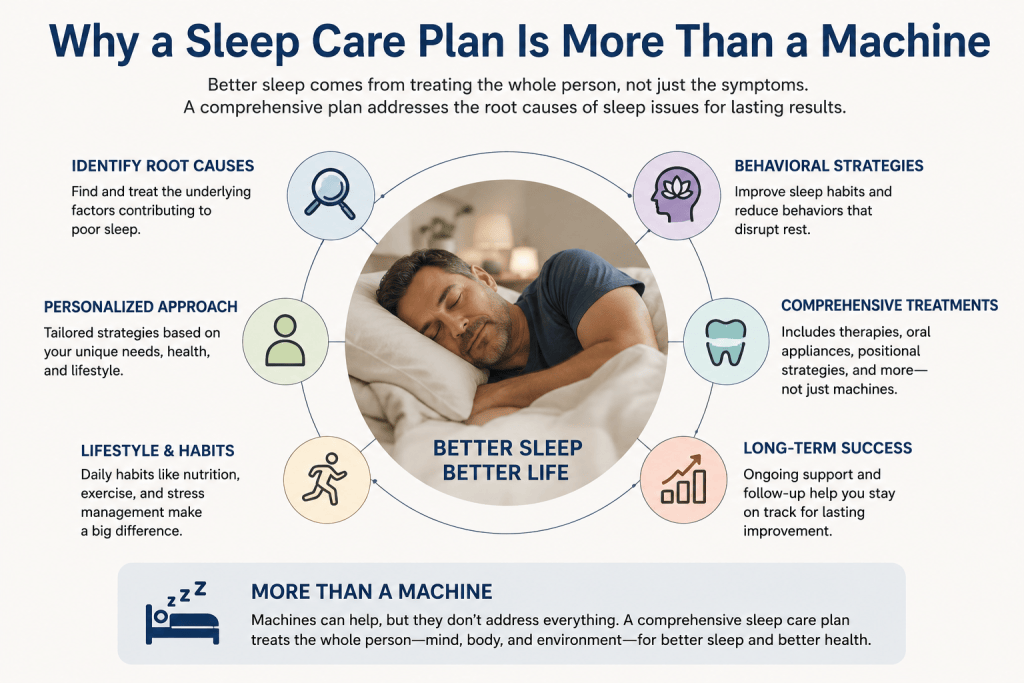
Why a Sleep Care Plan Is More Than a Machine
The CPAP is a familiar name in sleep health, and for good reason. It helps many people breathe more easily at night. But a machine on its own is not a plan. A plan is the bigger strategy that surrounds it.
A real sleep care plan starts with understanding your sleep, then matches the right approach to your needs. That means looking at the whole person, not just handing over one device and hoping it sticks. The plan is personal, and it can change over time.
The goal of this article is to show what complete care looks like. It is educational, not a promise of any single result. If you are unsure where to begin, a sleep telemedicine visit can help you map out your first steps.
CHECK YOUR SLEEP SYMPTOMS: TAKE THE 2 MINUTE QUIZ
TAKE THE QUIZ
Step One: A Proper Evaluation
Every good plan begins with understanding the problem. You cannot match the right approach to your needs without first knowing what is happening during your sleep. This is why evaluation comes first.
A clear evaluation is the foundation of any sleep care plan, because the right next step depends on the right diagnosis. A sleep physician reviews your history and symptoms, and a sleep study gathers real data about your nights.
Our overview of what sleep apnea is explains why this matters, and our list of signs to watch for can help you spot clues. A home sleep test done in your own bed makes this first step simple and convenient.
Step Two: Personalized Options
Once you understand your sleep, the next step is choosing an approach that fits you. CPAP is one option, but it is not the only one. For some people, other paths suit their comfort, their lifestyle, and their needs better.
A comprehensive plan offers more than one path, so you and your physician can find the best fit instead of forcing one device. This is where care becomes truly personal. The right choice depends on your situation, not on a default.
Some people do well with a CPAP, and our review of a travel-friendly CPAP option shows how far the technology has come. Others prefer a smaller device, which we cover in our article on oral appliance versus CPAP and our guide to oral appliance therapy.
Step Three: Lifestyle and Daily Habits
A complete plan does not stop at a device. Daily habits play a real role in how well you sleep. Things like your schedule, your wind-down routine, and your overall wellness all support better rest.
Lifestyle habits are a key part of any plan, working alongside any device to support healthier nights. Small, steady changes can make a meaningful difference over time. These habits are within your control, which is empowering.
For ideas on building rest-friendly routines, our guide on reasons for improving the quality of your sleep shares practical steps. The Centers for Disease Control and Prevention also offers clear guidance on healthy sleep habits.
Step Four: Follow-Up and Support
Here is a part many people overlook. Care does not end the day you start a device or change a habit. The best results come from checking in, adjusting as needed, and getting support along the way.
Ongoing follow-up turns a one-time fix into a lasting plan that grows with you. Your needs can change, and a plan that includes support can change with them. This is what separates true care from a single handoff.
A physician can help you fine-tune your approach, answer questions, and keep you on track. Our article on the value of an online sleep doctor explains how convenient, ongoing care can work.
The Role of Virtual Care
One of the biggest barriers to sleep care used to be access. Lab visits, long waits, and travel kept many people from getting help. Virtual care has changed that. Now you can get expert support from home.
Virtual care makes a comprehensive plan easier to start and easier to stick with, all from the comfort of home. You can meet a physician by video, get a test shipped to your door, and follow up without rearranging your life.
This convenience matters because the best plan is one you can actually follow. Our article on why people choose sleep telemedicine explains the benefits in plain terms. The National Heart, Lung, and Blood Institute also shares helpful guidance on healthy sleep.
Putting It All Together
A complete plan weaves these pieces into one journey. You start with a clear evaluation. You choose a personalized approach. You support it with healthy habits. And you stay connected with follow-up care.
The whole point of a sleep care plan is to fit your life, not the other way around. When all the pieces work together, you have a real strategy for better rest, not just a single tool.
For a reminder of why this effort is worth it, our article on the importance of sleep covers the wide-reaching benefits of good rest. Better sleep touches nearly every part of your day.
Watch: CPAP Side Effects and Solutions by Dr. Bhar (SLIIIP)
When to Talk With a Sleep Physician
If you snore, wake gasping, or feel tired no matter how long you sleep, it may be time to start your own plan. The first step is simply getting clear answers.
A sleep evaluation is the starting point for a plan built around you, your needs, and your life. Dr. Avinesh Bhar and the SLIIIP team can review your sleep history, talk through your symptoms, and arrange a home sleep test if needed.
The process is built around convenience. You can meet a board-certified physician through a virtual visit, and a home sleep test can be shipped right to your door. There is no need to spend a night in a lab. From there, your physician can help you build a complete approach that fits your life.
At Sliiip, we accept the following insurances:

SLIIIP’s board-certified sleep physicians can do sleep evaluations for sleep apnea. Virtual consultations in all 50 states. Home sleep tests shipped to your door.
Frequently Asked Questions
- What is a sleep care plan?
It is a personalized strategy for better sleep that includes evaluation, the right approach for you, healthy habits, and ongoing follow-up, not just a single device. - Is a CPAP the only option for sleep apnea?
No. CPAP helps many people, but it is one of several options. A comprehensive plan offers more than one path so you can find the best fit. - Why does evaluation come first?
The right next step depends on the right diagnosis. A clear evaluation is the foundation of any plan, since it shows what is happening during your sleep. - What is a home sleep test?
It is a sleep study you can do in your own bed. The device is shipped to you, and the results help a physician understand your nights. - What are some alternatives to CPAP?
Options can include smaller devices like oral appliances, along with lifestyle changes. A physician helps match the right approach to your needs. - Do habits really matter in sleep care?
Yes. Lifestyle habits work alongside any device to support healthier nights, and small, steady changes can make a real difference over time. - Why is follow-up important?
Ongoing follow-up turns a one-time fix into a lasting plan. Your needs can change, and a plan with support can change with them. - Can I get sleep care from home?
Yes. Virtual care lets you meet a physician by video, get a test shipped to your door, and follow up without rearranging your life. - Is a comprehensive plan more expensive?
A plan is about the right approach for you, not necessarily more cost. Virtual care can make expert support more accessible and convenient. - How do I know which approach is right for me?
A physician reviews your evaluation and helps match the best option to your comfort, lifestyle, and needs, rather than using a default. - Do I have to visit a lab for a sleep evaluation?
No. SLIIIP offers virtual consultations in all 50 states, and home sleep tests can be shipped to your door. - What if a CPAP did not work for me before?
A comprehensive plan can explore other options and adjust your approach. A poor experience with one tool does not close the door. - How much sleep do adults need?
Most adults benefit from at least seven hours of sleep each night to support overall health and wellbeing. - Can a plan change over time?
Yes. A good plan grows with you, with follow-up that lets a physician fine-tune your approach as your needs change. - Is an oral appliance part of a plan?
It can be. For some people, a smaller device suits their comfort and lifestyle. A physician can help you decide what fits. - What makes virtual care convenient?
You can start and stick with a plan from home, with video visits, a test shipped to your door, and easy follow-up. - Why does sleep matter so much?
Good sleep supports nearly every part of your day, from energy and focus to mood and overall wellbeing. - What happens during a sleep evaluation?
A physician reviews your sleep history and symptoms and, if needed, arranges a home sleep test to better understand your nights. - Where do I start with a comprehensive plan?
The first step is a clear evaluation. From there, a physician helps you build an approach that fits your life. - How do I get started with SLIIIP?
You can schedule a virtual sleep evaluation online, and a board-certified physician will guide you through each step of your plan.
Take the Next Step Toward Better Rest
Real sleep care is a journey, not a single machine. With the right evaluation, personalized options, healthy habits, and ongoing support, you can build a plan that truly works for you. You do not have to navigate it alone.
SLIIIP’s board-certified sleep physicians can do sleep evaluations for sleep apnea. Virtual consultations in all 50 states. Home sleep tests shipped to your door.
Latest posts
-
Why Can’t I Wake Up Even After Getting Enough Sleep?
Last updated: October 2, 2026. Medically reviewed by Dr. Avinesh Bhar, Board-Certified Sleep Physician, SLIIIP.com. If you can’t wake up after enough sleep, the cause is usually not the number…
-
Why Does My Heart Rate Drop So Low While I Sleep?
Last updated: October 2, 2026. Medically reviewed by Dr. Avinesh Bhar, Board-Certified Sleep Physician, SLIIIP.com. Your heart rate drops low while sleeping mainly because your body needs less work from…
-
Why Are My Naps Never Refreshing?
Last updated: October 2, 2026. Medically reviewed by Dr. Avinesh Bhar, Board-Certified Sleep Physician, SLIIIP.com. Naps that leave you groggy usually come down to how long you sleep, when you…
Get updates
Spam-free subscription, we guarantee. This is just a friendly ping when new content is out.

