👉 Register for Free. How to Diagnose Sleep Apnea Faster in Primary Care – FREE Webinar by Dr. Audrey Wells. – Friday, April 24 at 12 PM ET

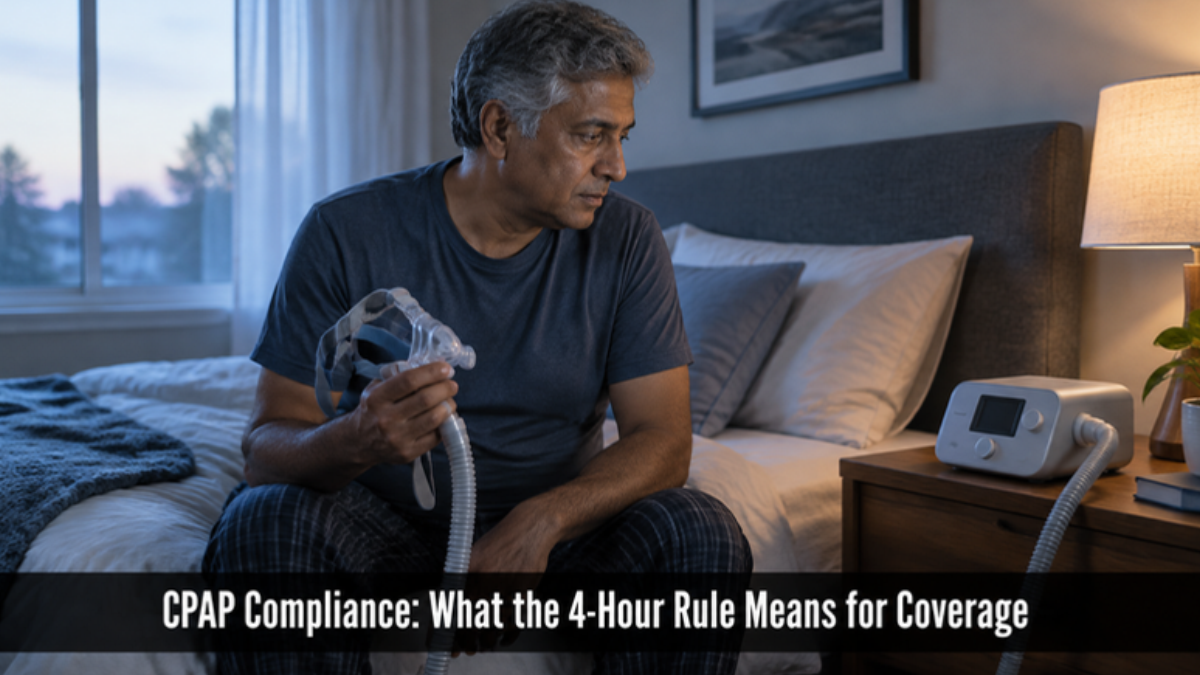
CPAP Compliance: What the 4-Hour Rule Means for Coverage
Last updated: November 5, 2026. Medically reviewed by Dr. Avinesh Bhar, Board-Certified Sleep Physician, SLIIIP.com.
CPAP compliance means using your machine often enough to meet your insurer’s rule. For Medicare, that rule is at least 4 hours a night on 70% of nights. You must reach it during 30 days in a row in your first 3 months.
Your machine records your usage, and many insurers use that record to decide whether to keep paying. Missing the target can put your coverage at risk, but it does not mean treatment has failed you.
SLIIIP’s board-certified sleep physicians can do sleep evaluations for sleep apnea. Virtual consultations in all 50 states. Home sleep tests shipped to your door.

What Is CPAP Compliance?
CPAP compliance is the minimum use an insurer expects before it keeps paying for your machine and supplies. You may also hear it called adherence, which is the word Medicare’s policy uses.
The rule is about payment, not about how much sleep you need. Meeting the minimum does not mean your sleep apnea is fully treated. It means you have shown enough use for your plan to keep covering the equipment. Your care team still looks at how you feel and what your data shows.
What Is the 4-Hour Rule for CPAP?
The 4-hour rule means using CPAP for at least 4 hours a night on at least 70% of nights in a 30-day stretch. Medicare’s coverage policy for PAP devices says this 30-day stretch can fall anytime during your first 3 months of use. You do not need perfect use for the full 3 months. You need one qualifying stretch of 30 days in a row.

The math is simple. AASM guidance on PAP and insurance explains that 70% works out to at least 21 nights out of 30. That leaves room for 9 nights that miss the mark. A night of 3 hours and 50 minutes still counts as a miss, even though you wore the mask.
Watch: Dr. Wells answers how do you find the right CPAP mask?
Here is how the Medicare timeline usually works:
- Day 1: Your therapy starts, and your 12-week trial begins.
- First 3 months: You need one 30-day stretch that meets the 4-hour, 70% rule.
- Day 31 to day 91: Your treating practitioner re-evaluates you and reviews your usage data.
- After the trial: Coverage can continue if your record shows good use and better symptoms.
How Does Your Insurance Know How Much You Use CPAP?
Your insurance usually knows because your machine tracks your use and that data gets shared. Usage data is often sent to your equipment supplier or doctor’s office, or read from a memory card. Many newer machines send it wirelessly, so you may not need to do anything.
The report often shows more than hours. It may list your mask leak, your pressure, and the breathing events that still occur during therapy. Your clinician can use those details to find out why a night went badly. That makes the report useful for your care, not just for your insurer.
Ask your supplier early how you can see your own numbers. Many people find an app or machine screen helpful. Checking once a week is often enough to spot a problem before your 30-day window runs out.
Do Private Insurers Follow the Same Rule?
Many private insurers follow rules like Medicare’s, but they do not all match. AASM notes that plans often use similar standards and advises confirming the details with your insurer. A few direct questions can save you a surprise bill later.
Ask your plan or supplier these questions in your first week:
- How many hours a night do I need, and on what share of nights?
- How long is my trial, and when does the window close?
- Do I need a follow-up visit, and by what date?
- Does a video visit count, or must the visit be in person?
- Am I renting this machine or buying it?
That visit question matters. Medicare’s policy calls for an in-person re-evaluation, so check with your plan or supplier before you book a follow-up. Rules can also differ under Medicare Advantage and private plans.
What Happens If You Fail CPAP Compliance?
If you do not meet the rule, your insurer may stop paying for your machine and supplies. AASM warns that a rental machine may have to go back, and you may have to pay out of pocket to continue. Under Medicare’s policy, continued coverage is denied when the criteria are not met.
Timing can change the outcome. Medicare’s policy says a late re-evaluation that shows benefit can restart coverage from the date of that visit. So a missed visit is worth fixing quickly. Call your clinician’s office as soon as you notice the gap.
Rental rules matter too. Medicare’s coverage page says it pays a supplier to rent a machine for 13 months of continuous use, and then you own it. After your Part B deductible, you generally pay 20% of the approved amount if your supplier accepts assignment. A coverage gap can complicate that path, so ask your supplier how it affects you.
Can You Requalify for CPAP After Failing the Trial?
Yes, people on Medicare who fail the first 12-week trial can requalify. Medicare’s policy requires two things: an in-person visit to work out why therapy failed, and a repeat sleep test in a facility. That test can be a diagnostic, titration, or split-night study. A home test does not meet this requalifying step under the policy.
Private plans may handle this differently, so ask yours before you schedule anything. Either way, bring your usage reports and notes on what went wrong. Details like mask leaks or trouble with pressure give your clinician a place to start.
Does Missing the Target Mean CPAP Will Not Work for You?
No, an early miss does not always predict long-term results. Research presented at the American Thoracic Society’s 2026 conference reviewed more than 132,000 patients at Kaiser Permanente Southern California. That health system offers CPAP whether or not people hit early targets, which made the question easier to study.
About 51% of those patients did not meet Medicare’s 90-day criteria. More than one in three of them were still using CPAP a year later. Many who missed the 4-hour target still averaged at least 2 hours a night. This was conference research, so it should be read with some caution. Even so, it suggests an early struggle does not settle the question.
Keep one point clear, though. Your coverage rule has not changed because of this study. You still need to meet your plan’s rule, or work with your clinician on the next step.
How Can You Meet the CPAP Compliance Rule?
Start by fixing what wakes you up or makes you take the mask off. Most compliance problems come down to a specific problem you can name, such as a leak or dry mouth. Write down what happened on each bad night, then bring those notes to your care team.
- Mask problems: Ask your supplier about a different size or style. Our guide on preventing mask leaks when you sleep on your side covers common fit issues.
- Pressure that feels too strong: Learn the signs your CPAP pressure may need a review, then talk with your clinician.
- Bloating or gas: Read about aerophagia and CPAP, which is linked to swallowing air during therapy.
- Dry nose or mouth: Review our CPAP humidifier settings guide and ask what is right for your device.
- Trouble adjusting: Wear the mask while you read or watch TV, so it feels familiar before bedtime.
- Travel or illness: Before you skip nights, read about taking a break from CPAP and check your window dates.
When to See a Doctor
See a doctor if you are not on track by about week 3 of your trial. By then, you still have time to fix problems and meet the 30-day stretch.
Waiting until the last week leaves far fewer options.
Book a visit sooner if you still snore loudly with CPAP, wake up gasping, or feel very sleepy during the day. Those signs can point to a therapy problem, even if your usage hours look fine. Dr. Avinesh Bhar of SLIIIP.com has urged people to stop normalizing fatigue, and that advice applies to CPAP users too. If you use your machine and still feel exhausted, that deserves a closer look.
Also speak up if your insurer or supplier says you are at risk of losing coverage.
SLIIIP works with many insurance plans. Check your benefits before your visit so you know what to expect.

SLIIIP’s board-certified sleep physicians can do sleep evaluations for sleep apnea. Virtual consultations in all 50 states. Home sleep tests shipped to your door.
CPAP Compliance FAQ
What does CPAP compliance mean?
It means using your machine enough to meet your insurer’s minimum. For Medicare, that is at least 4 hours on 70% of nights during a 30-day stretch.
How many nights do I need for CPAP compliance?
You need at least 21 nights of 4 or more hours in a 30-day stretch. That equals 70% of nights.
Does the 30-day stretch have to be my first month?
No, Medicare’s policy allows any 30 days in a row during your first 3 months. Your stretch still has to finish in time for your plan’s review.
How long is the Medicare CPAP trial?
Medicare describes a 12-week trial of CPAP therapy. Continued coverage depends on a re-evaluation and documented benefit.
When is the follow-up visit due for Medicare?
Medicare’s policy places it no sooner than day 31 and no later than day 91 after you start therapy. Confirm the exact date with your clinician’s office.
Can a video visit count as my CPAP re-evaluation?
Medicare’s policy calls for an in-person re-evaluation. Ask your plan or supplier before you book, since rules can vary.
Do private insurers use the 4-hour rule?
Many use similar rules, but plans differ. Call your insurer or supplier to confirm yours.
How does my insurer see my CPAP data?
Your machine records use, and the data may go to your supplier or doctor’s office. Some machines send it wirelessly, while others use a memory card.
What happens if I miss the compliance target?
Your insurer may stop paying for the machine and supplies. A rented machine may also have to be returned.
Can I requalify for CPAP on Medicare?
Yes, you can requalify after a failed 12-week trial. Medicare requires an in-person visit and a repeat sleep test in a facility.
Does a home sleep test count for Medicare requalification?
Medicare’s policy calls for a facility-based Type 1 study for this step. Ask your clinician how to arrange it.
Does a night under 4 hours count at all?
It does not count toward the 70% target, but it is still part of your usage record. Any use may still give you some benefit, so keep trying.
Is 4 hours of CPAP enough?
Four hours is an insurance minimum, not a sleep goal. Ask your clinician how much use makes sense for you.
Does failing compliance mean CPAP does not work for me?
No, not necessarily. Research presented in 2026 found that over a third of people who missed early targets were still using CPAP a year later.
Does compliance matter after I own my machine?
It may still affect your supplies, depending on your plan. Ask your insurer what it requires for refills.
Who owns the CPAP machine under Medicare?
Medicare pays a supplier to rent it for 13 months of continuous use. After that, you own the machine.
Can I change my CPAP settings to make it more comfortable?
Do not change prescribed settings on your own. Ask your clinician to review your data and decide if a change makes sense.
What should I do if my mask keeps leaking?
Ask your supplier to check your size and style. Write down when leaks happen, because the pattern can help them find the cause.
Can I skip CPAP when I travel or feel sick?
Talk with your clinician first, and check your trial dates before skipping nights. Missed nights can make the 30-day target harder to reach.
When should I call my doctor about compliance?
Call as soon as you notice you are falling behind, ideally by week 3. Also call if you feel very tired despite using CPAP.
SLIIIP’s board-certified sleep physicians can do sleep evaluations for sleep apnea. Virtual consultations in all 50 states. Home sleep tests shipped to your door.
Latest posts
-
Sleep Apnea and Heart Failure: The Link and When to Test
Last updated: November 6, 2026. Medically reviewed by Dr. Avinesh Bhar, Board-Certified Sleep Physician, SLIIIP.com. Sleep apnea and heart failure often show up in the same person, and often it…
-
CPAP Compliance: What the 4-Hour Rule Means for Coverage
Last updated: November 5, 2026. Medically reviewed by Dr. Avinesh Bhar, Board-Certified Sleep Physician, SLIIIP.com. CPAP compliance means using your machine often enough to meet your insurer’s rule. For Medicare,…
·
-
Sleep Study Near Me: How to Find the Right One
Last updated: November 5, 2026. Medically reviewed by Dr. Avinesh Bhar, Board-Certified Sleep Physician, SLIIIP.com. To find a sleep study near you, start with the directory of accredited sleep centers…
Get updates
Spam-free subscription, we guarantee. This is just a friendly ping when new content is out.

