👉 Register for Free. How to Diagnose Sleep Apnea Faster in Primary Care – FREE Webinar by Dr. Audrey Wells. – Friday, April 24 at 12 PM ET


How Many Hours of Sleep Before an Exam Should You Get?
Students who ask how many hours of sleep before an exam want one clear number, and Dr. Avinesh Bhar, Board-Certified Sleep Physician at SLIIIP.com, gives one while explaining why the nights leading up to test day carry just as much weight. For most college and high school students, seven to nine hours is the target range the night before a test. That range is not a lucky guess. It matches the amount of sleep that adult brains generally need to move information from short-term storage into longer-term storage, and it leaves room for the deeper stages of sleep that tend to arrive later in the night.
The tricky part is that a single good night cannot undo two weeks of short nights. Sleep works like a running balance, not a switch you flip the evening before an exam. This guide covers the target number, how to build a schedule you can actually keep, what to do when you are already behind, and when trouble sleeping before a test may point to something worth discussing with a physician.
SLIIIP’s board-certified sleep physicians can do sleep evaluations for sleep apnea. Virtual consultations in all 50 states. Home sleep tests shipped to your door.
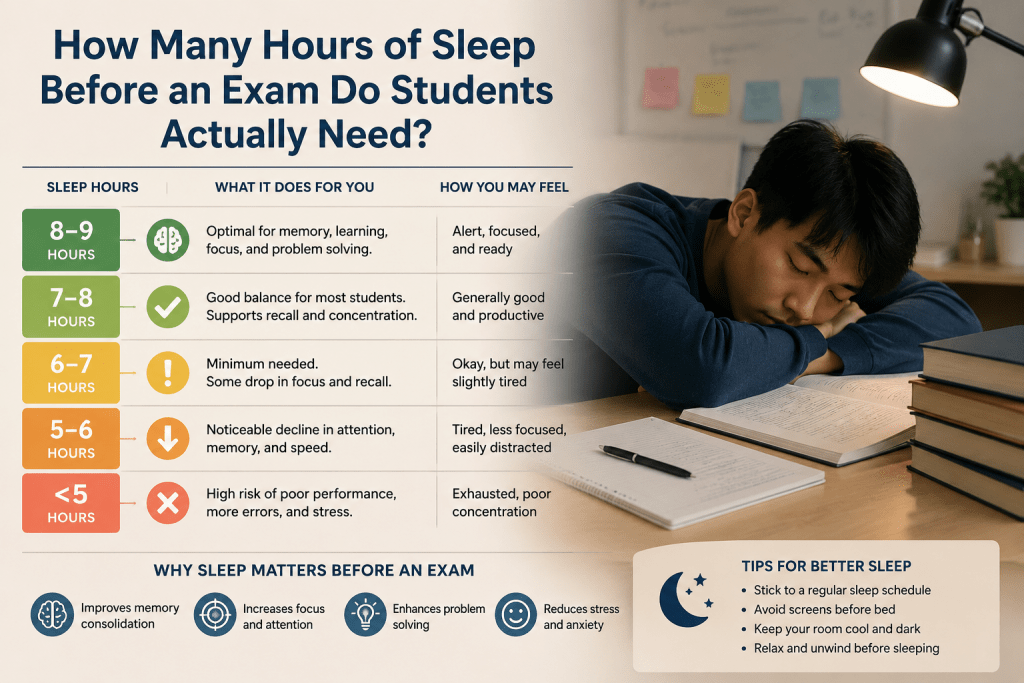
How Many Hours of Sleep Before an Exam Do Students Actually Need?
Age is the first thing that sets the number. The Centers for Disease Control and Prevention groups sleep guidance by age band, and most university students fall into the adult range of seven or more hours per night. Teenagers still in high school sit in a higher band, closer to eight to ten hours, because their bodies are still developing.
A practical target for exam season looks like this:
- High school students, ages 13 to 18: eight to ten hours
- College and graduate students, age 18 and up: seven to nine hours
- Anyone recovering from several short nights: aim for the top of your range
Notice that none of these numbers drop below seven. That floor matters. Studies on attention and reaction time tend to show measurable slowing once nightly sleep falls under about six hours, and the effect builds night after night. A student running on five hours for a week may feel normal while performing well below their own baseline.
There is also a difference between hours in bed and hours asleep. Most people need a bit of a buffer. If your target is eight hours of sleep, plan for roughly eight and a half hours in bed so that the time spent falling asleep does not eat into the total.
CHECK YOUR SLEEP SYMPTOMS: TAKE THE 2 MINUTE QUIZ
TAKE THE QUIZ
Why the Nights Before the Exam Matter More Than the Last One
Students often treat the night before a test as the only one that counts. It is the one they can control, so it gets all the attention. The research points somewhere else. Sleep in the days after you study appears to be closely tied to how well that material sticks.
Here is the general pattern. When you study a set of terms, dates, or formulas, that information is initially held in a fragile state. During sleep, the brain replays and reorganizes recent activity, which is associated with stronger and more durable recall later on. Skip the sleep and the material is still there in some form, but it tends to be harder to retrieve under pressure.
This is why a student who studies steadily for two weeks and sleeps eight hours a night usually walks in better prepared than a student who studies the same total hours in three sleepless days. Sleep is not time away from studying. It is part of how studying turns into memory.
If you want to understand how much of your nightly total is doing this heavy lifting, our guide on how much core sleep you need breaks down the portion of the night that matters most.
Building an Exam Week Sleep Schedule You Can Keep
A schedule only helps if you follow it. The most common mistake is designing something perfect and abandoning it by Tuesday. Start with your wake time, since exams usually fix that for you, and count backward.
Step one: lock your wake time. If your exam starts at 9:00 a.m. and you need ninety minutes to get ready and travel, your alarm is set for 7:00 a.m. Keep that same wake time every day of exam week, including weekends.
Step two: count backward to bedtime. For an eight hour target plus buffer, 7:00 a.m. means lights out around 10:30 p.m.
Step three: build a wind down block. Give yourself thirty to forty-five minutes between closing your notes and closing your eyes. Cramming right up to the moment you lie down tends to leave the mind churning.
Step four: shift gradually. If your current bedtime is 1:00 a.m. and your target is 10:30 p.m., move in fifteen to twenty minute steps across several nights. Jumping two and a half hours in one evening usually ends with staring at the ceiling.
Step five: protect the morning light. Getting daylight shortly after waking helps anchor the body clock, which makes the earlier bedtime easier to hold as the week goes on.
What to Do When You Are Already Short on Sleep
Sometimes the schedule falls apart before it starts. Maybe a project ran long or you got sick. The question then becomes damage control rather than optimization.
Sleeping some is meaningfully better than sleeping none. If it is 2:00 a.m. and your exam is at 9:00 a.m., going to bed now for five hours is generally a better call than pushing through until morning. Full nights without sleep are associated with slower processing speed, weaker attention, and more careless errors, which is a poor trade for a few extra hours of review.
Short daytime naps can help take the edge off. A nap of about twenty minutes is long enough to lift alertness without dropping you into deep sleep, which is what tends to cause that heavy, foggy feeling on waking. Our overview of the benefits of napping covers timing in more detail.
Caffeine has a place here, but the timing matters. Its effects last far longer than most people assume, and a late afternoon coffee can quietly push back your bedtime the night before your next exam. If you are testing over several days, keep caffeine to the morning.
One thing worth saying plainly: if you take a prescribed sleep or stimulant medication, do not change the dose or timing on your own before an exam. Talk to the prescribing clinician first.
Sleep Quality Counts, Not Just the Hours
Two students can both spend eight hours in bed and wake up in completely different shape. Time in bed is only part of the picture.
If you regularly sleep a full night and still wake up tired, the hours may not be the problem. Fragmented sleep, frequent brief awakenings, or breathing disruptions during the night can all reduce how restorative that time actually is. The National Heart, Lung, and Blood Institute describes how sleep deficiency covers both insufficient sleep and sleep of poor quality.
Signs that quality may be the issue include loud snoring, waking with a dry mouth or headache, gasping or choking at night, and daytime sleepiness that does not match how long you slept. If any of that sounds familiar, our article on why you may feel exhausted no matter how much you sleep is a useful starting point.
Watch: Dr. Wells explains what are the effects of poor sleep?
When Trouble Sleeping Before Exams Deserves a Closer Look
Nerves before a big test are normal. Most students have a restless night now and then, and it resolves once the exam is over. A pattern that continues outside of exam season is a different situation.
Dr. Avinesh Bhar notes that students sometimes assume years of unrefreshing sleep are simply part of student life, when a treatable sleep condition may be involved. Conditions such as obstructive sleep apnea are associated with daytime fatigue, difficulty concentrating, and morning headaches. These overlap heavily with what students expect from a heavy course load, which is part of why the underlying issue can go unaddressed for a long time.
Concentration problems in particular are worth attention. Our piece on sleep apnea and brain fog explains why mental clarity often tracks with sleep quality. If you are wondering whether a formal evaluation makes sense, this guide on whether you need a sleep study walks through the usual reasons a physician would recommend one.
Nothing here is a diagnosis, and none of it replaces a conversation with a clinician who knows your history.
At Sliiip, we accept the following insurances:

SLIIIP’s board-certified sleep physicians can do sleep evaluations for sleep apnea. Virtual consultations in all 50 states. Home sleep tests shipped to your door.
Frequently Asked Questions
How many hours of sleep before an exam is ideal?
Seven to nine hours for college students and eight to ten hours for high school students.
Is it better to sleep or study the night before an exam?
For most students, sleeping is the stronger choice once you have covered the material at least once.
Should I pull an all-nighter before a test?
Going without sleep entirely is associated with slower thinking and more errors on test day.
Is four hours of sleep enough before an exam?
Four hours is well below the recommended range and generally leaves attention and recall reduced.
Is six hours of sleep enough before an exam?
Six hours is below the adult target and the shortfall tends to build across several days.
Does sleeping more the night before make up for a bad week?
One longer night helps, but it does not fully reverse the effects of repeated short nights.
What time should I go to bed before a morning exam?
Count back eight to nine hours from your wake time, then add thirty minutes of buffer.
Should I nap on exam day?
A short nap of about twenty minutes can help alertness without leaving you groggy.
How long before an exam should I stop studying?
Give yourself thirty to forty-five minutes to wind down before you try to sleep.
Does caffeine before an exam help or hurt?
Morning caffeine can support alertness, while late caffeine often interferes with that night’s sleep.
Why can I not sleep the night before a test?
Pre-exam alertness is common, and a consistent schedule during the week usually helps more than anything done that night.
Does sleep really help memory?
Sleep is associated with stronger retention of recently learned material.
How many hours of sleep before an exam do medical and graduate students need?
The same adult range of seven to nine hours applies regardless of program.
Is it bad to change my sleep schedule during exam week?
Large sudden shifts are hard to hold, so move your bedtime in small steps instead.
Should I wake up early to review before an exam?
Cutting sleep to add review time often costs more in performance than it gains in content.
Can exercise help me sleep during exam week?
Regular daytime activity is associated with easier sleep onset for many people.
Does screen use before bed affect exam sleep?
Late screen use can delay sleep onset, so a short break before bed is a reasonable habit.
What if I wake up in the middle of the night before an exam?
Brief awakenings are common, and getting out of bed only if you are still awake after a long stretch is a standard approach.
How many hours of sleep before an exam do I need if I am sick?
Aim for the top of your range and speak with a clinician about the illness itself.
When should I see a sleep physician about exam week sleep problems?
If poor sleep or daytime sleepiness continues outside of exam season, an evaluation is reasonable.
SLIIIP’s board-certified sleep physicians can do sleep evaluations for sleep apnea. Virtual consultations in all 50 states. Home sleep tests shipped to your door.
Latest posts
-
Why Are My Naps Never Refreshing?
Last updated: October 2, 2026. Medically reviewed by Dr. Avinesh Bhar, Board-Certified Sleep Physician, SLIIIP.com. Naps that leave you groggy usually come down to how long you sleep, when you…
-
Is Sleeping Too Much a Sleep Disorder?
Last updated: October 2, 2026. Medically reviewed by Dr. Avinesh Bhar, Board-Certified Sleep Physician, SLIIIP.com. Sleeping too much is not always a sleep disorder, but it can be a sign…
-
Why Does My Insomnia Get Worse After Stopping Sleep Medication?
Last updated: October 2, 2026. Medically reviewed by Dr. Avinesh Bhar, Board-Certified Sleep Physician, SLIIIP.com. Insomnia can get worse after stopping sleep medication for three main reasons. They are rebound…
Get updates
Spam-free subscription, we guarantee. This is just a friendly ping when new content is out.

