👉 Register for Free. How to Diagnose Sleep Apnea Faster in Primary Care – FREE Webinar by Dr. Audrey Wells. – Friday, April 24 at 12 PM ET

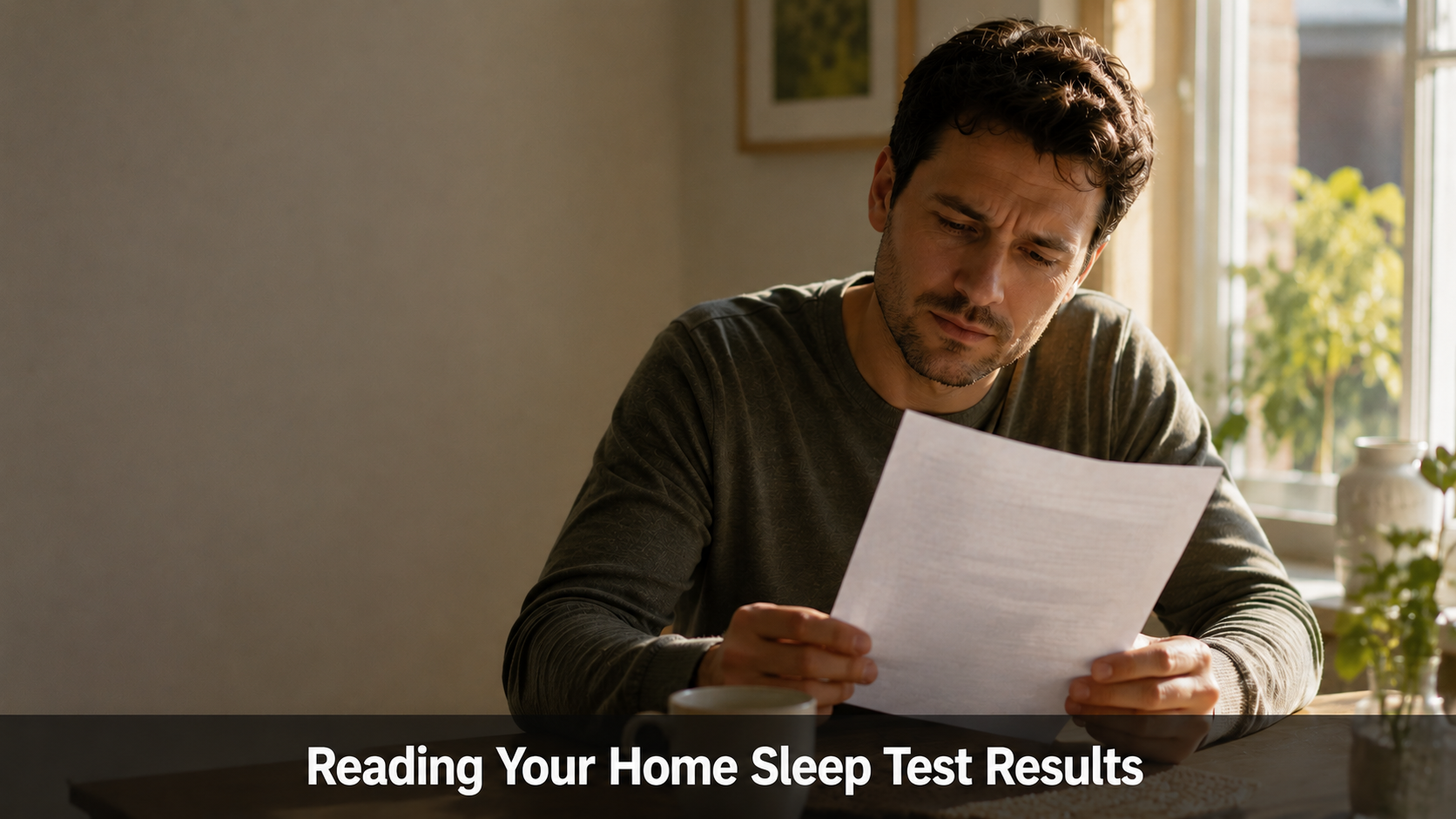
How to Read Your Home Sleep Test Results: A Patient’s Guide
Your home sleep test results arrive as a dense page of numbers and abbreviations, and Dr. Avinesh Bhar, Board-Certified Sleep Physician at SLIIIP.com, says learning what those numbers mean helps you walk into your follow-up ready to ask the right questions.
This guide explains the most common terms on the report in plain language, but it does not replace a diagnosis from your own physician. Only a licensed sleep doctor can read the full picture, confirm what is going on, and decide what comes next for you.
SLIIIP’s board-certified sleep physicians can do sleep evaluations for sleep apnea. Virtual consultations in all 50 states. Home sleep tests shipped to your door.

What a Home Sleep Test Actually Measures
A home test uses a small set of sensors to track your breathing while you sleep. It usually records airflow through your nose, the effort your chest makes, your oxygen levels, your heart rate, and sometimes your body position and snoring.
The device does not measure brain waves the way a full lab study does, so it focuses on breathing rather than sleep stages. That is why a home test is great for spotting breathing problems but is not used to study every kind of sleep issue.
When you mail the device back, software turns the raw signals into a report. A sleep physician then reviews that report. If you want a refresher on the test itself, see our overview of the home sleep apnea test and how it works.
CHECK YOUR SLEEP SYMPTOMS: TAKE THE 2 MINUTE QUIZ
TAKE THE QUIZ
Understanding Your AHI Score
The AHI, or Apnea-Hypopnea Index, is usually the headline number on the page. It counts how many times per hour your breathing either stopped (apnea) or got very shallow (hypopnea).
The AHI is the single number most doctors look at first, because it shows how often your breathing was interrupted across the night. A higher number means more interruptions per hour.
Here is the simple math. If the device recorded 30 events over 6 hours of sleep, your AHI would be about 5. The report does this calculation for you and prints the final value. To go deeper on this metric, our guide to what is a good AHI score on CPAP breaks it down further.
The AHI Severity Scale
Most reports group the AHI into ranges. These ranges are widely used, though your doctor weighs them against your symptoms and health history.
An AHI under 5 events per hour is generally considered normal for adults. An AHI of 5 to 14 falls in the mild range. An AHI of 15 to 29 is often called moderate. An AHI of 30 or more sits in the severe range.
These cutoffs are a starting point, not a verdict, since two people with the same number can feel very different. Someone with a lower number but heavy daytime fatigue may still need attention, while a higher number with mild symptoms still deserves a careful look.
For a closer comparison of these tiers, our piece on mild vs severe sleep apnea explains how severity shapes the conversation.
Oxygen Levels on Your Home Sleep Test Results
Your home sleep test results also show how your blood oxygen behaved through the night. This is one of the most useful parts of the report.
You will likely see an average oxygen level and a lowest reading, sometimes called the nadir or O2 minimum. Healthy oxygen saturation usually sits in the mid to high 90s. Big dips in oxygen can matter as much as the AHI, so doctors look closely at how low your levels fell and how often.
You may also see the ODI, or Oxygen Desaturation Index. This counts how many times per hour your oxygen dropped by a set amount. A high ODI often tracks with a high AHI, but not always.
If any of these oxygen numbers worry you, do not try to judge them alone. Share them with your physician, who can place them in the context of your overall health.
Common Terms and Abbreviations You Will See
Reports are full of shorthand. Here are a few you may spot beyond AHI and ODI.
RDI, the Respiratory Disturbance Index, is similar to AHI but can include smaller breathing events. It is sometimes a little higher than the AHI.
Total recording time and total sleep time tell you how long the device ran and how much of that it counted as sleep. A short recording can make the results less reliable.
Supine AHI shows your event rate while lying on your back. Many people have far more events on their back than on their side. If your back-sleeping number is much higher, your sleeping position may be playing a real role.
If the alphabet soup gets confusing, our sleep telemedicine glossary defines these terms in everyday language.
What Body Position and Snoring Data Tell You
Many home devices log your body position and your snoring. These extra details add color to the raw breathing numbers.
Position data shows whether your events clustered while you slept on your back. Snoring data shows how loud and how often you snored. Together they help your doctor see patterns, not just totals.
Position-related findings can open up simple options, since some people improve a lot just by avoiding back sleeping. Your physician decides whether that applies to you, but the data starts the conversation.
Why a Doctor Must Interpret Your Home Sleep Test Results
It is tempting to read your home sleep test results and reach your own conclusion. That is a mistake. A report is data, not a diagnosis.
A single night can underestimate or overestimate what is really happening, which is one reason a trained physician reviews the full report. A short recording, a sensor that slipped off, or an unusual night can all skew the numbers.
A sleep physician compares your data to your symptoms, your medical history, and your risk factors. They can tell whether a normal-looking report still needs a closer look or whether a borderline number is meaningful for you. Our article on the normal sleep study explains why a clean report does not always close the case.
Dr. Avinesh Bhar and the SLIIIP team can walk you through your report over a virtual visit and explain what each number means for your situation.
What Happens After You Get Your Results
Once your physician reviews the report, you will talk through the findings together. If the results point to a breathing problem, your doctor explains the options and what fits your life.
If the test is unclear or the recording was too short, you may be asked to repeat it. This is common and nothing to worry about. Our guide on whether you need another sleep study covers when a retest makes sense.
If a breathing problem is confirmed, your doctor will discuss a plan with you. You can learn more about the general landscape in our overview of sleep apnea treatment options.
Simple Habits While You Wait for Your Follow-Up
These tips support general sleep wellness. They are not medical advice and do not change what your report says, but they can help you feel more rested while you wait to review your results.
Keep a steady bedtime and wake time, even on weekends. A regular rhythm helps your body settle.
Limit caffeine and alcohol in the evening, since both can fragment your sleep and affect how you feel.
Try sleeping on your side if back sleeping feels worse for you. Note that this is a comfort tip, not a treatment.
Write down your daytime symptoms, like fatigue, morning headaches, or trouble focusing. Bringing that list to your visit gives your doctor useful context.
This section offers general wellness tips only. It is not a diagnosis or treatment plan. For anything related to your breathing, your heart, or your medications, talk with your own physician or a licensed sleep specialist.
Watch: Home sleep test that tests for sleep disorders
Trusted Sources on Sleep and Sleep Apnea
To understand why healthy sleep matters, the CDC sleep resources explain how rest connects to your overall health. For a plain-language medical overview of the condition many home tests screen for, the NHLBI guide to sleep apnea is a reliable, clear source.
At Sliiip, we accept the following insurances:

SLIIIP’s board-certified sleep physicians can do sleep evaluations for sleep apnea. Virtual consultations in all 50 states. Home sleep tests shipped to your door.
Frequently Asked Questions
How do I read my home sleep test results?
Start with the AHI, which counts breathing interruptions per hour, then check your oxygen levels and any position data. Use this as background, but let your physician give you the official interpretation.
What is a normal AHI on a home sleep test?
For adults, an AHI under 5 events per hour is generally considered normal. Your doctor still reads that number alongside your symptoms and health history.
What does AHI stand for?
AHI stands for Apnea-Hypopnea Index. It measures how many times per hour your breathing stopped or became very shallow during the recording.
What is the difference between AHI and RDI?
AHI counts apneas and hypopneas, while RDI, the Respiratory Disturbance Index, can also include smaller breathing events. RDI is sometimes a little higher than AHI.
What is a good oxygen level on the report?
Healthy oxygen saturation usually sits in the mid to high 90s. Your doctor pays attention to how low your oxygen fell and how often, not just the average.
What does ODI mean?
ODI is the Oxygen Desaturation Index. It counts how many times per hour your blood oxygen dropped by a set amount during the night.
Can I diagnose myself from the report?
No. The report is data, not a diagnosis. Only a licensed physician can confirm what the numbers mean for you and decide on next steps.
Why is my back-sleeping number higher?
Many people have more breathing events while lying on their back. The supine AHI on your report shows this, and your doctor can explain whether position matters in your case.
What if my AHI is borderline?
A borderline number is read in context. Your symptoms, your medical history, and your oxygen data all help your doctor decide whether it is meaningful for you.
How accurate is a home sleep test?
Home tests are reliable for screening breathing problems, but a single night can sometimes miss or overstate things. That is why a physician reviews the full report.
What does total sleep time mean?
It is how much of the recording the device counted as actual sleep. A short total sleep time can make the results less reliable and may call for a retest.
Will I need a repeat test?
Sometimes. If the recording was too short or the signals were unclear, your doctor may ask you to test again. This is common and not a cause for concern.
Does a normal report mean nothing is wrong?
Not always. A clean report can still miss a problem, especially with strong daytime symptoms. Your physician decides whether more testing is needed.
What is a hypopnea?
A hypopnea is a period of shallow breathing where airflow drops but does not fully stop. The report counts these alongside full pauses to build the AHI.
How long should the recording be?
Most tests aim for several hours of sleep so the numbers are reliable. Very short recordings may not give your doctor enough to work with.
Can my heart rate data tell me anything?
Your heart rate is part of the picture your physician reads, but it is not something to interpret on your own. Bring questions about it to your visit.
What if my results are different from how I feel?
This happens. Numbers and symptoms do not always match, which is exactly why a trained doctor reviews both together before drawing conclusions.
Do I bring my report to my appointment?
Yes. Having your report and a list of your symptoms ready helps your physician give you a clear, personal explanation during the visit.
Are home test results covered by insurance?
Coverage varies by plan. You can check your specific benefits with SLIIIP before you test, so there are no surprises later.
Can SLIIIP explain my home sleep test results online?
Yes. SLIIIP’s board-certified sleep physicians can review your report over a virtual visit and explain what each number means, with care available in all 50 states.
Take the Next Step Toward Clear Answers
A page of numbers does not have to feel like a foreign language. Knowing the basics helps, but the real value comes from a physician who reads your report against your symptoms and history. That is how a list of figures becomes a clear plan.
SLIIIP’s board-certified sleep physicians can do sleep evaluations for sleep apnea. Virtual consultations in all 50 states. Home sleep tests shipped to your door.
Latest posts
-
Why Can’t I Wake Up Even After Getting Enough Sleep?
Last updated: October 2, 2026. Medically reviewed by Dr. Avinesh Bhar, Board-Certified Sleep Physician, SLIIIP.com. If you can’t wake up after enough sleep, the cause is usually not the number…
-
Why Does My Heart Rate Drop So Low While I Sleep?
Last updated: October 2, 2026. Medically reviewed by Dr. Avinesh Bhar, Board-Certified Sleep Physician, SLIIIP.com. Your heart rate drops low while sleeping mainly because your body needs less work from…
-
Why Are My Naps Never Refreshing?
Last updated: October 2, 2026. Medically reviewed by Dr. Avinesh Bhar, Board-Certified Sleep Physician, SLIIIP.com. Naps that leave you groggy usually come down to how long you sleep, when you…
Get updates
Spam-free subscription, we guarantee. This is just a friendly ping when new content is out.

