👉 Register for Free. How to Diagnose Sleep Apnea Faster in Primary Care – FREE Webinar by Dr. Audrey Wells. – Friday, April 24 at 12 PM ET

Narcolepsy Symptoms: Early Signs and When to Get Tested
Narcolepsy symptoms can hide behind years of ordinary tiredness, which is why Dr. Avinesh Bhar, Board-Certified Sleep Physician at SLIIIP.com, urges anyone battling relentless daytime sleepiness to learn the warning signs. At SLIIIP.com, patients meet with board-certified sleep physicians through virtual consultations available nationwide in all 50 states, and home sleep tests are shipped directly to your door. Feeling sleepy after a poor night is normal, but nodding off in the middle of a conversation or a meal is a different story, and it deserves a closer look.
SLIIIP’s board-certified sleep physicians can do sleep evaluations for sleep apnea. Virtual consultations in all 50 states. Home sleep tests shipped to your door.
What Is Narcolepsy?
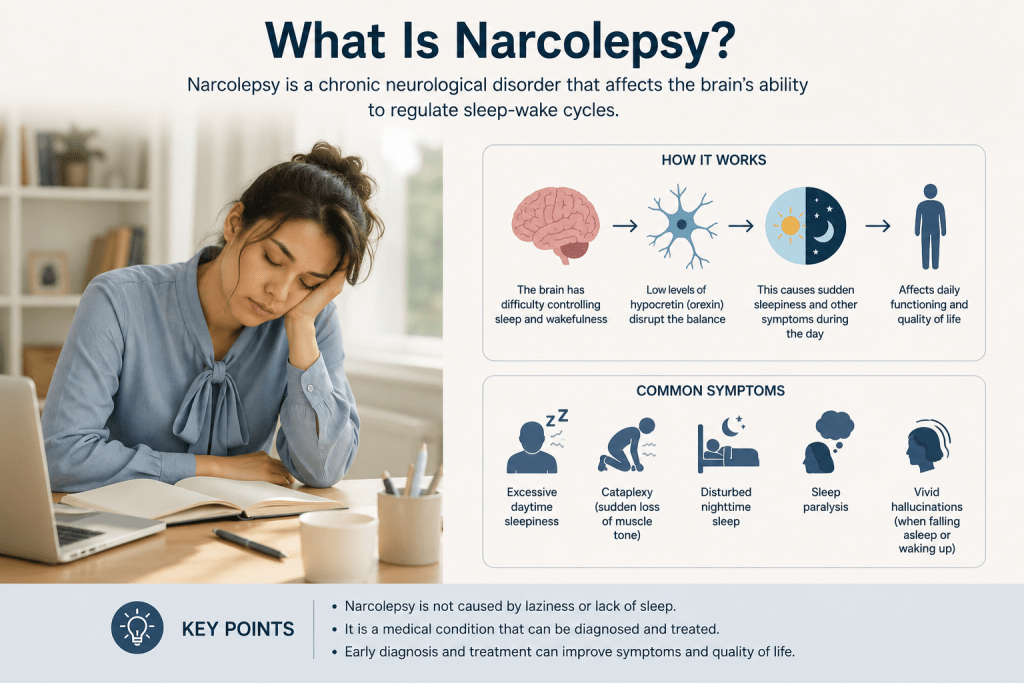
Narcolepsy is a long-term neurological condition that affects how the brain controls the cycle of sleep and wakefulness. The hallmark is overwhelming daytime sleepiness that does not go away no matter how much rest a person gets. People with the condition can fall asleep suddenly, sometimes within seconds, at moments when they very much want to stay awake.
The disorder is uncommon, and it is likely underrecognized, in part because the main complaint, feeling tired, is so easy to blame on a busy life. Many people live with it for years before they get answers. It can begin in childhood, the teen years, or early adulthood, and it affects both men and women.
There are two main forms. Type 1 involves a symptom called cataplexy, which is a sudden loss of muscle control triggered by strong emotion. Type 2 does not include cataplexy but still brings the same heavy daytime sleepiness. Both types share the same core problem of a brain that struggles to keep sleep and wakefulness in their proper lanes.
CHECK YOUR SLEEP SYMPTOMS: TAKE THE 2 MINUTE QUIZ
TAKE THE QUIZ
Common Narcolepsy Symptoms
The narcolepsy symptoms most people recognize fall into a familiar cluster, though not everyone experiences all of them.
Excessive daytime sleepiness is the central feature. This is more than a mid-afternoon slump. It is a constant, heavy pull toward sleep that can strike while eating, talking, working, or even driving. Short naps may bring brief relief, only for the fog to return an hour or two later.
Cataplexy is the most distinctive sign. During an episode, a person stays fully aware while their muscles suddenly go weak. It may be as small as a drooping eyelid or slurred speech, or as dramatic as buckling knees. Laughter, surprise, or excitement often set it off.
Sleep paralysis is another common experience. This is a brief inability to move or speak while falling asleep or waking up. It can feel frightening, but it usually passes within seconds to a couple of minutes.
Vivid, dreamlike hallucinations at the edge of sleep round out the classic picture. These can feel intensely real and sometimes overlap with sleep paralysis, which makes them especially unsettling.
Broken nighttime sleep is easy to overlook but very common. Even though people with the condition are sleepy all day, their nights are often restless and fragmented. Some also have automatic behaviors, where they keep doing a routine task while half asleep and later cannot remember it.
What Causes Narcolepsy?
Researchers are still piecing together the full story, but the science has advanced a great deal. In type 1, the condition is associated with the loss of brain cells that make a chemical messenger called orexin, also known as hypocretin. This messenger helps keep you awake and steadies the timing of dream sleep. When those cells decline, the sleep-wake system loses its anchor.
Current research suggests this cell loss may be linked to an autoimmune process, in which the body’s own defenses mistakenly target these cells. Genetics appear to play a part as well, since certain inherited markers are more common in people with the condition. In some cases, an infection or other trigger may set the process in motion. Type 2 is less well understood, and orexin levels are usually normal.
None of this means narcolepsy is caused by poor habits or a lack of willpower. It is a medical condition rooted in brain chemistry, and only a qualified clinician can sort out what is happening in an individual case.
Narcolepsy or Something Else?
Because narcolepsy symptoms overlap with several more common problems, it is easy to head down the wrong path. Overwhelming daytime sleepiness has many possible sources, and most of them are not narcolepsy.
Sleep apnea is the biggest one to rule out. It causes breathing pauses that fragment sleep and leave people exhausted during the day. The overlap in tiredness is why understanding sleep apnea symptoms matters so much before jumping to conclusions. Simple insufficient sleep, shift work, and certain medications can also mimic the picture.
Mood is another area of confusion. Low energy and heavy fatigue can look like depression, and the two can even occur together. If you have wondered whether your exhaustion is really about sleep, it can help to explore why you feel exhausted no matter how much you sleep. Sorting out the true cause is the whole point of a proper evaluation, because the right answer changes everything about what comes next.
When and How Narcolepsy Is Tested
Narcolepsy is not something a person can confirm on their own, and it is not diagnosed from a single home test. It usually calls for two studies done together. The first is an overnight sleep study that records brain waves, breathing, and movement. The next day, a series of scheduled naps, known as a nap latency test, measures how quickly a person falls asleep and how fast they enter dream sleep. These studies are typically arranged through a sleep specialist.
If you think you might need testing, a good starting point is learning whether your situation warrants a sleep study at all. For a deeper look at the specific process for this condition, SLIIIP has a detailed guide on how narcolepsy is tested. If a diagnosis is confirmed, your clinician can walk you through the options for managing narcolepsy over the long term.
The key message is simple. Do not try to self-diagnose, and do not ignore severe daytime sleepiness either. A trained clinician is the person who can tell the difference between a common cause and something that needs specialized testing.
Watch: Dr. Wells explains why sleep trackers don’t work
How SLIIIP Fits In
Most people who feel crushed by daytime sleepiness do not have narcolepsy. Far more often, the culprit is something like sleep apnea, which is very treatable once it is identified. That is where a sleep evaluation earns its keep.
Dr. Avinesh Bhar and the SLIIIP team review your symptoms, your sleep history, and your daytime function during a virtual visit. When it makes sense, a home sleep test is shipped to your door so you can screen for sleep apnea in your own bed. You can see what that looks like in this guide on how to get a home sleep test.
A sleep evaluation is one part of a broader clinical picture. It can identify or rule out common causes of sleepiness, and if the pattern points toward narcolepsy, your physician can guide you toward the specialized testing that condition requires. For general, trustworthy background, the Centers for Disease Control and Prevention covers healthy sleep, and the National Heart, Lung, and Blood Institute describes the range of sleep disorders researchers study.
At Sliiip, we accept the following insurances:

SLIIIP’s board-certified sleep physicians can do sleep evaluations for sleep apnea. Virtual consultations in all 50 states. Home sleep tests shipped to your door.
Frequently Asked Questions
What is narcolepsy?
It is a long-term neurological condition in which the brain has trouble regulating sleep and wakefulness, leading to overwhelming daytime sleepiness.
What are the main narcolepsy symptoms?
The classic signs are severe daytime sleepiness, cataplexy, sleep paralysis, vivid hallucinations near sleep, and fragmented nighttime sleep.
What is cataplexy?
It is a sudden, brief loss of muscle control while a person stays fully aware. Strong emotions such as laughter or surprise often trigger it.
Is narcolepsy the same as just being tired?
No. Everyday tiredness improves with rest, while the sleepiness of narcolepsy is constant and can cause sudden sleep at inappropriate times.
At what age does narcolepsy usually start?
It often begins in the teen years or early adulthood, though it can appear in childhood. Symptoms sometimes go unrecognized for years.
What causes narcolepsy?
Type 1 is associated with the loss of brain cells that make orexin, a wake-promoting messenger. Research links this to an autoimmune process, with genetics also playing a role.
Is narcolepsy genetic?
There appears to be an inherited component, since certain genetic markers are more common in people who have it. Genes are not the whole story, however.
What is the difference between type 1 and type 2 narcolepsy?
Type 1 includes cataplexy and low orexin levels. Type 2 has the same heavy sleepiness but no cataplexy and usually normal orexin.
Can narcolepsy cause sleep paralysis?
Yes. Sleep paralysis, a brief inability to move while falling asleep or waking, is one of the recognized features of the condition.
Are hallucinations a sign of narcolepsy?
Vivid, dreamlike hallucinations at the edge of sleep can be a feature. They often occur alongside sleep paralysis and can feel very real.
How is narcolepsy different from sleep apnea?
Sleep apnea involves breathing pauses that fragment sleep. Narcolepsy is a problem with sleep-wake regulation in the brain. Both can cause daytime sleepiness.
Can narcolepsy be mistaken for depression?
Yes. Low energy and fatigue can resemble depression, and the two can coexist, which is why a careful evaluation matters.
How is narcolepsy diagnosed?
It usually requires an overnight sleep study followed by a daytime nap test, arranged through a sleep specialist rather than a single home test.
Do I need a sleep study for narcolepsy?
Confirming the condition typically requires specialized in-lab studies. A clinician can help you decide whether testing is the right next step.
Can a home sleep test detect narcolepsy?
Not on its own. A home sleep test mainly screens for sleep apnea. Narcolepsy testing needs an overnight study plus a daytime nap test.
Is narcolepsy a rare condition?
It is uncommon and likely underrecognized. Many people go years before their symptoms are correctly identified.
Can narcolepsy go away on its own?
It is considered a lifelong condition rather than something that resolves by itself. It is managed over time with the help of a clinician.
Is narcolepsy dangerous?
The main risk comes from sudden sleepiness in unsafe settings, such as driving. This is one reason to seek professional guidance rather than wait.
How does narcolepsy affect daily life?
It can affect work, school, relationships, and safety. With the right support and plan, many people find ways to manage its impact on daily life.
When should I see a doctor about narcolepsy symptoms?
Talk with a clinician if daytime sleepiness is severe, if you fall asleep at unsafe moments, or if you notice cataplexy, sleep paralysis, or hallucinations.
Ready to Understand Your Sleepiness?
If relentless daytime sleepiness is running your life, an evaluation can help you find the real cause. SLIIIP’s board-certified sleep physicians can do sleep evaluations for sleep apnea. Virtual consultations in all 50 states. Home sleep tests shipped to your door.
SLIIIP’s board-certified sleep physicians can do sleep evaluations for sleep apnea. Virtual consultations in all 50 states. Home sleep tests shipped to your door.
Latest posts
-
Why Can’t I Wake Up Even After Getting Enough Sleep?
Last updated: October 2, 2026. Medically reviewed by Dr. Avinesh Bhar, Board-Certified Sleep Physician, SLIIIP.com. If you can’t wake up after enough sleep, the cause is usually not the number…
-
Why Does My Heart Rate Drop So Low While I Sleep?
Last updated: October 2, 2026. Medically reviewed by Dr. Avinesh Bhar, Board-Certified Sleep Physician, SLIIIP.com. Your heart rate drops low while sleeping mainly because your body needs less work from…
-
Why Are My Naps Never Refreshing?
Last updated: October 2, 2026. Medically reviewed by Dr. Avinesh Bhar, Board-Certified Sleep Physician, SLIIIP.com. Naps that leave you groggy usually come down to how long you sleep, when you…
Get updates
Spam-free subscription, we guarantee. This is just a friendly ping when new content is out.

