👉 Register for Free. How to Diagnose Sleep Apnea Faster in Primary Care – FREE Webinar by Dr. Audrey Wells. – Friday, April 24 at 12 PM ET

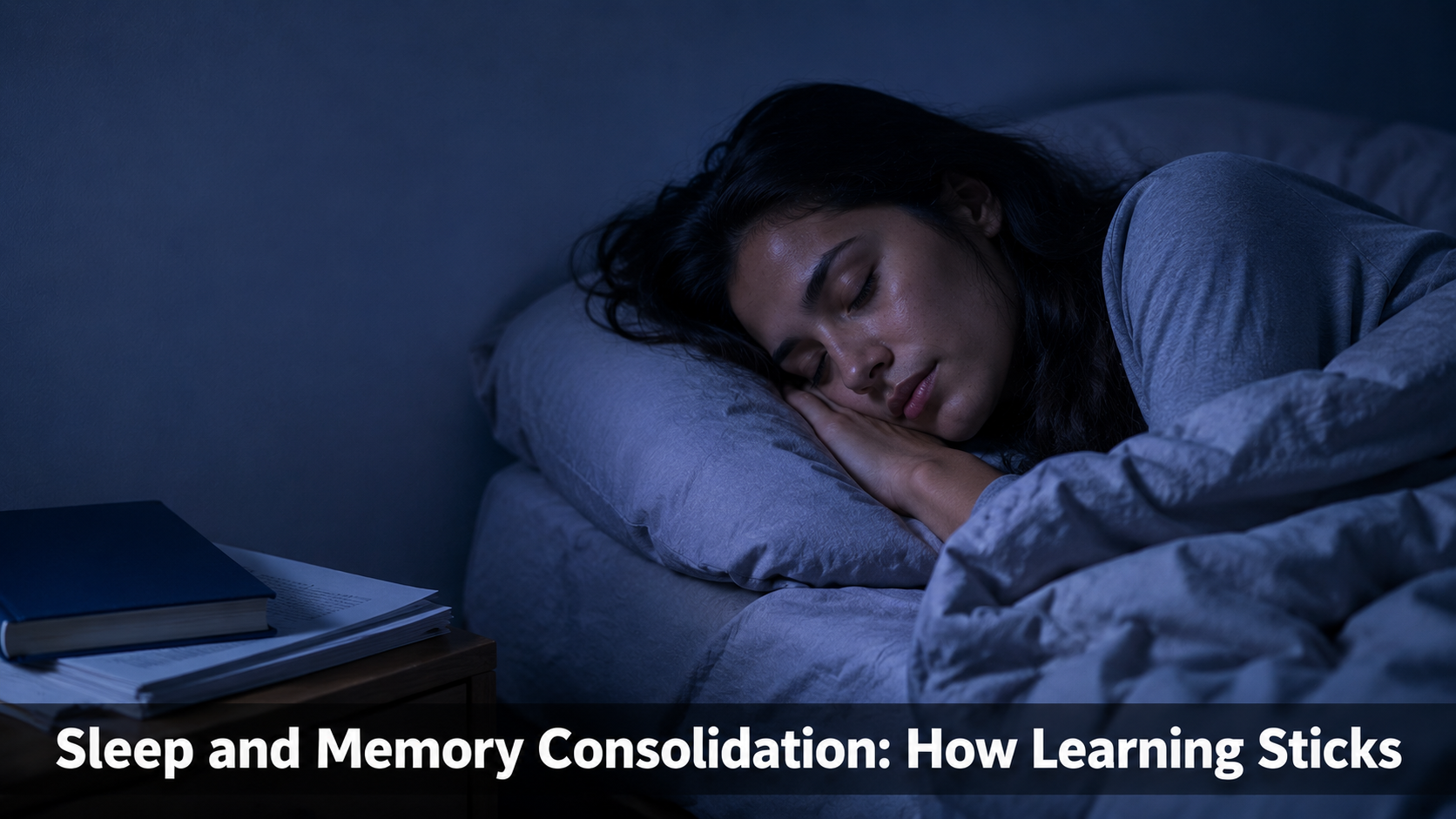
Sleep and Memory Consolidation: How Your Brain Files Your Lectures
Sleep and memory consolidation is the process that turns a lecture you sat through into something you can actually retrieve, and according to Dr. Avinesh Bhar, Board-Certified Sleep Physician at SLIIIP.com, it is the part of studying that happens after you close the book rather than while you are reading it.
Most students picture learning as a single act. You read, you highlight, you repeat, and the information lands. The research describes something closer to a two stage process. During the day your brain takes in new material and holds it in a temporary form. During the night it decides what to keep, strengthens what it keeps, and connects it to what you already knew.
That second stage is not optional and it cannot be rushed. This guide explains how the process is thought to work, what happens across a normal night, how to time your studying around it, and when memory problems point to something worth checking with a physician.
SLIIIP’s board-certified sleep physicians can do sleep evaluations for sleep apnea. Virtual consultations in all 50 states. Home sleep tests shipped to your door.

What Sleep and Memory Consolidation Actually Means
Memory is usually described in three steps. Encoding is taking the information in. Consolidation is stabilizing it so it lasts. Retrieval is getting it back out when you need it.
Studying handles the first step. Sleep appears to handle a large share of the second.
The working idea in sleep research is that new material is first held in a temporary store, then gradually transferred and strengthened into longer term storage during sleep. The brain seems to replay recent patterns while you are unconscious, which is thought to reinforce the connections that hold the memory.
This is why the gap between studying and sleeping matters more than most students expect. Material learned in the afternoon has a night ahead of it. Material crammed at 3 a.m. does not.
The Centers for Disease Control and Prevention lists improved attention and memory among the benefits of getting enough sleep, alongside the more familiar physical ones. It is not a side effect. It is one of the main jobs of the night.
CHECK YOUR SLEEP SYMPTOMS: TAKE THE 2 MINUTE QUIZ
TAKE THE QUIZ
How Sleep and Memory Consolidation Works Across the Night
A normal night runs through repeated cycles, each lasting roughly ninety minutes. The mix changes as the night goes on, and this shift is the reason a shortened night is not simply a smaller version of a full one.
Deeper sleep is concentrated in the earlier part of the night. It is associated with holding on to facts and information, the kind of material that fills a vocabulary list, an anatomy diagram, or a set of dates.
Dream heavy sleep becomes longer toward the morning. It is associated with pattern recognition, problem solving, and linking new material to existing knowledge. This is the stage many researchers connect to insight and to making sense of concepts rather than memorizing them.
Here is what that means in practice. If you cut two hours off the end of your night, you are not losing a random slice. You are disproportionately losing the stage that supports understanding and connection, which is exactly what essay questions and applied problems demand.
If you want the full breakdown of the stages themselves, our guides on core sleep versus deep sleep and how much core sleep you need go into detail.
Why a Shortened Night Hits Studying Harder Than You Expect
Students often judge a night by how they feel the next morning. That is a poor measure, because alertness recovers faster than the finer functions do.
The National Heart, Lung, and Blood Institute describes how sleep deficiency is associated with problems in learning, focusing, and remembering, along with slower reaction time and more mistakes. Notice that these are three separate failures, and each one hurts a different part of studying.
Short sleep affects encoding, so you take in less during the study session itself. It affects consolidation, so less of what you did take in gets stabilized. And it affects retrieval, so material you genuinely learned can be harder to reach under exam pressure.
A short night therefore charges you three times for the same hour you saved. This is the mechanical reason why trading sleep for study time rarely comes out ahead.
Timing: When to Study So the Night Can Do Its Work
You cannot control consolidation directly. You can control what you feed it and when.
Review the hardest material closest to bedtime, but keep it calm. A short, low pressure review of the section you find most difficult, finished at least an hour before bed, gives that material a clean run at night. A stressful two hour session right up to lights out tends to backfire by making sleep harder.
Spread the same total hours across more days. Four one hour sessions across four days give the material four nights of processing. One four hour session gives it one. The study time is identical. The number of consolidation opportunities is not.
Sleep between learning and testing. Where you have a choice, put a full night between the last serious review and the exam rather than a final morning scramble.
Protect the end of the night. Since the later cycles carry more of the connective work, going to bed thirty minutes earlier is usually less valuable than not cutting the morning short.
If your schedule makes any of this feel impossible, our walkthrough on how to fix your sleep schedule covers the practical reset.
Where Naps Fit In
Short daytime sleep appears to offer a small consolidation benefit, which is part of why a nap after a heavy study block can feel useful rather than lazy.
The caveats matter though. A brief nap of roughly twenty minutes tends to leave people alert. Longer naps often produce grogginess on waking and can push bedtime later, which costs you the very stages you were trying to protect.
A nap supports the night. It does not replace it. Our overview of the benefits of napping covers timing and length in more detail.
Habits That Quietly Interfere
A few common student habits work against consolidation without being obvious about it.
Caffeine late in the day reduces the depth and continuity of the night even when you fall asleep without trouble. The sleep happens. The quality is lower.
Alcohol is often assumed to help sleep because it shortens the time to fall asleep. It is associated with more fragmented sleep in the second half of the night, which is where a lot of the connective processing sits.
Irregular timing is the third one. A body clock that moves by several hours between weekdays and weekends spends part of every week trying to catch up, and the nights during that adjustment tend to be lighter.
None of these require perfection. They require boundaries: a caffeine cutoff, a limit on late drinking during study periods, and a wake time that does not swing wildly.
For improving the depth of the nights you do protect, see our guide on how to get more deep sleep.
When Memory Problems Are Not About Study Habits
There is a group of students for whom none of the above is the issue. They are in bed for eight hours. They are not drinking coffee at midnight. They still cannot hold what they read, and they still feel foggy through the afternoon.
That pattern deserves a different conversation. Sleep can be long in duration and still be poor in quality. Repeated brief interruptions through the night can fragment the deeper stages without the person ever remembering waking up.
Warning signs worth taking seriously include loud or frequent snoring, waking with a dry mouth or a morning headache, gasping or choking awake, and heavy daytime sleepiness despite adequate time in bed. Untreated obstructive sleep apnea is associated with difficulties in attention and memory, and it is not limited to older adults.
Dr. Avinesh Bhar and the SLIIIP team evaluate these patterns through virtual consultations, and testing can often be arranged at home. Our guides on sleep apnea and brain fog and sleep apnea symptoms cover what to watch for, and how to get a home sleep test explains the process.
This article is general education and is not a diagnosis. If you already use a prescribed therapy such as CPAP or an oral appliance, do not adjust the settings or stop using it on your own during a heavy study period. Speak with your treating physician first.
Watch: Sleep Builds Memories
The Takeaway
Sleep and memory consolidation is the reason the same study hour produces different results depending on the night that follows it. Reading builds the raw material. The night decides how much of it survives.
Study earlier, review calmly before bed, and protect the full night rather than the first half of it. For the broader picture on why rest supports the whole system, see our guide on the importance of sleep.
At Sliiip, we accept the following insurances:

SLIIIP’s board-certified sleep physicians can do sleep evaluations for sleep apnea. Virtual consultations in all 50 states. Home sleep tests shipped to your door.
Frequently Asked Questions
What is memory consolidation?
It is the process of stabilizing newly learned information so it lasts, and sleep is thought to play a major role in it.
Does sleeping right after studying help?
Sleeping within a reasonable window after learning gives the material a night of processing, which research links with better retention.
Which sleep stage matters most for memorizing facts?
Deeper sleep, concentrated earlier in the night, is generally associated with retaining factual information.
Which stage helps with understanding concepts?
Dream heavy sleep, which becomes longer toward morning, is associated with pattern recognition and linking ideas together.
Can I learn something new while asleep?
No. Sleep appears to strengthen what you already encoded while awake. It does not teach new material.
Is it better to review before bed or in the morning?
A short calm review before bed gives the material a night of processing. Long stressful sessions close to bedtime tend to backfire.
How long after studying should I go to sleep?
There is no exact number. Finishing at least an hour before bed helps the mind settle enough to fall asleep normally.
Does a nap help memory?
Short naps appear to offer a modest benefit. They support the night rather than replacing it.
How long should a study nap be?
Around twenty minutes for most people. Longer naps often cause grogginess and can delay bedtime.
Does cutting two hours off the end of the night matter?
Yes. The later cycles carry more of the stage linked with connecting and understanding material.
Why can I remember the lecture but not recall it in the exam?
Retrieval is a separate step from storage, and it is affected by sleep loss, stress, and how the material was practiced.
Does caffeine affect memory consolidation?
Caffeine late in the day is associated with lighter and more broken sleep, which can reduce the quality of overnight processing.
Does alcohol help or hurt overnight processing?
It may shorten the time to fall asleep but is associated with more fragmented sleep later in the night.
Is spaced study really better than one long session?
The same total hours spread across more days give the material more nights of processing, which is generally associated with better retention.
Can I catch up on consolidation later?
Extra sleep aids recovery, but the processing tied to a specific night cannot simply be rescheduled.
Do sleep trackers show whether consolidation happened?
Consumer devices estimate stages and can be useful for spotting patterns, but they are not diagnostic tools.
Why do I feel foggy after eight hours in bed?
Time in bed is not the same as quality sleep. Fragmented nights can leave people tired and unfocused.
Can sleep apnea affect memory?
Untreated sleep apnea is associated with difficulties in attention and memory, which is why persistent symptoms are worth evaluating.
Is memory fog during finals normal?
Some difficulty under stress and short sleep is common, but ongoing fog that does not improve with rest is worth discussing with a physician.
When should I see a sleep specialist about memory problems?
When fog and sleepiness persist for weeks despite adequate time in bed, or when snoring, gasping, or morning headaches are present.
SLIIIP’s board-certified sleep physicians can do sleep evaluations for sleep apnea. Virtual consultations in all 50 states. Home sleep tests shipped to your door.
Latest posts
-
RingConn vs Oura: Which Smart Ring Tracks Sleep Better?
Last updated: September 10, 2026. Medically reviewed by Dr. Avinesh Bhar, Board-Certified Sleep Physician, SLIIIP.com. RingConn and Oura both track sleep through a finger-worn ring, but they differ most in…
-
Withings ScanWatch Sleep Tracking Accuracy: What It Can and Cannot Tell You
Last updated: September 10, 2026. Medically reviewed by Dr. Avinesh Bhar, Board-Certified Sleep Physician, SLIIIP.com. Withings ScanWatch is a hybrid analog watch that tracks sleep stages and can flag nighttime…
-
Are Cheap Fitness Trackers Accurate for Sleep?
September 10, 2026. Medically reviewed by Dr. Avinesh Bhar, Board-Certified Sleep Physician, SLIIIP.com. Cheap fitness trackers can be reasonably accurate at telling you when you fell asleep and woke up,…
Get updates
Spam-free subscription, we guarantee. This is just a friendly ping when new content is out.

