👉 Register for Free. How to Diagnose Sleep Apnea Faster in Primary Care – FREE Webinar by Dr. Audrey Wells. – Friday, April 24 at 12 PM ET


Sleep Regularity: Why Consistency Beats Total Hours
Sleep regularity, meaning the habit of falling asleep and waking up at close to the same time each day, is a pattern that Dr. Avinesh Bhar, Board-Certified Sleep Physician at SLIIIP.com, connects to how rested and steady people feel throughout the week. Many adults track their total hours in bed while paying little attention to the clock times behind those hours. Research now suggests that when you sleep may carry as much weight as how long you sleep. A steady sleep schedule gives your body a rhythm it can plan around. When wake times and bedtimes shift night after night, the internal clock struggles to keep pace. This article looks at what regular sleep timing means, why consistency may beat raw hours, and simple habits that support a steadier routine.
SLIIIP’s board-certified sleep physicians can do sleep evaluations for sleep apnea. Virtual consultations in all 50 states. Home sleep tests shipped to your door.
What Sleep Regularity Really Means
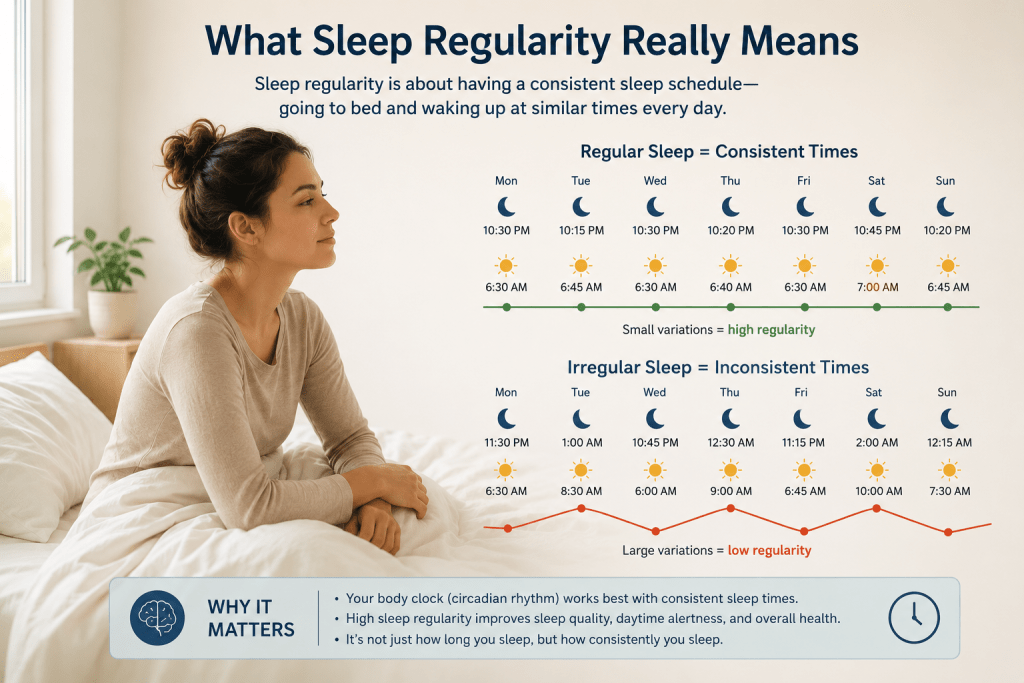
Sleep consistency describes how steady your sleep and wake times are from one day to the next. A person who goes to bed near 11 p.m. and wakes near 7 a.m. most days has high regularity. A person who bounces between early and late nights, even while logging the same weekly total, has low regularity.
The key idea is that your body reads timing, not just duration. Two people can each average seven hours a night. One keeps a tight window every day. The other swings by two or three hours depending on work, screens, or social plans. Their weekly totals match, yet their bodies experience very different signals.
Regularity is easy to overlook because it hides inside averages. A weekly sleep total looks fine on a tracker even when the pattern behind it is scattered. Looking at the shape of your week, not only the sum, gives a clearer picture of your rest.
CHECK YOUR SLEEP SYMPTOMS: TAKE THE 2 MINUTE QUIZ
TAKE THE QUIZ
Why Sleep Regularity May Matter More Than Total Hours
A large body of research has started to compare steady sleepers with irregular sleepers who log similar amounts. Studies have linked more consistent sleep timing with better daytime function and steadier mood. These are associations reported in research, not guarantees for any single person, and they do not replace a personal evaluation.
The reason timing matters comes down to the body clock. Your internal clock expects light, food, and rest to arrive on a schedule. When those cues stay consistent, the systems that manage alertness and recovery can prepare in advance. When cues jump around, the clock keeps resetting, and that resetting has a cost.
Think of it like catching a bus. If the bus comes at the same time daily, you arrive ready. If the schedule changes without warning, you spend energy guessing and often miss it. Your body works in a similar way with sleep timing.
This is why chasing a big number of hours on the weekend rarely fixes a scattered week. The extra sleep helps a little, but it does not undo the strain of a shifting schedule. Regularity is the pattern that lets your total hours do their best work.
The Science Behind Consistent Sleep Timing
Your circadian rhythm is a roughly 24 hour cycle that guides alertness, body temperature, and hormone release. Morning light is its strongest anchor. When you wake at a steady time and get daylight soon after, you reinforce that anchor and help the whole day fall into place.
Consistent timing supports the natural rise and fall of melatonin, the hormone tied to sleepiness. A steady schedule lets melatonin climb at a predictable hour, which can make falling asleep feel more natural over time. A scattered schedule sends mixed signals that blur that rise.
If you want to understand how the body clock works and how to steady it, our guide on how to fix your circadian rhythm walks through practical steps. You can also read more about circadian rhythm sleep disorders when timing problems become persistent.
According to the Centers for Disease Control and Prevention, keeping a consistent sleep schedule is one of the core habits that supports healthy rest. This lines up with what steady sleepers tend to report about their days.
What Happens When Sleep Timing Drifts
Many people live with a hidden gap between their weekday and weekend schedules. They wake early for work, then sleep late on days off. This back and forth is sometimes called social jet lag, because the body reacts as if it crossed time zones without leaving home.
The Monday morning struggle is a familiar sign. After a weekend of later nights and later mornings, the body is asked to snap back to an early alarm. The result can feel like a mild version of travel fatigue, complete with grogginess and a slow start.
Drifting timing can also affect appetite, focus, and evening energy. When the clock is unsure what hour it is, the systems that ride along with it lose their footing too. Over weeks and months, that low grade mismatch adds up. If you often feel drained even after a full night, our article on why you wake up tired may help you spot patterns worth changing.
None of this means an occasional late night will harm you. Life includes travel, events, and the odd rough night. The goal is a steady baseline most days, not perfection every day.
How to Build Better Sleep Consistency
Building regularity starts with the morning, not the night. Pick one wake time and hold it every day, weekends included, within about an hour. A fixed wake time is the single strongest lever most people have, because it sets the clock that governs the rest of the day.
Get bright light soon after you wake. Daylight through a window or a short walk outside tells your clock the day has begun. In the evening, dim the lights and step back from bright screens so your body can read the shift toward night.
Keep meals and movement on a rough schedule as well. Eating and exercising at wildly different hours can tug at the clock the same way inconsistent sleep does. A loose but steady daily rhythm supports the sleep rhythm you want.
Wind down with a simple routine you can repeat. A short sequence of the same calming steps signals bed is near. For more ideas, our ultimate sleep routine guide offers a full framework, and the piece on the importance of sleep explains why the effort is worth it.
Protect your wake time even after a poor night. It is tempting to sleep in and repay lost hours, but sleeping in scatters your schedule and can make the next night harder. Holding the anchor is usually the faster path back to steady sleep.
Watch: How to Get Better Sliiio – SLIIIP.COM
When Consistency Is Not Enough
Good habits help many people, yet some still wake tired despite steady timing. When strong sleep regularity does not bring rest, an underlying condition may be part of the picture. Loud snoring, gasping, morning headaches, or heavy daytime sleepiness are signals worth a professional look.
Conditions like obstructive sleep apnea can fragment sleep even when the schedule is perfect. This is not a diagnosis you can make from a tracker alone, and habits by themselves may not resolve it. A qualified evaluation, like the ones led by Dr. Avinesh Bhar, is the right next step when consistency has not solved the tiredness.
The National Heart, Lung, and Blood Institute notes that ongoing sleep problems deserve attention from a professional rather than guesswork at home. If steady habits are not moving the needle, that guidance is worth following.
At Sliiip, we accept the following insurances:

SLIIIP’s board-certified sleep physicians can do sleep evaluations for sleep apnea. Virtual consultations in all 50 states. Home sleep tests shipped to your door.
Frequently Asked Questions
What is sleep regularity?
It is how steady your bedtimes and wake times are from day to day. High regularity means your sleep window stays close to the same each night.
Does consistency really beat total hours of sleep?
Research links steady timing with better daytime function, though total hours still matter. The best results tend to come from pairing enough hours with a regular schedule.
How much can my sleep schedule vary and still count as regular?
Staying within about an hour of your usual times most days is a common target. Small shifts are normal, while large swings tend to lower regularity.
What is social jet lag?
Social jet lag is the mismatch between your weekday and weekend sleep schedules. The body reacts as if it changed time zones, which can leave you groggy.
Why do I feel worse on Monday mornings?
Later nights and later mornings on weekends can shift your clock. Snapping back to an early alarm on Monday can feel like mild travel fatigue.
Is it better to fix my wake time or my bedtime first?
A fixed wake time is usually the stronger anchor. Holding it steady helps your bedtime settle into place over the following days.
Should I sleep in on weekends to catch up?
Sleeping in can scatter your schedule and make the next night harder. A steadier wake time often leads to better rest across the week.
Does morning light help sleep consistency?
Yes, daylight soon after waking is a strong signal to your body clock. It helps reinforce a consistent rhythm for the rest of the day.
Can naps hurt my sleep consistency?
Long or late naps can blur your schedule and make night sleep harder. A short early afternoon nap is less likely to disrupt your rhythm.
How long does it take to build a regular sleep schedule?
Many people notice a difference within one to two weeks of steady timing. Consistency over time is what makes the pattern stick.
Is irregular sleep the same as not getting enough sleep?
No, they are different problems that can overlap. You can log enough hours yet still have irregular timing that leaves you feeling off.
Does sleep consistency affect mood?
Studies have associated steadier sleep timing with more stable mood and focus. These are patterns seen in research, not promises for any one person.
Can I improve regularity if I work night shifts?
Shift work makes regularity harder, but a consistent routine on your own schedule still helps. Light exposure and fixed meal times can support the effort.
What time should I go to bed?
There is no single right bedtime, since needs vary by person and age. Choosing a time that lets you wake naturally at a steady hour is a good guide.
Do sleep trackers measure regularity?
Many trackers estimate timing, though accuracy varies between devices. They can show patterns, but they cannot diagnose a sleep condition.
Why am I still tired even with a regular schedule?
Steady timing helps, but tiredness can also come from other causes. Persistent fatigue despite good habits is worth a professional evaluation.
Is an occasional late night going to ruin my progress?
No, one late night will not undo a steady routine. The goal is a consistent baseline most days, not a flawless record.
How does sleep consistency connect to sleep apnea?
Regularity supports rest, but it does not prevent conditions like sleep apnea. Snoring or gasping with steady timing still deserves a closer look.
Can children benefit from sleep consistency too?
Steady timing supports rest across ages, including children. A consistent routine can help the whole household settle into better sleep.
When should I see a sleep doctor about my sleep?
If steady habits do not bring rested days, or you notice loud snoring or gasping, a professional visit makes sense. A sleep evaluation can clarify what is going on.
SLIIIP’s board-certified sleep physicians can do sleep evaluations for sleep apnea. Virtual consultations in all 50 states. Home sleep tests shipped to your door.
Latest posts
-
How Are My Hot Flashes Related to Menopause? The Mechanism Explained
Last updated: September 21, 2026. Medically reviewed by Dr. Avinesh Bhar, Board-Certified Sleep Physician, SLIIIP.com. Hot flashes are directly related to menopause through declining estrogen’s effect on the hypothalamus, the…
-
Why Did My Sleep Change So Fast in My Late 40s?
Last updated: September 21, 2026. Medically reviewed by Dr. Avinesh Bhar, Board-Certified Sleep Physician, SLIIIP.com. Sleep can change quickly in the late 40s because this is often when the perimenopause-to-menopause…
-
Why Does PMS Wreck My Sleep Even When My Symptoms Are Mild?
Last updated: September 21, 2026. Medically reviewed by Dr. Avinesh Bhar, Board-Certified Sleep Physician, SLIIIP.com. Sleep can fall apart in the days before your period even when your other PMS…
Get updates
Spam-free subscription, we guarantee. This is just a friendly ping when new content is out.

