👉 Register for Free. How to Diagnose Sleep Apnea Faster in Primary Care – FREE Webinar by Dr. Audrey Wells. – Friday, April 24 at 12 PM ET


I Can’t Sleep Because of Work Stress: What Do I Do?
When you can’t sleep because of work stress, the problem is rarely the job alone, explains Dr. Avinesh Bhar, Board-Certified Sleep Physician at SLIIIP.com, because the pattern usually comes from how the workday ends rather than how hard it was. Your nervous system does not clock out when you close your laptop. Deadlines, unanswered messages, a difficult conversation, and the mental list of tomorrow all keep your alerting system running well past the point where sleep should begin.
The useful news is that this pattern responds to structure. You do not need a less stressful job to sleep better. You need a clear boundary between work mode and sleep mode, and a way to keep short term stress from turning into a long term sleep habit.
SLIIIP’s board-certified sleep physicians can do sleep evaluations for sleep apnea. Virtual consultations in all 50 states. Home sleep tests shipped to your door.
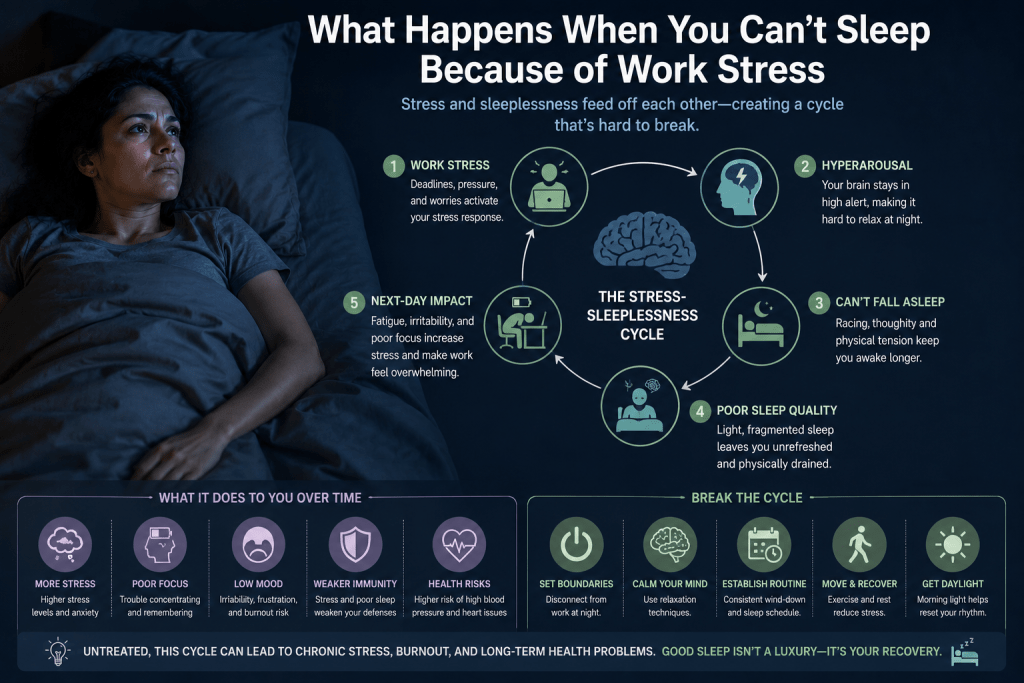
What Happens When You Can’t Sleep Because of Work Stress
Stress activates your body’s alerting system. Heart rate rises, attention sharpens, and the body prepares for effort. That system is useful during the day. It becomes a problem when it is still running at eleven at night.
Work stress has a particular shape. It is recurring, it has a schedule, and it involves open loops. An unfinished task is not just a thought. Your brain keeps it active in working memory because it has not been resolved or written down.
There is also a learning process. If you spend several weeks lying in bed thinking about work, your brain starts to associate the bed with problem solving. After that, the stress can fade and the sleep problem stays. This is how a short stretch of hard weeks turns into chronic insomnia.
SLIIIP covers the general physiology of this in why do I have insomnia during stress. What follows here is the work specific version.
CHECK YOUR SLEEP SYMPTOMS: TAKE THE 2 MINUTE QUIZ
TAKE THE QUIZ
Close the Workday on Purpose
Most people end the workday by running out of time. A deliberate closing routine works far better than an accidental one.
Take ten minutes at the end of your work block and do four things:
- Write down every open item, even the vague ones
- Note the single next action for each
- Pick the two or three that matter tomorrow
- Close the laptop and physically leave the workspace
The list is the point. Your brain stops rehearsing items once it trusts that they are captured somewhere reliable. Doing this at five or six in the evening works. Doing it at eleven does not, because it restarts the thinking you are trying to end.
If you work from home, the transition matters even more. Change clothes, walk around the block, or move to a different room. You need a physical signal that the day changed categories.
Set a Real Cutoff for Messages
A single work notification at nine in the evening can restart the alerting system for an hour.
Practical steps that work for most people:
- Set a message cutoff time and tell your team what it is
- Move work apps off your phone home screen, or log out in the evening
- Turn off badge counts and previews
- If you are genuinely on call, define what actually qualifies as urgent
Checking once to reassure yourself is still checking. The relief lasts a few minutes and the alertness lasts much longer.
For the deeper habit work behind this, see cant shut brain off at night and how do I stop overthinking at night.
Protect the Bed So the Habit Does Not Set In
This is the part that prevents a stressful season from becoming a lasting problem.
- Use the bed for sleep and intimacy only
- No laptops, no work calls, no planning in bed
- If you are awake and frustrated for roughly twenty minutes, get up
- Go to another room, keep the lights low, do something calm and dull
- Return when you feel sleepy, not when the clock says you should
- Keep the same wake time every day, weekends included
Do not watch the clock. Turn it away from you. Counting the hours you have left raises frustration, and frustration raises alertness.
These steps come from cognitive behavioral therapy for insomnia, which the National Heart, Lung, and Blood Institute describes as a standard first line approach for chronic insomnia. SLIIIP explains the method in cognitive behavior therapy for sleep disorders and describes the experience in what CBTI feels like week by week.
Handle the Thoughts Earlier, Not in Bed
A scheduled worry period sounds artificial. It works anyway.
Pick fifteen minutes in the early evening. Write what is bothering you. For each item, write one next step. Then close the notebook. You are not solving anything. You are moving items out of active memory.
Keep a pad on the nightstand for anything that surfaces later. One line, no detail. The habit tells your brain that late night thoughts have a destination other than rumination.
If Sunday night is your hardest night, do this on Sunday afternoon rather than Sunday evening. The Sunday pattern is one of the clearest examples of anticipatory work stress, and moving the planning earlier usually helps more than any relaxation technique.
Watch the Inputs That Amplify Stress
Habits interact with stress load.
Caffeine stays active far longer than most people expect, and stressful weeks are exactly when intake creeps up. Move your cutoff earlier by several hours.
Alcohol shortens the time to fall asleep and then fragments the second half of the night. A drink to unwind after a hard day often produces a three in the morning wake up with an active mind.
Late work sessions raise alertness and push your internal clock later. If you must work late, dim the lights and add a buffer before bed.
Exercise helps stress but timing matters. Morning or early evening suits sleep better for most people. The Centers for Disease Control and Prevention publishes general guidance on sleep habits that supports this kind of consistency.
Related reading: feeling stressed, lack of sleep and weight management and why cant I fall asleep even when Im tired.
If You Work Nights or Rotating Shifts
Shift work adds a timing problem on top of the stress problem. Your internal clock is being asked to run against daylight.
The core tactics are consistency where possible, blackout conditions for daytime sleep, controlled light exposure at the right hours, and protecting a fixed sleep block rather than sleeping in fragments. SLIIIP covers this in the night shift and sleep.
Watch: A Doctor Explains Is it Burnout or Just Amxiety?
When to Stop Troubleshooting and Get Evaluated
Behavioral changes usually need two to four weeks of consistency before the pattern shifts. If you still can’t sleep because of work stress after a month of a consistent routine, it is worth an evaluation rather than another technique.
Dr. Avinesh Bhar notes that stress and sleep breathing problems often look identical from the outside. Someone wakes at night with a racing heart, blames the job, and never learns that breathing interruptions triggered the awakening. Signs worth taking seriously include snoring or reported breathing pauses, gasping at night, morning headaches, dry mouth on waking, and heavy daytime tiredness that rest does not fix.
Useful next steps:
- Chronic insomnia: when to get a sleep test
- Anxiety, insomnia and sleep apnea
- Signs of sleep apnea
- Home sleep apnea test
Do not start, stop, or adjust prescribed therapy, including sleep medication or CPAP settings, on your own. Any change should go through the clinician managing your care.
If low mood, hopelessness, or anxiety is a large part of the picture, that deserves its own support rather than being treated as a sleep issue alone. Speaking with your primary care provider or a mental health professional is a reasonable step. Related reading: why do I feel depressed and tired all the time.
At Sliiip, we accept the following insurances:

SLIIIP’s board-certified sleep physicians can do sleep evaluations for sleep apnea. Virtual consultations in all 50 states. Home sleep tests shipped to your door.
Frequently Asked Questions
What do I do first when I can’t sleep because of work stress?
Start with a deliberate end to the workday. Write down open items and next steps in the early evening, then keep work out of the bedroom entirely.
Why does my mind race the moment I lie down?
Bedtime is often the first quiet moment of the day, so unresolved items become audible. The thoughts were active earlier, but nothing was competing for attention.
Is a scheduled worry period actually effective?
For many people, yes. Writing items down earlier in the evening reduces the need for the brain to rehearse them at night.
How long should it take to fall asleep?
Fifteen to twenty minutes is typical for many adults. Consistently much longer is worth discussing with a clinician.
Should I stay in bed and keep trying?
Usually no. Lying awake and frustrated teaches the brain to link the bed with wakefulness. Get up, keep lights low, and return when sleepy.
Can I work in bed if I am careful about it?
It is better not to. The bed works best as a single purpose cue for sleep, especially during a stressful period.
Why is Sunday night the worst?
Anticipating the week ahead raises alertness before anything has happened. Moving your planning to Sunday afternoon often helps.
Does checking email one last time really matter?
It can. A single work message in the evening restarts the alerting system, and the effect lasts longer than the relief does.
Is alcohol a reasonable way to unwind?
It shortens the time to fall asleep but fragments the second half of the night. It is a common reason for early morning awakenings.
How much does caffeine matter during stressful weeks?
Intake often rises exactly when sleep is already fragile. Caffeine stays active for hours, so an earlier cutoff usually helps.
Can exercise help with work stress and sleep?
Regular activity supports both. Timing it earlier in the day suits sleep better for most people.
How long before a new routine works?
Give it two to four weeks of consistency. Judging changes after two or three nights is too soon.
When does stress related to sleep trouble become insomnia?
When it persists for weeks and continues even during calmer periods, the habit has usually taken hold on its own.
Is CBT for insomnia better than medication?
Research supports behavioral approaches as a first line option for chronic insomnia. The right choice depends on your situation and should be made with a clinician.
Could this be anxiety rather than work stress?
The two overlap and feed each other. An evaluation can help separate them and point to the right kind of support.
Can sleep apnea look like stress related insomnia?
It can. Breathing interruptions cause brief awakenings with a racing heart, and people often attribute those to stress instead.
Do naps help during a demanding stretch?
A short early afternoon nap affects most people less than a long or late one, which reduces nighttime sleep pressure.
What if I work nights or rotating shifts?
Shift schedules add a timing problem on top of stress. Consistency, darkness for daytime sleep, and controlled light exposure become the priorities.
Do I need a sleep lab to get answers?
Not always. Home testing is validated for many situations, and a clinician determines which option fits your case.
Can I be evaluated if I live far from a sleep center?
Yes. SLIIIP offers virtual consultations in all 50 states with home sleep tests shipped to your door.
SLIIIP’s board-certified sleep physicians can do sleep evaluations for sleep apnea. Virtual consultations in all 50 states. Home sleep tests shipped to your door.
Latest posts
-
Why Can’t I Wake Up Even After Getting Enough Sleep?
Last updated: October 2, 2026. Medically reviewed by Dr. Avinesh Bhar, Board-Certified Sleep Physician, SLIIIP.com. If you can’t wake up after enough sleep, the cause is usually not the number…
-
Why Does My Heart Rate Drop So Low While I Sleep?
Last updated: October 2, 2026. Medically reviewed by Dr. Avinesh Bhar, Board-Certified Sleep Physician, SLIIIP.com. Your heart rate drops low while sleeping mainly because your body needs less work from…
-
Why Are My Naps Never Refreshing?
Last updated: October 2, 2026. Medically reviewed by Dr. Avinesh Bhar, Board-Certified Sleep Physician, SLIIIP.com. Naps that leave you groggy usually come down to how long you sleep, when you…
Get updates
Spam-free subscription, we guarantee. This is just a friendly ping when new content is out.

