👉 Register for Free. How to Diagnose Sleep Apnea Faster in Primary Care – FREE Webinar by Dr. Audrey Wells. – Friday, April 24 at 12 PM ET


Digital Insomnia Therapy: A Doctor’s Guide to the Drug-Free Fix for Sleepless Nights
Digital insomnia therapy has quietly become one of the most effective tools in modern sleep medicine, says Dr. Avinesh Bhar, Board-Certified Sleep Physician at SLIIIP.com, and many people now use it without ever stepping foot in a clinic.
The idea is simple. The same therapy that sleep doctors have used in person for decades now runs through an app, a website, or a guided online program. It teaches your brain to fall asleep again, stay asleep, and stop fearing the bed. No sleeping pills. No tossing for hours. Just structured steps that work over a few weeks.
SLIIIP’s board-certified sleep physicians can do sleep evaluations for sleep apnea. Virtual consultations in all 50 states. Home sleep tests shipped to your door.
What Digital Insomnia Therapy Really Is
In plain terms, digital insomnia therapy is cognitive behavioral therapy for insomnia, called CBT-I, delivered through a phone, tablet, or computer.
CBT-I is the first-line, drug-free treatment most sleep doctors recommend for chronic insomnia. It used to be hard to find. Few therapists were trained in it, and waitlists could last months. Digital programs solved that problem by putting the same steps into a guided app that you can use at home.
The Centers for Disease Control and Prevention reports that about 1 in 3 American adults do not get enough sleep on a regular basis. Insomnia is a big driver of that number, and digital insomnia therapy is now one of the most studied ways to fix it.
For more, see our pages on insomnia treatment methods and cognitive behavior therapy CBT-I for sleep disorders.
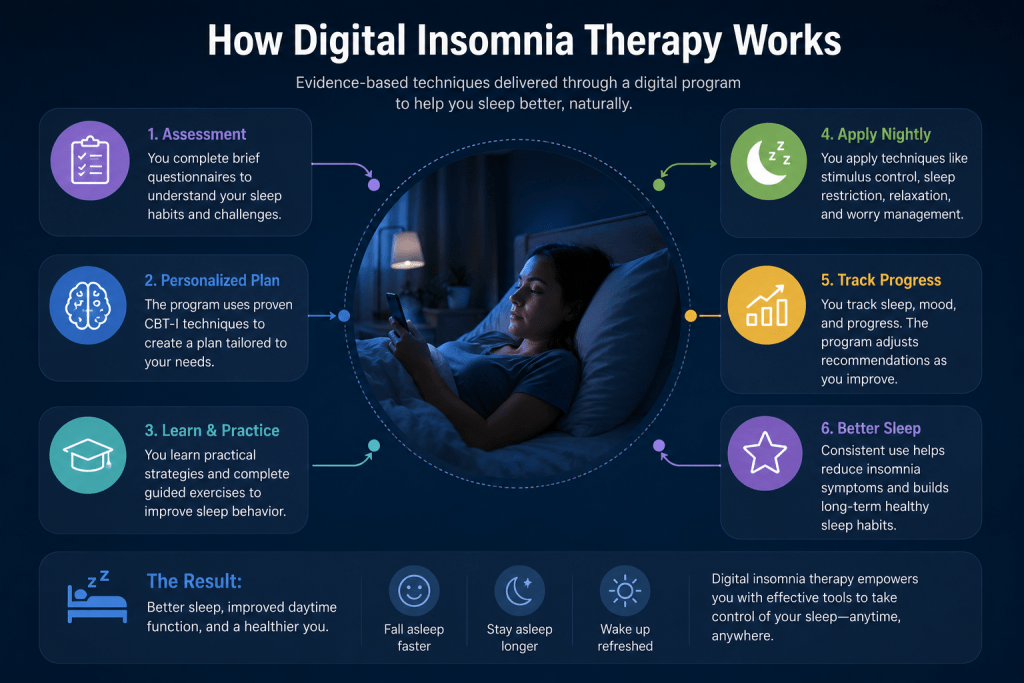
How Digital Insomnia Therapy Works
Most programs run over six to eight weeks. You check in every day, log your sleep, and follow short lessons.
The app then tunes its advice based on your real sleep log. The longer you use it, the more it adapts to your body.
A typical week might include a short video, a sleep log review, a new wind-down step, and a personalized bedtime. The app tracks how you respond and shifts the plan if you stall.
See our digital therapeutics page for more on this category.
The Five Core Techniques in Digital Insomnia Therapy
Every solid program teaches the same five tools. They are simple on paper but powerful in practice.
1. Sleep Restriction
You spend less time in bed at first. That sounds wrong, but it builds sleep pressure. Once your body falls asleep faster and stays asleep, the app slowly adds more time back.
This step is the heart of CBT-I. It is also the hardest part.
2. Stimulus Control
You only use the bed for sleep. No phone scrolling. No work. No long worry sessions. If you cannot sleep within 20 minutes, you get up and come back when sleepy.
This step retrains your brain to link the bed with rest, not with stress.
For help with night thoughts, see how do I stop overthinking at night and cant shut brain off at night.
3. Cognitive Restructuring
You learn to spot the thoughts that fuel insomnia, like “I will never sleep tonight” or “I cannot work tomorrow if I get less than 8 hours.”
The app teaches you to swap those thoughts for calmer, truer ones. Most people are shocked at how much these silent thoughts shape their nights.
4. Relaxation Training
Short guided sessions teach breathing, body scans, and gentle imagery. These tools quiet the body so the brain can follow.
See sleep sounds and meditation and guided meditation for sleep disorders.
5. Sleep Hygiene Education
The basics still matter. Cool dark room. Steady wake time. Limit caffeine and alcohol. Wind down with a routine.
Our your ultimate sleep routine guide for 2025 covers this in depth.
The Evidence Behind Digital Insomnia Therapy
Digital CBT-I has been studied in thousands of patients. Most studies show it works almost as well as in-person CBT-I, and far better than sleep pills over the long run.
The benefit lasts. Pills wear off. Habits do not. Once your brain learns to sleep again, it tends to keep doing so even when life gets stressful.
For more on the pill versus therapy choice, see is CBT-I better than sleep meds, CBT-I vs sleep medications, and why CBT-I works when medications dont.
Who Benefits Most From Digital Insomnia Therapy
The best fit is an adult with chronic insomnia who is otherwise in fair health.
Signs you may be a good fit:
You have trouble falling asleep, staying asleep, or both, for three or more nights a week, for three months or more. You feel tired or low during the day because of it. You are open to short daily steps. You want to avoid long-term sleep meds.
Many people see clear gains within four weeks. Most programs finish in six to eight.
Read how to fix insomnia naturally and what CBT-I feels like week by week.
When Digital Insomnia Therapy Is Not Enough
Insomnia is sometimes a symptom of something else. A solid sleep doctor visit can rule out the hidden causes before therapy begins.
These conditions may need care first or alongside:
Sleep apnea, which can wake you many times a night without you knowing. The National Heart, Lung, and Blood Institute notes that sleep apnea is often missed for years and can look like insomnia. See signs of sleep apnea and do I have insomnia or something else.
Restless legs syndrome. Treatable, but a different fix.
Hormone shifts, often during perimenopause. See hormonal insomnia and menopause sleep problems natural remedies.
Anxiety or depression that needs its own care.
A SLIIIP visit can sort out which path is right for you.
Digital Insomnia Therapy vs Sleep Pills
Both can help in the short term. Only one fixes the root cause.
Sleep pills can lose effect, build tolerance, and bring side effects. Digital insomnia therapy teaches your brain to sleep on its own, with effects that often last for years.
For a deeper look, see the sleeping pill scam and top picks for the best sleep aids.
How Long Digital Insomnia Therapy Takes
Most programs run six to eight weeks. Many people feel a real shift around week three or four.
The hardest weeks are the first two, when sleep restriction kicks in. You may feel more tired before you feel better. That is normal and part of the process.
After the program ends, the skills stay with you. You can pull them back out any time life gets stressful.
Watch: Insomnia and Your Health online session by Dr. Avinesh Bhar
How to Get Started With Digital Insomnia Therapy
The simplest path looks like this.
First, see a sleep doctor to rule out a hidden cause. A virtual visit through SLIIIP can do this from your couch.
Second, pick a digital CBT-I program. Some are guided by an app. Some pair you with a coach. Both can work.
Third, commit for at least six weeks. Daily steps matter more than perfect ones.
Fourth, check in with your doctor when the program ends. They can read your data, adjust if needed, and confirm the gains.
Learn more on sleep telemedicine and 3 benefits of sleep telemedicine.
At Sliiip, we accept the following insurances:

SLIIIP’s board-certified sleep physicians can do sleep evaluations for sleep apnea. Virtual consultations in all 50 states. Home sleep tests shipped to your door.
Frequently Asked Questions
1. What is digital insomnia therapy?
It is cognitive behavioral therapy for insomnia, or CBT-I, delivered through an app, website, or guided online program.
2. Does digital insomnia therapy really work?
Yes. Studies show it works almost as well as in-person CBT-I and far better than sleep pills long-term.
3. How long does digital insomnia therapy take?
Most programs run six to eight weeks. Many people feel a shift by week three or four.
4. Is digital insomnia therapy the same as a sleep app?
Not quite. Many sleep apps only track sleep. Digital insomnia therapy actively guides you through CBT-I steps.
5. Is digital insomnia therapy safe?
Yes, for most healthy adults. People with certain conditions like bipolar disorder or seizures should talk to a doctor first.
6. Can I do digital insomnia therapy without a doctor?
You can, but a quick doctor visit first is smart. It rules out sleep apnea and other hidden causes.
7. Will my insurance cover digital insomnia therapy?
Some plans do, especially when it is part of a doctor visit. SLIIIP can help check. See verify your benefits.
8. What if I have both insomnia and sleep apnea?
You may need both treatments. CBT-I helps insomnia. A home sleep test can sort out the apnea. See home sleep apnea test.
9. Why does sleep restriction make me more tired at first?
It is by design. Less time in bed builds sleep pressure. After a week or two, that pressure helps you fall asleep faster and stay asleep.
10. Can I stop sleep pills once digital insomnia therapy works?
Many people do. Always taper with a doctor’s help.
11. Is digital insomnia therapy better than melatonin?
For chronic insomnia, yes. Melatonin can help with jet lag or shift changes, but it does not fix the root cause.
12. How is digital insomnia therapy different from sleep hygiene tips?
Sleep hygiene is one piece. Digital insomnia therapy adds sleep restriction, stimulus control, and thought work, which do the heavy lifting.
13. Can teens use digital insomnia therapy?
Some programs are built for teens. Talk to a doctor before starting.
14. Can older adults use digital insomnia therapy?
Yes. In fact, it is often a safer first step than sleep pills for older adults.
15. What if my insomnia is from menopause?
Hormone-driven insomnia may need extra care. See hormonal insomnia and menopause sleep problems natural remedies.
16. Can I use digital insomnia therapy while shift working?
Yes, but you may need extra tools for light and timing. See the night shift and sleep.
17. Do I need a wearable for digital insomnia therapy?
No. A simple sleep diary in the app is usually enough.
18. What if I miss a few days of the program?
Most apps adjust and let you keep going. Skip the guilt and pick up the next step.
19. Can digital insomnia therapy help with anxiety too?
Yes, often. The thought tools used in CBT-I also calm anxious night thoughts. See why do I feel anxious at night.
20. When should I see a sleep doctor instead of just using an app?
If you snore loudly, gasp at night, feel tired every day, or your insomnia has lasted more than three months, book a visit. Digital insomnia therapy works best when a doctor confirms the diagnosis first.
The Bottom Line
Digital insomnia therapy is one of the strongest, safest, and most lasting fixes for chronic insomnia. It costs less than years of sleep pills, takes weeks instead of months, and gives your brain real skills it keeps for life.
The best results come when a real sleep doctor confirms the diagnosis, then guides you through the program. That is exactly what SLIIIP was built for.
SLIIIP’s board-certified sleep physicians can do sleep evaluations for sleep apnea. Virtual consultations in all 50 states. Home sleep tests shipped to your door.
Latest posts
-
Why Can’t I Wake Up Even After Getting Enough Sleep?
Last updated: October 2, 2026. Medically reviewed by Dr. Avinesh Bhar, Board-Certified Sleep Physician, SLIIIP.com. If you can’t wake up after enough sleep, the cause is usually not the number…
-
Why Does My Heart Rate Drop So Low While I Sleep?
Last updated: October 2, 2026. Medically reviewed by Dr. Avinesh Bhar, Board-Certified Sleep Physician, SLIIIP.com. Your heart rate drops low while sleeping mainly because your body needs less work from…
-
Why Are My Naps Never Refreshing?
Last updated: October 2, 2026. Medically reviewed by Dr. Avinesh Bhar, Board-Certified Sleep Physician, SLIIIP.com. Naps that leave you groggy usually come down to how long you sleep, when you…
Get updates
Spam-free subscription, we guarantee. This is just a friendly ping when new content is out.

