👉 Register for Free. How to Diagnose Sleep Apnea Faster in Primary Care – FREE Webinar by Dr. Audrey Wells. – Friday, April 24 at 12 PM ET

How Much REM Sleep Adults Actually Need
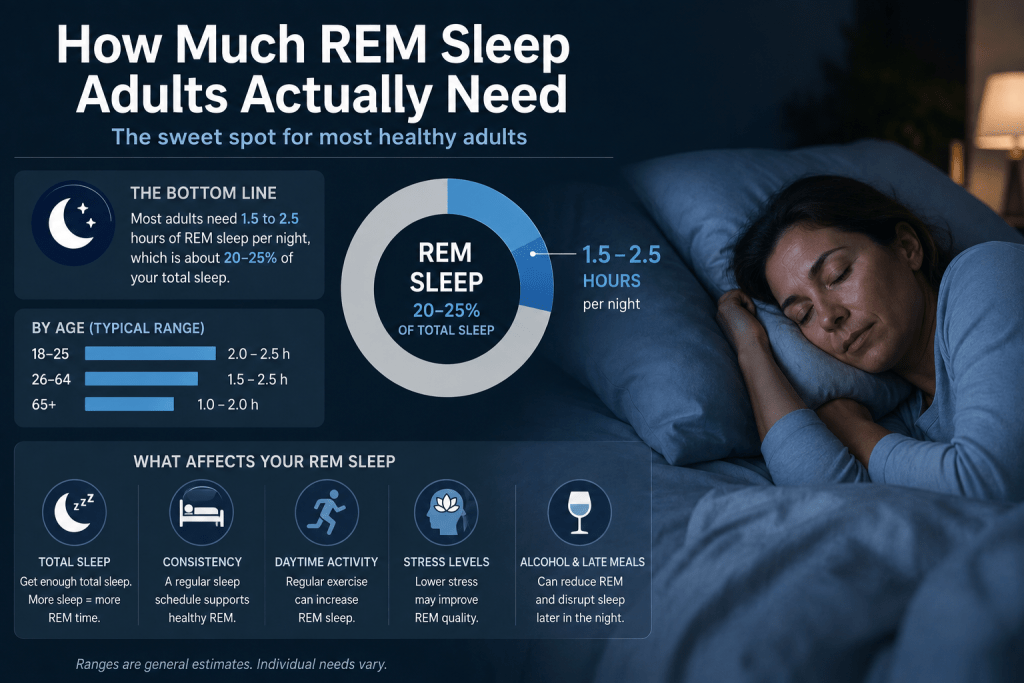
Asking how much REM sleep you need is a more useful question than most tracker owners realize, says Dr. Avinesh Bhar, Board-Certified Sleep Physician at SLIIIP.com, because the answer is a proportion rather than a fixed target. Most healthy adults spend roughly 20 to 25 percent of the night in REM, which works out to about 90 to 120 minutes across a normal seven to nine hour night. That number is not something you set directly. It follows from how long you sleep, when you sleep, and whether anything is interrupting the night. This guide explains the target, what pulls REM down, and when a low number is worth a medical conversation.
SLIIIP’s board-certified sleep physicians can do sleep evaluations for sleep apnea. Virtual consultations in all 50 states. Home sleep tests shipped to your door.
How Much REM Sleep Adults Actually Need
The standard figure in sleep research is 20 to 25 percent of total sleep time. Non REM sleep makes up the remaining 75 to 80 percent.
Turning that into minutes depends entirely on your total. The Centers for Disease Control and Prevention publishes recommended sleep amounts by age group, and for adults that lands at seven or more hours. At seven hours of sleep, 20 to 25 percent is roughly 85 to 105 minutes. At eight hours, it is closer to 95 to 120 minutes.
The proportion is the target. The minutes are just arithmetic on top of your sleep duration. This is why the single most effective way to raise a low REM number is usually to sleep longer, not to chase REM directly.
A range is also not a pass or fail line. Individual variation is wide, and sitting slightly outside 20 to 25 percent on its own is not a problem. When people ask how much REM sleep is enough, they are often hoping for a threshold to clear. There is not one. What sleep physicians look at is the pattern over weeks alongside how you actually feel during the day.
CHECK YOUR SLEEP SYMPTOMS: TAKE THE 2 MINUTE QUIZ
TAKE THE QUIZ
Lorem ipsum dolor sit amet, consectetur adipiscing elit. Ut elit tellus, luctus nec ullamcorper mattis, pulvinar dapibus leo.
Why REM Clusters in the Second Half of the Night
This is the detail that explains most low REM readings, and it is worth understanding properly.
The National Heart, Lung, and Blood Institute describes how you cycle through sleep stages roughly every 80 to 100 minutes, with four to six cycles a typical night, and more REM later in the night. REM is not distributed evenly. The first REM period of the night may last only ten minutes. By the final cycle it can run thirty minutes or more.
The consequence is direct. Cutting an hour off the end of your night removes far more than one seventh of your REM. It removes the richest REM of the whole night. Deep sleep loads the early hours, so an early bedtime with a rushed morning protects deep sleep and sacrifices REM.
If you keep waking before your alarm and losing that final stretch, waking up in the middle of the night covers the common causes.
How REM Changes With Age
Sleep architecture is not static across a lifetime.
Newborns spend up to half their sleep in REM, which is tied to brain development. That proportion falls through childhood and settles near adult levels in the late teens. Adults hold fairly steady in the 20 to 25 percent range through middle age.
Older adults commonly run lower, often in the range of 15 to 20 percent. Slow wave sleep declines with age even more sharply. A gradual decline in REM percentage over decades is expected, not a disorder. What matters more is whether you wake feeling restored.
What Lowers Your REM
Several ordinary things suppress REM, and most of them are modifiable.
Alcohol is the most consistent one. It shortens the time it takes to fall asleep and then suppresses REM in the first part of the night, with fragmented sleep in the second half.
Short nights. Covered above, and by far the biggest lever.
Irregular timing. REM is partly governed by your body clock, so a schedule that shifts around blunts it. Our guide on how to fix your sleep schedule covers the correction.
Certain medications. Several classes of prescription medicines reduce REM, including some antidepressants. This is a known and often accepted effect. It is not a reason to stop or adjust anything on your own. Raise it with your prescribing clinician if you are concerned.
Fragmented sleep from a breathing problem. Untreated sleep apnea repeatedly pulls you out of sleep, and REM is often hit hardest because muscle tone drops during REM and the airway becomes more collapsible.
Stress and a warm room both contribute in smaller ways.
Can You Have Too Much REM?
Occasionally people see a high REM percentage and worry.
The usual explanation is harmless. After a period of restricted sleep or after cutting back on alcohol, the body often shows a temporary rebound where REM claims more of the night than usual. That is recovery, not a problem.
Sustained unusually high REM alongside daytime sleepiness is a different picture and worth discussing with a clinician. The same is true of vivid, disturbing dreams that are new, or of physically acting out dreams, which is a specific pattern covered in REM sleep behavior disorder.
Why Your Tracker’s REM Number May Be Wrong
Before you act on a low reading, know what produced it.
Sleep stages are defined by brain activity, measured in a sleep study. Consumer wearables have no access to that. They estimate stages from heart rate, movement, and temperature, which correlate with brain states without measuring them.
Wearables are reasonably good at separating asleep from awake and considerably less reliable at classifying specific stages. Treat your REM percentage as a rough weekly trend, not as a fact about last night. A single night showing twelve percent REM is not evidence of anything.
If you are trying to make sense of stage terminology across devices, core sleep versus deep sleep untangles the naming, and how much core sleep you need covers the parallel question for that category.
How to Support Healthy REM
There is no technique that targets REM directly, which reframes the whole question of how much REM sleep you are getting. What works is protecting the conditions that let it happen.
Give yourself enough time in bed, and protect the last ninety minutes of the night in particular.
Keep your wake time consistent, including weekends, since REM timing is clock dependent.
Reduce alcohol, especially in the two or three hours before bed.
Keep the bedroom cool and dark. Body temperature regulation is impaired during REM, which makes a warm room more disruptive at that stage than others.
Get morning daylight to anchor your rhythm.
The same fundamentals apply to the other stages, which is why our guides on how to get more deep sleep and how to improve core sleep cover much of the same ground.
Watch: Dr. Wells answers why mild sleep apnea happens during REM sleep
When Low REM Points to Something Medical
Dr. Avinesh Bhar notes that patients often arrive focused on a REM percentage when the more useful question is why their sleep is being fragmented in the first place.
Some signals deserve evaluation rather than another adjustment to your routine. Loud snoring, witnessed pauses in breathing, gasping awake, morning headaches, or a dry mouth on waking all point toward a breathing problem, and sleep apnea can be present without snoring.
Persistent exhaustion despite adequate time in bed is another. That pattern is explored in why you are exhausted no matter how much you sleep and waking up tired even after eight hours. Cognitive symptoms that do not lift are covered in sleep apnea and brain fog.
A home sleep test can answer the breathing question from your own bed. Nothing here replaces personal medical advice, and no one should stop or adjust a prescribed medication or device setting on their own.
At Sliiip, we accept the following insurances:

SLIIIP’s board-certified sleep physicians can do sleep evaluations for sleep apnea. Virtual consultations in all 50 states. Home sleep tests shipped to your door.
Frequently Asked Questions
How much REM sleep should an adult get?
About 20 to 25 percent of total sleep, which is roughly 90 to 120 minutes across a seven to nine hour night. The proportion matters more than the exact minutes.
Is 1 hour of REM sleep enough?
It is on the low side for a full night but not alarming as a one off. If it happens consistently, look first at your total sleep duration and alcohol intake.
What percentage of REM is too low?
Consistently below about 15 percent is generally considered low. A single night outside the range carries little meaning.
Why is my REM sleep low every night?
Short sleep duration is the most common reason, followed by alcohol, irregular timing, some medications, and fragmented sleep from a breathing problem.
Does alcohol reduce REM sleep?
Yes. It suppresses REM early in the night and fragments the later hours, which is where most REM would normally occur.
Why does REM happen more in the morning?
REM periods lengthen with each successive cycle. The last cycles before waking contain the longest REM stretches of the night.
Does waking up early cut my REM?
Considerably. Cutting the final hour removes a disproportionate share of the night’s REM.
Can I get more REM without sleeping longer?
Only modestly. Consistent timing and less alcohol help, but sleeping longer is by far the most effective approach.
Does REM sleep decline with age?
Yes, gradually. Older adults commonly fall in the 15 to 20 percent range, which is a normal change rather than a disorder.
Is REM more important than deep sleep?
Neither is more important. They serve different functions, and a healthy night includes appropriate amounts of both.
What does REM sleep actually do?
It is closely associated with memory consolidation, learning, and emotional processing, and it is when most vivid dreaming occurs.
Can too much REM be a problem?
A temporary rebound after sleep loss or after reducing alcohol is normal. Persistently high REM with daytime sleepiness is worth discussing with a clinician.
Is my smartwatch REM measurement accurate?
It is an estimate from heart rate and movement, not a measurement of brain activity. Read it as a weekly trend rather than a nightly fact.
Do antidepressants affect REM sleep?
Several classes are known to reduce REM. Discuss any concerns with your prescribing clinician and never adjust medication on your own.
Does sleep apnea reduce REM sleep?
It commonly does. Muscle tone drops during REM, which makes the airway more prone to collapse and often makes events worse in that stage.
Do I dream only in REM?
Most vivid, narrative dreaming occurs in REM, though some dreaming happens in other stages. Dream recall depends heavily on when you wake.
Does exercise increase REM sleep?
Regular activity supports better sleep overall. The effect on REM specifically is smaller than the effect of sleeping longer.
Why do I remember dreams some mornings and not others?
Recall is much stronger when you wake directly out of REM. Waking from a different stage usually means no memory of dreaming.
Can naps give me REM sleep?
Longer naps of about ninety minutes can include REM. Short naps generally stay in lighter stages.
When should I see a sleep doctor about REM?
If you snore loudly, gasp awake, act out dreams, or feel exhausted despite adequate sleep, get evaluated rather than adjusting your routine further.
SLIIIP’s board-certified sleep physicians can do sleep evaluations for sleep apnea. Virtual consultations in all 50 states. Home sleep tests shipped to your door.
Latest posts
-
Why Are My Naps Never Refreshing?
Last updated: October 2, 2026. Medically reviewed by Dr. Avinesh Bhar, Board-Certified Sleep Physician, SLIIIP.com. Naps that leave you groggy usually come down to how long you sleep, when you…
-
Is Sleeping Too Much a Sleep Disorder?
Last updated: October 2, 2026. Medically reviewed by Dr. Avinesh Bhar, Board-Certified Sleep Physician, SLIIIP.com. Sleeping too much is not always a sleep disorder, but it can be a sign…
-
Why Does My Insomnia Get Worse After Stopping Sleep Medication?
Last updated: October 2, 2026. Medically reviewed by Dr. Avinesh Bhar, Board-Certified Sleep Physician, SLIIIP.com. Insomnia can get worse after stopping sleep medication for three main reasons. They are rebound…
Get updates
Spam-free subscription, we guarantee. This is just a friendly ping when new content is out.

