👉 Register for Free. How to Diagnose Sleep Apnea Faster in Primary Care – FREE Webinar by Dr. Audrey Wells. – Friday, April 24 at 12 PM ET

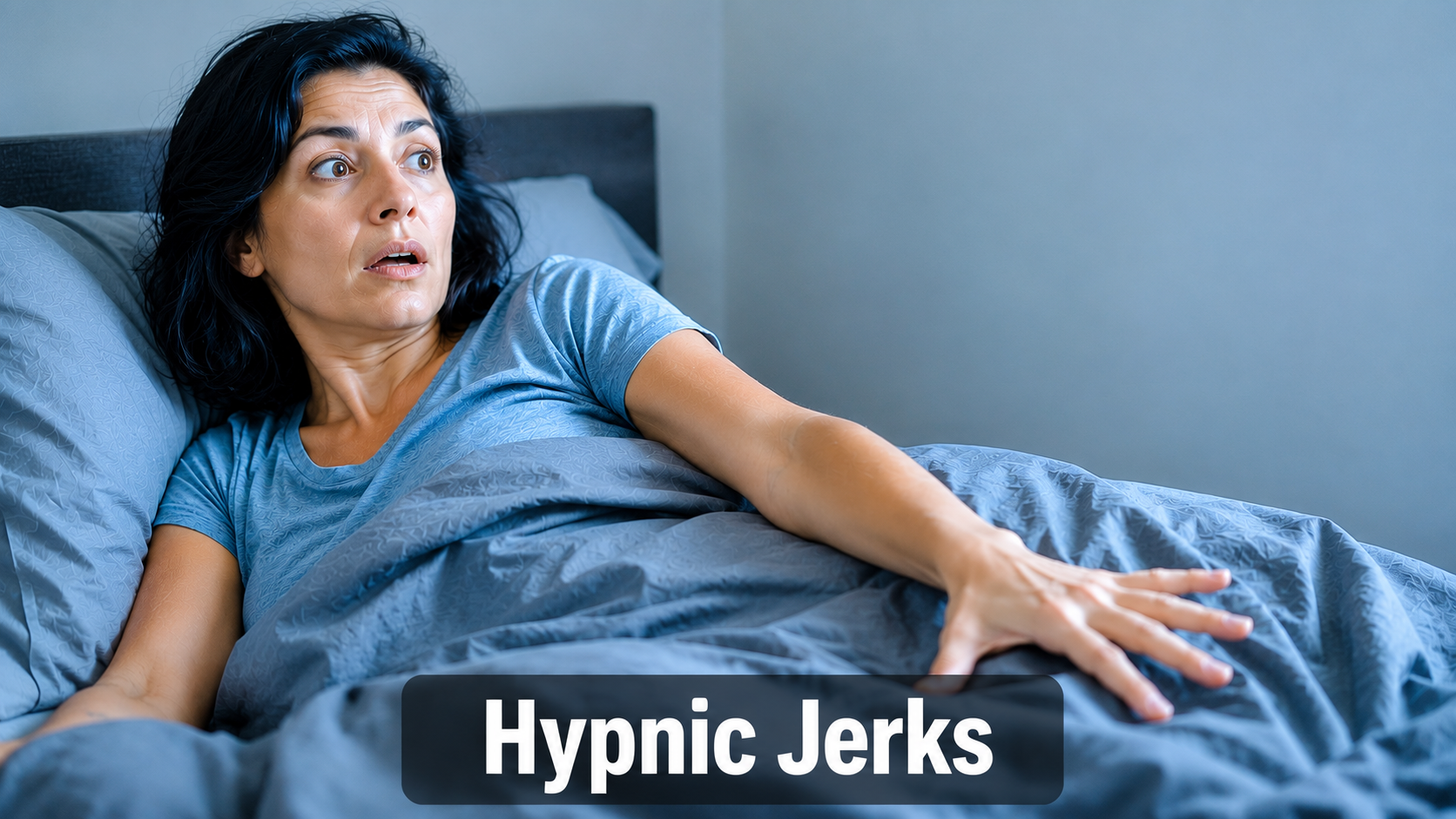
Hypnic Jerks: Why You Feel Like You’re Falling Asleep
That sudden full body twitch at the edge of sleep has a name, and Dr. Avinesh Bhar, Board-Certified Sleep Physician at SLIIIP.com, gets asked about hypnic jerks more often than almost any other nighttime sensation.
Here is the short answer that calms most people down: this is a normal thing that happens to healthy brains. Surveys suggest that most adults have felt it at least once. Many feel it regularly. It is not a seizure, and it is not a sign that something is broken.
That said, the frequency matters. When the twitch shows up every night and starts blocking sleep, it is usually telling you something about stress, stimulants, or a schedule that has drifted.
SLIIIP’s board-certified sleep physicians can do sleep evaluations for sleep apnea. Virtual consultations in all 50 states. Home sleep tests shipped to your door.
What Hypnic Jerks Are
A hypnic jerk is a brief, involuntary muscle contraction that fires as you drift from wakefulness into sleep. Clinicians also call it a sleep start or a hypnagogic jerk. The word hypnagogic simply refers to that in between zones at the start of the night.
The twitch usually comes with a mental scene attached. People report a sense of falling, a missed step off a curb, a flash of light, or a loud bang that nobody else heard. The body reacts, the eyes open, and the heart is suddenly moving faster than it was a second ago.
The whole event lasts under a second. What lingers is the adrenaline, which is why one twitch can cost you twenty minutes of sleep.
Sleep medicine classifies this in the category of benign sleep related movements. Benign is the operative word. It sits alongside things like sleep talking, which are common and generally harmless.
CHECK YOUR SLEEP SYMPTOMS: TAKE THE 2 MINUTE QUIZ
TAKE THE QUIZ

Why the Body Does This
There is no single confirmed explanation, and honest sources say so. There are two main ideas, and they are not mutually exclusive.
The first is a handoff problem. Falling asleep is not a switch. The systems that keep muscles active and the systems that relax them for sleep swap control gradually. If the relaxation signal arrives while the alerting system is still partly awake, the muscles can fire a burst on the way down.
The second idea is evolutionary and less proven. Some researchers have suggested the brain briefly misreads the loss of muscle tone as a real fall and reacts the way it would if you were slipping off a branch. It is a memorable story, though it remains a hypothesis rather than a finding.
What is well documented is that the twitch tends to cluster around light sleep, which is exactly where the transition happens. Our explainer on core sleep versus deep sleep covers how those stages are built.
What Makes Hypnic Jerks More Frequent
This is the practical part, because the triggers are mostly things you control.
Caffeine is the biggest one. It has a long tail, and an afternoon coffee is still working at bedtime for plenty of people.
Nicotine and some stimulant medications do the same thing to the alerting system.
Sleep deprivation matters more than people expect. A brain that is overtired hits the transition harder and faster, which makes a rough handoff more likely.
Late exercise can keep the nervous system revved. Morning or early evening training is usually a better fit.
Stress and anxiety are the other heavy hitters. A mind still solving problems at midnight does not hand over control smoothly. Our guide on why the brain will not shut off at night is a useful companion here, along with our piece on nighttime anxiety.
Alcohol deserves a note of its own. It can make you fall asleep faster and then fragment the rest of the night, which feeds the deprivation cycle.
Take those five inputs seriously for two weeks and most people see the frequency drop on its own.
What Hypnic Jerks Are Not
Confusion here causes a lot of unnecessary worry, so it is worth drawing clear lines.
They are not seizures. Seizure activity has a different pattern, different timing, and different findings on testing.
They are not restless legs syndrome. That condition brings an urge to move the legs, usually with an uncomfortable feeling, and it happens while you are awake and still. Our overview of restless leg syndrome explains the difference in detail.
They are not periodic limb movements, which are repetitive and happen throughout the night rather than once at the doorway to sleep.
They are not REM sleep behavior disorder, which involves acting out dreams later in the night.
They also are not sleep apnea, but this is where people get tripped up. A person who wakes with a gasp or a choking sensation may assume it was a twitch. That is a different event with a different cause. If that sounds familiar, read our article on waking up gasping for air, and consider getting evaluated rather than guessing.
Habits That Smooth the Transition
The goal is a calmer runway into sleep. These are the habits that do the most work.
Keep one wake time, weekends included. Your body clock reads your wake time as the daily anchor.
Get outside light within an hour of waking. Ten to fifteen minutes is enough for most people.
Set a caffeine cutoff in the early afternoon and hold it.
Move your workouts earlier if you train at night.
Build a wind down hour with dim light, no work email, and no doom scrolling.
Keep the bedroom cool, dark, and quiet.
If you have been lying awake and frustrated for roughly twenty minutes, get up. Read something dull in low light and go back when you feel heavy.
Protect your total sleep time. Chronic short sleep is the fuel behind a lot of rough transitions.
None of this is exotic, and that is the point. For a fuller routine, see our guide to fixing insomnia naturally and our piece on falling asleep faster.
For general public health guidance on sleep duration, the CDC sleep resources are a reliable starting point. The National Heart, Lung, and Blood Institute publishes plain language material on what short sleep does to the body.
Watch: Insomnia at Bedtime – Fix it at SLIIIP.COM
When to Talk to a Sleep Physician
Most of the time this needs reassurance and a caffeine adjustment, not a workup. Some patterns are worth a real conversation.
Book an evaluation if the twitching happens most nights and is keeping you from falling asleep. Same if you have started dreading bedtime, since anticipatory anxiety turns a minor annoyance into an insomnia pattern.
Get checked if the movements happen throughout the night rather than only at sleep onset, if they involve one side of the body consistently, if you wake confused, or if there is any tongue biting or loss of bladder control. Those features point elsewhere and deserve proper assessment.
Also get checked if daytime sleepiness is following you around. Snoring, witnessed pauses in breathing, morning headaches, or exhaustion that survives a full night in bed are worth objective testing. A home sleep test gives you data instead of theories.
When patients bring this to a visit, Dr. Avinesh Bhar starts with the simple questions before anything else. What time does the caffeine stop. How many hours are you actually sleeping. When did the pattern change, and what changed in your life around the same week. Those answers resolve a large share of cases without any testing at all.
A sleep evaluation is one piece of a broader health picture. Mood, medications, iron status, and neurologic history all interact with nighttime movement, so your physician may look wider than sleep alone.
At Sliiip, we accept the following insurances:

SLIIIP’s board-certified sleep physicians can do sleep evaluations for sleep apnea. Virtual consultations in all 50 states. Home sleep tests shipped to your door.
What is a hypnic jerk?
It is a brief involuntary muscle twitch that happens as you transition from being awake into sleep.
Are they dangerous?
For most people they are considered harmless and are classified among benign sleep related movements.
How common are they?
Very common. Survey estimates suggest a majority of adults have experienced them.
Why do I feel like I am falling?
The brain often attaches a falling image or a startle sensation to the muscle burst, though researchers still debate why.
Do they mean I have a sleep disorder?
Not on their own. They become worth investigating when they are frequent enough to block sleep or when other symptoms appear with them.
Can caffeine cause them?
Caffeine is one of the most commonly reported triggers, especially when consumed late in the day.
Does stress make them worse?
Yes. A revved nervous system makes the handoff into sleep less smooth.
Can being overtired trigger them?
It can. Sleep deprivation is associated with more frequent sleep starts, which creates a frustrating loop.
Are they the same as restless legs syndrome?
No. Restless legs brings an urge to move while you are awake and still, and it is a different condition.
Are they seizures?
No. Seizure activity looks different in timing, pattern, and testing.
Can they happen during a nap?
Yes, since naps involve the same transition into sleep.
Do children get them?
Yes. They occur across all age groups.
Do they get worse with age?
There is no strong evidence of a clear age trend. Lifestyle inputs matter more.
Can medication cause them?
Some stimulants and certain other medications are reported to increase them. Review your list with your clinician.
Is there a treatment?
There is no standard drug treatment. Management focuses on triggers, sleep timing, and stress.
Will magnesium help?
Evidence is limited outside of deficiency. Talk with your clinician before adding supplements.
Why does my heart race afterward?
The startle response releases adrenaline, which raises heart rate for a short period.
Can they wake my partner?
Yes. A strong twitch can move the mattress enough to wake someone beside you.
Should I see a doctor about this?
Consider an evaluation if the events are nightly, if they occur throughout the night, or if you have daytime sleepiness or breathing symptoms.
Can I get tested without going to a sleep lab?
Yes. SLIIIP ships home sleep tests to your door and reviews the results with you by video.
Your Next Step
For most people, hypnic jerks are a quirk of a healthy brain changing gears. Cut the late caffeine, protect your total sleep time, and lower the pressure around bedtime, and the twitching usually fades into the background.
When it does not fade, that is worth a real look rather than another year of wondering. A virtual visit takes less time than the sleep you are losing.
SLIIIP’s board-certified sleep physicians can do sleep evaluations for sleep apnea. Virtual consultations in all 50 states. Home sleep tests shipped to your door.
Latest posts
-
Sleep Debt: What It Is and How to Pay It Back
Most people first hear the term sleep debt after a rough week, and Dr. Avinesh Bhar, Board-Certified Sleep Physician at SLIIIP.com, says the banking metaphor is useful right up until…
-
Studying at Night vs Morning: Which Works Better for You?
The debate over studying at night vs morning usually gets framed as a discipline question, but Dr. Avinesh Bhar, Board-Certified Sleep Physician at SLIIIP.com, treats it as a biology question…
-
Can’t Sleep the Night Before an Exam? Here Is What to Do
If you can’t sleep the night before an exam, you are dealing with a normal stress response rather than a broken sleep system, according to Dr. Avinesh Bhar, Board-Certified Sleep…
Get updates
Spam-free subscription, we guarantee. This is just a friendly ping when new content is out.

