👉 Register for Free. How to Diagnose Sleep Apnea Faster in Primary Care – FREE Webinar by Dr. Audrey Wells. – Friday, April 24 at 12 PM ET

Sleep Debt: What It Is and How to Pay It Back
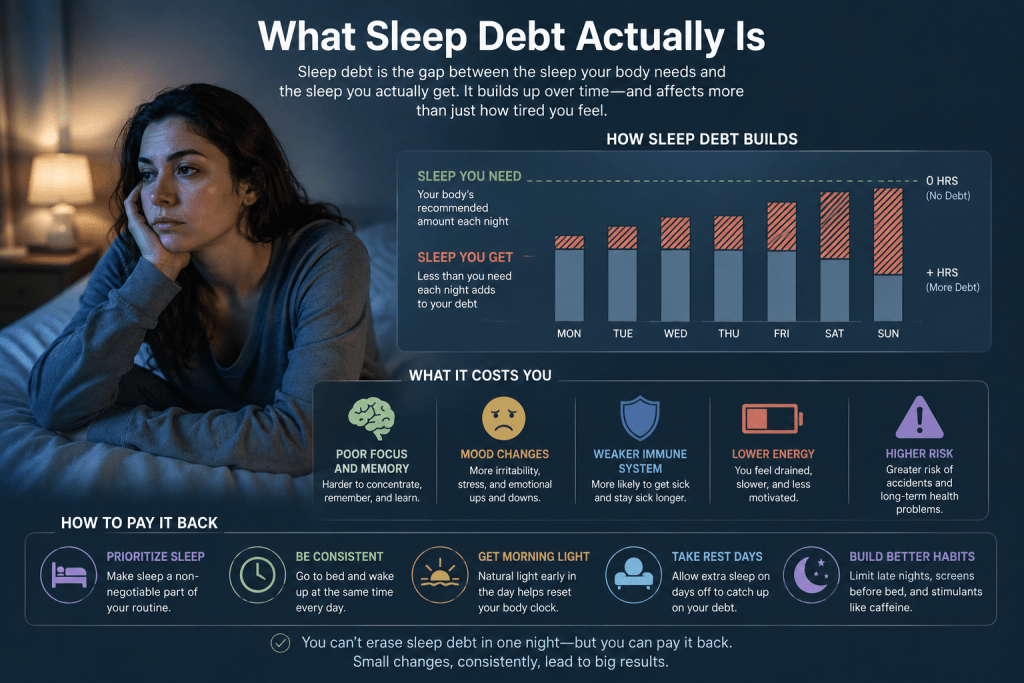
Most people first hear the term sleep debt after a rough week, and Dr. Avinesh Bhar, Board-Certified Sleep Physician at SLIIIP.com, says the banking metaphor is useful right up until people assume the account settles as easily as a checking balance. The shortfall accumulates faster than it repays. An hour lost each weeknight adds up to five hours by Friday, and a single long Saturday morning does not fully cancel it.
That gap between how quickly the deficit builds and how slowly it clears is the part worth understanding. The body keeps a running tally whether or not you are tracking it, and the effects tend to show up as ordinary complaints: dragging afternoons, a shorter fuse, getting sick more often, needing three alarms. This guide covers what the deficit actually is, how it accumulates, what recovery genuinely looks like, and how to tell the difference between a shortfall you can fix and a problem that needs a physician.
SLIIIP’s board-certified sleep physicians can do sleep evaluations for sleep apnea. Virtual consultations in all 50 states. Home sleep tests shipped to your door.
What Sleep Debt Actually Is
The concept is simple arithmetic. Take the amount of sleep your body needs and subtract what you actually get. The difference accumulates.
If you need eight hours and average six and a half across a work week, you finish the week roughly seven and a half hours short. Nothing dramatic happens on any single night, which is exactly why the pattern persists.
Two things make this harder to spot than it sounds.
Your requirement is not obvious. The Centers for Disease Control and Prevention sets seven or more hours as adult guidance, and most people land somewhere between seven and nine. Where you fall inside that range is individual, and plenty of people have never actually measured it.
Self-assessment degrades as the deficit grows. Research on sustained short sleep tends to find that measured performance keeps declining while people’s rating of their own alertness levels off. Feeling adjusted to six hours is one of the more reliable signs of having accumulated a shortfall, not evidence of needing less sleep.
A small number of people genuinely function well on less, but that group is far smaller than the number who believe they belong to it.
CHECK YOUR SLEEP SYMPTOMS: TAKE THE 2 MINUTE QUIZ
TAKE THE QUIZ
How the Deficit Builds
The accumulation is usually undramatic. A few patterns account for most of it.
Fixed wake time, variable bedtime. Work or school locks your morning. Everything that runs late comes directly out of sleep.
Weekday and weekend mismatch. Sleeping until noon on Saturday shifts your internal clock later, which makes Sunday night harder and Monday worse. The pattern is sometimes called social jet lag, and it produces a version of what happens after crossing time zones.
Time in bed versus time asleep. Eight hours in bed with twenty minutes to fall asleep and two brief awakenings is closer to seven hours of sleep. Most people overestimate their total.
Quality problems hiding as quantity problems. This one matters. If sleep is fragmented by breathing disruptions, noise, or pain, the hours on the clock overstate the rest actually obtained.
Our guide on how much core sleep you need breaks down the portion of the night that carries the most weight, which helps explain why two people with identical hours can feel very different.
A worked example makes the arithmetic concrete. Say your requirement is eight hours. Monday through Thursday you get six and a half, which puts you six hours short by Friday morning. Friday night runs late and you get five, adding three more. Saturday you sleep ten, which returns two. Sunday you sleep nine, returning one. You start the new week roughly six hours behind, having felt reasonably rested for two days.
That is the trap. The weekend feels like a reset because alertness recovers faster than the underlying balance does. Repeat the pattern for a couple of months and the baseline quietly moves, which is why people often date the start of their fatigue to a specific stressful period and then cannot explain why it never lifted afterward.
Certain situations make accumulation faster and harder to notice. Shift work scrambles both timing and duration at once. New parents lose sleep in fragments rather than in blocks, which is harder to measure. Chronic pain and untreated breathing problems both add fragmentation on top of whatever the schedule already costs.
What the Shortfall Costs
The effects are cumulative rather than sudden, which is part of why they get attributed to something else.
Attention lapses. Brief moments where the brain effectively goes offline. In practice this looks like missing part of a conversation or rereading the same paragraph.
Weaker memory consolidation. Sleep is associated with stabilizing what was learned during the day. Chronic shortfall means everything is being stored under worse conditions.
Lower stress tolerance. Ordinary irritations land harder, and emotional recovery takes longer.
Immune function. Insufficient sleep is associated with a weaker immune response.
Appetite changes. Short sleep is associated with shifts in the hormones regulating hunger and fullness.
Driving risk. Reaction time and attention lapses affect driving directly, and drowsy driving is a genuine hazard rather than a figure of speech.
The National Heart, Lung, and Blood Institute describes sleep deficiency as covering insufficient duration, poor quality, and bad timing together, which is a more accurate frame than hours alone.
Can You Actually Pay It Back?
Partly, and more slowly than the metaphor suggests.
Recovery is real but incomplete. After a stretch of short nights, alertness typically improves substantially after one full night. Some measures of attention and reaction time take several consecutive nights of adequate sleep to return to baseline. Longer accumulations take longer to clear.
Consistency beats volume. Three or four normal nights in a row do more than one enormous weekend sleep followed by a return to the old pattern. The marathon lie-in also shifts your clock later, which quietly sets up the next week’s shortfall.
Add time to the front, not the back. Going to bed thirty minutes earlier works better than sleeping in, because it preserves your wake time and keeps the body clock anchored.
Naps supplement, they do not substitute. Around twenty minutes restores some alertness without leaving you groggy. Our overview of the benefits of napping covers the timing. A nap does not replace the nighttime hours it stands in for.
Caffeine masks rather than repays. It postpones the feeling of sleepiness while the underlying deficit stays exactly where it was, and late use pushes the next night later still.
Expect a temporary increase in need. During recovery, sleeping nine or ten hours for several nights is common and appropriate. If that continues for weeks without improvement, the issue is probably not the balance you were trying to clear.
If the pattern has drifted far enough that your schedule itself feels broken, our guide on how to fix your sleep schedule covers rebuilding it in manageable steps.
One note on medication: if you take a prescribed sleep aid or stimulant, do not change the dose or timing on your own to manage a rough stretch or force a recovery. Speak with the prescribing clinician first.
Watch: How Does a Home Sleep Test Work? — SLIIIP.COM
When It Is Not a Shortfall at All
Here is the distinction that saves people months of frustrating effort.
If you consistently spend eight hours in bed, keep a steady schedule, and still wake up unrefreshed, you are probably not dealing with an accumulated shortfall. Adding more hours to a night that is not restorative rarely helps, because the problem is what is happening during those hours rather than how many there are.
Dr. Avinesh Bhar notes that people often spend a long time trying to sleep more before anyone asks whether the sleep they are getting is being disrupted. Obstructive sleep apnea is associated with unrefreshing sleep, morning headaches, daytime sleepiness, and difficulty concentrating, and it produces fragmentation that a person may not notice at all.
Signs worth raising with a clinician:
- Loud snoring, gasping, or witnessed pauses in breathing
- Waking with a dry mouth or headache most mornings
- Daytime sleepiness that does not improve after a week of adequate sleep
- Falling asleep unintentionally during quiet activities or while driving
Our article on why you may feel exhausted no matter how much you sleep covers this pattern in more detail, and if you are weighing whether a formal evaluation makes sense, this guide on whether you need a sleep study walks through the usual reasons a physician would recommend one.
Nothing here is a diagnosis, and none of it replaces an evaluation by a clinician who knows your history.
At Sliiip, we accept the following insurances:

SLIIIP’s board-certified sleep physicians can do sleep evaluations for sleep apnea. Virtual consultations in all 50 states. Home sleep tests shipped to your door.
Frequently Asked Questions
What is sleep debt?
It describes the cumulative difference between the sleep your body needs and the sleep you actually get.
How do I calculate mine?
Subtract your average nightly sleep from your individual requirement, then multiply across the days involved.
Can you fully recover from sleep debt?
Recovery is substantial but often incomplete, and longer accumulations take longer to clear.
How many nights does recovery take?
Alertness usually improves after one full night, while some performance measures take several consistent nights.
Does sleeping in on weekends fix it?
Weekend recovery helps partially, though large shifts in wake time move your body clock later.
Is it better to go to bed earlier or wake up later?
Going to bed earlier generally works better because it preserves a consistent wake time.
Do naps reduce sleep debt?
Naps restore some alertness but do not replace the nighttime sleep that was missed.
How long should a recovery nap be?
About twenty minutes lifts alertness without leaving you groggy.
Does caffeine help me repay it?
Caffeine postpones sleepiness without addressing the underlying shortfall.
Can I train myself to need less sleep?
Most people who believe they have adapted to short sleep are performing below their own baseline.
Why do I feel fine on six hours?
Self-assessment of alertness becomes less accurate as a deficit accumulates.
Is sleeping ten hours after a bad week normal?
A temporary increase in sleep need during recovery is common and expected.
What is social jet lag?
It describes the mismatch between weekday and weekend sleep timing, which resembles crossing time zones.
Does sleep debt affect weight?
Short sleep is associated with changes in appetite regulation, though weight involves many factors.
Can it make me sick more often?
Insufficient sleep is associated with a weaker immune response.
Does it affect memory?
Sleep is associated with consolidating what was learned during the day, so a sustained shortfall works against retention.
Is drowsy driving really dangerous?
Attention lapses and slowed reaction time affect driving directly.
What if I sleep eight hours and still feel tired?
That pattern usually points to sleep quality rather than quantity and is worth discussing with a clinician.
How do I know if my sleep is fragmented?
Reports of snoring or gasping from a partner, morning headaches, and unrefreshing sleep are common clues.
When should I see a sleep physician?
If exhaustion persists despite adequate and consistent sleep, an evaluation is reasonable.
SLIIIP’s board-certified sleep physicians can do sleep evaluations for sleep apnea. Virtual consultations in all 50 states. Home sleep tests shipped to your door.
Latest posts
-
RingConn vs Oura: Which Smart Ring Tracks Sleep Better?
Last updated: September 10, 2026. Medically reviewed by Dr. Avinesh Bhar, Board-Certified Sleep Physician, SLIIIP.com. RingConn and Oura both track sleep through a finger-worn ring, but they differ most in…
-
Withings ScanWatch Sleep Tracking Accuracy: What It Can and Cannot Tell You
Last updated: September 10, 2026. Medically reviewed by Dr. Avinesh Bhar, Board-Certified Sleep Physician, SLIIIP.com. Withings ScanWatch is a hybrid analog watch that tracks sleep stages and can flag nighttime…
-
Are Cheap Fitness Trackers Accurate for Sleep?
September 10, 2026. Medically reviewed by Dr. Avinesh Bhar, Board-Certified Sleep Physician, SLIIIP.com. Cheap fitness trackers can be reasonably accurate at telling you when you fell asleep and woke up,…
Get updates
Spam-free subscription, we guarantee. This is just a friendly ping when new content is out.

