👉 Register for Free. How to Diagnose Sleep Apnea Faster in Primary Care – FREE Webinar by Dr. Audrey Wells. – Friday, April 24 at 12 PM ET


Can You Switch from CPAP to an Oral Appliance Permanently?
Switching from CPAP to an oral appliance is a goal many people quietly chase, and as Dr. Avinesh Bhar, Board-Certified Sleep Physician at SLIIIP.com, explains, whether it can be a permanent move depends on you, not on a one size fits all rule.
For the right person, an oral appliance can become a long term therapy, but the switch should always be guided by a physician and confirmed with follow-up testing. Trading one device for another without that check can leave apnea untreated, which is the very thing you are trying to fix.
SLIIIP’s board-certified sleep physicians can do sleep evaluations for sleep apnea. Virtual consultations in all 50 states. Home sleep tests shipped to your door.
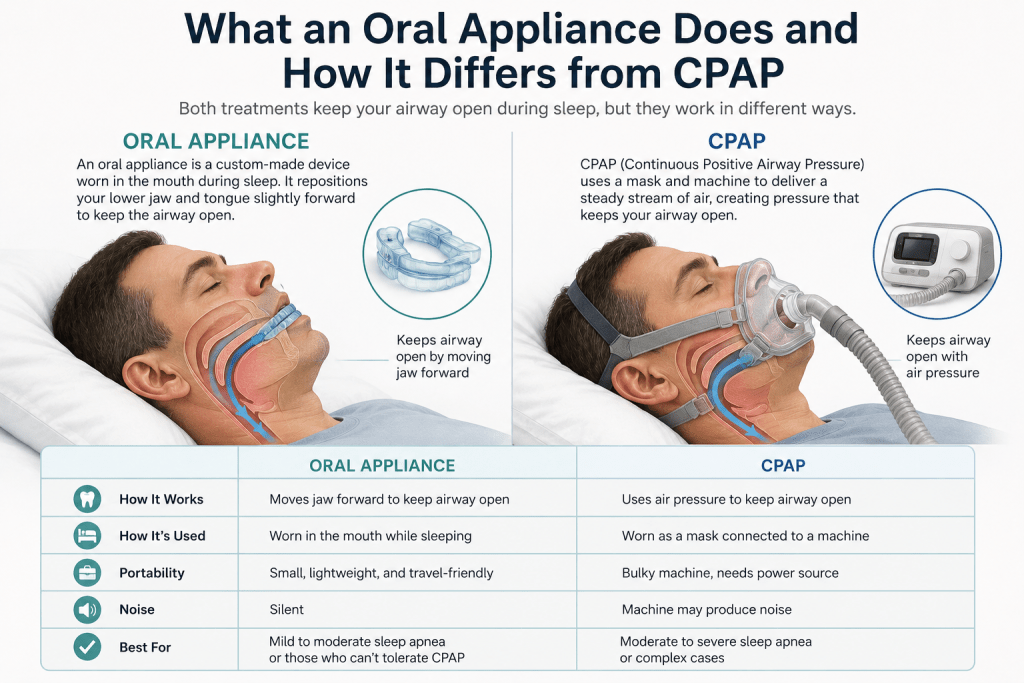
What an Oral Appliance Does and How It Differs from CPAP
To understand the switch, it helps to see how the two devices work. They solve the same problem in very different ways.
CPAP keeps your airway open by pushing a steady stream of air through a mask, while an oral appliance holds your lower jaw slightly forward to keep the airway from collapsing. One uses air pressure. The other uses a gentle jaw position.
An oral appliance looks a bit like a sports mouthguard, but it is custom fit by a professional. Most are a type called a mandibular advancement device, which nudges the jaw forward just enough to keep the throat open. Our guides on oral appliance therapy and the best mandibular advancement devices explain the details.
For a side by side look, our article on oral appliance versus CPAP breaks down the trade offs in plain terms.
CHECK YOUR SLEEP SYMPTOMS: TAKE THE 2 MINUTE QUIZ
TAKE THE QUIZ
Reasons People Want to Make the Switch
The wish to move from CPAP to an oral appliance usually comes from real frustration, not laziness. Comfort and convenience are the most common drivers.
Some people never get used to the mask or the air pressure. Some deal with dryness, bloating, or a stuffy feeling. Others travel often and want something small and quiet. Our article on why people are not loving CPAP covers many of these reasons.
A device that fits in a small case and needs no power can feel like freedom. That said, the goal is not just comfort. The goal is to treat apnea that you will actually stick with. If you are exploring life beyond the mask, our overview of sleep apnea without CPAP is worth a read.
What the Switch Process Usually Looks Like
Moving from one therapy to another is a process, not a single appointment. A clear path keeps you safe and makes the change more likely to last.
First, you talk with a sleep physician about your history and your reasons. Next, they review whether your apnea level and dental health fit an appliance. Then a custom device is made and fitted, and you wear it as directed. Finally, a follow-up test confirms it is controlling your apnea.
Do not stop your CPAP on your own before this is sorted out. If you simply need a short pause, our articles on taking a break from CPAP and quitting a CPAP machine explain why timing and testing matter.
Watch: Sleep Apnea: What is Oral Appliance Therapy?
When to Talk With Dr. Avinesh Bhar and the SLIIIP Team
If the mask is the reason you dread bedtime, a virtual visit is a low pressure first step. You can lay out your frustrations and learn whether an appliance is a realistic option for you.
Dr. Avinesh Bhar and the SLIIIP care team can review your history, talk through your apnea level, and explain what a switch would involve. Because SLIIIP runs on telemedicine, this happens from home.
From there, your physician can map out testing and next steps. The aim is therapy you will use every night, whether that ends up being CPAP, an oral appliance, or a mix. Our overview of sleep apnea treatment lays out the bigger picture.
Habits That Support Whichever Therapy You Choose
No device works in a vacuum. Your daily habits shape how well any therapy holds up. Small, steady routines make a real difference.
Keep a regular sleep and wake schedule.
Go easy on alcohol near bedtime, since it relaxes the airway.
Reach a comfortable weight at a steady pace, as weight can affect apnea.
Sleep on your side if your physician says it helps your case.
Clean your device exactly as directed to keep it working and healthy.
Bring up new or returning symptoms with your care team promptly.
These habits do not cure or treat apnea on their own, and they do not replace medical care. They simply support the plan your physician builds with you. For appliance care, see our guide on how to clean a sleep apnea oral appliance.
For trusted background, the Centers for Disease Control and Prevention and the National Heart, Lung, and Blood Institute both publish clear public guides on sleep apnea.
At Sliiip, we accept the following insurances:

SLIIIP’s board-certified sleep physicians can do sleep evaluations for sleep apnea. Virtual consultations in all 50 states. Home sleep tests shipped to your door.
Frequently Asked Questions
Can you switch from CPAP to an oral appliance permanently?
Some people do make the move for good. It works best for mild or moderate apnea and must be guided by a physician and confirmed with follow-up testing. The switch can be lasting when the appliance controls your apnea and you tolerate it.
Is an oral appliance as effective as CPAP?
For many people with mild or moderate apnea, an appliance can work well. CPAP is often more effective for severe apnea. A physician helps match the therapy to your case.
Who is a good candidate for an oral appliance?
People with mild or moderate sleep apnea, and some with snoring, tend to do best. Dental and jaw health also matter. A professional checks if the device fits you well.
Do I need a follow-up sleep test after switching?
Yes. A follow-up test is the only way to confirm the appliance is controlling your apnea. An appliance can feel comfortable and still not do the full job.
Can I just stop using my CPAP and try an appliance?
No. Do not stop CPAP on your own. Untreated apnea carries real risks. Work with a physician so the change is safe and confirmed.
What is a mandibular advancement device?
It is the most common type of oral appliance. It holds your lower jaw slightly forward to help keep your airway open while you sleep.
Is an oral appliance the same as a store mouthguard?
No. A custom appliance is fit by a professional for your mouth and jaw. A generic mouthguard is not designed to treat apnea.
Why do people want to leave CPAP behind?
Common reasons include mask discomfort, dryness, bloating, noise, and travel. An appliance is smaller and needs no power, which appeals to many.
Will an oral appliance stop my snoring?
It may help with snoring for some people by keeping the airway more open. Your physician can tell you what to expect for your case.
Is an oral appliance more comfortable than CPAP?
Many people find it easier to tolerate since there is no mask or air pressure. Comfort varies, and your physician can help you weigh it.
Can severe sleep apnea be treated with an appliance?
Severe apnea often needs CPAP for full control. An appliance alone may not be enough. A physician decides based on your test results.
How long does it take to get used to an appliance?
Many people adjust within a few weeks. Mild jaw soreness or extra saliva early on usually eases with time.
Does insurance cover oral appliances?
Coverage varies by plan. Many plans cover an appliance when a physician recommends it for apnea. You can verify your own benefits.
Can I use both CPAP and an oral appliance?
Some people use one device at home and the other for travel, or combine therapies in certain cases. Your physician can explain if this fits you.
Will my jaw or teeth change over time?
Some people notice small dental or bite changes with long term use. Regular checkups help your provider catch and manage any shifts.
How do I clean an oral appliance?
Clean it as directed, usually with gentle methods that protect the material. Good cleaning keeps it working and supports oral health.
Can I switch back to CPAP if the appliance does not work?
Yes. If testing shows the appliance is not controlling your apnea, your physician can move you back to CPAP or adjust the plan.
Do I need a dentist or a sleep doctor for this?
Often both. A sleep physician evaluates your apnea, and a qualified professional fits the device. The two can coordinate your care.
Is the switch permanent once I make it?
It can be lasting if it controls your apnea and you tolerate it. Permanent is not automatic. Ongoing follow up keeps the plan on track.
How can SLIIIP help me explore this?
Through virtual consultations, the SLIIIP team can review your history, talk through your apnea level, arrange testing, and explain whether an appliance is a realistic option for you.
SLIIIP’s board-certified sleep physicians can do sleep evaluations for sleep apnea. Virtual consultations in all 50 states. Home sleep tests shipped to your door.
Latest posts
-
Circular Ring Sleep Accuracy: What It Gets Right and Wrong
Last updated: September 14, 2026. Medically reviewed by Dr. Avinesh Bhar, Board-Certified Sleep Physician, SLIIIP.com. The Circular Ring estimates sleep stages, heart rate, and recovery using a finger-worn light sensor,…
-
Ballistocardiography Sleep Sensors: How Under-Mattress Tracking Works
Last updated: September 14, 2026. Medically reviewed by Dr. Avinesh Bhar, Board-Certified Sleep Physician, SLIIIP.com. Ballistocardiography sleep sensors sit under your mattress and detect the tiny mechanical vibrations your body…
-
RingConn vs Oura: Which Smart Ring Tracks Sleep Better?
Last updated: September 10, 2026. Medically reviewed by Dr. Avinesh Bhar, Board-Certified Sleep Physician, SLIIIP.com. RingConn and Oura both track sleep through a finger-worn ring, but they differ most in…
Get updates
Spam-free subscription, we guarantee. This is just a friendly ping when new content is out.

