👉 Register for Free. How to Diagnose Sleep Apnea Faster in Primary Care – FREE Webinar by Dr. Audrey Wells. – Friday, April 24 at 12 PM ET

Top CBT-I Programs for Insomnia Treatment
CBT-I programs for insomnia treatment have quietly become the gold standard for chronic sleeplessness, and Dr. Avinesh Bhar, Board-Certified Sleep Physician at SLIIIP.com, sees firsthand how the right structured plan can rebuild healthy sleep without long term medication.
Cognitive Behavioral Therapy for Insomnia, known as CBT-I, is now considered the first line option for chronic sleep problems by major sleep medicine groups.
SLIIIP’s board-certified sleep physicians can do sleep evaluations for sleep apnea. Virtual consultations in all 50 states. Home sleep tests shipped to your door.
What CBT-I Is and Why It Works
CBT-I is a short, structured program that targets the thoughts and habits that keep insomnia going. It usually runs six to eight weeks. Each session builds on the last. The goal is not just one good night of sleep. The goal is a steady pattern your body can hold on its own.
CBT-I targets the cause of insomnia, not just the symptom. Sleeping pills can help in the short term, but they do not retrain your sleep system. CBT-I does. According to the Centers for Disease Control and Prevention, about one in three adults in the U.S. does not get enough sleep on a regular basis. For many of these people, behavior based tools work better than medication over time.
You can learn more about how the method compares to drugs in our guide on CBT-I vs sleep medications.
CHECK YOUR SLEEP SYMPTOMS: TAKE THE 2 MINUTE QUIZ
TAKE THE QUIZ
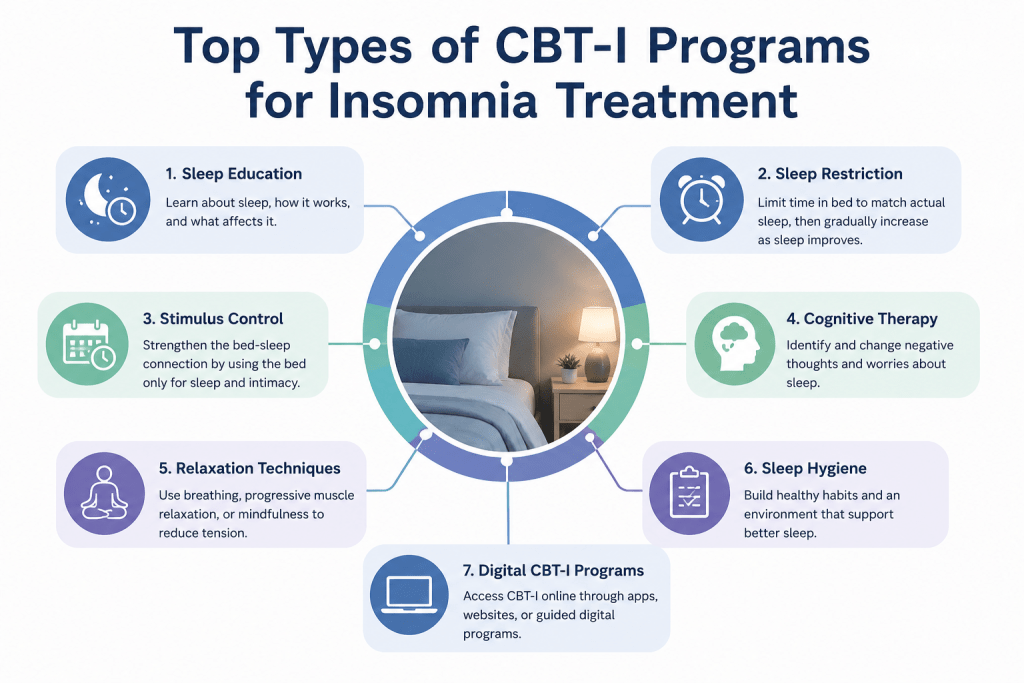
Core Pieces of Any Strong CBT-I Program
A solid CBT-I program for insomnia treatment will always include a few key parts. If a program is missing one or two of these, it may not give you the full benefit.
- Sleep restriction therapy. This is the engine of CBT-I. It limits your time in bed at first to build sleep pressure.
- Stimulus control. This rebuilds the link between your bed and sleep.
- Cognitive restructuring. This works on the racing thoughts and worries that block rest.
- Relaxation training. This teaches your body how to wind down.
- Sleep hygiene education. This covers light, food, screens, and timing.
- Weekly sleep tracking. This shows real progress over time.
If you want a deeper look at how each week feels in practice, see what CBT-I feels like week by week.
Top Types of CBT-I Programs for Insomnia Treatment
Not every program looks the same. The best fit depends on your schedule, your comfort with screens, and how much guidance you want from a clinician.
1. Clinician Led Virtual CBT-I
This is a live program with a trained sleep clinician or therapist. Sessions run by video. You meet once a week for six to eight weeks. The clinician reviews your sleep diary and adjusts your plan.
Live CBT-I is often the best choice for complex cases. This includes people with anxiety, depression, chronic pain, or shift work. SLIIIP.com offers this through its sleep telemedicine service, with virtual consultations in all 50 states.
2. Digital CBT-I Apps
Digital CBT-I, sometimes called dCBT-I, runs through an app or website. You watch short lessons, log your sleep, and follow a weekly plan. There is no live clinician for most of it. Some programs add a coach for messages.
These programs work well for people who like to move at their own pace. They are also often more affordable. SLIIIP.com offers a digital path through its digital therapeutics program.
3. Group CBT-I
Group programs bring four to ten people together with one clinician. You share progress, hear other stories, and get the same core lessons. Some people find the group format makes them stick with the plan.
4. Self Guided Workbooks
Books and printed guides also exist. These cost less and give you full control. The trade off is that you have to keep yourself on track. There is no clinician to push you through the hard middle weeks.
5. Hybrid Programs
Hybrid CBT-I mixes app lessons with short live check ins. You get the speed of digital with the support of a real clinician. This format is growing fast in telehealth.
How to Pick the Right CBT-I Program
Choosing among CBT-I programs for insomnia treatment can feel hard at first. A few key questions can narrow it down fast.
- How long have you had trouble sleeping? Three months or more often points to a need for live support.
- Do you have other health issues? Anxiety, pain, or sleep apnea often need a clinician’s eye.
- What is your budget? Digital options cost less. Live care offers more depth.
- Will your insurance cover it? Many plans now cover CBT-I when ordered by a sleep doctor.
- Do you sleep alone or with a partner? This can shape your plan.
It also helps to first rule out other sleep issues. Some people who think they have insomnia actually have sleep apnea. A home sleep test can answer this in one night. See how to get a home sleep test for the steps.
What Results Look Like
Most people who finish a CBT-I program for insomnia treatment see real change by week four or five. The first two weeks can be the hardest. Sleep restriction may leave you tired at first. That short term tiredness is part of how CBT-I works. It builds the sleep drive your body has lost.
By the end of the program, common results include:
- Falling asleep in under 20 minutes most nights
- Sleeping through the night with fewer wake ups
- Less worry about sleep during the day
- More steady energy in the morning
Dr. Avinesh Bhar has noted that patients often report less anxiety about bedtime once they trust the program. The mental shift matters as much as the time in bed.
For more on the science of why this approach works, see why CBT-I works when medications don’t.
Common Mistakes That Slow Progress
Even strong CBT-I programs can stall when small habits get in the way. Watch for these issues:
- Skipping the sleep diary. Without daily logs, your plan cannot be adjusted.
- Quitting in week two. This is when sleep restriction feels the worst.
- Napping during the day. This drains the sleep pressure CBT-I tries to build.
- Staying in bed when wide awake. This breaks stimulus control.
- Mixing in sleeping pills without telling your clinician. This hides your real progress.
If your mind races at night, our guide on how to stop overthinking at night pairs well with CBT-I tools.
Watch: The Importance of Sleep Behaviors session by Dr. Avinesh Bhar
How SLIIIP.com Supports CBT-I Care
SLIIIP.com is a sleep telehealth platform built for people who cannot or do not want to visit an in person clinic. Our team offers:
- Virtual consultations in all 50 states
- Home sleep tests shipped to your door
- Nationwide coverage with board certified sleep physicians
- Insurance verification for many major plans
- Digital therapeutics for chronic insomnia
This setup lets you start a CBT-I plan from home. You meet your doctor by video. If a sleep test is needed first, the device ships to you. You can learn more about the process in our how it works guide.
If you are not sure whether your symptoms fit insomnia or another sleep disorder, our insomnia treatment page is a good place to start. You can also read about the types of insomnia and how to fix insomnia naturally.
According to the National Heart, Lung, and Blood Institute, chronic insomnia is best supported with behavior based care first, with medication used only when needed. CBT-I matches this guidance.
At Sliiip, we accept the following insurances:

SLIIIP’s board-certified sleep physicians can do sleep evaluations for sleep apnea. Virtual consultations in all 50 states. Home sleep tests shipped to your door.
Frequently Asked Questions
What does CBT-I stand for? CBT-I stands for Cognitive Behavioral Therapy for Insomnia. It is a short term, skill based approach.
How long do CBT-I programs for insomnia treatment last? Most run six to eight weeks. Some shorter programs run four weeks.
Is CBT-I better than sleeping pills? For chronic insomnia, most sleep groups list CBT-I as the first line option. See is CBT-I better than sleep meds.
Can I do CBT-I on my own? Some people do well with workbooks or apps. Others need a clinician for the harder weeks.
Will CBT-I work if I also have anxiety? Yes. CBT-I can be paired with broader cognitive therapy for anxiety.
Does insurance cover CBT-I?
Many major plans cover CBT-I when ordered by a sleep doctor. You can verify your benefits today.
How fast will I see results?
Most people see real change by week four or five.
Can I do CBT-I online?
Yes. Digital CBT-I and virtual clinician led CBT-I are both common.
What is sleep restriction?
It is a CBT-I tool that limits time in bed at first. This builds your sleep drive.
Will I feel tired during the program?
Yes, often in weeks one and two. This is normal and part of the method.
Can teens or older adults use CBT-I?
Yes. CBT-I has been studied in many age groups.
Do I need a sleep study before CBT-I?
Not always. But if snoring or gasping is part of your sleep, see do I need a sleep study.
What if I work the night shift?
A clinician led program can adjust your plan to your shift pattern.
Can CBT-I help with menopause sleep issues?
Yes. Many women use CBT-I for sleep changes during this stage.
Is there a CBT-I program for racing thoughts?
The cognitive part of CBT-I targets this. See also can’t shut brain off at night.
How do I know if my issue is insomnia or sleep apnea?
A home sleep test can rule out apnea. See do I have insomnia or something else.
Can I keep my sleep meds during CBT-I?
This depends on your doctor. Most plans aim to taper slowly.
What happens after I finish CBT-I?
You keep the tools for life. Many people use them again during stress.
How is CBT-I different from sleep hygiene tips?
Sleep hygiene is only one part of CBT-I. The full program has five or six core tools.
Where can I start a CBT-I plan today?
You can book a virtual visit with SLIIIP.com from home.
Start Your Sleep Plan Today
The right CBT-I program for insomnia treatment can shift your nights and your days. Dr. Avinesh Bhar and the SLIIIP.com team are ready to guide you through the right next step, whether that means a home sleep test, a digital program, or a live virtual visit.
SLIIIP’s board-certified sleep physicians can do sleep evaluations for sleep apnea. Virtual consultations in all 50 states. Home sleep tests shipped to your door.
Latest posts
-
Circular Ring Sleep Accuracy: What It Gets Right and Wrong
Last updated: September 14, 2026. Medically reviewed by Dr. Avinesh Bhar, Board-Certified Sleep Physician, SLIIIP.com. The Circular Ring estimates sleep stages, heart rate, and recovery using a finger-worn light sensor,…
-
Ballistocardiography Sleep Sensors: How Under-Mattress Tracking Works
Last updated: September 14, 2026. Medically reviewed by Dr. Avinesh Bhar, Board-Certified Sleep Physician, SLIIIP.com. Ballistocardiography sleep sensors sit under your mattress and detect the tiny mechanical vibrations your body…
-
RingConn vs Oura: Which Smart Ring Tracks Sleep Better?
Last updated: September 10, 2026. Medically reviewed by Dr. Avinesh Bhar, Board-Certified Sleep Physician, SLIIIP.com. RingConn and Oura both track sleep through a finger-worn ring, but they differ most in…
Get updates
Spam-free subscription, we guarantee. This is just a friendly ping when new content is out.

