👉 Register for Free. How to Diagnose Sleep Apnea Faster in Primary Care – FREE Webinar by Dr. Audrey Wells. – Friday, April 24 at 12 PM ET

Wearable Sleep Trackers: What They Can and Cannot Tell You About Your Sleep
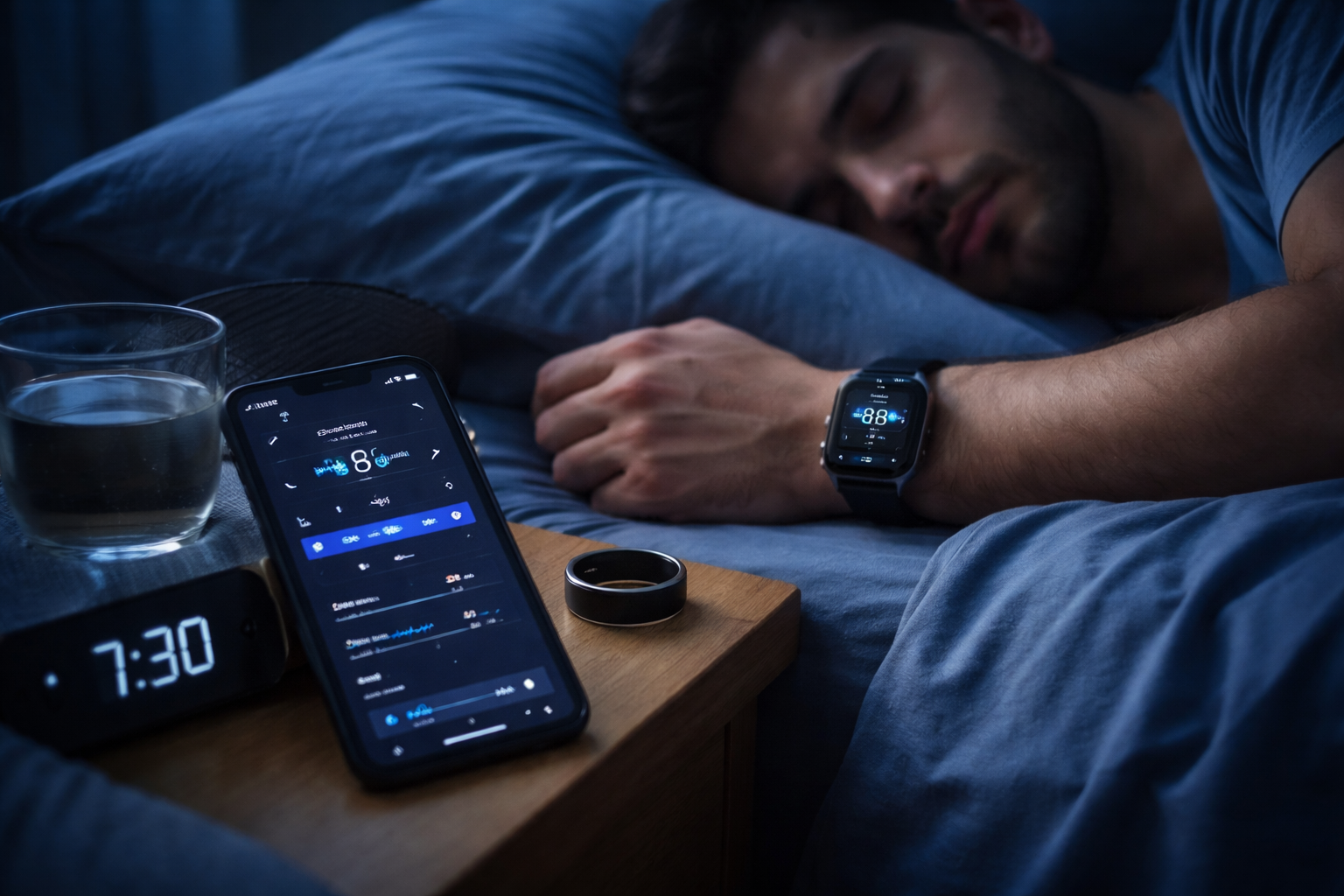
You strap on a ring, a watch, or a band before bed. In the morning, you open an app and see a number: your sleep score. Maybe it tells you that you spent two hours in deep sleep, or that your heart rate dipped to 52 beats per minute, or that your blood oxygen fluctuated during the night. It feels like a window into a part of your life that was previously invisible. And in many ways, it is.
Wearable sleep trackers have become one of the fastest growing categories in consumer health technology, with the global market valued at approximately 30 billion dollars in 2024. Devices from Apple, Samsung, Oura, Whoop, Garmin, Fitbit, and Withings now offer an impressive range of sleep-related metrics, and some have even received FDA authorization to screen for signs of sleep apnea. But what do these numbers actually mean, what are the limitations, and when is it time to move beyond consumer tracking and get a professional evaluation?
Dr. Avinesh Bhar, the Founder of SLIIIP, is also a sleep apnea sufferer. He has helped thousands of patients understand their sleep data and take the right next step, and he and his team of board-certified sleep medicine physicians can help you too. This guide breaks down everything you need to know about wearable sleep trackers, including what they measure, how accurate they are, and when a professional sleep test is the better choice.
What Wearable Sleep Trackers Actually Measure
Most wearable sleep trackers rely on a combination of sensors to estimate what is happening while you sleep. The specific sensors vary by device, but the core technologies include accelerometers that detect movement, photoplethysmography (PPG) sensors that measure heart rate through light signals on the skin, and in some devices, temperature sensors and blood oxygen (SpO2) monitors.
From these raw signals, the device’s algorithms estimate several key metrics. Total sleep time is calculated by identifying when you fell asleep and when you woke up, primarily based on reduced movement and changes in heart rate. Sleep stages, including light, deep, and REM sleep, are estimated using patterns in heart rate variability and movement, though these estimates are less precise than what a clinical sleep study provides. Heart rate and heart rate variability during sleep offer insights into your autonomic nervous system and how well your body recovers during the night. Blood oxygen saturation, available on devices with SpO2 sensors, tracks fluctuations that may indicate breathing disruptions.
Some trackers also provide a composite sleep score, a single number that combines several metrics into an overall rating of your night. While this score can be a useful motivational tool, it is important to understand that the underlying algorithm varies from brand to brand, and the same night of sleep might receive different scores on different devices. SLIIIP has a detailed guide on understanding core sleep and what the different stages of rest mean for your body.
Popular Wearable Sleep Trackers and What They Offer
The current generation of sleep trackers offers more variety than ever. Smart rings like the Oura Ring 4 have become a popular choice for people who want discreet, comfortable overnight tracking without wearing a watch to bed. The Oura Ring uses 18 sensor pathways to monitor heart rate, movement, body temperature, and blood oxygen, and it provides detailed sleep stage breakdowns along with readiness and recovery scores.
Wrist-worn devices remain the most common category. The Apple Watch Series 10 and later models now include an FDA-authorized sleep apnea notification feature that analyzes accelerometer data over a 30-day period and alerts users to signs of moderate to severe obstructive sleep apnea. Samsung’s Galaxy Watch 7 and later models were actually the first to receive FDA authorization for sleep apnea screening, using a similar approach that tracks breathing disturbance patterns over two nights of sleep within a 10-day window.
Fitness-focused bands like the Whoop 5.0 and Fitbit Charge 6 emphasize recovery metrics alongside sleep tracking, helping active users understand how their rest relates to physical performance. Non-wearable options also exist, including under-mattress sensors from Withings that track sleep without requiring you to wear anything at all. The Withings Sleep Analyzer can even estimate breathing disturbance frequency and classify potential sleep apnea severity based on the American Academy of Sleep Medicine’s standards.
If you are specifically curious about how the Apple Watch compares to clinical sleep apnea detection, SLIIIP has covered this topic in detail in an article about whether the Apple Watch can detect sleep apnea.
How Accurate Are Consumer Sleep Trackers?
This is the question that matters most, and the honest answer is: it depends on what you are measuring. Wearable sleep trackers tend to do a reasonable job of estimating total sleep time and identifying when you are asleep versus awake. Most devices are fair to good at tracking overall sleep duration, which makes them useful for identifying broad patterns like consistently short sleep or irregular schedules.
Where accuracy drops off is in sleep stage classification. The gold standard for measuring sleep stages is polysomnography, a clinical sleep study that monitors brain waves, eye movements, muscle activity, and multiple other signals. Consumer wearables rely primarily on movement and heart rate patterns to estimate stages, which introduces a meaningful margin of error. Independent validation studies consistently show that while wearable devices can detect general trends in sleep staging, they are not reliable enough for clinical-level decisions about specific stages like deep sleep or REM sleep.
Blood oxygen monitoring on consumer devices has improved significantly, but it still does not match the precision of medical-grade pulse oximetry used in clinical home sleep tests. Consumer SpO2 sensors can identify general trends and flag notable dips, but they are not calibrated for the specific thresholds used to diagnose conditions like obstructive sleep apnea.
The American Academy of Sleep Medicine has noted that while consumer smartwatches can screen for OSA risk and track sleep timing robustly, none replace polysomnography or home sleep apnea testing for diagnosis. This distinction is critical: a sleep tracker can tell you that something may be off, but it cannot tell you exactly what is happening or how serious it is.
Your Wearable Flagged a Sleep Issue. Now What?
SLIIIP’s team of board-certified sleep medicine physicians is licensed in 40 states and can help you understand what your tracker data means. If your device has flagged breathing disturbances, low oxygen, or poor sleep quality, a professional home sleep test is the next step. No referral needed. No long waits.
We can help with: Sleep Apnea Evaluation and Diagnosis, Home Sleep Testing, CPAP Therapy and Management, Oral Appliance Therapy, Snoring, Chronic Fatigue and Daytime Sleepiness, Sleep-Related Breathing Disorders, Ongoing Remote Monitoring.
We accept Medicare, Tricare, and most major insurance plans. Book your appointment today.

What Sleep Trackers Cannot Do
For all their sophistication, consumer wearable sleep trackers have important limitations that are worth understanding clearly.
They cannot diagnose sleep apnea. Even the FDA-authorized screening features on Apple Watch and Samsung Galaxy Watch are designed to flag potential signs of moderate to severe obstructive sleep apnea, not to provide a diagnosis. The FDA authorization is for screening, which means the device can suggest you may be at risk, but a clinical evaluation is still required to confirm and classify the condition. Both Apple and Samsung state explicitly that their features are not intended to replace a professional sleep study.
They cannot measure brain activity. Without electroencephalography (EEG) sensors, consumer wearables cannot directly observe the electrical activity in your brain that defines true sleep stages. The sleep stage estimates they provide are inferences based on proxy signals like movement and heart rate, not direct measurements. This means conditions that affect brain activity during sleep, such as central sleep apnea, are particularly difficult for consumer devices to detect.
They cannot provide a complete picture of respiratory events. A clinical home sleep test measures airflow through the nose, breathing effort from chest and abdominal sensors, and blood oxygen with medical-grade equipment. This allows a sleep specialist to calculate your apnea-hypopnea index (AHI), which is the standard measure of sleep apnea severity. Consumer devices do not capture this level of respiratory detail.
They can sometimes increase anxiety about sleep. A phenomenon known as orthosomnia has been documented in sleep medicine literature, where people become so focused on optimizing their sleep tracker data that the anxiety itself begins to interfere with sleep. If you find yourself lying in bed worrying about whether your sleep score will be good enough, the tracker may be doing more harm than good.
When a Consumer Tracker Is Enough
Wearable sleep trackers are genuinely useful tools for many people, and they serve several valuable purposes when used appropriately. They can help you identify patterns you might not notice otherwise, like the fact that you consistently sleep 45 minutes less on nights you drink alcohol, or that your resting heart rate is higher on days after poor rest. They can motivate behavior change by providing visible feedback on the impact of habits like exercise, caffeine timing, and consistent bedtimes.
For people who are generally healthy and curious about their sleep, a consumer tracker provides a helpful layer of self-awareness. If your tracker shows consistent, restful nights with stable oxygen levels and regular sleep stages, that is reassuring data. Building a strong sleep routine and using a tracker to monitor your progress is a perfectly valid approach for many people.
Trackers are also useful as an early warning system. If your device begins flagging elevated breathing disturbances, consistently low blood oxygen, or fragmented sleep patterns, that information is valuable not as a diagnosis but as a prompt to seek professional evaluation. Think of your sleep tracker as a smoke detector: it can alert you to a potential problem, but you still need a professional to determine what is happening and how to address it.

When You Need a Professional Sleep Test
There are clear situations where a consumer sleep tracker is not sufficient, and a clinical evaluation becomes the appropriate next step.
If your tracker has flagged potential sleep apnea indicators, the logical follow-up is a professional home sleep test. Unlike a consumer device, a home sleep test uses medical-grade sensors to measure nasal airflow, respiratory effort, blood oxygen, heart rate, and body position with enough precision to calculate your AHI and determine whether you have obstructive sleep apnea, and if so, how severe it is.
If you experience symptoms like loud snoring, witnessed breathing pauses, gasping or choking during sleep, excessive daytime sleepiness, morning headaches, or the pattern of waking up tired despite adequate time in bed, these are signs that warrant professional evaluation regardless of what your tracker says. Some conditions, including central sleep apnea and upper airway resistance syndrome, may not generate the specific signals that consumer devices are designed to detect.
If you are already using a CPAP machine and want to track your progress, your CPAP device itself provides more relevant and accurate data than a consumer wearable. CPAP machines record detailed information about your AHI while on therapy, mask leak rates, and usage hours. SLIIIP offers CPAP management and remote monitoring to help patients optimize their therapy based on this clinical-grade data.
How to Get the Most From Your Sleep Tracker
If you decide to use a wearable sleep tracker, a few principles will help you get the most value from the experience. Focus on trends rather than individual nights. A single night’s data can be influenced by many variables, but patterns over weeks and months reveal meaningful insights. Pay attention to consistency: are you going to bed and waking up at roughly the same time each day? Your tracker can help you see whether irregular schedules are affecting your rest.
Use the data as a conversation starter, not a final answer. If your tracker shows something concerning, bring that data to a healthcare provider. Many sleep specialists appreciate when patients come prepared with weeks of tracking data, as it provides useful context for the clinical conversation. SLIIIP’s sleep specialists can help you interpret what your tracker data means in the context of your symptoms and health history.
Remember that how you feel matters as much as what the numbers say. If your tracker reports a great sleep score but you still feel exhausted, that mismatch is important information. It may indicate that the tracker is not capturing something relevant, or that the issue lies in sleep quality factors that consumer devices cannot measure. If you are consistently waking up unrefreshed, SLIIIP’s article on sleeping 8 hours but still feeling tired explores the possible explanations in detail.
Ready for Answers Beyond What Your Tracker Can Provide?
SLIIIP’s board-certified sleep medicine physicians are licensed in 40 states and can take you from tracker data to a real diagnosis. Get a medical-grade home sleep test shipped to your door and receive expert interpretation of your results, all from the comfort of home.
We can help with: Home Sleep Apnea Testing, Sleep Apnea Diagnosis and Severity Classification, CPAP Therapy and Remote Monitoring, Oral Appliance Therapy, Snoring Evaluation, Excessive Daytime Sleepiness, Apple Watch and Wearable Sleep Apnea Alert Follow-Up.
We accept Medicare, Tricare, and most major insurance plans. Schedule your evaluation now.
Frequently Asked Questions
Are wearable sleep trackers accurate?
Consumer sleep trackers are reasonably accurate for estimating total sleep time and identifying broad sleep patterns. However, they are less precise for sleep stage classification and cannot match the accuracy of clinical sleep studies for detecting conditions like sleep apnea.
Can an Apple Watch diagnose sleep apnea?
No. The Apple Watch has FDA authorization to screen for potential signs of moderate to severe obstructive sleep apnea, but it cannot provide a diagnosis. A clinical sleep test is required to confirm and classify the condition.
Can a Samsung Galaxy Watch detect sleep apnea?
Samsung was the first to receive FDA authorization for a sleep apnea screening feature. The Galaxy Watch can assess for signs of moderate to severe OSA over two nights of sleep within a 10-day period, but it is a screening tool, not a diagnostic device.
What is the best wearable sleep tracker?
The best tracker depends on your priorities. The Oura Ring 4 is widely regarded for comfortable, accurate overnight tracking. The Apple Watch and Samsung Galaxy Watch offer sleep apnea screening features. The Whoop 5.0 emphasizes recovery and performance. Each has strengths and limitations.
Can a sleep tracker replace a home sleep test?
No. Consumer trackers provide estimates based on proxy signals like movement and heart rate. A home sleep test uses medical-grade sensors to measure airflow, respiratory effort, and blood oxygen with the precision needed to diagnose sleep apnea and calculate your AHI score.
What should I do if my smartwatch says I might have sleep apnea?
Take the alert seriously and schedule a professional evaluation. A board-certified sleep specialist can order a home sleep test that provides the clinical data needed for a definitive assessment. SLIIIP’s telemedicine consultations make this process convenient and accessible.
Do sleep trackers measure deep sleep accurately?
Sleep trackers estimate deep sleep based on heart rate patterns and movement, but these are proxy measurements. True deep sleep detection requires EEG monitoring of brain waves, which consumer devices do not provide. Tracker estimates can show general trends but should not be taken as precise measurements.
Can a sleep tracker detect central sleep apnea?
Consumer sleep trackers are not designed to detect central sleep apnea. CSA involves a failure of brain signaling rather than a physical airway obstruction, and the subtle respiratory patterns involved require clinical-grade monitoring to identify.
Is the Oura Ring good for tracking sleep apnea?
The Oura Ring tracks blood oxygen and breathing patterns, which can provide indirect clues about sleep-disordered breathing. However, it does not have FDA authorization for sleep apnea screening and cannot diagnose the condition. It is best used as a general sleep quality monitor.
What is a sleep score on a wearable tracker?
A sleep score is a composite number that combines metrics like total sleep time, sleep efficiency, time in each sleep stage, and heart rate variability into a single rating. The algorithm varies by brand, so the same night of sleep may receive different scores on different devices.
Can wearable trackers track snoring?
Some devices, including certain Samsung watches and the Withings Sleep Analyzer, include microphone-based snoring detection. These features can identify snoring episodes and their duration, but they do not measure airflow or oxygen levels in the way needed to assess whether snoring is associated with sleep apnea.
How does a home sleep test differ from a wearable tracker?
A home sleep test uses medical-grade sensors including a nasal airflow cannula, chest and abdominal effort belts, and a medical pulse oximeter. It provides data precise enough for a sleep specialist to diagnose sleep apnea and calculate your AHI, something consumer trackers cannot do.
Are under-mattress sleep trackers accurate?
Under-mattress sensors like the Withings Sleep Analyzer can estimate sleep stages, heart rate, and breathing disturbances without requiring you to wear anything. Their accuracy is comparable to wrist-worn devices for general tracking, and some models include sleep apnea severity estimation based on AASM classification standards.
Can a Fitbit detect sleep apnea?
Fitbit devices do not have a dedicated sleep apnea detection feature. However, newer models with SpO2 sensors can track blood oxygen variations during sleep, which may provide indirect clues about breathing disruptions. These readings are not precise enough for a diagnosis.
What is orthosomnia?
Orthosomnia is a condition where people become so focused on achieving perfect sleep tracker scores that the resulting anxiety actually worsens their sleep. If monitoring your data is causing stress rather than helping you, it may be worth taking a break from the tracker.
Should I bring my sleep tracker data to my doctor?
Yes. Many sleep specialists find tracker data useful as supplementary context. Weeks or months of tracking data can reveal patterns that inform the clinical conversation, even though the data itself is not diagnostic.
Can a sleep tracker tell me if I need a CPAP machine?
No. Only a clinical sleep study, whether in-lab polysomnography or a home sleep test, can provide the data needed to determine whether CPAP therapy is appropriate. A tracker can flag warning signs, but the treatment decision requires a professional diagnosis.
How long should I use a sleep tracker before seeing patterns?
Most experts recommend at least two to four weeks of consistent use before drawing conclusions from tracker data. Some devices, like the Oura Ring, need a calibration period of about two weeks to establish baseline measurements for your body.
Are wearable sleep trackers covered by insurance?
Consumer sleep trackers are generally not covered by insurance, as they are classified as wellness devices rather than medical equipment. However, clinical home sleep tests prescribed by a sleep specialist are covered by Medicare, Tricare, and most major insurance plans when ordered through a provider like SLIIIP.
What is the difference between FDA-cleared and FDA-authorized for sleep trackers?
FDA authorization (De Novo classification) for sleep apnea screening means the device has met certain standards for identifying potential signs of the condition. It does not mean the device can diagnose sleep apnea. FDA clearance for medical devices like home sleep test equipment involves a higher standard of validation for clinical use.
Latest posts
-
Why Are My Naps Never Refreshing?
Last updated: October 2, 2026. Medically reviewed by Dr. Avinesh Bhar, Board-Certified Sleep Physician, SLIIIP.com. Naps that leave you groggy usually come down to how long you sleep, when you…
-
Is Sleeping Too Much a Sleep Disorder?
Last updated: October 2, 2026. Medically reviewed by Dr. Avinesh Bhar, Board-Certified Sleep Physician, SLIIIP.com. Sleeping too much is not always a sleep disorder, but it can be a sign…
-
Why Does My Insomnia Get Worse After Stopping Sleep Medication?
Last updated: October 2, 2026. Medically reviewed by Dr. Avinesh Bhar, Board-Certified Sleep Physician, SLIIIP.com. Insomnia can get worse after stopping sleep medication for three main reasons. They are rebound…
Get updates
Spam-free subscription, we guarantee. This is just a friendly ping when new content is out.

