👉 Register for Free. How to Diagnose Sleep Apnea Faster in Primary Care – FREE Webinar by Dr. Audrey Wells. – Friday, April 24 at 12 PM ET


Night Shifts and Health: How Irregular Hours Wreck Men’s Biology
Night shifts and health pull in opposite directions for a lot of men, and Dr. Avinesh Bhar, Board-Certified Sleep Physician at SLIIIP.com, points out that clocking in after dark forces the body to run against the rhythms it leans on to feel rested and strong.
When your work hours fight your body’s natural sleep window, your energy, mood, and overall wellness can all feel the strain.
Millions of men work overnight or rotating shifts to keep hospitals, factories, roads, and stores running. The work matters, but the schedule asks a lot of the body.
SLIIIP’s board-certified sleep physicians can do sleep evaluations for sleep apnea. Virtual consultations in all 50 states. Home sleep tests shipped to your door.
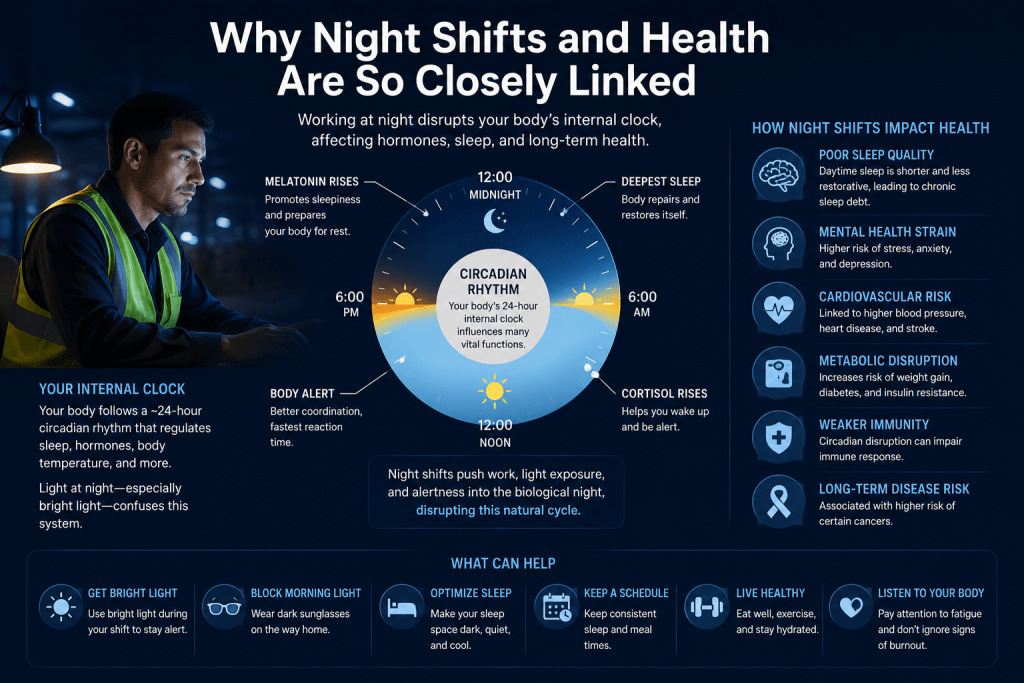
Why Night Shifts and Health Are So Closely Linked
Your body runs on a roughly 24-hour rhythm often called the body clock. This rhythm helps decide when you feel awake and when you feel sleepy. It is set mainly by light and darkness, with bright daylight saying stay alert and night saying time to rest.
Night shift work asks your body to be alert when it expects to sleep, and to sleep when it expects to be awake. That mismatch is the core reason night shifts and health are so closely tied together. Your body is doing its best to follow two opposite signals at once.
The goal of this article is not to alarm you. The goal is to help you understand the pattern so you can support your wellness with smart habits. If your rest keeps slipping, a sleep telemedicine visit can help you make a plan that fits your schedule.
CHECK YOUR SLEEP SYMPTOMS: TAKE THE 2 MINUTE QUIZ
TAKE THE QUIZ
How Irregular Hours May Affect the Body Clock
When you work nights, you often sleep during the day. The problem is that daylight tells your body to stay awake, so daytime sleep can feel lighter and shorter. Many men find they wake up after only a few hours, still tired.
Rotating shifts can be even harder. Each time your schedule changes, your body clock has to try to catch up. A body clock that never settles can leave you feeling jet-lagged even though you never left town. This unsettled feeling is common among shift workers.
If your sleep timing feels stuck or scrambled, our guide on how to fix your circadian rhythm shares practical steps. You can also read about circadian rhythm sleep patterns to understand how light shapes your rest.
What Men Often Notice With Night Shifts and Health
Men who work overnight frequently describe a familiar set of feelings. They feel drained, foggy, and slow to recover. Workouts feel harder. Focus drifts. The drive that used to come easily can dip.
Quality sleep is one of the body’s main recharge windows, so when shift work cuts it short, men often feel it in their energy and mood. Deep, steady rest helps the body and mind repair. When that rest is broken up by an off-track schedule, you may not reach the deeper, restoring stages of sleep as often.
It is worth knowing that sleep supports many parts of men’s overall wellness, including focus, mood, and drive. Our article on how sleep affects libido explores one of these links in a clear, balanced way. None of this is about quick fixes. It is about giving your body the rest it needs to feel its best, even on a tough schedule.
The Melatonin Factor
Melatonin is a natural signal your body uses to know it is time to wind down. It usually rises in the evening as light fades. For night workers, daylight at the end of a shift can hold that signal back, which makes daytime sleep harder.
You can learn more about this natural rhythm in our overview of melatonin and sleep. Supporting your body’s own signals with good habits is often a better long-term path than fighting your rest every day.
The Wider Wellness Picture for Shift Workers
Sleep does more than recharge your energy. It supports nearly every system in the body, from the heart to metabolism to mood. When shift work disrupts rest over a long stretch, those systems can feel the effect.
Steady, quality rest is a foundation for whole-body wellness, and shift workers have to work a little harder to protect it. Research groups continue to study how irregular hours connect to long-term health, which is one reason a regular check-in with a physician is smart for anyone at night.
If you have wondered how rest ties into other areas of wellness, our articles on sleep and obesity and sleep and heart disease offer balanced, easy-to-read overviews. The point is not to worry, but to stay aware and take simple steps to support your body.
According to the Centers for Disease Control and Prevention, most adults need at least seven hours of sleep each night, or each rest period, to support good health. Hitting that target is harder on shifts, which makes good habits even more valuable.
Simple Habits to Make Shift Life Easier on Your Body
Good news: you do not have to quit your job to rest better. A few smart habits can help your body adjust and protect your wellness. These are everyday lifestyle steps, not treatments.
Make your sleep space dark. Use blackout curtains and a sleep mask so your daytime rest feels more like night.
Keep it quiet. Earplugs or white noise can block daytime sounds that would otherwise wake you.
Stay consistent when you can. Try to keep a similar sleep schedule even on days off, so your body is not constantly resetting.
Use light wisely. Bright light during your shift can help you stay alert, while dark, dim light before sleep helps you wind down.
Watch caffeine timing. A coffee early in your shift can help, but caffeine too close to your sleep period can keep you awake.
Plan smart meals. Lighter meals during the night and a real meal before sleep can ease the strain on your body.
Protect your sleep window. Let family and friends know your rest hours so they can help guard that time.
For a full routine you can adapt to your shift, our ultimate sleep routine guide gives you a step-by-step plan. Our deep dive on the night shift and sleep speaks directly to the challenges of overnight work.
When to Talk With a Sleep Physician
Sometimes you do everything right and still feel wiped out. You darken the room, guard your sleep window, and stay consistent, yet you wake up drained. When that happens, it may be a sign that something deeper is affecting your rest.
Ongoing fatigue that does not improve with better habits is worth discussing with a sleep physician. Conditions like sleep-disordered breathing can leave men feeling unrested no matter how long they spend in bed, and shift workers can miss the signs because they already expect to feel tired.
Dr. Avinesh Bhar and the SLIIIP team make this easy to sort out. You can meet a board-certified physician through a virtual visit scheduled around your shift, and if needed, a home sleep test can be shipped right to your door. There is no need to spend a night in a lab or rearrange your whole week.
If you often wake up worn out, our piece on why you feel exhausted no matter how much you sleep can help you think through possible causes. For the bigger picture on why rest matters so much, our article on the importance of sleep and the National Heart, Lung, and Blood Institute both offer clear, plain-language guidance.
At Sliiip, we accept the following insurances:

SLIIIP’s board-certified sleep physicians can do sleep evaluations for sleep apnea. Virtual consultations in all 50 states. Home sleep tests shipped to your door.
Frequently Asked Questions
- Why are night shifts and health so closely connected?
Night shift work asks your body to be awake when it expects to sleep. That mismatch can affect your energy, mood, and overall wellness over time. - What is the body clock?
The body clock is your roughly 24-hour rhythm that helps decide when you feel awake and when you feel sleepy. Light and darkness set it each day. - Why is daytime sleep harder than night sleep?
Daylight tells your body to stay alert, so sleeping during the day can feel lighter and shorter than sleeping at night. - Are rotating shifts worse than fixed nights?
Rotating shifts can be harder because your body clock has to keep resetting. A fixed schedule gives your body more chances to adjust. - What is shift work jet lag?
It is the worn-out, off-balance feeling that comes when your body clock cannot keep up with your changing work hours. - How does melatonin affect shift workers?
Melatonin signals your body to wind down. Daylight after a night shift can hold that signal back, which makes daytime sleep harder. - Can night shifts affect men’s energy and drive?
Sleep supports focus, mood, and drive. When shift work cuts rest short, many men notice changes in how they feel and perform. - How much sleep do shift workers need?
According to the CDC, most adults need at least seven hours of sleep per rest period to support good health. - How can I make my room better for daytime sleep?
Blackout curtains, a sleep mask, earplugs, or white noise can make your daytime rest feel more like nighttime sleep. - Should I keep my schedule the same on days off?
Staying close to your work-sleep schedule on days off can help, since constant resetting makes it harder for your body to adjust. - Does caffeine help on night shifts?
A coffee early in your shift can help you stay alert, but caffeine too close to your sleep period can keep you awake. - What should I eat during the night shift?
Lighter meals during the night and a real meal before sleep can ease the strain on your body during overnight hours. - Can shift work affect my heart or weight?
Sleep supports the heart and metabolism, so long-term disruption may play a role. Our articles on these links offer balanced overviews. - Why do I feel tired even after sleeping all day?
Daytime sleep is often lighter and broken up, so you may spend hours in bed and still wake up feeling unrested. - What is a home sleep test?
It is a sleep study you can do in your own bed. The device is shipped to you, and the results help a physician understand your rest. - Do I have to visit a lab for a sleep evaluation?
No. SLIIIP offers virtual consultations in all 50 states, and home sleep tests can be shipped to your door. - When should I talk with a sleep physician?
Consider reaching out if your fatigue does not improve with better habits, or if you have concerning symptoms during sleep. - Can shift workers miss signs of a sleep problem?
Yes. Because shift workers already expect to feel tired, they can overlook signs of a deeper issue worth checking. - How does light help me stay alert at work?
Bright light during your shift can help signal your body to stay awake, while dim light before sleep helps you wind down. - How do I get started with SLIIIP?
You can schedule a virtual sleep evaluation around your shift, and a board-certified physician will guide you, including arranging a home sleep test if needed.
Take the Next Step Toward Better Rest
Working nights asks a lot of your body, but with the right habits and support, you can protect your energy and wellness. You do not have to keep pushing through exhaustion alone.
SLIIIP’s board-certified sleep physicians can do sleep evaluations for sleep apnea. Virtual consultations in all 50 states. Home sleep tests shipped to your door.
Latest posts
-
Evie Ring Sleep Tracking Review: Does It Work?
Last updated: September 14, 2026. Medically reviewed by Dr. Avinesh Bhar, Board-Certified Sleep Physician, SLIIIP.com. The Evie Ring tracks sleep using a finger-based light sensor that estimates heart rate, movement,…
-
Do EEG Sleep Headbands Actually Track Sleep Accurately?
Last updated: September 14, 2026. Medically reviewed by Dr. Avinesh Bhar, Board-Certified Sleep Physician, SLIIIP.com. EEG sleep headbands, like the Dreem headband, use dry electrodes to record brain wave activity,…
-
Circular Ring Sleep Accuracy: What It Gets Right and Wrong
Last updated: September 14, 2026. Medically reviewed by Dr. Avinesh Bhar, Board-Certified Sleep Physician, SLIIIP.com. The Circular Ring estimates sleep stages, heart rate, and recovery using a finger-worn light sensor,…
Get updates
Spam-free subscription, we guarantee. This is just a friendly ping when new content is out.

