👉 Register for Free. How to Diagnose Sleep Apnea Faster in Primary Care – FREE Webinar by Dr. Audrey Wells. – Friday, April 24 at 12 PM ET


Positional Sleep Apnea: When Position Is the Problem
Some people breathe reasonably well on their side and badly on their back, and Dr. Avinesh Bhar, Board-Certified Sleep Physician at SLIIIP.com, calls that pattern positional sleep apnea when the sleep study data actually supports it.
The last part of that sentence is the part most articles skip. This is not a preference or a hunch. It is a specific finding that comes from a test, based on how your breathing compares between lying on your back and lying on your side.
That distinction matters, because it changes what the conversation with your physician looks like.
SLIIIP’s board-certified sleep physicians can do sleep evaluations for sleep apnea. Virtual consultations in all 50 states. Home sleep tests shipped to your door.
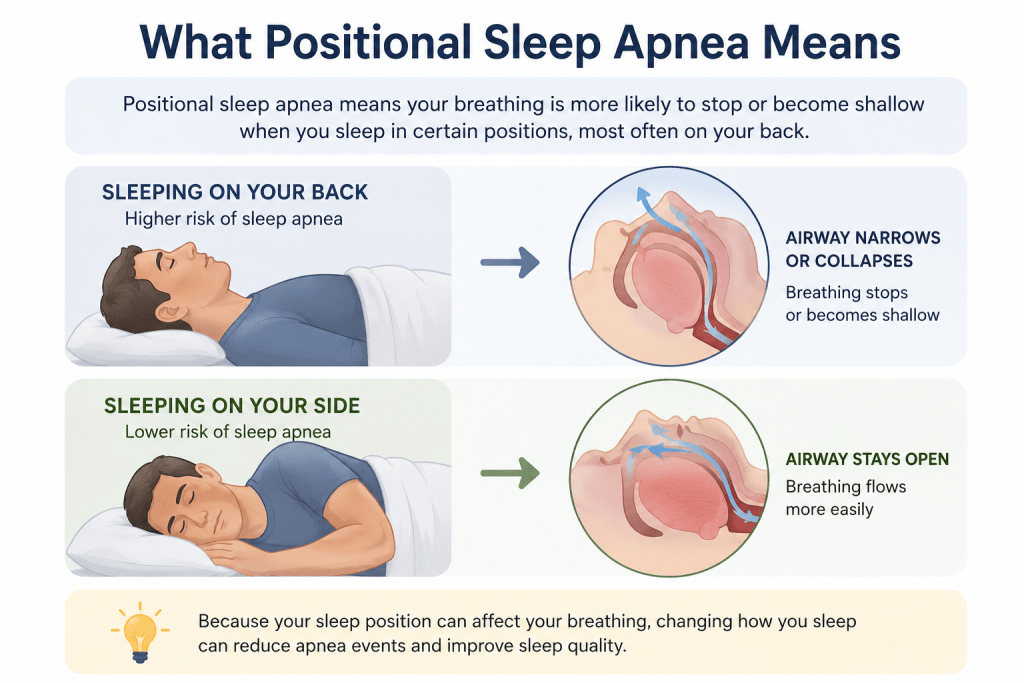
What Positional Sleep Apnea Means
Obstructive sleep apnea is measured with a number called the AHI, which counts breathing events per hour of sleep. A sleep study that records body position can break that number down by whether you were on your back or not.
The commonly used definition is straightforward: the AHI while lying on your back is at least twice the AHI in other positions. Some definitions add that the non supine number should fall below a certain threshold. Your physician will use the criteria that fit your report.
Back sleeping is called supine in the report you receive. If you see supine AHI and non supine AHI listed separately, you are looking at the data that answers this question.
Nobody can tell you whether you fit this pattern by looking at you, and you cannot tell from how you feel. People who are certain their back is the problem sometimes turn out to have events spread evenly across all positions. The reverse happens too. Our explainer on what an AHI score means covers how to read that part of a report.
CHECK YOUR SLEEP SYMPTOMS: TAKE THE 2 MINUTE QUIZ
TAKE THE QUIZ
Why Lying on Your Back Changes Breathing
The mechanics are not complicated. Gravity is doing most of the work.
When you lie face up, the tongue and the soft tissues at the back of the throat fall backward toward the airway. The space available for air narrows.
The soft palate and the jaw shift in the same direction. In a throat that is already narrow, a small change makes a large difference.
Lung volume tends to be lower when supine, and lower lung volume is associated with less tension holding the upper airway open.
On your side, gravity pulls those same tissues sideways instead of backward, which leaves the airway with more room. That is the whole idea in one sentence.
This is also why snoring often gets louder on the back and quieter on the side. Snoring is not the same as apnea, but the airway mechanics behind them overlap.
Who Tends to Have This Pattern
Research suggests a substantial share of people with obstructive sleep apnea show some degree of position dependence, though estimates vary widely depending on the definition used.
Certain features come up repeatedly in the literature. The pattern appears more often in people with milder overall AHI numbers, in people at lower body weights, and in younger adults. It appears less often in severe cases, where events tend to occur regardless of position.
None of that is a rule you can apply to yourself. A person can be young, slim, and still have severe apnea in every position. A person can be older and heavier and still show a strong positional pattern. Our comparison of mild versus severe sleep apnea explains why severity and pattern are two separate questions, and our page on mild sleep apnea covers the lower end of the range.
How It Gets Identified
This is where guesswork ends and testing begins.
A sleep study that records body position gives you the supine and non supine numbers side by side. Many home sleep tests include a position sensor, which is why this can often be answered without a night in a lab. Our overview of the home sleep test explains how the process works, and our guide on whether you need a sleep study helps you decide if it is time.
One practical caveat is worth knowing in advance. If you barely spent any time on your back during the recording, the report cannot make a fair comparison. Sometimes a repeat study or a longer recording is needed to get a usable answer.
Consumer wearables and phone apps do not measure this. They estimate movement and sometimes sound. They do not measure airflow, oxygen, or breathing events, and they cannot establish a diagnosis of any kind.
What Positional Therapy Involves
If your report confirms positional sleep apnea, your physician may raise positional therapy as one option among several. The decision belongs in that conversation, not in a shopping cart.
The general idea is to make back sleeping harder. Approaches range from the old tennis ball sewn into the back of a shirt, to wearable devices that vibrate gently when you roll over, to positioning pillows and bolsters. Studies have reported reductions in supine time and in AHI with several of these, though long term adherence is a recurring problem in the research. People tend to abandon uncomfortable solutions within months.
Positional approaches are not a replacement for therapy you have already been prescribed. If you are using CPAP or an oral appliance, do not stop or change it on your own. Bring the question to your physician instead, and bring your data with you. Our overview of oral appliance therapy for sleep apnea and our page on approaches beyond CPAP cover the wider set of options that may come up.
If your interest is more about comfort and setup than about the diagnostic question, we cover that separately in our guides to the best sleeping position, wedge pillows, and sleep apnea pillows.
Habits That Support Better Nights
None of these replace an evaluation. All of them make the picture cleaner.
Keep one wake time, weekends included, so your body clock has a stable anchor.
Get outside light within an hour of waking, ten to fifteen minutes for most people.
Skip alcohol in the evening. It relaxes airway muscles and reliably makes breathing during sleep worse.
Set a caffeine cutoff in the early afternoon so your total sleep time stays protected.
Treat nasal congestion. Breathing through a blocked nose pushes you toward mouth breathing, which does the airway no favors.
Discuss any sedating medications with your prescriber rather than adjusting them yourself.
Keep the bedroom cool, dark, and quiet, and protect enough hours to actually get through full sleep cycles.
For general public health guidance on sleep and health, the CDC sleep resources are a solid starting point. The National Heart, Lung, and Blood Institute publishes plain language material on sleep apnea itself.
Watch: SIDE SLEEPING IN OBSTRUCTIVE SLEEP APNEA
When to Talk to a Sleep Physician
Book an evaluation if you snore loudly, if someone has seen you stop breathing, if you wake gasping, if you get morning headaches, or if you are tired during the day no matter how long you spent in bed. Our page on sleep apnea symptoms lists the full set.
Also worth raising: a partner who reports that the snoring changes dramatically depending on how you are lying. That observation does not diagnose anything, but it is a reasonable prompt to get tested.
When patients bring this up, Dr. Avinesh Bhar tends to start with what the data shows rather than what the position seems to be. Was position recorded. How much of the night was spent supine. What is the AHI in each position. How severe is the overall number. Those answers decide whether positional therapy is even a reasonable topic.
A sleep evaluation is one piece of a broader picture. Weight, nasal anatomy, jaw structure, thyroid function, medications, and heart health all interact with breathing during sleep, so your physician may look wider than position alone and involve other specialists when the findings call for it.
At Sliiip, we accept the following insurances:

SLIIIP’s board-certified sleep physicians can do sleep evaluations for sleep apnea. Virtual consultations in all 50 states. Home sleep tests shipped to your door.
Frequently Asked Questions
What is positional sleep apnea?
It is a pattern in which breathing events during sleep are at least twice as frequent while lying on the back compared with other positions.
How do I know if I have it?
Only from a sleep study that records body position, which reports your AHI separately for supine and non supine sleep.
Can I diagnose it myself?
No. How you feel in the morning does not reliably indicate which position was responsible.
Does a home sleep test measure position?
Many home tests include a position sensor. Ask when you order, since devices differ.
What does supine mean in my report?
Supine means lying on your back. Non supine covers side and stomach sleeping.
Why is back sleeping worse for the airway?
Gravity pulls the tongue and soft tissues backward, which narrows the space available for air.
Is side sleeping always better?
It is better for many people with this pattern, but not for everyone, and not for people whose events occur in all positions.
Does this mean my apnea is mild?
Not necessarily. Position dependence appears more often in milder cases, but severity is a separate measurement.
Can I stop using CPAP if I sleep on my side?
No. Do not change prescribed therapy on your own. Bring the question to the physician who manages your care.
Does the tennis ball method work?
Studies have reported reduced back sleeping with this approach, though many people stop using it because it is uncomfortable.
What are positional therapy devices?
They are wearables or supports designed to discourage back sleeping, some of which vibrate gently when you roll over.
Are those devices covered by insurance?
Coverage varies by plan and by device. Verifying benefits before purchase is the practical step.
Will a wedge pillow help?
Elevation is a different concept from side positioning. We cover that topic on its own page.
Does weight change this pattern?
Body weight influences airway mechanics, and changes in weight can change study results. Your physician can advise on what applies to you.
Does alcohol make it worse?
Alcohol relaxes airway muscles and is associated with worse breathing during sleep, regardless of position.
Can children have this pattern?
Pediatric sleep apnea has its own evaluation pathway and should be handled by a clinician who treats children.
Does snoring alone mean I have it?
No. Snoring is common and does not establish a diagnosis on its own.
Can a smartwatch tell me?
No. Consumer wearables estimate movement and do not measure airflow, oxygen, or breathing events.
What if I never sleep on my back during the test?
The report may not have enough supine time for a fair comparison, and a repeat study is sometimes needed.
Can I get tested without going to a sleep lab?
Yes. SLIIIP offers virtual consultations and ships home sleep tests to your door.
Your Next Step
The appeal of this topic is obvious. If the problem is only how you are lying, the fix sounds easy. Sometimes that turns out to be part of the story, and sometimes the data says something entirely different.
The only way to know which one you are is to measure it. A test that records position answers in one night what guessing never will.
SLIIIP’s board-certified sleep physicians can do sleep evaluations for sleep apnea. Virtual consultations in all 50 states. Home sleep tests shipped to your door.
Latest posts
-
RingConn vs Oura: Which Smart Ring Tracks Sleep Better?
Last updated: September 10, 2026. Medically reviewed by Dr. Avinesh Bhar, Board-Certified Sleep Physician, SLIIIP.com. RingConn and Oura both track sleep through a finger-worn ring, but they differ most in…
-
Withings ScanWatch Sleep Tracking Accuracy: What It Can and Cannot Tell You
Last updated: September 10, 2026. Medically reviewed by Dr. Avinesh Bhar, Board-Certified Sleep Physician, SLIIIP.com. Withings ScanWatch is a hybrid analog watch that tracks sleep stages and can flag nighttime…
-
Are Cheap Fitness Trackers Accurate for Sleep?
September 10, 2026. Medically reviewed by Dr. Avinesh Bhar, Board-Certified Sleep Physician, SLIIIP.com. Cheap fitness trackers can be reasonably accurate at telling you when you fell asleep and woke up,…
Get updates
Spam-free subscription, we guarantee. This is just a friendly ping when new content is out.

