👉 Register for Free. How to Diagnose Sleep Apnea Faster in Primary Care – FREE Webinar by Dr. Audrey Wells. – Friday, April 24 at 12 PM ET


Top Ways to Address Sleep Apnea Without Sleeping Pills
Sleep apnea without sleeping pills often delivers better results than most people expect, according to Dr. Avinesh Bhar, Board-Certified Sleep Physician at SLIIIP.com, and the path forward is more straightforward than most people think.
Sleeping pills do not fix the airway issues behind most cases of sleep apnea. They can mask the problem, slow nighttime breathing further, and leave you groggy in the morning even when you sleep eight hours.
SLIIIP’s board-certified sleep physicians can do sleep evaluations for sleep apnea. Virtual consultations in all 50 states. Home sleep tests shipped to your door.
Why Sleeping Pills Miss the Real Problem
Sleeping pills aim to knock you out. They do not open the airway, strengthen the throat muscles, or correct the breathing pauses that define sleep apnea. Many sedatives actually relax the airway more, which can deepen the collapse during the night.
That is why people often wake up tired even after a long night on a sleep aid. The breathing pauses keep happening, just below conscious awareness. Targeting the airway itself usually brings better daytime energy, sharper focus, and steadier mood within weeks.
For more on this issue, see the sleeping pill scam and the case for CBT for insomnia versus sleep medications.
CHECK YOUR SLEEP SYMPTOMS: TAKE THE 2 MINUTE QUIZ
TAKE THE QUIZ
A Quick Look at What Sleep Apnea Actually Is
Sleep apnea is a breathing condition where the airway narrows or closes during sleep. According to the National Heart, Lung, and Blood Institute, this leads to pauses in breathing, drops in oxygen, and disrupted sleep cycles.
The most common form is obstructive sleep apnea. Common signs include loud snoring, gasping awakenings, dry mouth, morning headaches, and steady daytime fatigue. For a deeper overview, see what is sleep apnea and the full list of sleep apnea symptoms.
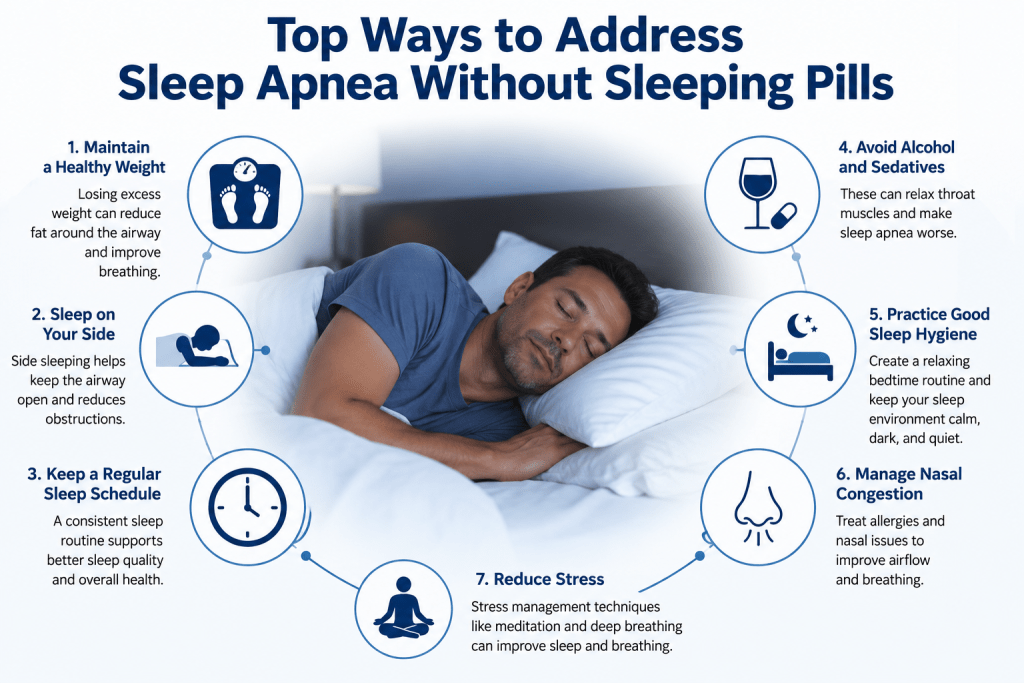
Top Ways to Address Sleep Apnea Without Sleeping Pills
There are many proven options that target the airway directly. The right mix depends on the severity of your apnea, your anatomy, your lifestyle, and your goals. A real plan to address sleep apnea without sleeping pills usually combines two or three changes that work together.
1. Get an Accurate Diagnosis First
You cannot fix what you have not measured. A simple home sleep apnea test can confirm whether you have sleep apnea and how severe it is. See home sleep apnea testing for how the process works.
2. Adjust Your Sleep Position
Many cases of mild sleep apnea improve when people stop sleeping on their back. Lying flat lets gravity pull the tongue and soft palate toward the throat. Side sleeping helps the airway stay open through the night.
For tips, see the best sleeping position and the wedge pillow for sleep apnea.
3. Manage Body Weight
Extra weight around the neck and torso can crowd the airway. Even a modest reduction can lower the number of breathing pauses per hour. See does losing weight reduce sleep apnea.
4. Use a Custom Oral Appliance
Oral appliances gently move the lower jaw forward, which helps keep the airway open during sleep. They are quiet, portable, and well tolerated by most people. Learn more about oral appliance therapy and the best oral appliance for sleep apnea.
5. Try CPAP or Auto PAP Therapy
CPAP remains the most studied therapy for moderate and severe cases. It uses gentle air pressure to splint the airway open. See our CPAP guide and the oral appliance versus CPAP comparison for a side by side view.
6. Practice Throat and Tongue Exercises
Targeted exercises strengthen the muscles that keep the airway open at night. They take a few minutes a day and pair well with other strategies.
7. Improve Nasal Breathing
A blocked nose forces mouth breathing, which often worsens snoring and apnea. Saline rinses, nasal strips, and treating allergies can all help. See upgrade your sleep through improved breathing and mouth taping for sleep.
8. Cut Back on Alcohol and Late Sedatives
Alcohol before bed relaxes the throat muscles and can trigger more breathing pauses. The same goes for many tranquilizers. Removing these can sharply reduce apnea events.
9. Build a Steady Sleep Schedule
Going to bed and waking up at consistent times improves sleep quality and supports breathing during REM stages. Cognitive behavioral techniques can help with this. See CBT for insomnia and sleep disorders.
10. Quit Smoking
Smoking inflames the upper airway and raises the risk of apnea. Quitting reduces swelling and improves nighttime breathing within weeks.
Lifestyle Habits That Support Long Term Results
Small daily habits add up. Daytime exercise, lower sodium meals, regular hydration, and reduced screen time before bed all support better sleep architecture. These habits also make every other therapy work better.
The Centers for Disease Control and Prevention lists short sleep as a public health concern tied to weight, blood pressure, and cardiovascular risk. Choosing to address sleep apnea without sleeping pills supports all of these areas at once.
Explore more in sleep apnea self care and sleep apnea without CPAP.
What Dr. Avinesh Bhar Recommends as a Starting Point
Dr. Avinesh Bhar suggests starting with three simple steps. First, get a clear diagnosis through a home sleep test. Second, pick one or two airway focused therapies that fit your daily life, such as a position change paired with a custom oral appliance. Third, track your sleep quality, daytime energy, and snoring over four to six weeks.
This stepwise plan helps you address sleep apnea without sleeping pills in a way that is measurable, sustainable, and matched to your body.
Watch: Danger of Pills for Insomnia
When to See a Sleep Doctor
You should see a sleep doctor if you have loud snoring, gasping awakenings, frequent waking, morning headaches, or unexplained daytime fatigue. Other red flags include high blood pressure that is hard to control, atrial fibrillation, or a partner who reports breathing pauses. See signs of sleep apnea and obstructive sleep apnea warning signs.
At Sliiip, we accept the following insurances:

SLIIIP’s board-certified sleep physicians can do sleep evaluations for sleep apnea. Virtual consultations in all 50 states. Home sleep tests shipped to your door.
Frequently Asked Questions
1. Can I really fix sleep apnea without sleeping pills?
Yes. Sleeping pills do not treat sleep apnea. Position changes, weight management, oral appliances, CPAP, and lifestyle habits all target the airway directly.
2. Are sleeping pills risky for someone with sleep apnea?
Many sedatives can relax the airway muscles and make breathing pauses worse. Talk with a sleep doctor before using any sleep aid.
3. What is the most effective drug free option for sleep apnea?
For moderate to severe cases, CPAP has the strongest evidence. For mild to moderate cases, oral appliances and side sleeping are often very effective.
4. Can melatonin help with sleep apnea?
Melatonin may help with sleep timing but does not treat the airway problem behind sleep apnea.
5. Does losing 10 pounds help sleep apnea?
For many people with overweight or obesity, even a small reduction in weight can lower the number of apnea events per hour.
6. How do I know if I have sleep apnea?
A home sleep test is the simplest first step. It records oxygen, airflow, and breathing patterns overnight in your own bed.
7. Is sleep apnea without sleeping pills a realistic long term plan?
Yes. Most evidence based plans rely on airway therapy, lifestyle changes, and behavior changes, not on sedatives.
8. Can mouth taping help with sleep apnea?
Mouth taping can encourage nasal breathing in some people but is not a standalone therapy for sleep apnea. Ask your sleep doctor before trying it.
9. What sleeping position is best for sleep apnea?
Side sleeping is usually best. Stomach sleeping helps some people too, but it can strain the neck over time.
10. Do oral appliances really work?
Yes, especially for mild to moderate obstructive sleep apnea. A custom fit appliance works better than a one size fits all device.
11. How long does it take to see results?
Some people notice better sleep within a few nights. Others need four to six weeks for the full benefit.
12. Can exercise reduce sleep apnea?
Regular exercise improves muscle tone, lowers inflammation, and supports weight management, which all help reduce apnea events.
13. Does alcohol affect sleep apnea?
Yes. Alcohol relaxes the airway and can worsen apnea events, especially in the first half of the night.
14. Will CBT for insomnia help with sleep apnea?
CBT for insomnia helps with sleep habits and routines. It does not treat the airway but it supports the schedule changes that make other therapies work better. See is CBT for insomnia better than sleep meds.
15. Can I stop CPAP if I lose weight?
Some people can reduce or stop CPAP after significant weight loss, but only after a follow up sleep study confirms it is safe.
16. Are there any natural habits that help?
Side sleeping, weight management, nasal hygiene, throat exercises, and consistent sleep timing are all evidence supported.
17. Can sleep apnea go away on its own?
Mild sleep apnea sometimes improves with weight loss or position changes. Moderate and severe sleep apnea usually needs active therapy.
18. Should I take a sleep apnea quiz first?
A quiz can guide your next step. Try the do I have sleep apnea quiz to see if a home sleep test makes sense for you.
19. Does SLIIIP cover all 50 states?
Yes. SLIIIP offers virtual consultations in all 50 states with home sleep tests shipped directly to your door.
20. How do I start with SLIIIP?
Book a virtual sleep evaluation and verify your insurance benefits online. The team handles the home sleep test, the results, and the follow up plan.
Ready to Address Sleep Apnea Without Sleeping Pills
SLIIIP’s board-certified sleep physicians can do sleep evaluations for sleep apnea. Virtual consultations in all 50 states. Home sleep tests shipped to your door.
Latest posts
-
Why Are My Naps Never Refreshing?
Last updated: October 2, 2026. Medically reviewed by Dr. Avinesh Bhar, Board-Certified Sleep Physician, SLIIIP.com. Naps that leave you groggy usually come down to how long you sleep, when you…
-
Is Sleeping Too Much a Sleep Disorder?
Last updated: October 2, 2026. Medically reviewed by Dr. Avinesh Bhar, Board-Certified Sleep Physician, SLIIIP.com. Sleeping too much is not always a sleep disorder, but it can be a sign…
-
Why Does My Insomnia Get Worse After Stopping Sleep Medication?
Last updated: October 2, 2026. Medically reviewed by Dr. Avinesh Bhar, Board-Certified Sleep Physician, SLIIIP.com. Insomnia can get worse after stopping sleep medication for three main reasons. They are rebound…
Get updates
Spam-free subscription, we guarantee. This is just a friendly ping when new content is out.

